
Average Speed Formula: Step-by-Step Methods and Examples
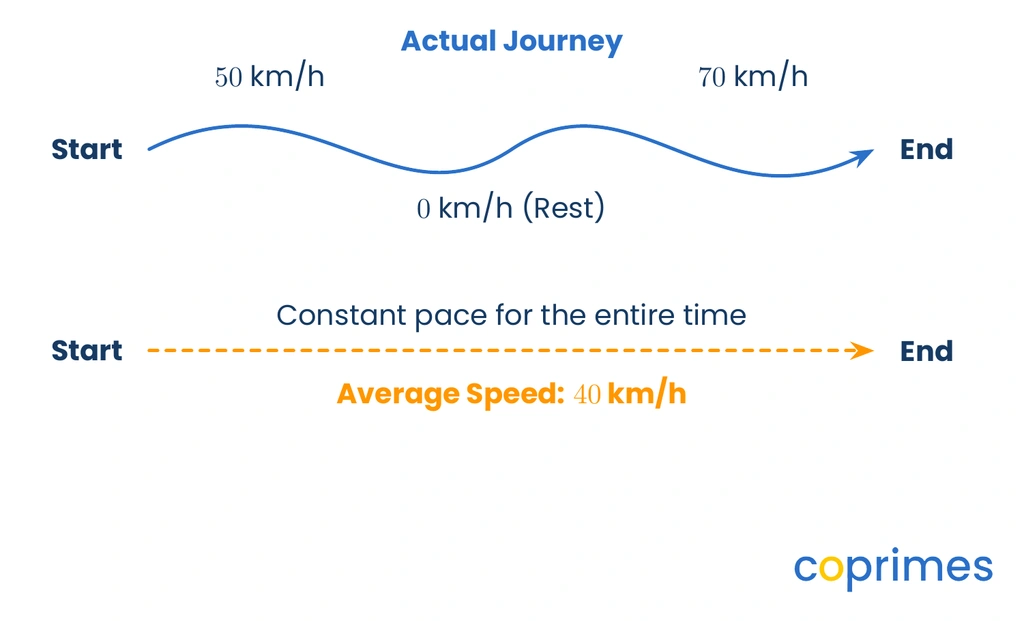
Average speed is the total distance traveled divided by the total time taken. It provides a single constant speed that would cover the exact same distance in the same amount of time, even if the actual speed changes during the journey.
What is average speed?
Average speed is a compound measure that describes how fast an object travels over an entire trip. It smooths out any variations, such as accelerating, slowing down, or stopping, by treating the journey as one continuous movement.
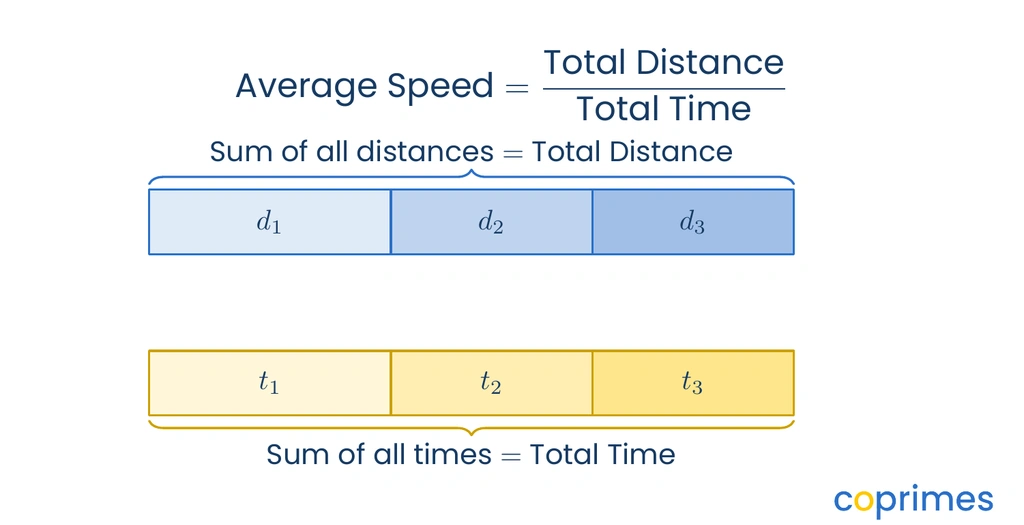
To use this, you must understand standard speed distance time relationships. The formula is:
Standard units include meters per second (), kilometers per hour (), and miles per hour (). Average speed is a specific rate that describes the distance covered per unit of time.
Use total distance and total time
To find the correct average speed, you must aggregate the entire journey. You cannot simply find the mean of different speeds unless the time spent at each speed is exactly the same.
Always calculate the overall sum of the distances and the overall sum of the times. It functions as a unit rate for the whole trip, representing the equivalent steady pace.
Calculate a one-part journey
For a continuous journey without breaks or changes in given information, apply the formula directly.
- Identify the total distance from the given information.
- Identify the total time taken.
- Ensure the units match the required speed unit.
- Divide the total distance by the total time.
When given the average speed and asked to find a missing distance or time, rearrange the formula:
A learning plan shaped by your child, not the class
State-aligned Math plus our own Logic and English curriculum. An adaptive baseline test finds the gaps and fills them.
Calculate a multi-part journey
When a journey consists of different legs, stops, or changing speeds, evaluate each part separately before using the final formula.
- Identify known distances, times, and speeds for each part of the journey.
- Use or to find any missing values for individual sections.
- Add all individual distances to find the overall total distance.
- Add all individual times, including any rest periods (where distance is ), to find the overall total time.
- Divide the overall total distance by the overall total time.
Organizing the given information into a distance-time summary table helps prevent calculation errors.
Journey Part | Distance | Speed | Time |
Part 1 | |||
Part 2 | |||
Total |
Convert units consistently
A frequent cause of errors is mixing incompatible units. If you are calculating a speed in kilometers per hour, the distance must be in kilometers and the time must be strictly in hours.
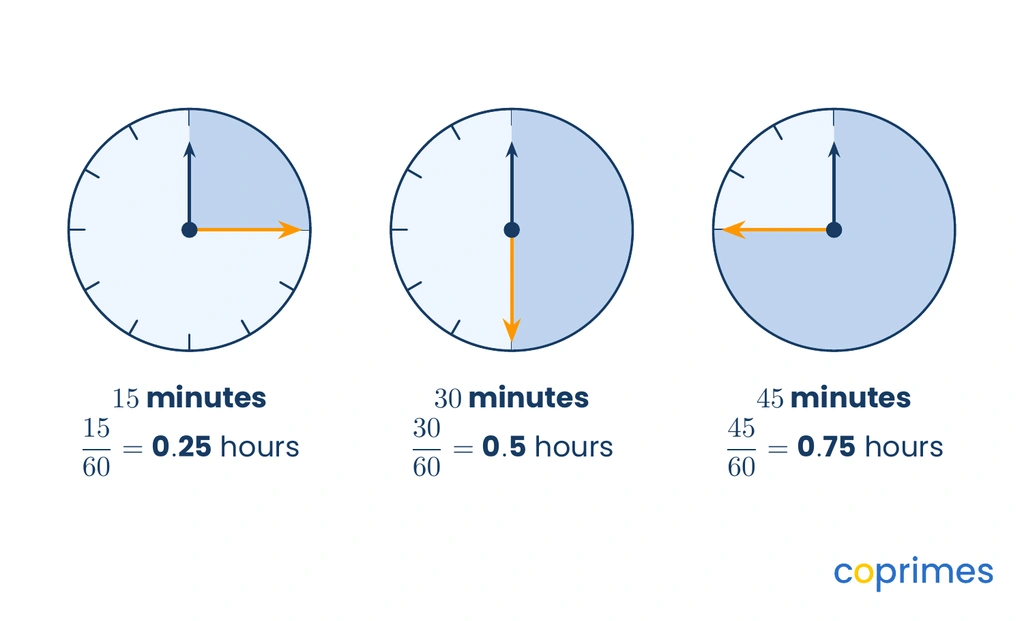
Time is often given in hours and minutes. Because there are minutes in an hour, you must write the minutes as a fraction of to convert it to a decimal.
For example, minutes is of an hour, which simplifies to or hours. A time of hours and minutes must be entered into the formula as hours, never as .
Worked examples
These types of math word problems require careful reading to extract the correct total values.
Example 1: Single one-part journey
Question: A train travels kilometers in hours and minutes. What is its average speed in ?
Method:
- Convert the total time into hours. minutes is hours, which equals hours. The total time is hours.
- Identify the total distance, which is .
- Divide the distance by the time.
Answer: The average speed is .
Check: Multiply the speed by the time to verify the distance: .
Example 2: Two-part journey
Question: A cyclist rides at a speed of . She then changes her pace and rides another in minutes. What is her average speed for the whole journey?
Method:
- Calculate the time for the first part of the journey. .
- Convert the time for the second part into hours. minutes is . The distance is given as .
- Find the total distance by adding the parts: .
- Find the total time by adding the times: .
- Divide the total distance by the total time.
Answer: The average speed is .
Check: Multiply the final speed by the total time: , which matches the total distance.
Example 3: Counterexample with unequal travel times
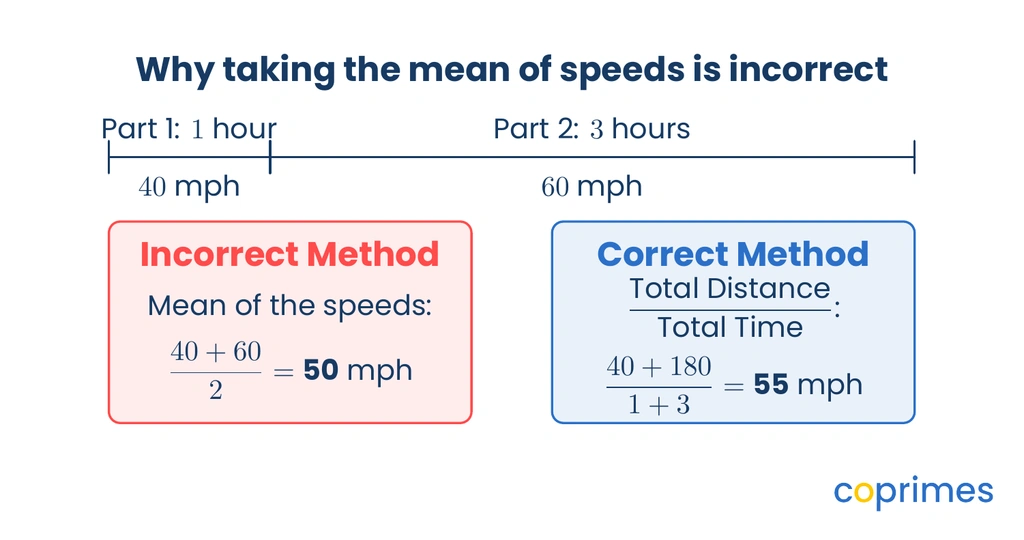
Question: A car travels for hour at , and then travels for hours at . Show why the average speed is not .
Method:
- If you incorrectly take the ordinary mean of the speeds, you get .
- Calculate the true total distance. Part 1 is . Part 2 is .
- Add the distances to find the true total distance: .
- Add the times to find the total time: .
- Divide total distance by total time.
Answer: The true average speed is .
Check: The true average is closer to because the car spent three times as long traveling at that higher speed.

Common mistakes
Avoid these frequent errors when applying the formula.
Mistake: Averaging the separate speeds
Never take the ordinary arithmetic mean of two speeds unless the time spent traveling at each speed is identical. A speed of for one hour and for three hours does not result in an average speed of . You must always find the overall total distance and divide by the overall total time.
Mistake: Incorrect decimal time
Treating hours and minutes as a standard decimal is incorrect. Writing hours and minutes as hours will produce the wrong answer, because minutes is or approximately hours, not hours.
Frequently asked questions
Clear up any remaining confusion with these common queries.
What is the difference between average speed and average velocity?
Average speed measures how fast an object covers its entire path, regardless of direction. Average velocity measures the overall change in position (displacement) divided by time, making it a vector that depends on direction.
Does average speed mean the object always traveled at that speed?
No. Average speed represents the constant pace required to complete the identical journey in the same time. The object's actual instantaneous speed might have been faster, slower, or zero during the trip.
Can I use the average speed formula if the journey includes a long rest?
Yes. A rest period adds to the total time but adds to the total distance. You must include the rest time in the denominator for the average speed to accurately reflect the whole journey.
Practice questions
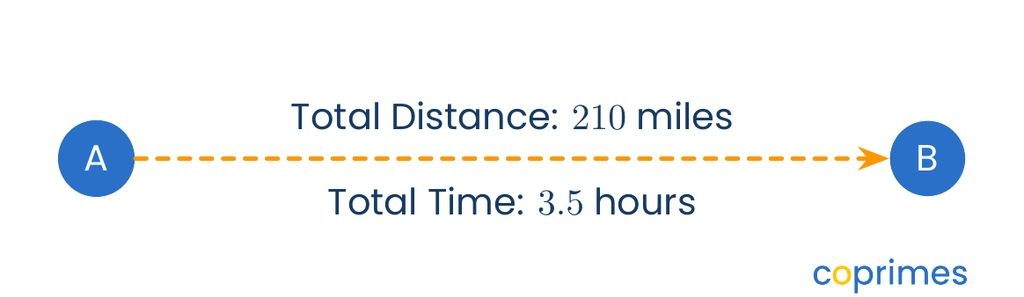
What is the average speed for the journey from point A to point B shown in the diagram?
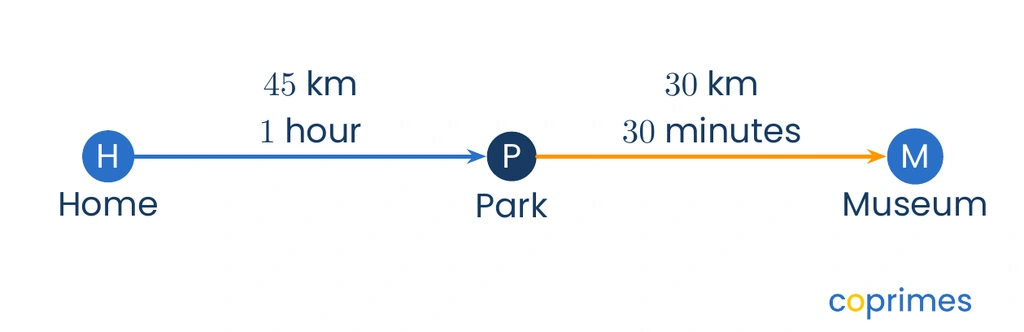
Based on the diagram, what is the average speed for the entire journey from Home to the Museum?
A driver travels a total distance of in hours and minutes. What is their average speed?
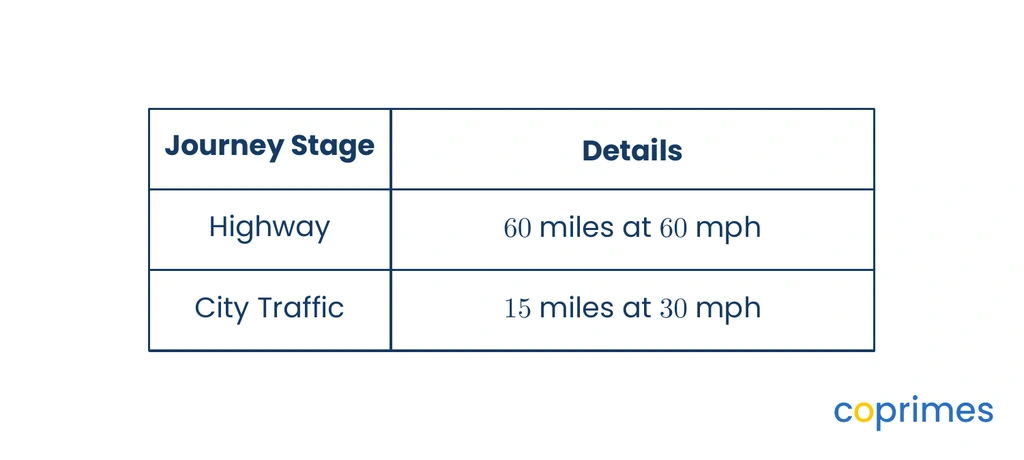
A delivery van follows the schedule shown in the table. What is the average speed for the whole trip?
An athlete runs at an average speed of for hour and minutes. What total distance did the athlete run?