
Direct and Inverse Variation: Definition, Method and Examples
In direct variation, the equation is , so divided by is constant and both quantities change by the same scale factor. In inverse variation, the equation is , so is constant and one quantity is divided by the factor by which the other is multiplied. Both types of variation describe a mathematical proportion where the rule connecting the variables does not change.
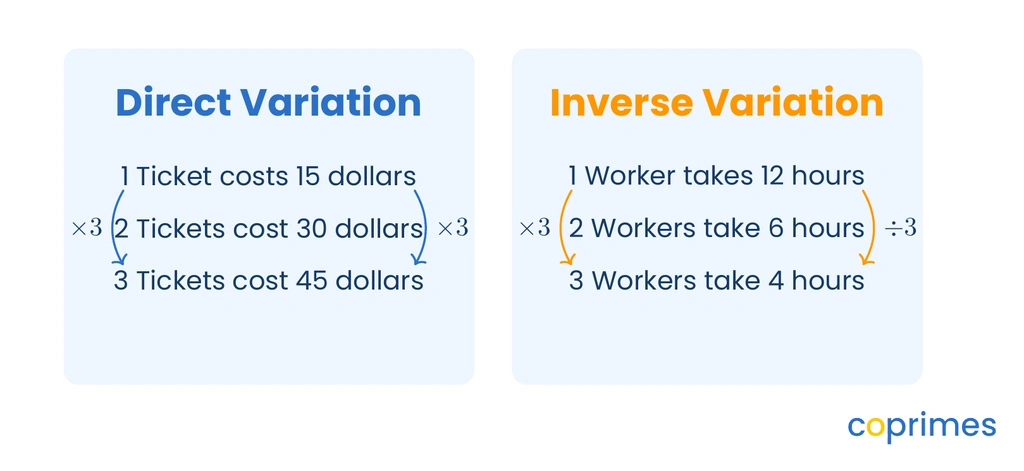
Direct and inverse variation at a glance
When two quantities are directly proportional, as one increases, the other increases at a constant rate. For example, buying more tickets increases the total cost predictably.
When two quantities are inversely proportional, as one increases, the other decreases so that their product remains constant. For example, hiring more workers decreases the time needed to complete a task.
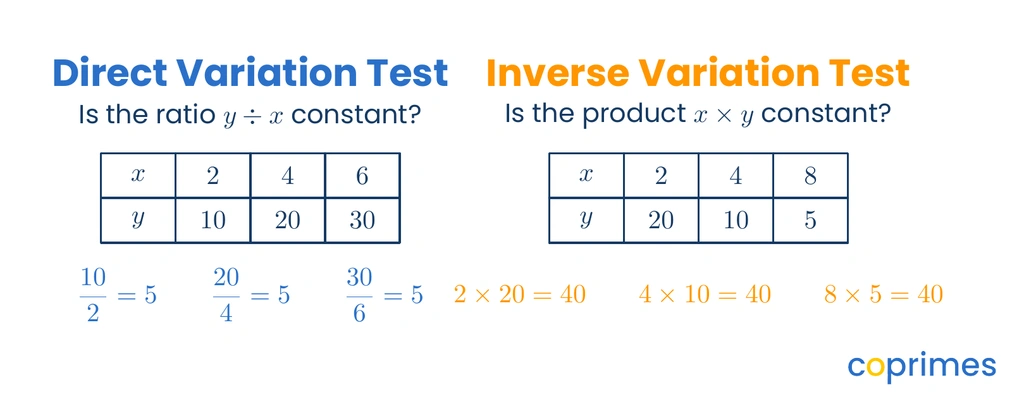
Test for a constant ratio or product
To determine the type of variation from a set of data, you must test the relationship between the pairs of and values.
- Direct Variation Test: Check if the ratio is the same for every data pair. If it is, the variables show direct variation.
- Inverse Variation Test: Check if the product is the same for every data pair. If it is, the variables show inverse variation.
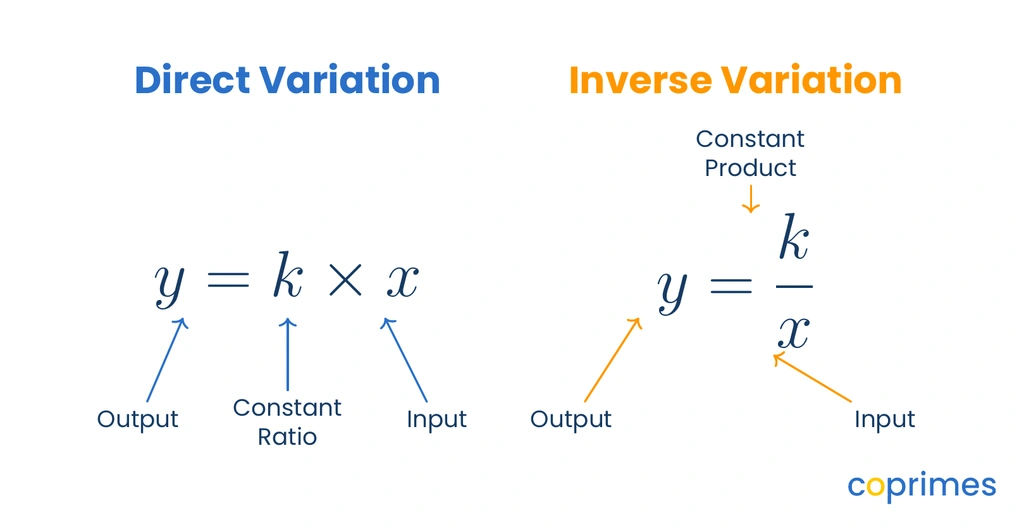
Compare the equations
The general structures of the equations reflect the underlying rules connecting the variables.
The direct variation equation is written as , where is the constant of proportionality. This format highlights that the output is found by multiplying the input by a constant ratio.
The inverse proportion formula is written as , where is the constant of proportionality. This format shows that the output is found by dividing a constant product by the input .

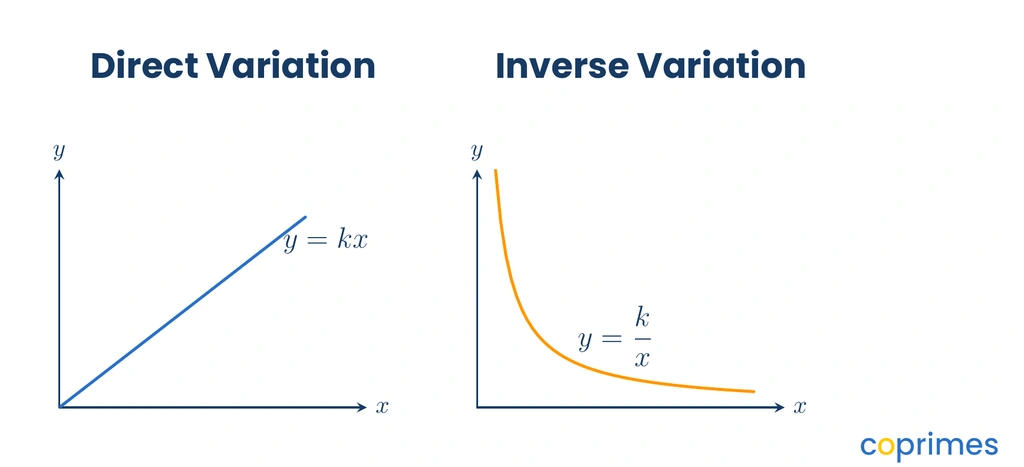
Compare the graphs
The two types of variation create distinctly different graphs on a coordinate plane. Because the variables represent real-world quantities like time, distance, or items, these relationships are typically graphed in the first quadrant where values are positive.
A direct variation graph must be a straight line that passes exactly through the origin.
An inverse variation graph forms a curve known as a hyperbola. As the input increases, the output decreases, causing the curve to approach the horizontal axis without ever touching it.
Choose a model from a context
Identifying the correct variation comparison requires understanding which quantities are changing and which quantity remains fixed.
To determine the model, look at how the variables move together. If one increases while the other increases proportionally, choose the direct variation model. If one increases while the other decreases proportionally, choose the inverse variation model.
Fixed Variable | Changing Variables | Type of Variation | Reason |
Time | Speed and Distance | Direct variation | Driving twice as fast covers twice the distance in the same amount of time. |
Distance | Speed and Time | Inverse variation | Driving twice as fast takes half the time to cover the same fixed distance. |
Worked examples
The mathematical steps for solving a variation problem are identical regardless of the context. Determine the correct model, find the constant , and substitute the given values to calculate the unknown amount.
Example 1: Identifying the type of variation from a table
Question: Does the table show direct variation, inverse variation, or neither?
Method:
- Test for direct variation by checking the ratio : , but . The ratio is not constant.
- Test for inverse variation by checking the product : , , and . The product is constant.
Answer: The table shows inverse variation.
Check: Since the product is always , the relationship is confirmed as .
Example 2: Direct variation word problem
Question: A recipe uses grams of flour to make muffins. How much flour is needed to make muffins?
Method:
- Determine the variation type: Flour and muffins increase together at a constant rate, so this is direct variation.
- Find the constant by dividing the flour by the number of muffins: .
- Substitute into the equation to find the new amount of flour: .
Answer: You need grams of flour.
Check: The ratio equals , which matches the original ratio .
Example 3: Inverse variation word problem
Question: A team of painters takes days to paint a large building. How many days would it take painters to paint the same building, assuming they all work at the same rate?
Method:
- Determine the variation type: Fewer painters will take more time, so this is inverse variation.
- Find the constant product by multiplying the painters and days: .
- Substitute into the equation to find the new time: .
Answer: It will take days.
Check: The new product correctly matches the original product .
A learning plan shaped by your child, not the class
State-aligned Math plus our own Logic and English curriculum. An adaptive baseline test finds the gaps and fills them.
Common mistakes
Many mistakes happen when determining the type of variation based purely on visual patterns instead of verifying the proportional relationship.
Always test for a constant ratio or constant product before assuming the type of variation.
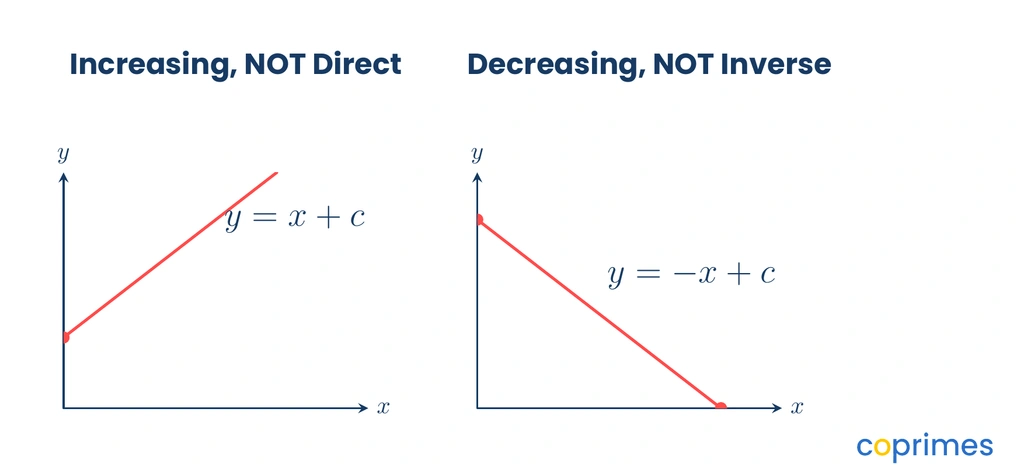
A frequent error is assuming that all increasing patterns represent direct variation. For example, a taxi fare with a starting fee plus a per-mile charge increases steadily, but it is not proportional. The graph is a straight line, but it does not pass through the origin .
Another error is assuming that all decreasing patterns represent inverse variation. For example, spending money from a fixed gift card causes the remaining balance to decrease at a constant rate. This creates a straight, downward-sloping line, which does not share the constant-product property or the curved shape of a hyperbola.
Frequently asked questions
What is the constant of proportionality?
The constant of proportionality, usually written as , is the fixed numerical value that relates two variables in a proportional relationship.
How do you find the variation constant ?
For direct variation, divide the output by the input . For inverse variation, multiply the input and output together.
Can a proportional relationship be negative?
Yes, the constant of proportionality can be negative. In those cases, the equations still apply, but the graphical lines or curves will appear in different coordinate quadrants.
Practice questions
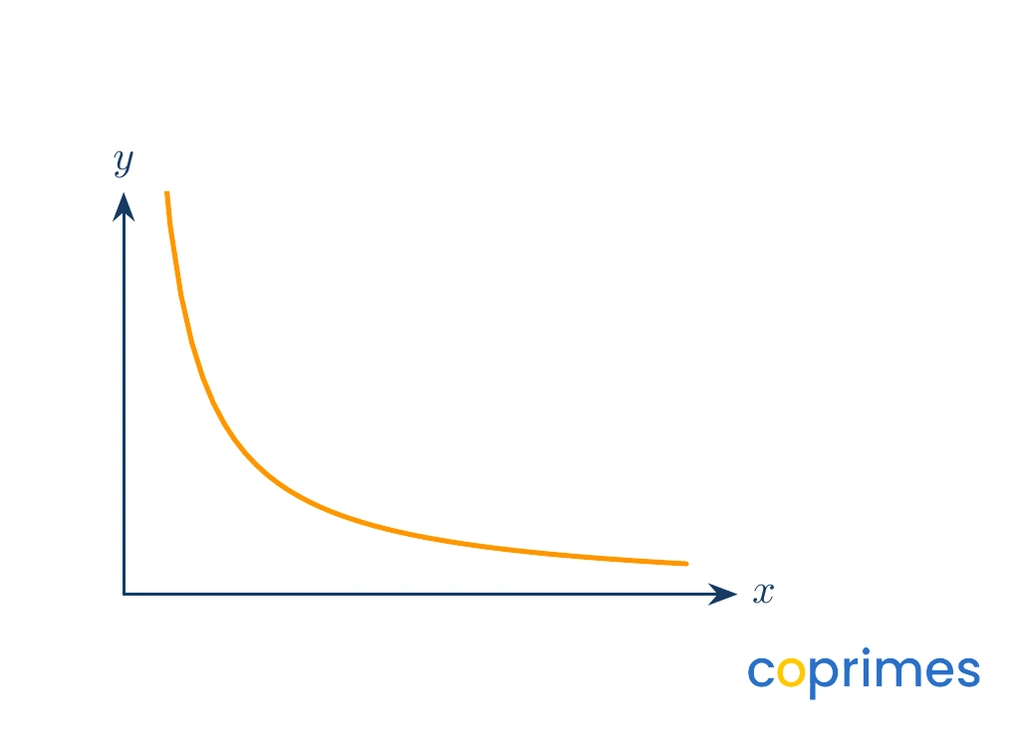
Which type of mathematical relationship does the graph show?
Direct variation
Inverse variation
Neither, it shows a constant ratio
Neither, it shows an increasing relationship
Inverse variation
If is inversely proportional to , and when , what is the value of the constant of proportionality ?
A group of machines takes hours to complete a manufacturing task. If all machines work at the same rate, how long will it take machines to complete the identical task?
hours
hours
hours
hours
hours
Which pair of data points belongs to an inverse variation relationship?
and
and
and
and
and
The time it takes to empty a water tank varies inversely with the pumping rate . If it takes minutes to empty the tank at a rate of liters per minute, what is the pumping rate needed to empty the tank in exactly minutes?
liters per minute
liters per minute
liters per minute
liters per minute
liters per minute