
Understanding the Inverse Proportion Formula
For inverse proportion, the general equation is , where the product is always a constant value. Use a known pair of values to calculate this constant, write the specific equation, substitute the new known value, and divide to solve. Because the constant is non-zero, the variable cannot be zero.
What is the inverse proportion formula?
The inverse proportion formula describes a relationship between two variables where one increases as the other decreases at the exact same rate.
The primary formula is written as:
In this formula, and are the variables that change, and represents the constant of proportionality.
This means that the value of is equal to a fixed number divided by . As becomes larger, dividing the constant by a larger number makes smaller.
Because division by zero is undefined, the value of in an inverse proportion can never be zero.
Recognise a constant product
When two quantities are inversely proportional, multiplying them together always produces the exact same result.
This relationship can be seen by rearranging the formula . By multiplying both sides by , we reveal the constant product formula: xy = k
The product of two inversely proportional variables is always constant.
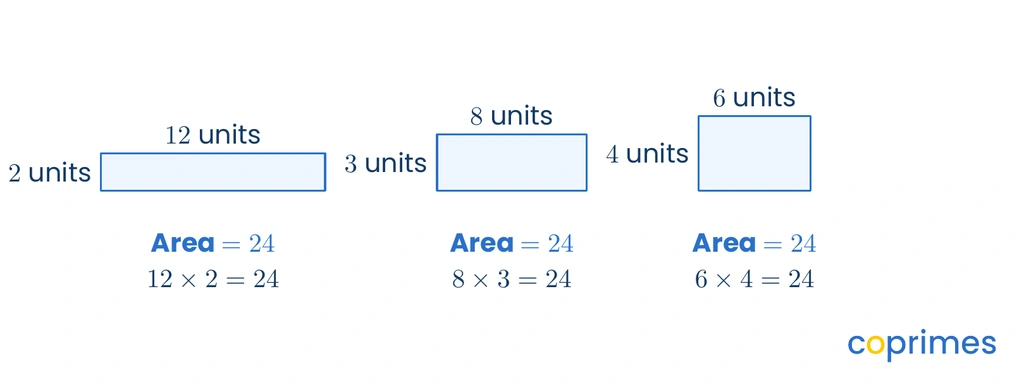
If you increase one dimension, you must decrease the other dimension proportionally to maintain the same total.
For example, consider rectangles that all share the exact same area. As the length increases, the width must decrease.
Find the constant k
To use the inverse proportion formula, you must first find the constant . You can find by substituting any given pair of values for and into the formula.
Because rearranging the formula is helpful, many learners prefer to use the multiplication form to find instantly.
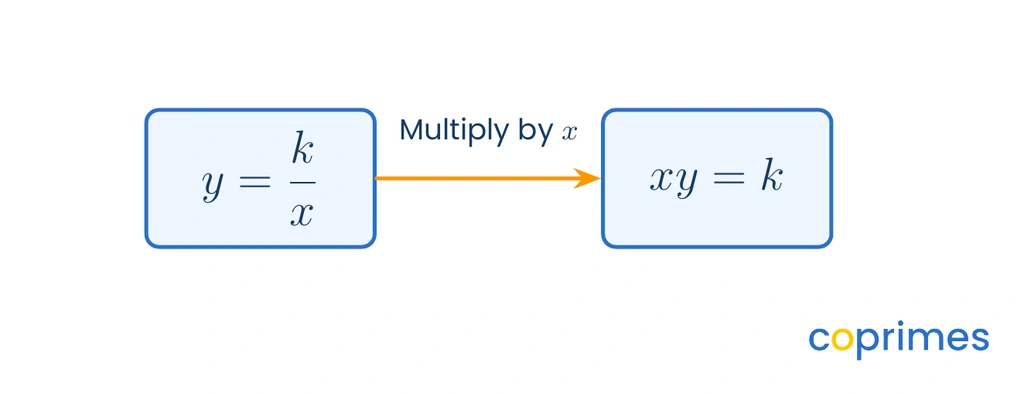
For example, if you know that when , you can multiply them together to find the constant: . The constant is .

Write and solve y equals k over x
Once you understand the relationship between the variables, you can calculate any missing value using a standard four-step procedure.
- Write the general formula .
- Substitute the given pair of values and solve for .
- Rewrite the formula with your calculated value for .
- Substitute the new known value into the specific formula to find the final answer.
This procedure works for all inverse variation problems, including complex examples involving powers or roots of .
Use inverse-proportion tables and graphs
Tables and graphs are useful tools to visualize inverse proportion. In a table of paired values, you can confirm an inverse relationship by checking if the product of every and pair is identical.
Product () | ||
When you plot these paired values on a coordinate plane, the graph forms a smooth curve called a hyperbola.
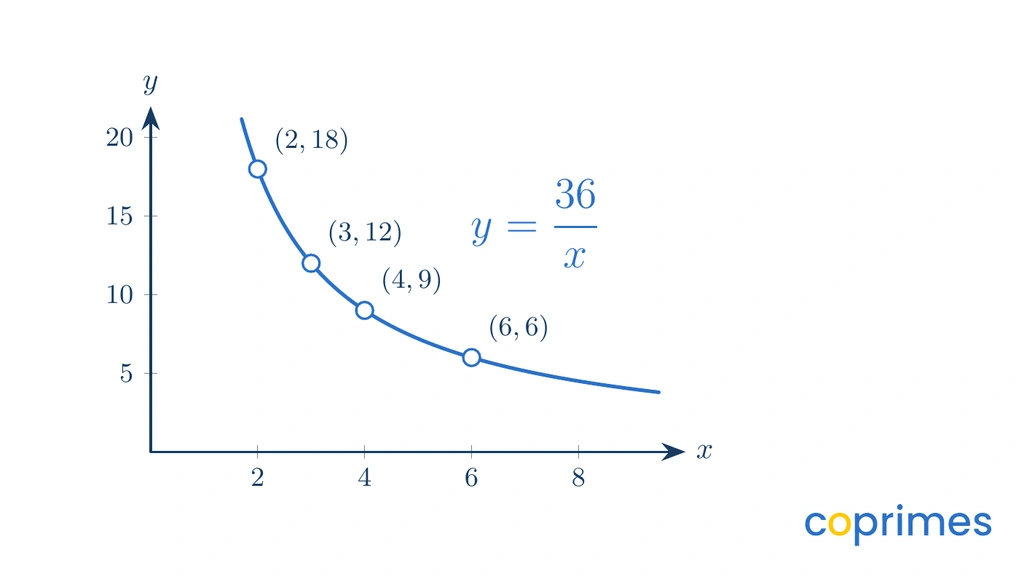
Because cannot equal zero, the curve approaches the vertical axis but never touches it. Similarly, because is not zero, can never reach zero, meaning the curve never touches the horizontal axis.
Worked examples
Here are two examples demonstrating how to apply the formula to both real-world modeling contexts and abstract algebraic relationships.
Example 1: Time to complete a fixed task
Question: A team of builders takes days to complete a project. Assuming all builders work at the same constant rate, how many days will it take a team of builders to complete the same project?
Method:
- Write the general equation relating days () and builders (): .
- Substitute the given values to find : , which means .
- Write the specific equation: .
- Substitute the new worker count to find the days: .
Answer: It will take the team days.
Check: Multiply the pairs to verify the constant product: and . The products match, confirming the inverse proportion.
Example 2: Inverse proportion with a squared variable
Question: The variable is inversely proportional to the square of . When , . Find the value of when .
Method:
- Write the general equation. Because is inversely proportional to , the formula is .
- Substitute the given values to find : . This means , so .
- Write the specific equation: .
- Substitute the new value to find : .
Answer: The value of is .
Check: Confirm the constant product with the square of . and .
A learning plan shaped by your child, not the class
State-aligned Math plus our own Logic and English curriculum. An adaptive baseline test finds the gaps and fills them.
Common mistakes
A frequent mistake is using the wrong formula entirely. When reading a problem, check carefully whether it describes direct or inverse proportion. Using the direct variation equation when the variables are inversely proportional will result in an incorrect constant and an incorrect final answer.
Another common error occurs in higher-order proportions involving powers. If is inversely proportional to the square of , you must remember to square the value of before calculating the constant or the final answer.
Frequently asked questions
Can the constant be negative?
Yes, can be a negative number. The variables are still inversely proportional because their product remains constant, but the graph will appear in different quadrants of the coordinate plane.
What is the difference between direct and inverse proportion?
In direct proportion, as one variable increases, the other variable increases by the same factor. In inverse proportion, as one variable increases, the other variable decreases by the same factor. You can learn more about identifying these relationships in the guide on direct and inverse variation.
How does this relate to equivalent fractions?
While solving proportions often involves finding equivalent fractions and using cross-multiplication for direct variation, inverse proportion relies on keeping the horizontal product of the variables constant rather than their ratio.
Practice questions
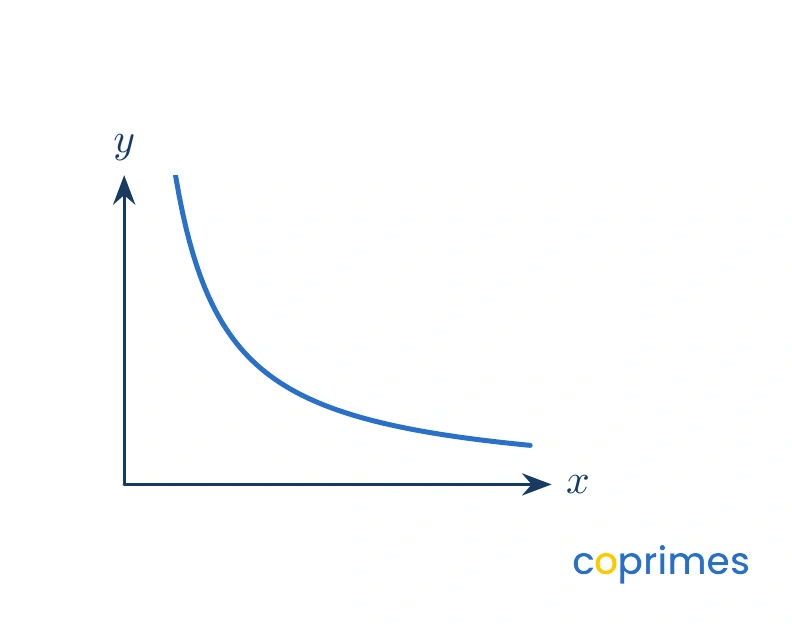
Which of the following equations best describes the curve shown in the graph?
The variable is inversely proportional to . When , .
What is the value of when ?
A school hires a bus for a trip. The cost per student is inversely proportional to the number of students. If students go, the cost is dollars each.
What is the cost per student if students go?
dollars
dollars
dollars
dollars
dollars
Which of the following statements is true for the inverse proportion equation ?
As increases, increases.
The product of and is constant.
The graph is a straight line.
The variable can equal zero.
The product of and is constant.
The variable is inversely proportional to the square of . When , .
What is the value of when ?