
Division by Zero: Understanding Undefined Division
Division by zero is undefined because no number multiplied by zero can produce a nonzero dividend. While zero divided by a nonzero number simply equals zero, attempting to use zero as a divisor contradicts the fundamental rules of mathematics and does not yield a valid numerical answer.
What is division by zero?
Division by zero occurs when zero is placed in the denominator of a fraction or used as the divisor in a division problem. In mathematics, division represents the process of separating a quantity into equal parts or groups.
When you divide a number by zero, you are asking to separate a quantity into zero groups. Because a group must exist to hold a quantity, this action is logically impossible. Therefore, the result of any nonzero number divided by zero is classified as undefined.
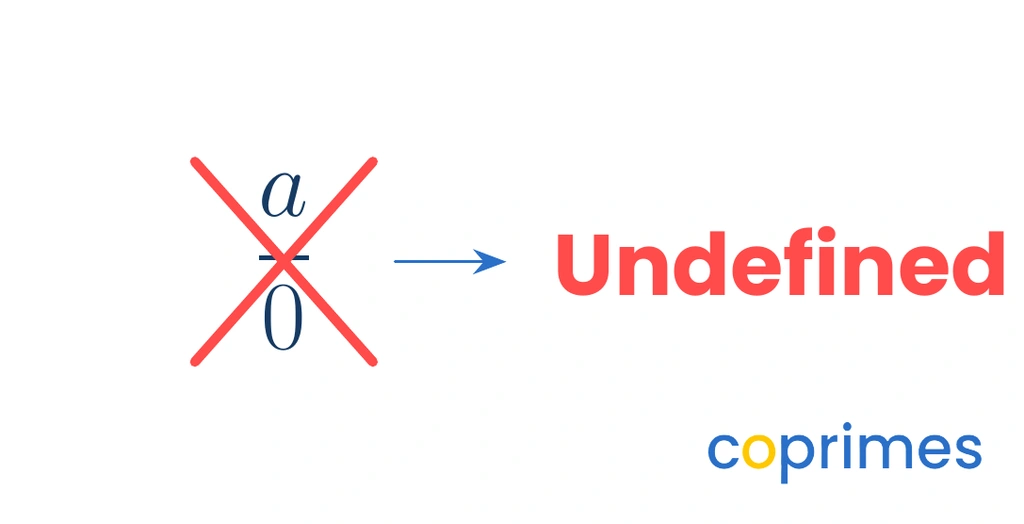
Division by zero is mathematically undefined, meaning there is no valid numerical answer.
Why a nonzero number cannot be divided by zero
A nonzero number cannot be divided by zero because the relationship between multiplication and division breaks down. Division is the inverse operation of multiplication. Every valid division equation can be rewritten as a multiplication equation.
For example, is true because .
If we try to calculate one divided by zero, we write . Rewriting this as a multiplication equation gives . According to the zero property of multiplication, any number multiplied by zero equals zero. There is no number that can be multiplied by zero to produce a nonzero result like . Because no such number exists, the division is undefined.
What is zero divided by a nonzero number?
Zero divided by any nonzero number is always zero. This is a common point of confusion, but unlike dividing by zero, dividing zero by another number is completely valid and has a distinct, defined answer.
If you have zero items and divide them into equal groups, each group will contain zero items.
Written as an equation, . We can use the division algorithm and checking method to verify this result. Multiplying the quotient by the divisor gives , which matches the original dividend.
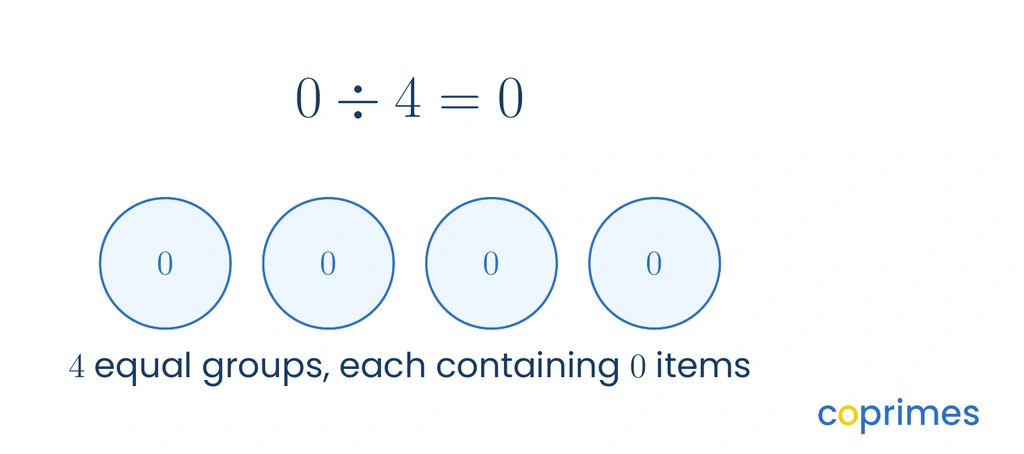
Zero divided by any nonzero number equals zero. It is not undefined.

What is zero divided by zero?
Zero divided by zero is undefined, but for a different reason than dividing a nonzero number by zero. It is sometimes called indeterminate because there is no single, unique answer.
If we write , the related multiplication equation is . Because multiplying any number by zero results in zero, every number could theoretically be the answer. For instance, , , and . Since division requires exactly one correct quotient, cannot be assigned a specific value and remains undefined.
Use inverse multiplication to reason
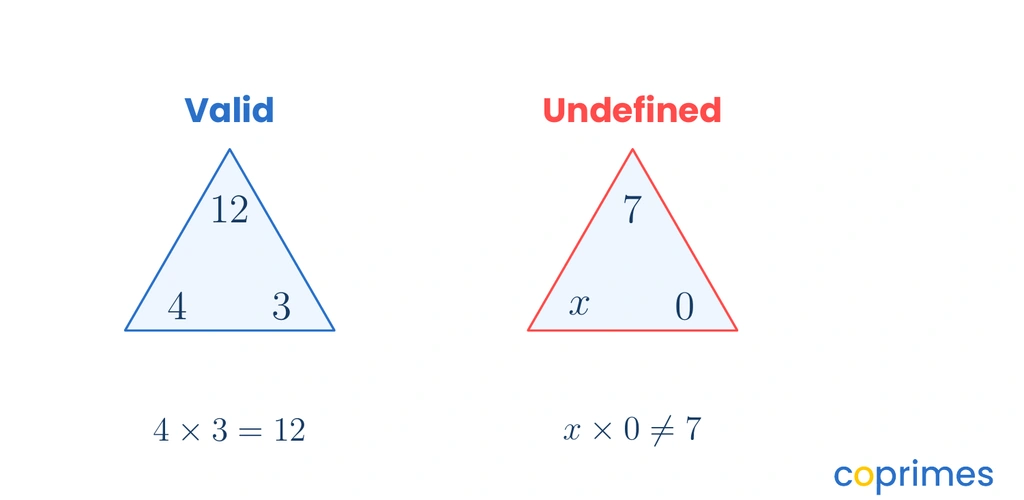
Whenever you encounter an unfamiliar division problem, rely on multiplication and division fact families to find the answer. A fact family connects three related numbers using both multiplication and division.
For the fact family of , , and , the related equations are:
If we attempt to build a fact family for , the multiplication step fails. The fact family cannot be completed because the required multiplication fact does not exist. Using the inverse operation is the most reliable way to prove that undefined division is mathematically impossible.
Common misconceptions
Learners often mistake the rules for handling zero in division. Pay attention to these common errors:
- Believing that : It is natural to assume that dividing by zero yields zero, but the correct result is undefined.
- Believing that : Some learners assume that dividing by zero leaves the original number unchanged. However, dividing by one leaves the number unchanged
(); dividing by zero is undefined. - Confusing with : The order of numbers in division matters. The equation is valid for any nonzero , whereas has no answer.
A learning plan shaped by your child, not the class
State-aligned Math plus our own Logic and English curriculum. An adaptive baseline test finds the gaps and fills them.
Worked examples
Example 1: Evaluating division involving zero
Question: Evaluate and .
Method:
- For , rewrite the division as a multiplication equation: .
- The number that satisfies this equation is , because .
- For , rewrite the division as a multiplication equation: .
- No number multiplied by zero produces . Therefore, this expression cannot be evaluated.
Answer: , and is undefined.
Check: Multiplying the result back to verify the first expression gives , which is correct. No check is possible for the second expression.
Example 2: Analyzing an unknown value
Question: What is the value of if ?
Method:
- Recognize that the fraction bar represents division.
- The expression means zero is the dividend and is the divisor.
- Dividing zero into equal parts results in zero per part.
Answer: .
Check: Since , the division equation is valid.
Example 3: Explaining zero over zero
Question: Why does the fraction not equal ?
Method:
- Normally, any nonzero number divided by itself equals (for example, ).
- If , the related multiplication check would be .
- While this is true, other values also work. If we guessed the answer was , the check is also true.
- Because division must yield exactly one unique quotient, the operation fails.
Answer: The fraction is undefined because multiple numbers can satisfy the inverse multiplication equation, meaning no single unique answer exists.
Frequently asked questions
What is one divided by zero?
One divided by zero is undefined. There is no number that you can multiply by zero to get an answer of one.
Why does a calculator say "Math Error" or "Divide by Zero"?
Calculators are programmed to return numerical answers. Because division by zero does not produce a valid real number, the calculator stops the operation and returns an error message to show that the calculation is mathematically impossible.
Can you divide by zero in fractions?
No, a fraction denominator can never be zero. A fraction represents a part of a whole, and the denominator represents the number of equal parts the whole is divided into. You cannot divide a whole into zero parts, so fractions like are undefined.
Practice questions
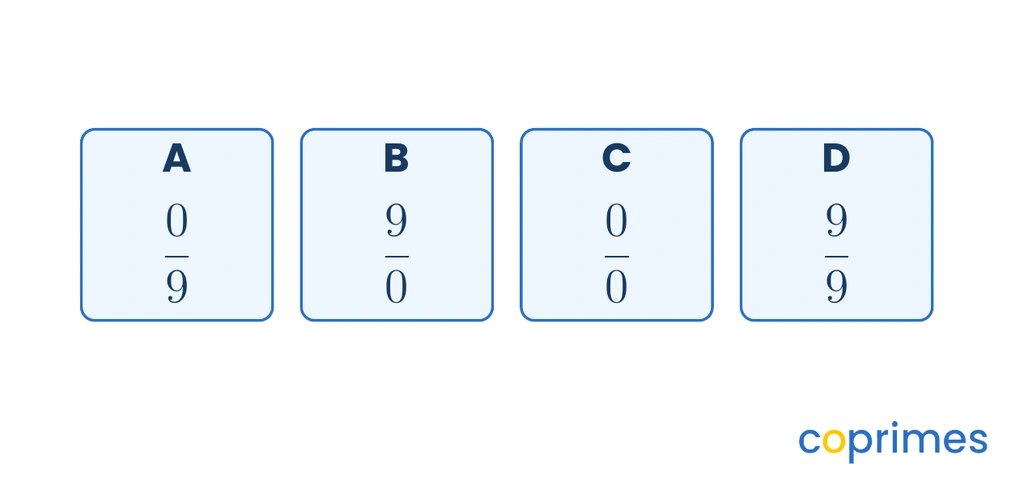
Which panel shows an expression that has a defined answer of zero?
Panel A
Panel B
Panel C
Panel D
Panel A
A student tries to solve by rewriting it as a multiplication equation. Which equation correctly represents this step, and what does it reveal?
; the answer is .
; the answer is undefined because no number times zero equals .
; the answer is .
; the answer is .
; the answer is undefined because no number times zero equals .
Evaluate the following two expressions: and .
, and .
, and .
, and is undefined.
Both expressions are undefined.
, and is undefined.
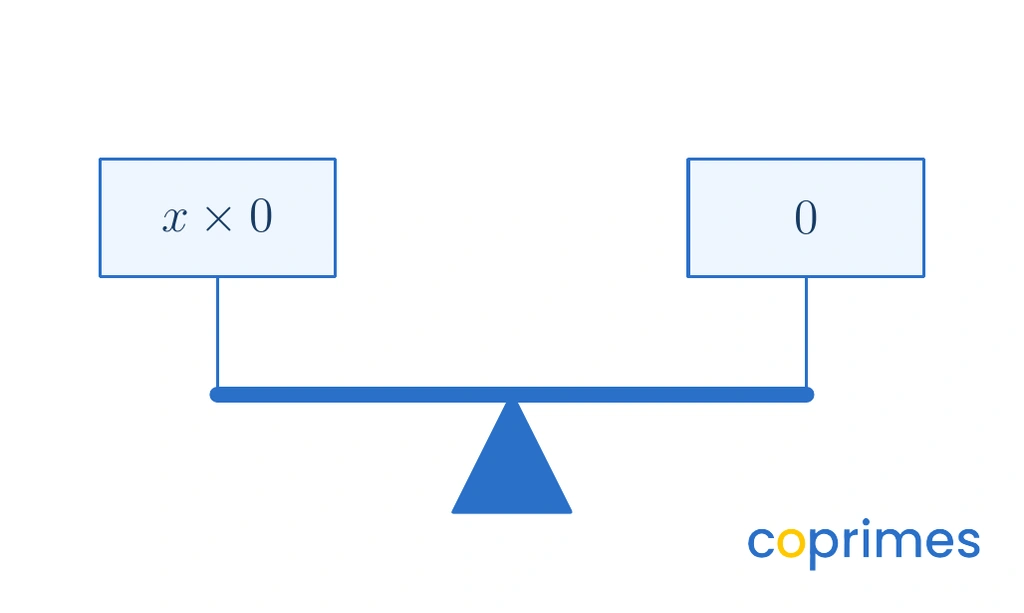
The balanced scale models the inverse equation for . Why does this balance show that is undefined?
The value of must be for the scale to balance.
Any number can replace to keep the scale balanced, meaning there is no unique answer.
The value of must be because a number divided by itself is .
No number can replace to balance the scale.
Any number can replace to keep the scale balanced, meaning there is no unique answer.
If is a positive integer, which of the following expressions will result in a math error on a calculator?