
Division Algorithm and Checking: Formula and Examples
For whole-number division, the dividend equals the divisor multiplied by the quotient, plus the remainder. This relationship is known as the division algorithm. It provides a reliable way to verify any exact or non-exact division calculation by turning it into a related verification equation.
What is the division algorithm?
The division algorithm is a fundamental mathematical rule stating that any whole number can be divided by a non-zero integer to produce a unique quotient and a unique remainder.
When working with basic arithmetic, identifying the dividend, divisor and quotient is the first step. The dividend is the total amount being divided, the divisor is the number of groups or the size of each group, and the quotient is the resulting whole number of complete groups.
If the total cannot be divided equally, a remainder is left over. The division algorithm combines these four values into a predictable, mathematically true equation.
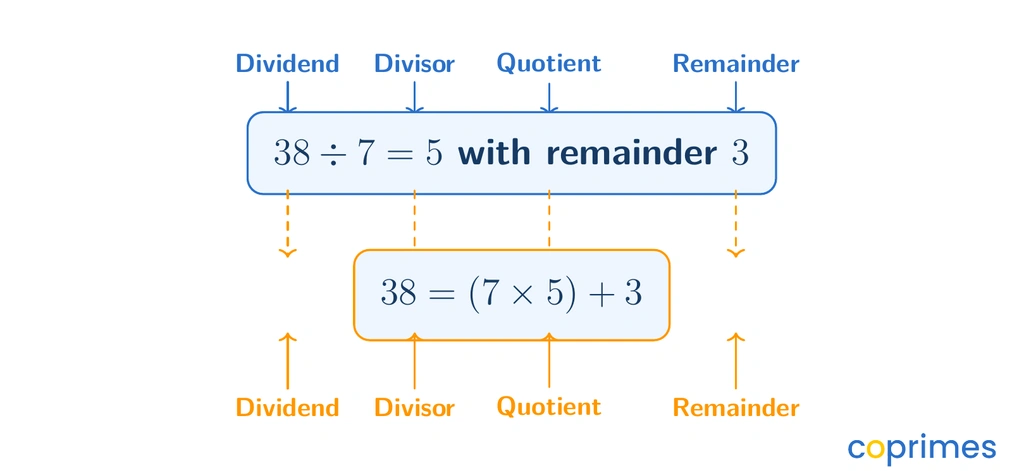
The dividend-divisor-quotient-remainder equation
The division identity clearly defines the relationship between the four fundamental parts of a division calculation. This forms the core dividend-divisor-quotient-remainder formula:
Multiplying the divisor by the quotient and adding the remainder will always recreate the original dividend.
This relationship is an extension of multiplication and division fact families. Because division is the inverse operation of multiplication, every division equation can be rewritten as a related multiplication equation. Adding the remainder accounts for the portion of the dividend that could not form a complete group.
How to check division
To verify a division answer, you can use the quotient remainder formula. This ensures no arithmetic mistakes were made during calculation.
Use the following steps to verify your division answer:
- Identify the divisor, the quotient, and the remainder from your calculation.
- Multiply the divisor by the quotient.
- Add the remainder to the product from the previous step.
- Compare the final sum to the original dividend. If the numbers match exactly, the calculation is verified.
Checking your work is highly recommended when performing long division, where multiple steps increase the likelihood of small arithmetic errors.
A learning plan shaped by your child, not the class
State-aligned Math plus our own Logic and English curriculum. An adaptive baseline test finds the gaps and fills them.
Why the remainder is bounded
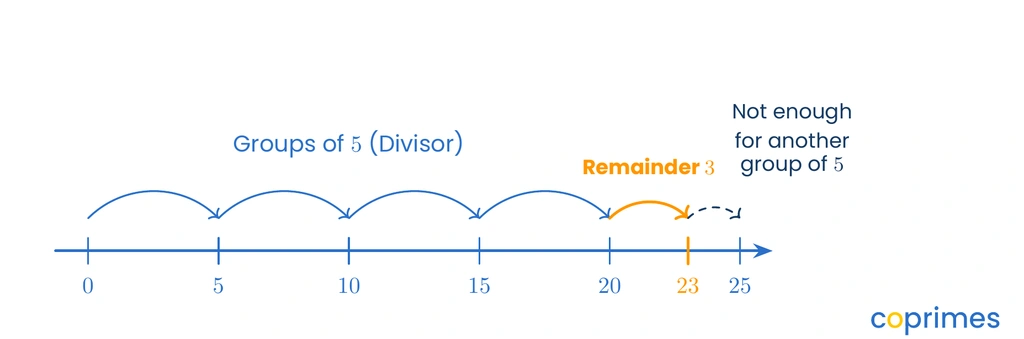
When performing division with remainders, the remainder is strictly limited by the size of the divisor. A valid remainder must be greater than or equal to zero, but it must remain strictly less than the divisor.
If the remainder equals or exceeds the divisor, it means another full group can still be formed, so the division is incomplete. For example, when dividing by , the only possible whole-number remainders are , , , , , and .
From arithmetic checking to Euclid's division lemma
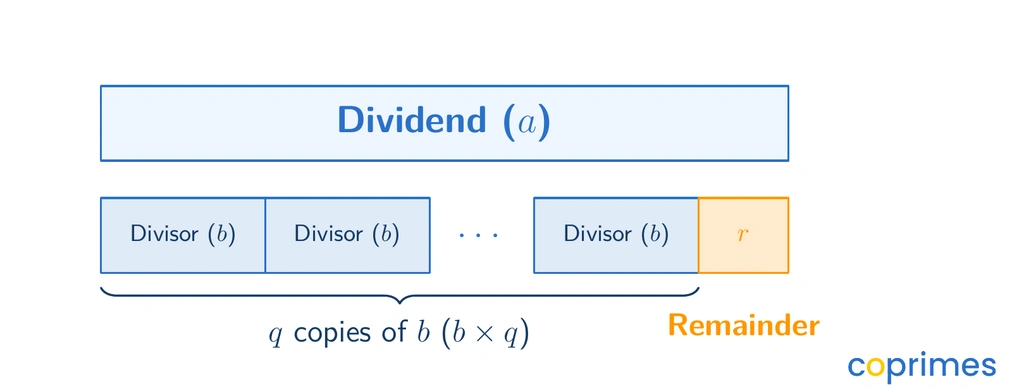
In later grades, the arithmetic check is formalized algebraically as Euclid's division lemma. This mathematical rule describes the exact same dividend-divisor relationship using variables.
For any two positive integers (the dividend) and (the divisor), there exist unique integers (the quotient) and (the remainder) such that:
where .
This formal statement confirms that division is always exact and predictable. It also serves as the foundation for the Euclidean algorithm, a repeated procedure used to find the highest common factor of two numbers.
Worked examples
The formula applies equally to verifying simple calculations and finding unknown components.
Example 1: Verifying a basic division
Question: Verify that with a remainder of .
Method:
- Identify the parts: the dividend is , the divisor is , the quotient is , and the remainder is .
- Check the remainder bound: The remainder is strictly less than the divisor .
- Multiply the divisor by the quotient: .
- Add the remainder: .
Answer: The sum equals the original dividend of , proving the division is exact and correct.
Check: Ensure no other multiplication fact fits. , which is larger than , confirming the quotient must be .
Example 2: Finding a missing dividend
Question: A number is divided by . The quotient is and the remainder is . What is the original number?
Method:
- State the formula: .
- Substitute the given values: .
- Perform the multiplication: .
- Add the remainder: .
Answer: The missing dividend is .
Check: Work backwards. Divide by . , leaving . , leaving . The quotient is with a remainder of .
Example 3: Writing Euclid's division lemma
Question: Apply Euclid's division lemma to express the relationship when dividing by .
Method:
- Identify the two positive integers: and .
- Find the largest multiple of that does not exceed . The multiple is . So, the unique integer quotient is .
- Subtract this multiple from the dividend to find the remainder: . So, the unique integer remainder is .
- Write the relationship in the form .
Answer: The relationship is .
Check: Verify the remainder rule . The remainder is greater than zero and less than the divisor .

Common mistakes
When using the division algorithm, students frequently make these predictable errors:
- Forgetting to add the remainder: When checking a division calculation, multiplying the divisor by the quotient only verifies the complete groups. If the remainder is left out of the check, the final sum will not match the original dividend.
- Allowing a remainder larger than the divisor: A common error during long division is stopping before the total is fully divided. If the remainder is equal to or larger than the divisor, the quotient is too small and the calculation is incomplete.
- Confusing the divisor and the dividend: Placing the larger number outside the division bracket by accident changes the entire problem, often producing fractional or decimal results where a whole number was expected.
Frequently asked questions
Can the remainder be zero?
Yes. If a number divides perfectly into another number without leaving anything behind, the remainder is zero. In this case, the division equation simply becomes .
What happens if the divisor is larger than the dividend?
If you attempt to divide a smaller whole number by a larger whole number, the quotient is because no complete groups can be made. The remainder is exactly equal to the original dividend. For example, yields a quotient of and a remainder of .
Does the division algorithm work for negative numbers?
Yes. The theorem extends to negative integers as well. However, the rule must be carefully applied so the remainder remains positive, which can shift the quotient differently than standard whole-number division.
Practice questions
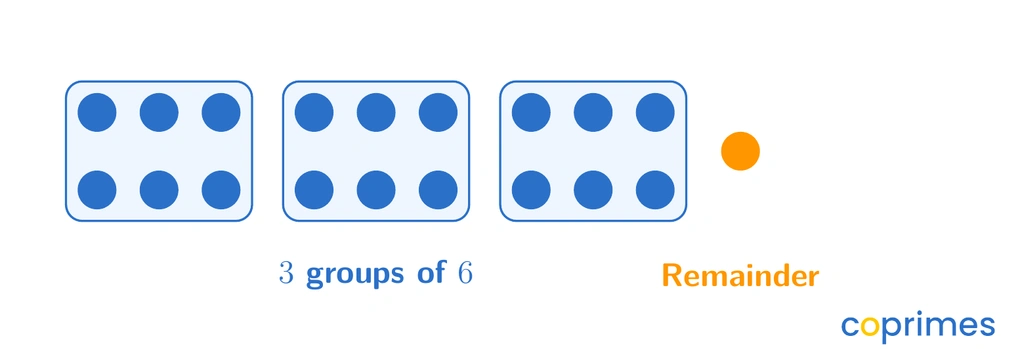
Which mathematical equation correctly describes the division algorithm modeled in the visual?
What is the original dividend if a calculation produces a divisor of , a quotient of , and a remainder of ?
According to the division algorithm, what is the strict rule for the remainder when dividing by a whole number?
The remainder must be greater than or equal to zero and strictly less than the divisor.
The remainder must always be greater than the quotient.
The remainder must always equal zero for the algorithm to be valid.
The remainder must be less than the original dividend but greater than the divisor.
The remainder must be greater than or equal to zero and strictly less than the divisor.
A student writes the division checking equation . Which statement best explains why this verification represents an incomplete division?
The sum of and does not mathematically equal .
The remainder is greater than the divisor , meaning another group can be formed.
The quotient should always be larger than the dividend in the checking formula.
The remainder cannot be an odd number when dividing by an even divisor.
The remainder is greater than the divisor , meaning another group can be formed.
By applying Euclid's division lemma to the positive integers and , what are the unique values of (quotient) and (remainder)?
and
and
and
and
and