
Equivalent Ratios: Definition, Method and Examples
Equivalent ratios describe the same multiplicative relationship. You can make an equivalent ratio by multiplying or dividing every term by the same non-zero number, so , , and are equivalent.
Understanding how to find equivalent ratios allows you to scale values up or down while keeping their proportions perfectly balanced.
What are equivalent ratios?
Equivalent ratios are two or more ratios that express the same relationship between numbers, even though they use different values. They are also known as equal ratios, matching ratios, or ratio equivalence.
When you compare quantities using a ratio, the specific numbers might change, but the underlying proportion remains constant. For example, if a recipe calls for cup of sugar for every cups of flour, the ratio is . If you double the recipe, you need cups of sugar and cups of flour, making the ratio . Both and represent the exact same mixture.
Equivalent ratios work exactly like equivalent fractions.
Because ratios can be written as fractions, you can find equivalent ratios using the same rules you use for equivalent fractions. The fraction is equal to the fraction .
Make an equivalent ratio
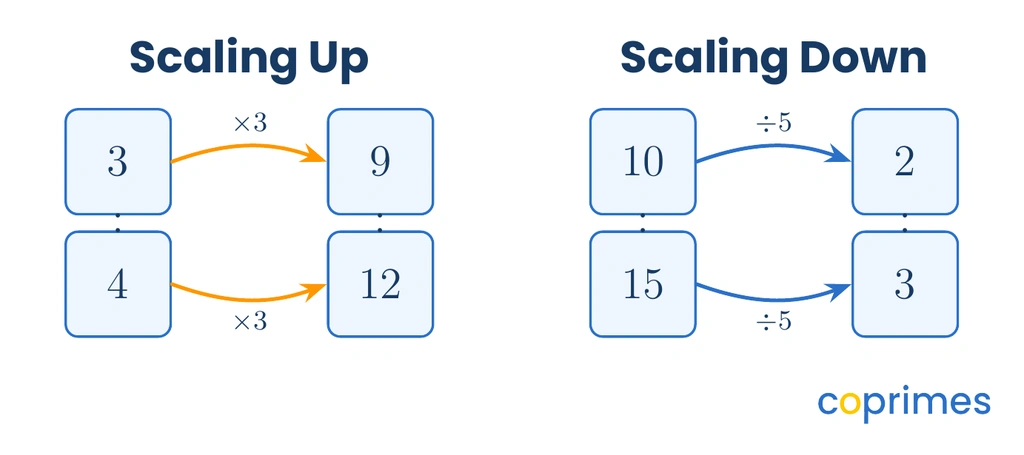
To make an equivalent ratio, you must multiply or divide both terms of the original ratio by the same non-zero number.
The Multiplication Method
Multiplying scales a ratio up to larger numbers. For example, to find an equivalent ratio for , you can multiply both the and the by . The new ratio is .
The Division Method
Dividing scales a ratio down to smaller numbers. For example, to find an equivalent ratio for , you can divide both the and the by . The new ratio is .
Check whether two ratios are equivalent
You can determine if two ratios are equivalent by simplifying them to their lowest terms or by cross-multiplying their fraction forms.
Method 1: Simplest Form
Reduce both ratios to their simplest form by dividing the terms by their greatest common factor. If the simplified ratios match exactly, the original ratios are equivalent.
For example, to check if and are equivalent:
- Simplify by dividing by . The simplest form is .
- Simplify by dividing by . The simplest form is .
Because both simplify to , they are equivalent ratios.
Method 2: Cross-Multiplication
Write the ratios as fractions and cross-multiply. If the two cross-products are equal, the ratios are equivalent.
To check and :
- Write them as and .
- Multiply the numerator of the first by the denominator of the second: .
- Multiply the denominator of the first by the numerator of the second: .
Because equals , the ratios are equivalent.

Use visual models
Visual models provide a clear way to see how equivalent ratio examples describe the same overall proportion. You can use linked bar models and ratio tables to display these relationships.
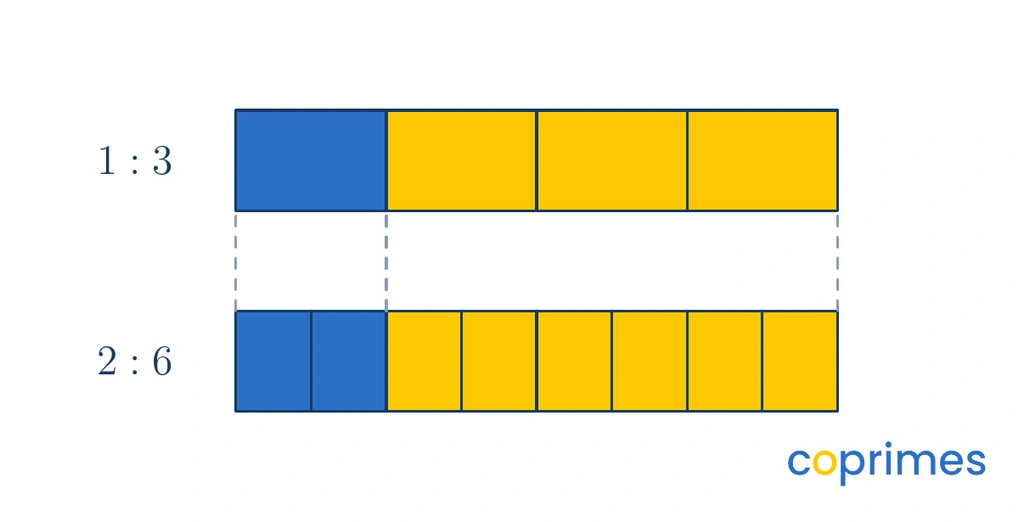
Linked Bar Models
A linked bar model, or tape diagram, shows equivalent ratios by dividing the same total length into smaller units. Below, the first model shows a ratio of . The second model is exactly the same size but is split into twice as many pieces, demonstrating the equivalent ratio .
Ratio Tables
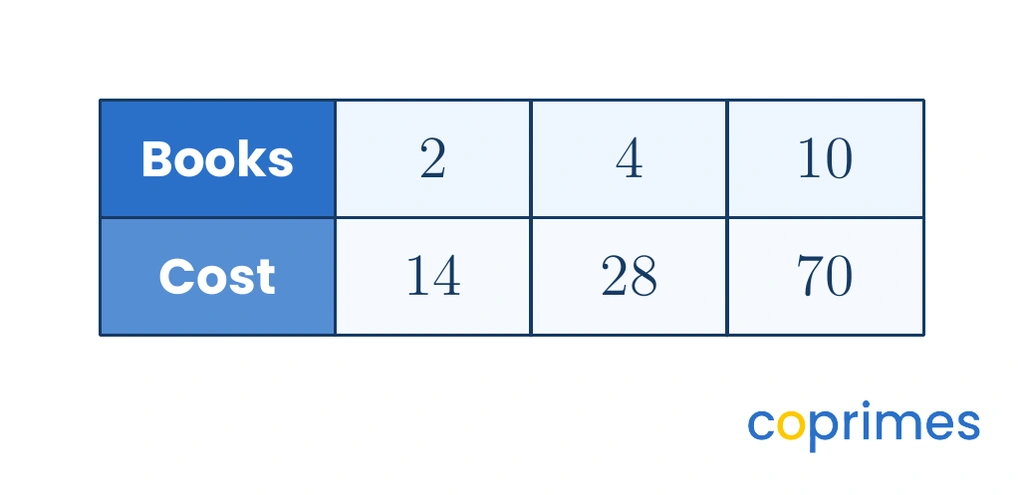
An equivalent ratio table organizes scaled values into rows and columns. Creating ratio tables helps you find patterns quickly and solve larger proportional problems without needing to draw individual shapes.
Find a missing term
You will often need to find a missing term in a pair of equivalent ratios. You can solve these problems by identifying the multiplier or divisor that connects the known parts of the ratios.
If you know that , you must find out how the first terms relate to each other. Because multiplied by equals , the scaling factor is . To find , apply the same scaling factor to the second term: multiply by . The missing term is .
Worked examples
Reviewing completed examples helps reinforce the steps for building and simplifying ratios.
Example 1: Creating an equivalent ratio by scaling up
Question: Create an equivalent ratio for using multiplication.
Method:
- Choose a non-zero whole number as your multiplier, such as .
- Multiply the first term by : .
- Multiply the second term by the same number: .
Answer: is an equivalent ratio to .
Check: Write the ratio as a fraction and simplify it. Dividing both numbers by returns the fraction to .
Example 2: Verifying equivalent ratios
Question: Are the ratios and equivalent?
Method:
- Simplify the first ratio by dividing both terms by their greatest common factor, which is . The result is .
- Simplify the second ratio by dividing both terms by their greatest common factor, which is . The result is .
- Compare the simplified ratios.
Answer: Yes, they are equivalent because both simplify to .
Check: Cross-multiply their fraction forms: and . The cross-products are and . Because , the ratios are equal.
Example 3: Finding a missing term in a ratio
Question: Find the missing value if the ratios and are equivalent.
Method:
- Compare the known corresponding terms. The second terms are and .
- Determine the multiplier. Since , the scaling factor is .
- Multiply the first term of the original ratio by the same factor: .
Answer: The missing value is .
Check: When simplifying ratios, reducing by a factor of gives . Reducing by a factor of also gives . The missing value is correct.
A learning plan shaped by your child, not the class
State-aligned Math plus our own Logic and English curriculum. An adaptive baseline test finds the gaps and fills them.
Common mistakes
The most common mistake when making equivalent ratios is adding or subtracting the same number instead of multiplying or dividing.
Ratios rely on multiplication, never addition.
For example, if you start with the ratio and add to both terms, you get . The ratio is not equivalent to . To keep the multiplicative relationship balanced, you must multiply both terms by , which yields the correct equivalent ratio of .
Frequently asked questions
Can equivalent ratios contain decimals?
Yes. While ratios are usually written with whole numbers, you can multiply or divide a ratio's terms by a decimal to find an equivalent ratio. For example, multiplying both terms of by gives the equivalent ratio .
How many equivalent ratios can one ratio have?
An infinite number. Because you can multiply the terms by any non-zero number, there is no limit to how many equivalent ratios you can generate from a single starting ratio.
Are equivalent ratios and proportions the same thing?
They are closely related concepts. An equivalent ratio is a ratio that has the same value as another. A proportion is an equation stating that two specific ratios are equal to each other, such as .
Practice questions
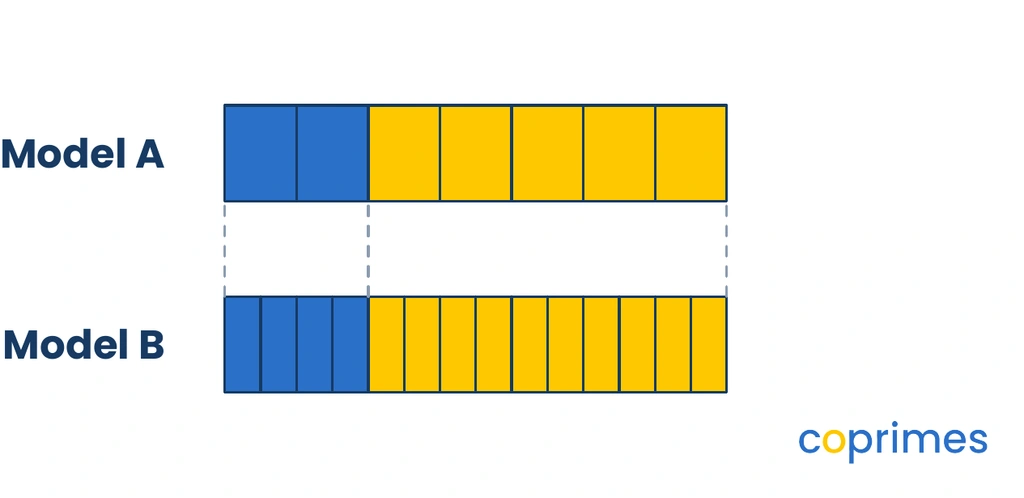
Which statement matches the equivalent ratios shown in the visual models?
Model A is and Model B is .
Model A is and Model B is .
Model A is and Model B is .
Model A is and Model B is .
Model A is and Model B is .
Which of the following is an equivalent ratio to ?
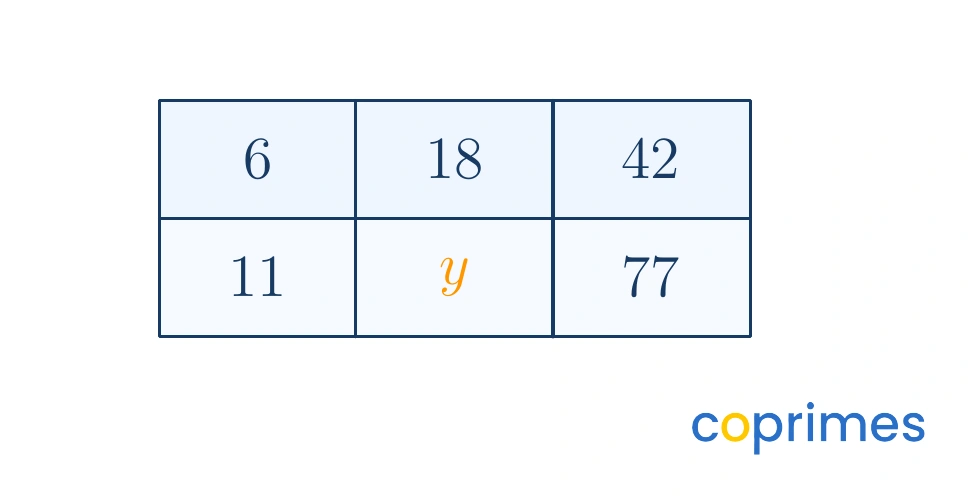
Find the missing value in the ratio table.
A student claims that and are equivalent ratios. Is the student correct?
Yes, because both ratios contain whole numbers.
No, because the student added to both terms instead of multiplying.
Yes, because , and .
No, because the first ratio should be multiplied by , not .
No, because the student added to both terms instead of multiplying.
A paint store mixes liters of yellow paint with liters of blue paint to make green paint. If a customer needs a larger batch of the exact same green color and buys liters of yellow paint, how many liters of blue paint should they buy?
liters
liters
liters
liters
liters