
Estimating Sums and Differences: Strategies and Examples
To estimate a sum or difference, round each number to a suitable common place value, then add or subtract the rounded numbers and label the result as approximate.
Estimating provides a fast way to find an answer that is close enough when an exact value is not required. By turning complex addition and subtraction problems into simpler numbers, you can calculate mentally and solve mathematical problems more efficiently.
What does it mean to estimate a sum or difference?
An estimate is an approximate answer that is close to the exact mathematical result. When estimating calculations, we replace precise numbers with rounded numbers before performing the operation.
We use the approximation symbol to show that an answer is an estimate rather than an exact computation. For example, writing tells the reader that is an expected, near-exact value.
Estimating is not simply guessing; it is a structured mathematical process used to simplify arithmetic operations.
Choose a place value
Before estimating a sum or difference, you must decide which place value to use. This step requires a solid understanding of rounding whole numbers.
Rounding to a smaller place value, such as the nearest ten, gives a more accurate estimate. Rounding to a larger place value, such as the nearest hundred or thousand, makes the calculation faster but produces an answer that is further from the exact value.
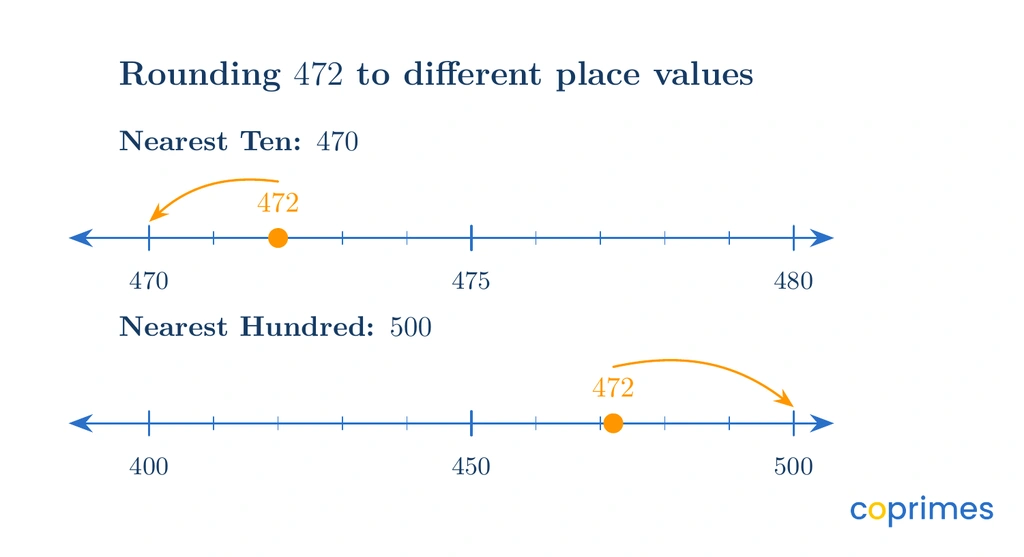
The choice of place value depends entirely on the numbers you are given and how precise your final estimate needs to be.
Estimate sums
To estimate a sum, round every addend to the chosen common place value, then add the rounded numbers together.
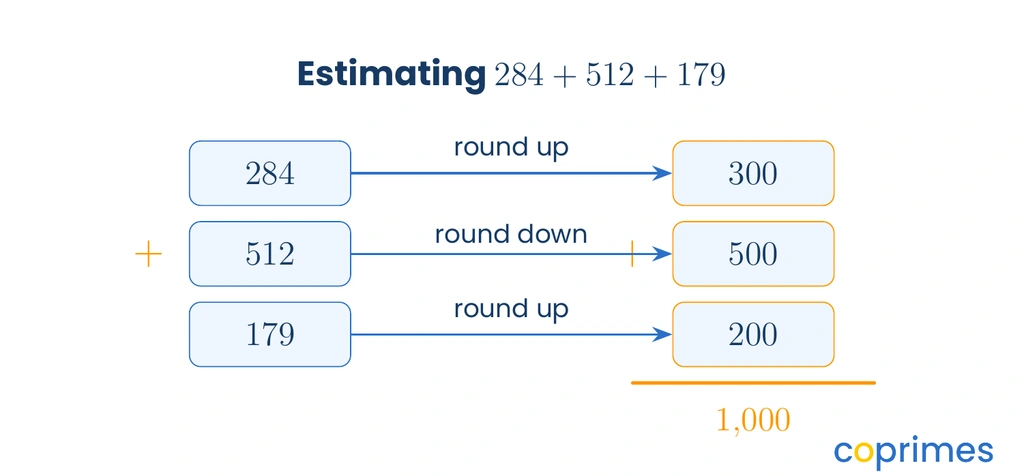
For example, to estimate the three-addend sum of to the nearest hundred, round each number first.
The value rounds up to , the value rounds down to , and the value rounds up to . Adding the rounded numbers gives , so the estimated sum is .

Estimate differences
To estimate a difference, round both the minuend and the subtrahend to the same place value, then subtract the rounded values.
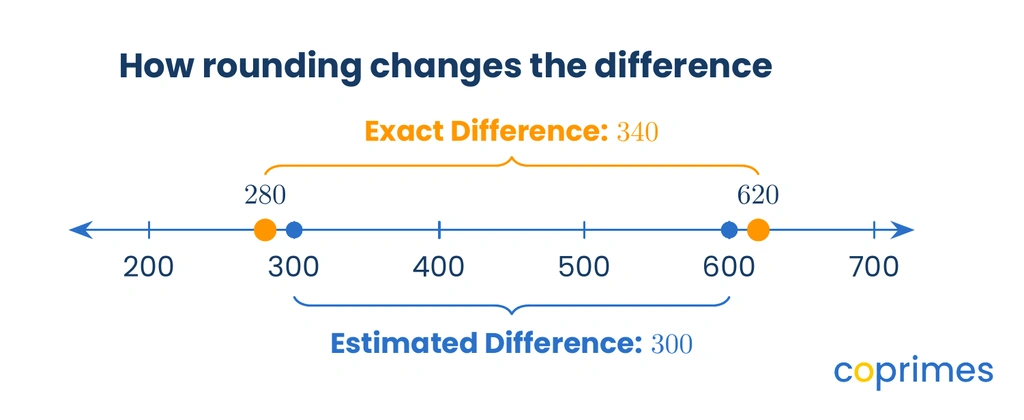
When estimating differences, pay close attention to the direction of rounding. If the larger number is rounded down and the smaller number is rounded up, they move closer together. This makes the estimated difference noticeably smaller than the exact difference.
For example, estimating to the nearest hundred gives . Because shifted down and shifted up, the gap between them shrank, underestimating the exact difference of .
Front-end estimation
Front-end estimation is an alternative strategy where you keep the highest place-value digit unchanged and change all remaining digits to zeros.
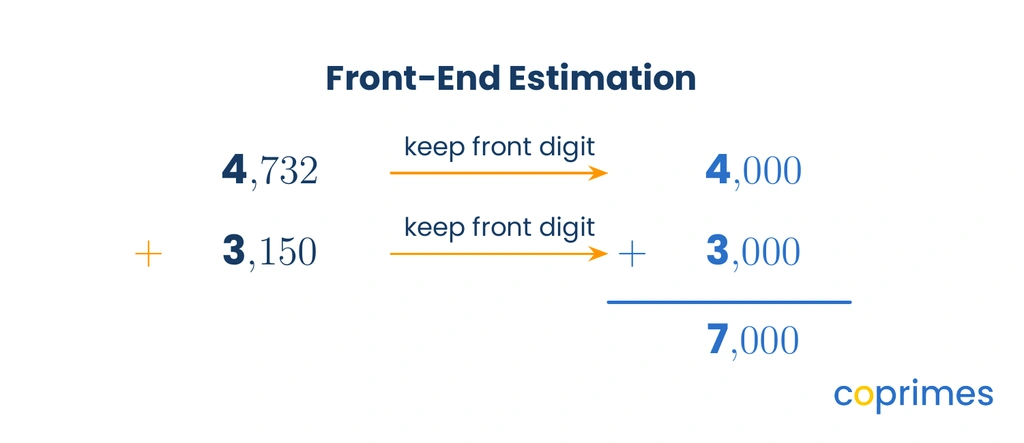
For example, to find the front-end estimate of , look only at the thousands place. The number becomes , and becomes .
Adding these values gives a front-end estimated sum of . This method is extremely fast but often produces a less accurate estimate because it completely ignores the values of the smaller digits.
How to check the estimate
You can verify whether an exact calculation is reasonable by comparing it to an estimate. If your precise computation is far away from the estimated value, you may have made a calculation error.
There are several estimation strategies you can use to check your work, but rounding to the nearest ten or hundred is usually the most reliable method for catching arithmetic mistakes.
A learning plan shaped by your child, not the class
State-aligned Math plus our own Logic and English curriculum. An adaptive baseline test finds the gaps and fills them.
Worked examples
Example 1: Estimating a sum to the nearest ten
Question: Estimate by rounding each number to the nearest ten.
Method:
- Round the first addend to the nearest ten. The number rounds down to .
- Round the second addend to the nearest ten. The number rounds up to .
- Add the rounded numbers. .
Answer: The estimated sum is .
Check: The exact sum is . The estimate of is extremely close, proving the calculation check is accurate.
Example 2: Front-end estimation for subtraction
Question: Use front-end estimation to find the approximate difference of .
Method:
- Apply front-end estimation to the minuend. Keep the and change the rest to zeros, yielding .
- Apply front-end estimation to the subtrahend. Keep the and change the rest to zeros, yielding .
- Subtract the front-end values. .
Answer: The front-end estimated difference is .
Check: The exact difference is . Because front-end estimation ignores the in the subtrahend, the estimate is somewhat rough, but it was calculated correctly.
Frequently asked questions
When should I estimate instead of calculating exactly?
Estimate when you need a quick answer for planning, such as finding a total measure, or when you want to check if an exact mathematical calculation is reasonable before finishing a test.
Does it matter which place value I round to?
Yes. Rounding to smaller place values like tens gives a much more precise estimate. Rounding to larger place values like thousands makes the arithmetic faster but produces a less accurate result.
Can an estimated sum equal the exact sum?
Yes. If all the original numbers already end in zeros for the chosen place value, no rounding change occurs. In that case, the estimated sum and the exact sum are identical.
Practice questions
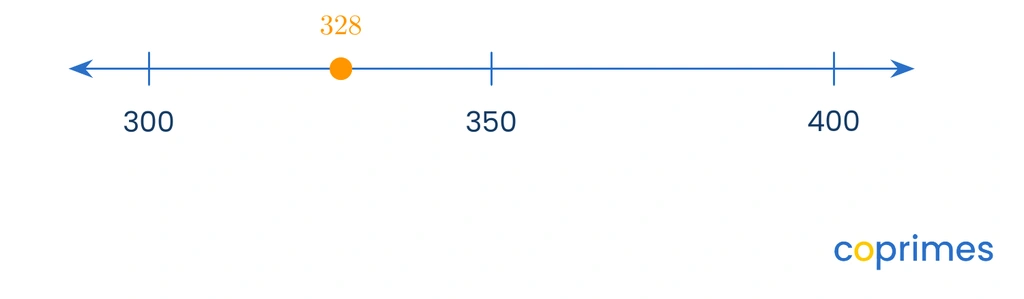
Based on the number line provided, what is rounded to the nearest hundred to use in an estimation?
Estimate the difference of using the front-end estimation strategy.
Estimate the sum of , , and by rounding each number to the nearest ten.
A store sold toys on Friday and toys on Saturday. What is the estimated difference if you round both amounts to the nearest hundred?
Why is the estimated difference between and smaller than the actual difference when rounding both numbers to the nearest hundred?
The larger number rounds up and the smaller number rounds down.
The larger number rounds down and the smaller number rounds up.
Both numbers were rounded down to the nearest hundred.
Subtraction always makes the estimated answer smaller than the exact answer.
The larger number rounds down and the smaller number rounds up.