
Estimating Calculations: Methods, Steps, and Examples
Estimating a calculation means replacing values with nearby, easier numbers, applying the needed operations in the correct order and reporting an approximate rather than exact answer. Estimation provides a quick, realistic result when an exact figure is either unnecessary or impossible to determine.
Learning to estimate helps evaluate whether a final calculation is reasonable. It also saves time when solving complex problems or interpreting real-world data.
What is an estimated calculation?
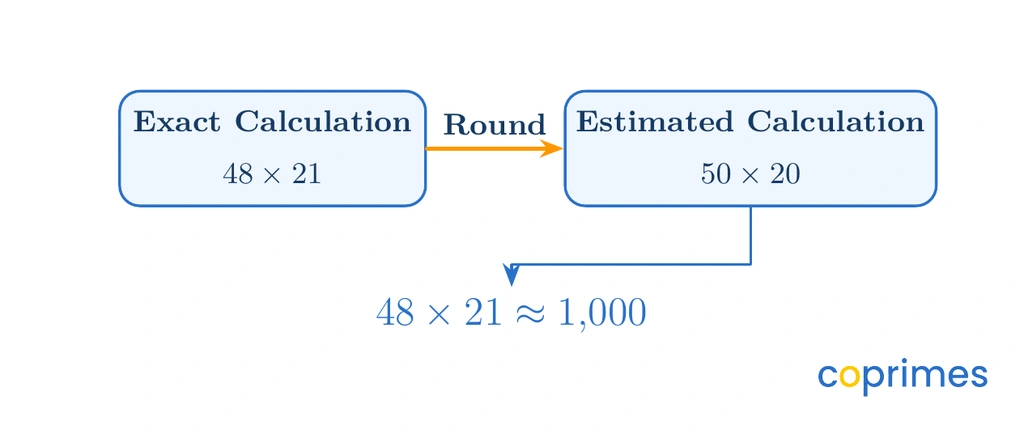
An estimated calculation is a mathematical simplification that provides a rough answer instead of a precise one. Understanding the difference between an exact answer and a rough guess is the foundation of estimation and approximation. You achieve this by rounding the original numbers to simpler values before applying the mathematical operations.
Estimation provides a fast, realistic result when exact figures are unnecessary or impossible to calculate.
Choose an appropriate level of rounding
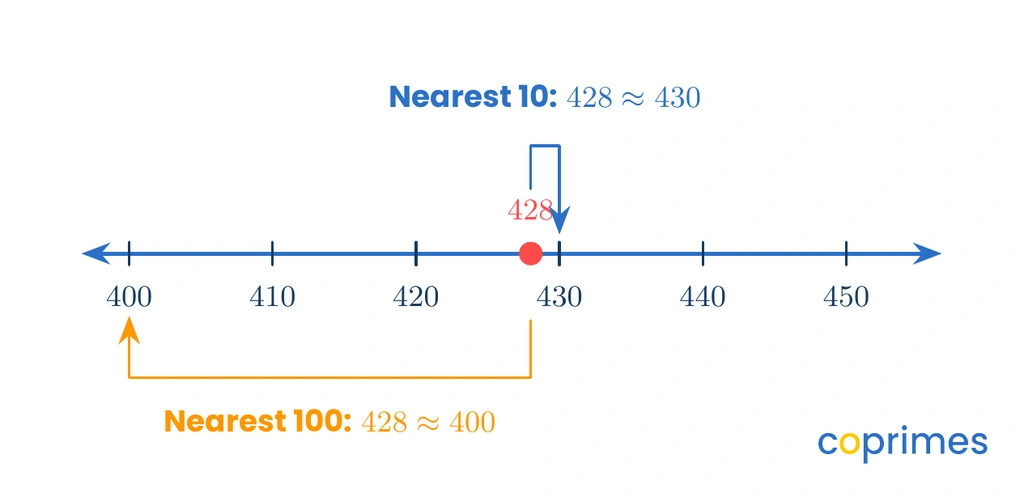
The accuracy of your estimate depends on the place value you choose. When you round to the nearest ten, the result is more accurate than rounding to the nearest hundred, but it might require more mental effort to calculate.
To estimate successfully, consider the context of the problem. If a calculation involves millions, rounding to the nearest hundred thousand is sensible. If you are calculating the cost of a few groceries, rounding to the nearest whole number is more appropriate.
For any chosen place value, follow standard rounding rules. If the digit to the right is or less, round down. If the digit is or more, round up. Learning these rounding whole numbers rules ensures consistent estimates.
Build the estimated expression
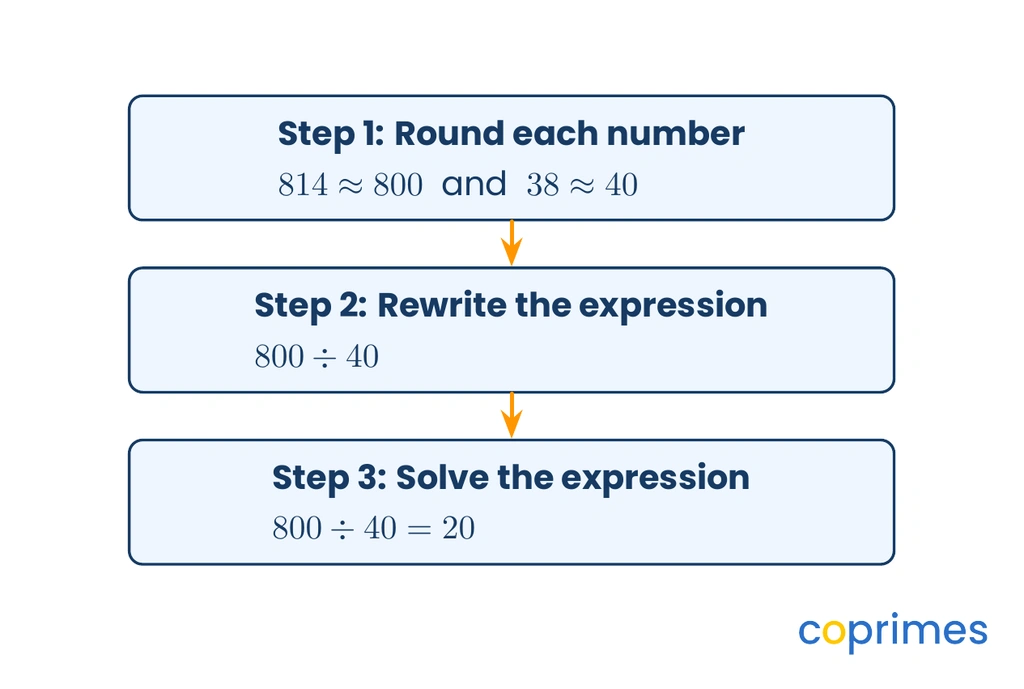
Constructing an estimate is a structured process. This straightforward sequence is an essential estimation strategies tool used for any operation.
- Round each number to an appropriate place value to create friendly numbers.
- Rewrite the expression using only the rounded values.
- Solve the simplified expression to calculate the estimate.
Always round the numbers before performing any addition, subtraction, multiplication, or division.
A learning plan shaped by your child, not the class
State-aligned Math plus our own Logic and English curriculum. An adaptive baseline test finds the gaps and fills them.
Keep the order of operations
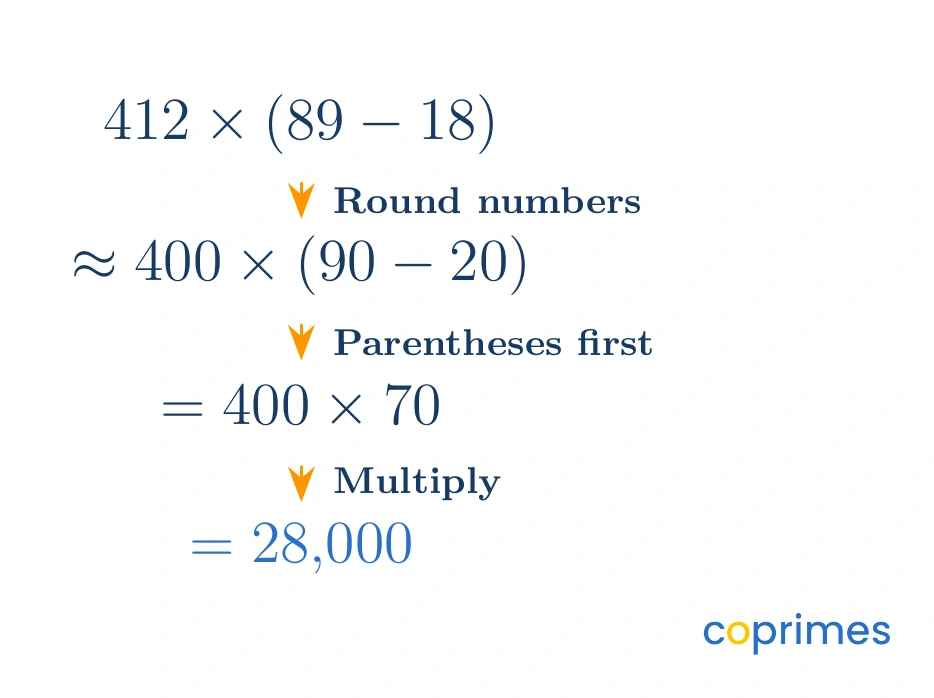
When an expression contains multiple operations, you must still apply the standard order of operations after rounding the numbers. Parentheses, exponents, multiplication and division, and finally addition and subtraction dictate the correct sequence.
Do not alter the structure of the mathematical phrase. Simply substitute the complex numbers with their rounded counterparts, then evaluate the expression step by step.
State an approximate answer
Because the final result is not mathematically exact, you must communicate that it is an estimate. This prevents confusion between exact figures and approximate values.
Instead of an equals sign (), use the approximately equal symbol () to link the original expression to your final estimate. Writing correctly signals that the result is a reasonable guess. This practice is crucial for checking reasonableness of answers.
The symbol with two wavy lines means is approximately equal to.
Worked examples
Example 1: Estimating addition and division
Question: Estimate the value of .
Method:
- Round each number to an appropriate place value. Round to , round to , and round to .
- Rewrite the expression using the rounded numbers: .
- Simplify the numerator first: .
- Divide the simplified numerator by the rounded denominator: .
Answer: The estimated value is .
Check: The exact calculation is , which is very close to our estimate of .
Example 2: Estimating multiplication for an area
Question: A rectangular field has a length of and a width of . Estimate the area of the field.
Method:
- Round the decimals to the nearest whole numbers or friendly tens. Here, and .
- Rewrite the area formula using the rounded values: .
- Multiply the rounded dimensions: .
Answer: The estimated area is .
Check: The exact area is , which is close to the estimated .
Example 3: Estimating a multi-operation expression
Question: Estimate the result of .
Method:
- Round each number to a convenient place value. Round to , round to , and round to .
- Rewrite the expression using the rounded numbers: .
- Follow the order of operations by multiplying first: .
- Subtract the product from the initial rounded value: .
Answer: The estimated result is .
Check: The exact evaluation is . The estimate of is reasonable.

Common mistakes
Rounding after calculating: A frequent error is performing the exact calculation first and then rounding the final answer. Estimation is designed to make the calculation itself easier; always round the initial numbers before performing operations.
Over-rounding: Rounding numbers too drastically can produce an estimate that is uselessly far from the true value. For instance, rounding to loses significant accuracy. In such cases, rounding to provides a much better estimate.
Ignoring the order of operations: Even when working with simple rounded numbers, multiplication and division must occur before addition and subtraction unless parentheses dictate otherwise.
Frequently asked questions
Why do we estimate calculations instead of finding the exact answer?
Estimation saves time when an exact answer is unnecessary. It provides a quick, reliable approximation that helps in planning, budgeting, or verifying that a precise calculation is logically correct.
How do I know which place value to round to?
Choose a place value that balances simplicity and accuracy. Rounding to larger place values makes the math faster but less precise, while rounding to smaller place values takes more effort but produces an estimate closer to the exact answer.
Does an estimate always use the nearest ten or hundred?
No. While tens and hundreds are common, you can estimate to any place value. The context of the problem determines whether you should round to the nearest whole number, thousand, or million.
Practice questions
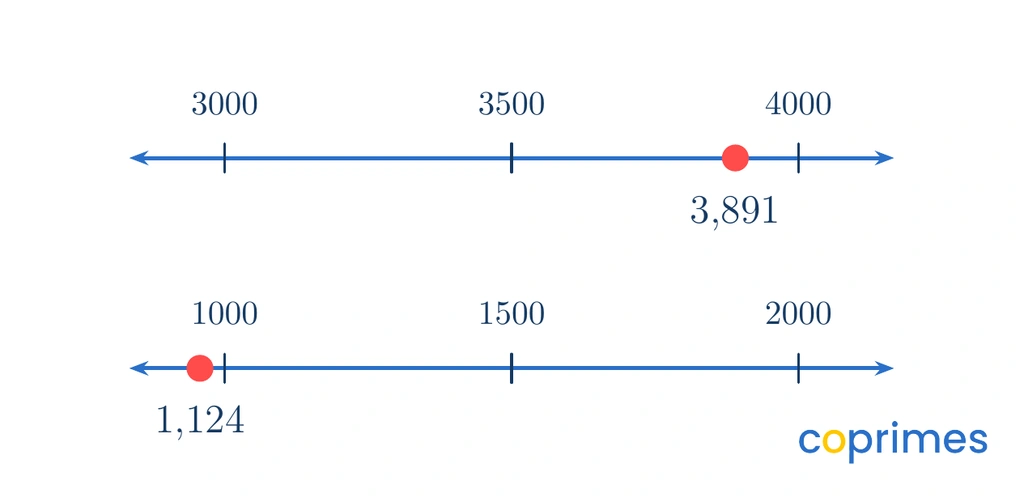
Based on the number lines, which expression provides the best rounded estimate for the sum of and ?
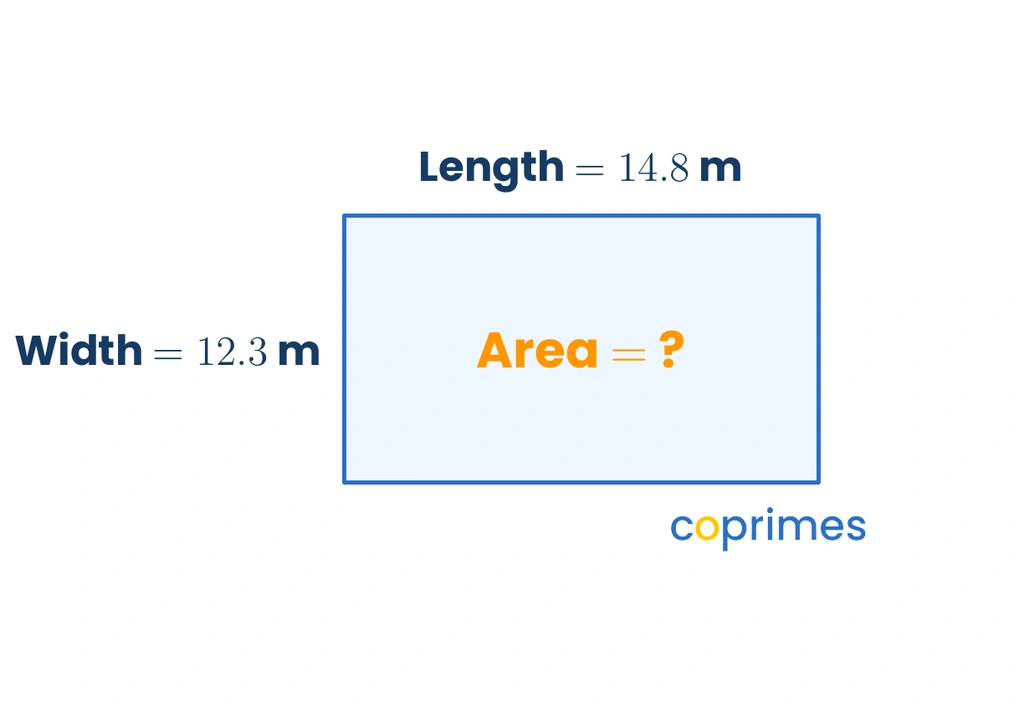
Estimate the area of the rectangle by rounding each dimension to the nearest whole number.
Which expression provides the most appropriate calculation to estimate the quotient of ?
A student estimated as . What mistake did the student make?
The student incorrectly rounded the exact difference instead of rounding each number first.
The student evaluated the multiplication before evaluating the subtraction.
The student rounded the multiplier to the wrong tens place.
The student should have added the numbers inside the parentheses.
The student incorrectly rounded the exact difference instead of rounding each number first.
A bakery produces cupcakes each day. They are packed into boxes that hold cupcakes each. Which estimate best represents the number of boxes needed per day?