
Estimation Strategies: Definition, Method and Examples
Estimation strategies use rounding, front-end thinking, compatible numbers, benchmarks or range checks to produce an answer accurate enough for the purpose. Instead of calculating exactly, these mathematical techniques simplify the numbers so the operation can often be done mentally.
There are multiple ways to estimate an answer depending on the context. Learning math estimation strategies is essential for quickly predicting outcomes, saving time, or verifying that a computed result makes sense without performing a full calculation.
What are estimation strategies?
Estimation strategies are mathematical shortcuts used to find an approximate answer. When performing estimating calculations, the goal is not to find the perfect value, but to find a number that is close enough to be useful.
These estimation methods allow you to quickly bypass complex arithmetic. There is no single correct way to estimate. The best method depends on the numbers involved and the required accuracy. A good estimate must always be faster to calculate than the exact answer.
Here is a summary of the main methods of estimation and when to use them:
Strategy | How it works | Best for |
Rounding | Change numbers to the nearest ten, hundred, or whole number. | General addition, subtraction, and multiplication. |
Front-End | Keep the largest place-value digit and change the rest to zero, then adjust. | Adding or subtracting large numbers. |
Compatible Numbers | Substitute numbers that easily divide or multiply together. | Division and complex multiplication. |
Benchmarks | Compare fractions, decimals, or percentages to known values like or . | Fractions, percentages, and decimals. |
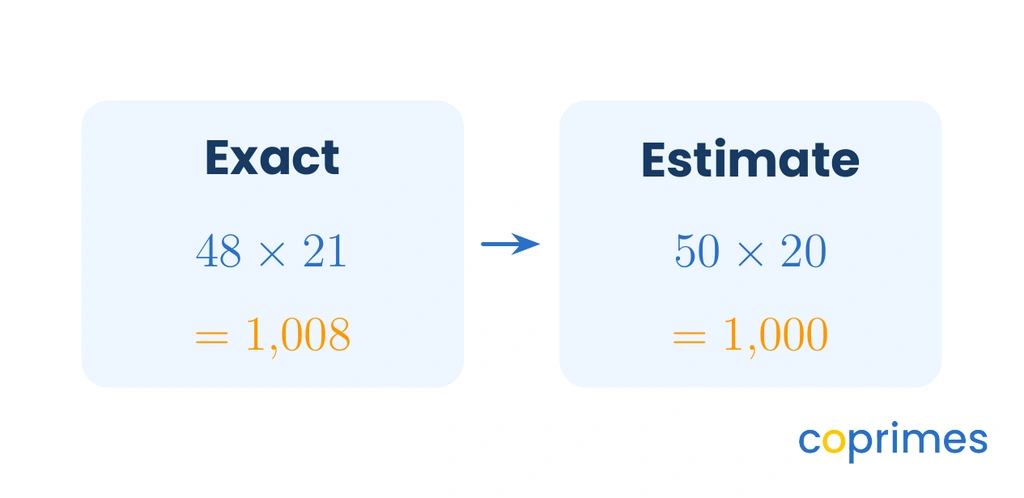
Choose how close the estimate needs to be
The chosen technique should match the required accuracy of the situation. Before applying any approximation strategies, decide if a rough guess is sufficient or if the result must be very close to the true value.
When estimating the total cost of groceries to ensure you have enough money, a rough estimate that intentionally rounds prices upward is the safest choice. If you are predicting the amount of paint needed for a room, you need a much closer estimate to avoid buying too much or running out.
You can often improve an estimate by making a mental adjustment. If you rounded both original numbers up, you immediately know your estimated result is slightly larger than the exact answer.
Rounding strategy
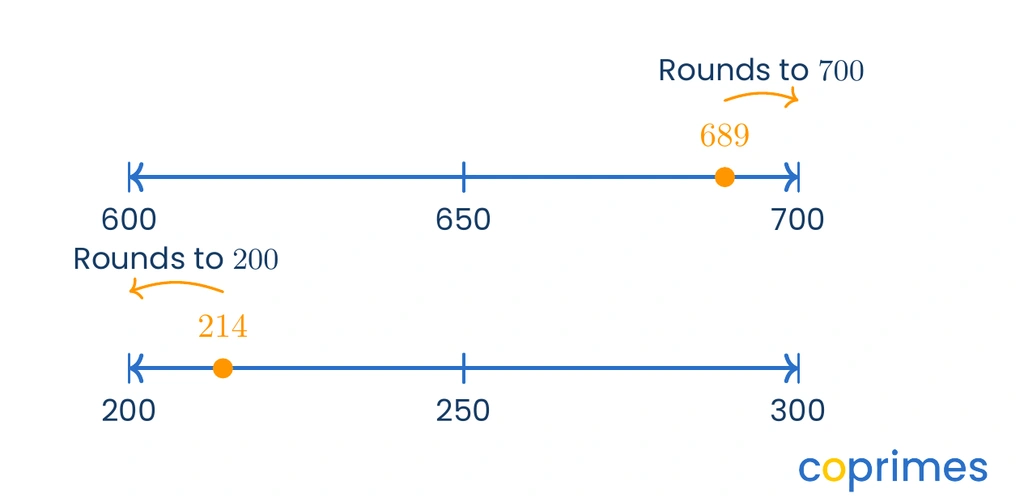
The rounding strategy involves changing numbers to the nearest ten, hundred, thousand, or decimal place to make them easier to compute mathematically.
When estimating sums and differences, rounding to the nearest hundred or ten is often the quickest path to a reliable answer. For example, to estimate , round up to and round down to . The estimated sum is .
Rounding also serves as a robust strategy for decimal numbers. To estimate , round each value to the nearest whole number to get .

Front-end estimation
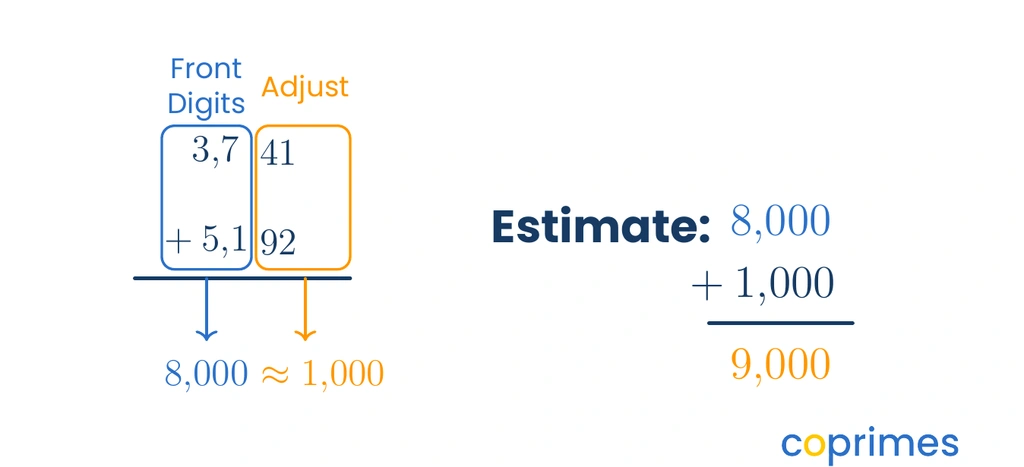
Front-end estimation focuses entirely on the first digit, which holds the largest place value, of each number. The remaining digits are temporarily treated as zeros. It is often faster than standard rounding, though it usually requires a secondary adjustment to remain accurate.
For example, to estimate :
- Add the front digits: .
- Look at the remaining digits to adjust: and are roughly another thousand.
- Combine the results: .
The leading digit has the biggest impact on the final answer, making front-end estimation very reliable.
Compatible-number strategy
When estimating division or complex multiplication, standard rounding might result in numbers that are still difficult to calculate. Instead, use compatible numbers, which are close values that fit perfectly into your mental multiplication tables.
For example, when estimating products and quotients like , rounding strictly to or does not help because neither easily divides by . However, is a compatible number because . Changing to makes the estimate .
You can also alter both numbers to make a calculation friendly. To estimate , replace with and with , utilizing the fact that . The estimate quickly becomes .
Range and benchmark checks
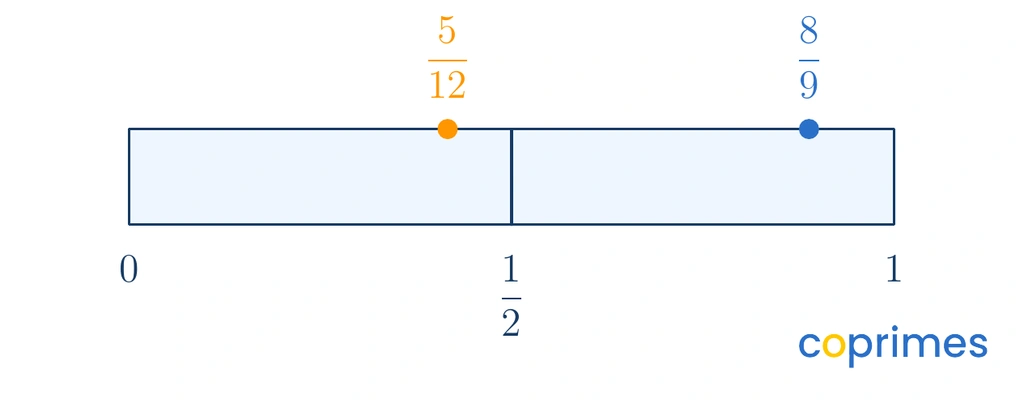
Quickly checking reasonableness of answers is simple when you establish a bounded range or compare the values to common benchmarks. A benchmark is a recognizable reference value, such as , , , or .
When estimating with fractions, decide if the fraction is closest to , , or . For example, to estimate :
- is very close to .
- is close to .
- The estimated sum is .
Percentages act similarly and serve as reliable approximation methods. To estimate of , note that is close to , which is exactly . Since is close to , a quick estimate is of , or .
A learning plan shaped by your child, not the class
State-aligned Math plus our own Logic and English curriculum. An adaptive baseline test finds the gaps and fills them.
Worked examples
By comparing different estimation techniques on the same calculation, you can decide which strategy is most useful for a specific context.
Example 1: Estimating addition using two methods
Question: Estimate using both the rounding strategy and front-end estimation.
Method:
- Using rounding: Round each number to the nearest hundred. rounds to . rounds to . Add the results: .
- Using front-end estimation: Add the leading digits. . Adjust for the remaining parts ( and are roughly ). Combine the parts: .
Answer: Rounding gives , while front-end estimation with adjustment gives .
Check: The exact answer is . The adjusted front-end estimate is closer, but the standard rounding method was faster. Both are mathematically sound estimates.
Example 2: Using compatible numbers for division
Question: A carpenter cuts a board that is centimeters long into equal pieces. Estimate the length of each piece.
Method:
- Identify the operation: .
- Find a compatible number close to that is easily divisible by .
- Recall multiplication facts for : , and .
- Since is closer to , replace with .
- Divide the compatible number: .
Answer: Each piece is approximately centimeters long.
Check: Because is slightly larger than the compatible number , the exact piece length will be slightly more than centimeters. The estimate is reasonable.
Example 3: Benchmark estimation with percentages
Question: A jacket costs dollars, and there is an tax. Estimate the total cost.
Method:
- Choose a benchmark for the percentage. is very close to .
- Choose a compatible number for the cost. dollars is close to dollars.
- Calculate the benchmark amount: of dollars is dollars.
- Add the estimated tax to the estimated cost: .
Answer: The total cost is roughly dollars.
Check: Since both the price and the percentage were slightly rounded upward, the exact total will be slightly less than dollars.
Frequently asked questions
Which estimation strategy is the best?
There is no single best method. Rounding is generally best for addition and subtraction. Compatible numbers are usually required for division because standard rounding creates messy numbers. Benchmarks are ideal for fractions and percentages.
Is an estimate the same as an exact answer?
No. An estimate is a deliberate approximation designed to be close enough for practical use while being much faster to calculate than finding the exact answer.
Why is my estimate different from someone else's?
Because you might have chosen different strategies. For example, rounding to the nearest hundred yields , but rounding to the nearest ten keeps it at . Both are valid estimation choices.
How do I know if I have underestimated or overestimated?
Compare the rounded numbers to the original values. If you round both numbers up before multiplying, the estimate will be larger than the exact answer, resulting in an overestimate. If you round them both down, the result will be an underestimate.
Practice questions
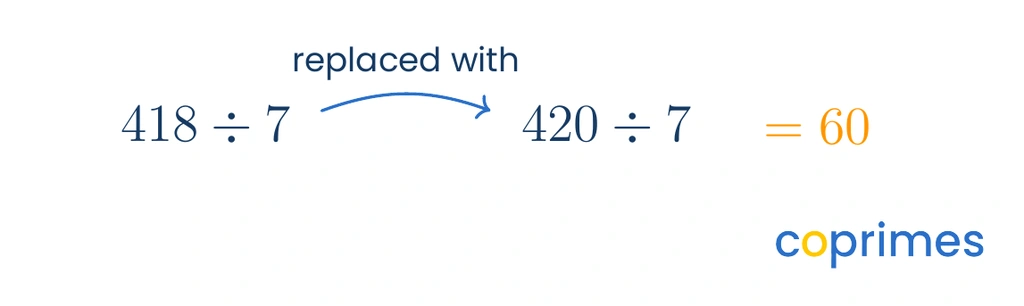
Which estimation strategy is being used in the diagram?
Front-end estimation
Compatible-number strategy
Fraction benchmarks
Rounding to the nearest hundred
Compatible-number strategy
Estimate by rounding each number to the nearest thousand.
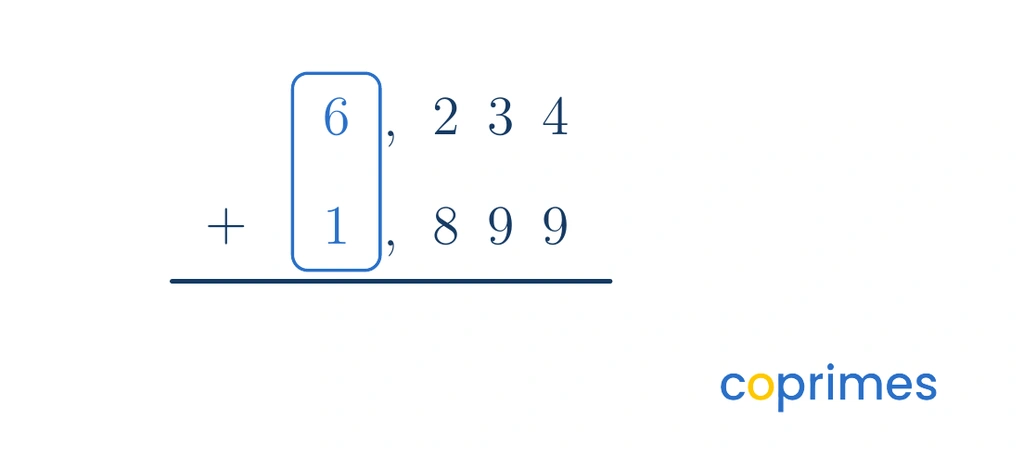
A student uses front-end estimation without adjustment to approximate . Based on the highlighted digits, what is the initial estimate?
A student estimates by calculating the exact product of and then rounding it to . Why is this an incorrect use of an estimation strategy?
Estimation requires simplifying the numbers before calculating, not after.
The student should have rounded to the nearest ten instead of hundred.
Multiplication calculations cannot be estimated using a rounding strategy.
The exact mathematical answer should never be rounded down.
Estimation requires simplifying the numbers before calculating, not after.
Which of the following is the best way to estimate of dollars using benchmarks and compatible numbers?
Find (or ) of dollars.
Find of dollars.
Find of dollars.
Find of dollars.
Find (or ) of dollars.