
Checking Word Problem Answers
Checking a word problem answer means verifying that the calculated result is mathematically accurate and makes sense in the real-world situation described. This process confirms that the correct numbers and operations were used and that the final answer directly addresses the original question. Solving math word problems requires more than finding a number; it requires proving the number represents a logical solution.
Why check a word problem answer?
Checking an answer prevents common errors such as using the wrong operation, misplacing a decimal point, or answering only part of a question. A complete verification process builds confidence and ensures mathematical reasoning aligns with the given scenario.
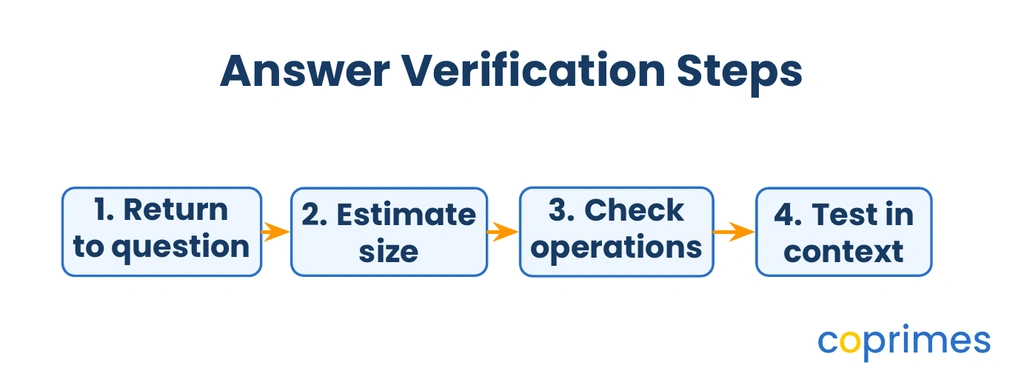
Return to the question
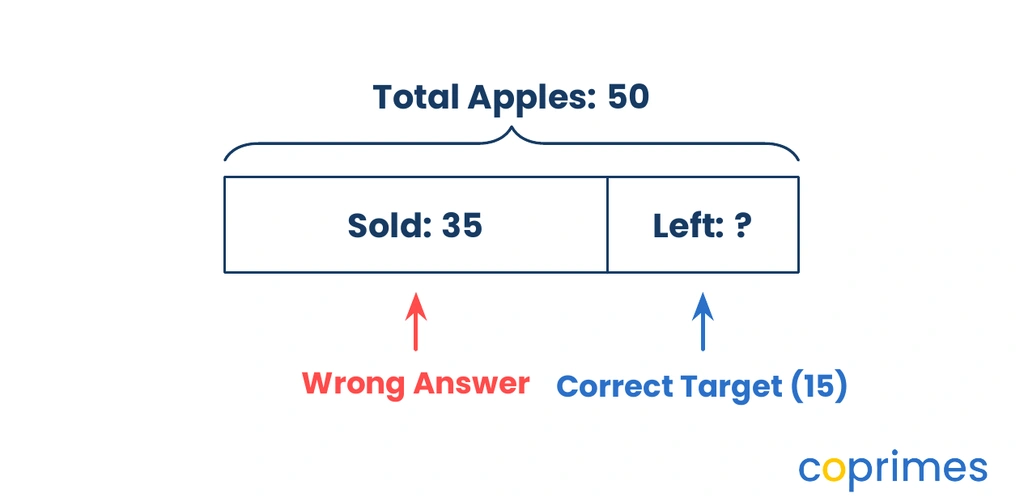
When a calculation is complete, re-read the original problem. A word problem may ask for a related quantity rather than the immediate result of the calculation. For example, if a problem asks how many apples are left after a sale, and the calculation finds the number of apples sold, the final step must subtract the sold amount from the total. Confirming the question ensures the final answer represents the requested information.
Estimate the size
Before accepting a calculated result, use estimating calculations to determine the approximate magnitude of the answer. Round the given values to simpler numbers and perform the operation mentally.
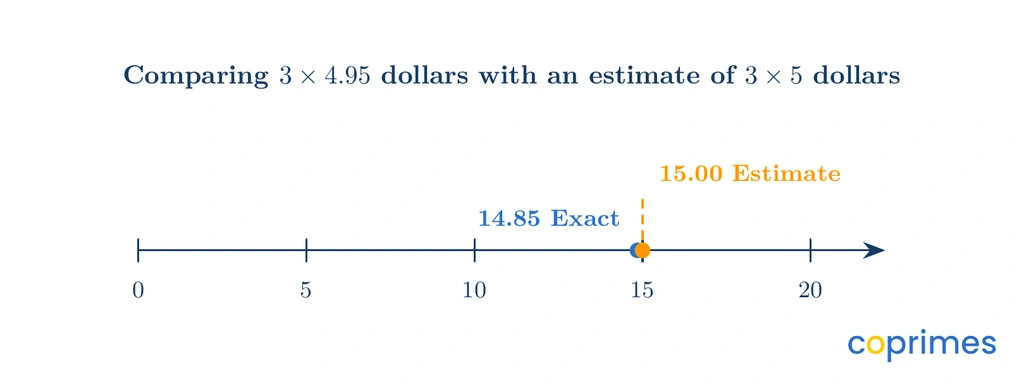
If a student buys notebooks for dollars each, an estimate rounds dollars to dollars. The estimated total is dollars. If the calculated answer is dollars, the estimate immediately reveals a misplaced decimal point. Comparing the exact answer to the estimate is a core strategy for checking reasonableness of answers.
A learning plan shaped by your child, not the class
State-aligned Math plus our own Logic and English curriculum. An adaptive baseline test finds the gaps and fills them.
Check operations and units
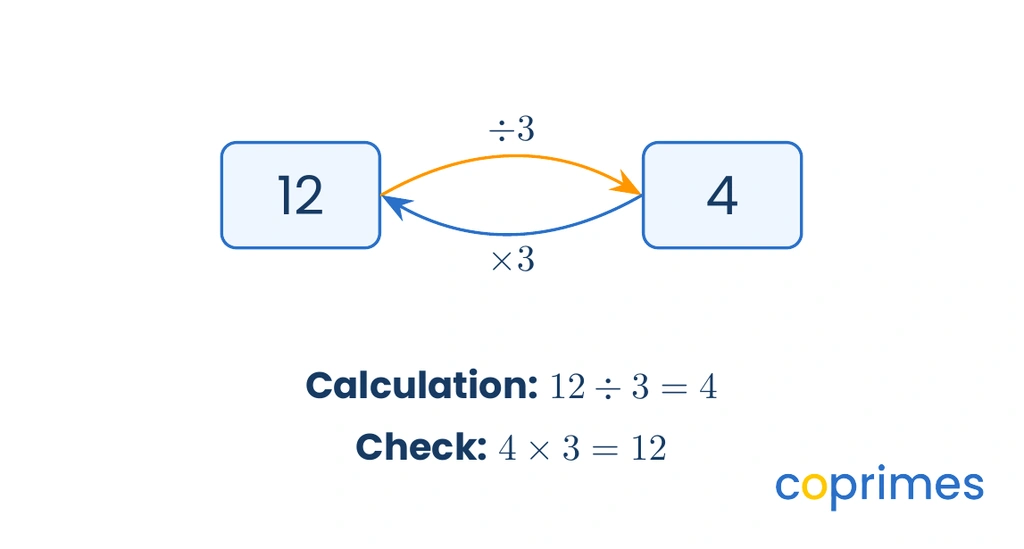
After calculating, verify that the arithmetic is correct. One reliable method is to work backward using the inverse relationship between addition and subtraction, or between multiplication and division. If a problem states that items divided equally among boxes results in items per box, checking confirms the operation.
Units must also align throughout the problem. If a question gives measurements in centimeters and asks for an answer in meters, the final answer must include the correct unit conversion. Labeling units at each step prevents mixing incompatible quantities.
Test the answer in context
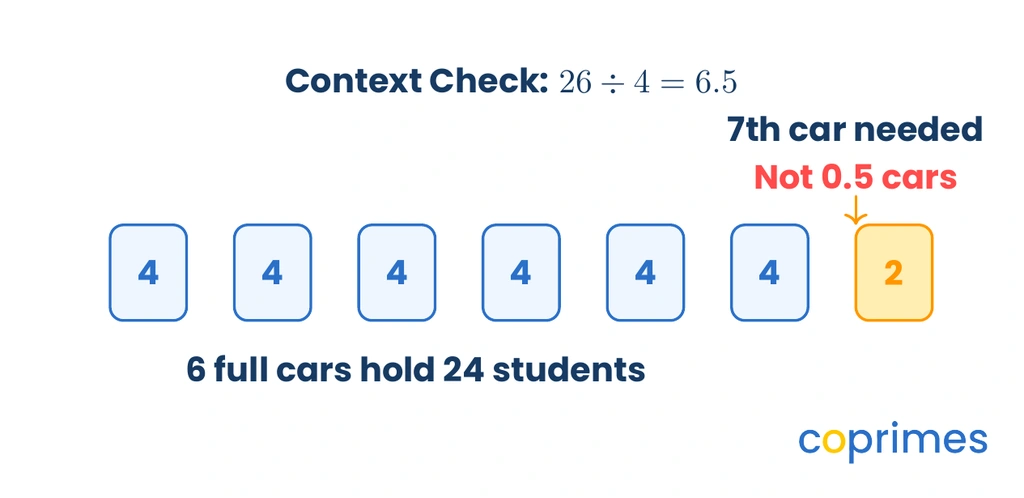
A mathematically correct calculation can still be the wrong answer if it defies the real-world context of the problem. This is especially true for division problems that result in remainders or fractional answers.
For example, if students are going on a trip and each car holds students, . In pure arithmetic, is correct. However, half of a car cannot be rented. The context dictates that cars are needed to transport everyone. Always ask whether the answer is physically possible in the situation described.
Worked examples
Applying a structured checking method ensures multi-step calculations remain accurate and logical.
Example 1: Checking with an inverse operation
Question: A baker makes muffins in the morning and sells of them. How many muffins are left?
Method:
- Identify the operation: The word "left" implies subtraction.
- Calculate the difference: .
- Check the operation: Use the inverse operation to add the difference and the subtracted amount.
Answer: muffins.
Check: . The calculated answer matches the original total, proving the subtraction is correct.
Example 2: Checking using estimation
Question: A garden is rectangular with a length of meters and a width of meters. What is the total area of the garden?
Method:
- Identify the operation: Area of a rectangle requires multiplication.
- Calculate the area: .
- Check by estimating: Round to and to .
Answer: The area is square meters.
Check: The estimated area is square meters. Because is very close to , the exact calculation is reasonable and the decimal point is in the correct position.
Example 3: Checking the context in a multi-step problem
Question: A teacher has dollars to spend on art supplies. Brushes cost dollars each and paints cost dollars per set. If the teacher buys sets of paints, what is the maximum number of brushes they can buy with the remaining money?
Method:
- Calculate the cost of the paints: dollars.
- Find the remaining money: dollars.
- Find how many brushes can be bought:
- Check the context: A fraction of a brush cannot be purchased. The context requires rounding down to the nearest whole number.
Answer: The teacher can buy brushes.
Check: The cost of brushes is dollars. The total spent is dollars. Because , and buying one more brush would cost dollars, the answer makes sense. Multi-step word problems often require verifying both the arithmetic and the physical context.

Common mistakes
When learning how to verify answers, students frequently encounter these errors:
- Answering the wrong question: A problem may give a total and a part, and ask for the difference between the two parts. Finding only the second part leaves the problem incomplete.
- Skipping the unit check: Calculating an answer of but failing to notice the question asked for the weight in kilograms when the data was in grams.
- Ignoring the magnitude: Accepting an answer of when adding and because of a misplaced digit, instead of recognizing that the answer must be near .
Frequently asked questions
Review these common questions to better understand how to verify answers and ensure accuracy when solving word problems.
How do I know if my word problem answer makes sense?
Compare the final answer to an estimate. If the estimate is close to the calculated answer, the arithmetic is likely correct. Then, read the original question again to ensure the final number describes the requested quantity and includes the correct units.
Why is working backward useful for checking?
Working backward uses the inverse operation to reverse the calculation. If starting with the final answer and applying the opposite operations produces the original given numbers, the math is proven correct.
Can a mathematically correct answer be wrong?
Yes. If the calculation does not reflect the physical reality of the problem, the raw number is incorrect in context. For example, dividing by gives or . If a problem asks how many complete -meter lengths can be cut from a -meter rope, the physical context limits the answer to whole pieces.
Practice questions
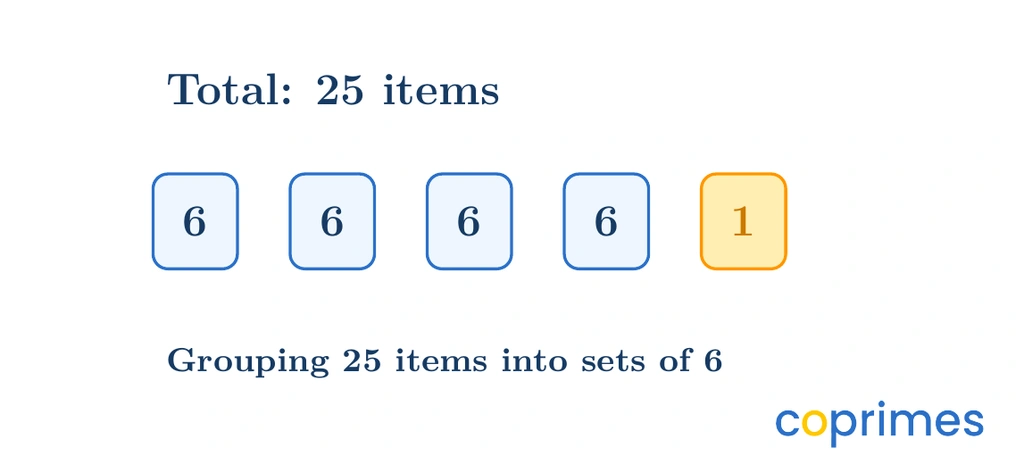
A problem asks how many full sets of items can be made from a total of items. The visual shows the distribution. Based on checking the context of the word problem, what is the correct answer?
full sets
full sets
full sets
full sets
full sets
A student calculates that . Which equation shows the correct way to check this answer using an inverse operation?
A student buys shirts that cost dollars each. They calculate the total cost as dollars. Which statement best explains how to check this answer using estimation?
Estimating dollars gives dollars, so dollars is too large.
Estimating dollars gives dollars, so dollars is correct.
The exact answer should be larger than dollars.
Working backward by adding four times equals .
Estimating dollars gives dollars, so dollars is too large.
A rope is meters long. It is cut into pieces that are exactly meters long. A student calculates and concludes that pieces of length meters can be made. Why is this conclusion incorrect in context?
The length of the rope should have been multiplied by .
The rope can only be cut into whole -meter pieces, resulting in pieces.
The remaining piece is larger than meters.
The exact answer should be exactly pieces to use all the rope.
The rope can only be cut into whole -meter pieces, resulting in pieces.
A word problem asks: "A farm has chickens and cows. How many more chickens than cows are there?" A student answers " animals." What step of checking the answer did the student miss?
They did not estimate the final sum.
They forgot to state the units of measurement.
They did not use the inverse operation correctly.
They did not return to the question to see what was asked.
They did not return to the question to see what was asked.