
Multiplication Word Problems: Method and Examples
A multiplication word problem describes equal groups, scaling, arrays, or combinations where multiplication finds the total or an unknown factor. These real-world scenarios require reading carefully, identifying the mathematical relationship, and translating the text into an equation to calculate a product.
Multiplication solves problems involving repeated addition or rates.
Understanding how to interpret these story problems builds a strong foundation for managing measurements, money, and larger quantities efficiently.
What is a multiplication word problem?
A multiplication word problem is a mathematical scenario presented in text that requires multiplication to solve. Instead of simply providing an equation like , the problem describes a situation with a specific context.
The learner must extract the relevant numbers and recognize that the scenario involves combining several groups of the same size. Finding the solution means determining the total quantity without counting each item individually.
Multiplication problem structures
Multiplication word problems generally fall into three distinct mathematical structures. Recognizing these structures helps correctly identify when to multiply.
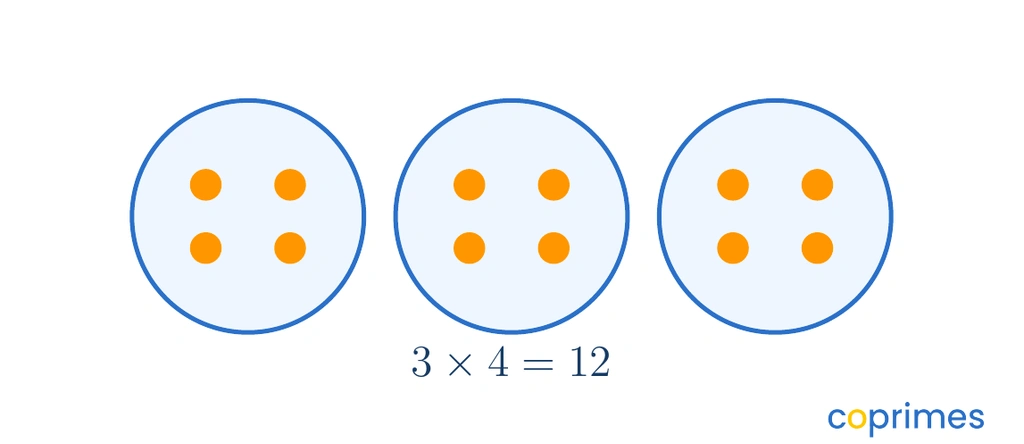
Equal Groups
This structure involves a specific number of groups, with each group containing the same number of items. Finding the total requires multiplying the number of groups by the size of each group.
Arrays and Area
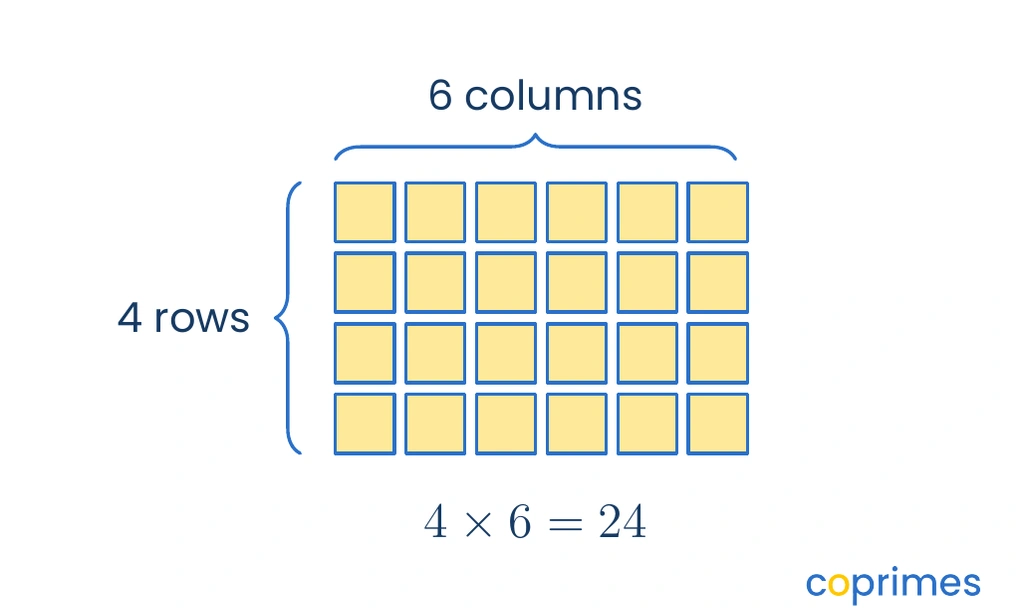
Array problems arrange items in equal rows and columns. They are common in seating arrangements, tiling, or organizing objects. This structure naturally links to using an area model for multiplication.
Scaling or Multiplicative Comparison
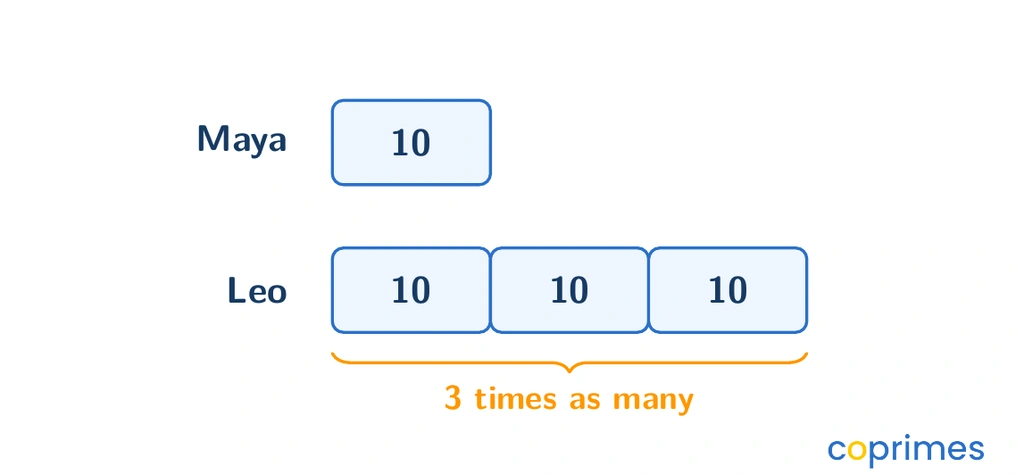
Scaling problems compare two quantities, describing one quantity as a certain number of times larger than another. Phrases like "three times as many" indicate this relationship.
How to identify multiplication
Recognizing when to multiply requires paying attention to both the context and specific keywords. While context is the most important factor, certain words frequently signal multiplication.
Look for situations that describe a rate or repeated equal quantities. Typical keywords include:
Keyword Phrase | Example Context |
Each | There are boxes. Each box holds toys. |
Per | The train travels kilometers per hour. |
Times as many | The blue building is times as tall as the red building. |
Product | Find the product of and . |
Twice / Triple | She collected twice as many coins today. |
Always verify the action. If the word "each" is used alongside a total that is already known and needs to be split, the operation might be division instead.
A learning plan shaped by your child, not the class
State-aligned Math plus our own Logic and English curriculum. An adaptive baseline test finds the gaps and fills them.
Draw a model and write an equation
Translating the text into a visual model makes the underlying mathematics clearer. A tape diagram (or bar model) is an excellent tool for visualizing multiplication word problems.
To draw a tape diagram, represent the equal groups as adjacent rectangular blocks. Write the size of each group inside the blocks, and use a bracket to show that the total is the unknown value being calculated.
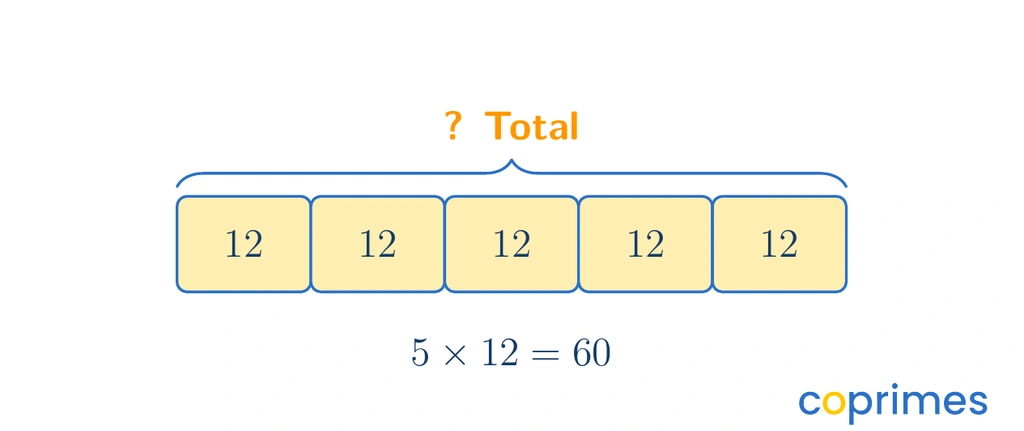
This visual easily translates into the equation , confirming that multiplication is the correct operation to find the total.
Step-by-step solving method
Approaching multiplication word problems systematically prevents errors and ensures the correct numbers are used.
- Read the problem carefully: Identify what the problem is asking you to find. Look for the unknown quantity.
- Identify the structure: Determine if the problem describes equal groups, an array, or scaling.
- Draw a model: Sketch a tape diagram or simple visual to represent the relationship between the numbers.
- Write the equation and solve: Translate the model into a multiplication equation and calculate the product.
- Check the answer: Verify that the answer makes sense in the context of the story and includes the correct units.
Worked examples
Reviewing completed examples helps reinforce the solving steps across different contexts.
Example 1: Equal groups problem
Question: A gardener plants rows of flowers. Each row contains flowers. How many flowers did the gardener plant in total?
Method:
- Identify the structure: This is an array structure with equal rows.
- Write the equation: Multiply the number of rows by the number of flowers in each row: .
- Solve: Calculate the product.
Answer: The gardener planted flowers.
Check: We can use repeated addition to check: .
Example 2: Multiplicative comparison problem
Question: A small bookshelf holds books. A large bookshelf holds times as many books as the small one. How many books are on the large bookshelf?
Method:
- Identify the structure: The phrase "times as many" indicates a scaling problem.
- Write the equation: Multiply the amount on the small bookshelf by the scale factor: .
- Solve: Calculate the product.
Answer: The large bookshelf holds books.
Check: Split into and . Then, .
Example 3: Multi-digit calculation
Question: A factory packages boxes of pencils every hour. How many boxes of pencils does the factory package in an -hour shift?
Method:
- Identify the context: The factory processes an equal group of boxes per hour for multiple hours.
- Write the equation: The equation is .
- Solve: This requires long multiplication. Multiply the units, tens, and hundreds by , carrying values over when necessary.
Answer: The factory packages boxes of pencils.
Check: Estimate the answer by rounding to . Since , the answer is reasonable.

Common mistakes
When solving multiplication word problems, errors often stem from reading the text too quickly rather than calculation mistakes.
- Adding instead of multiplying: Seeing two numbers and immediately adding them together without considering the context. If a problem says " bags with apples each", adding is incorrect.
- Misinterpreting "times more": Confusing additive comparison (finding the difference) with multiplicative comparison. "Three times more" means multiplying by , not adding .
- Ignoring units: Providing a numerical answer without specifying what it represents. In real-world problems, could mean dollars, meters, or apples.
Always draw a quick sketch or model to confirm the operation before calculating.
Frequently asked questions
Does the phrase "in all" always mean I should add?
No. While "in all" asks for a total, it can mean multiplication if the problem describes equal groups. For instance, "If there are cars with people in each, how many people are there in all?" requires multiplication ().
How do I know whether to multiply or divide?
Multiplication is used when you know the number of groups and the size of each group, and you need to find the total. Division is used when you already know the total and need to separate it into equal groups or find the size of the groups.
What happens if a problem has more than two numbers?
Some real-world scenarios require multiple steps. You might need to multiply to find one total, then add or subtract another number. These are known as two-step multiplication and division word problems and require careful reading to solve in the correct order.
Practice questions
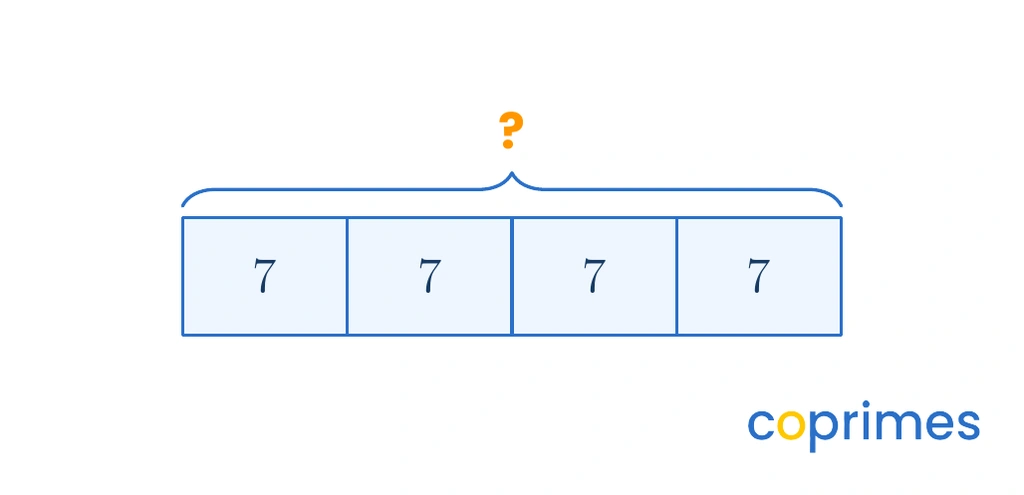
Which equation matches the visual model shown?
A baker prepares trays of muffins. Each tray holds exactly muffins. How many muffins did the baker prepare in total?
A zoo has tigers. The zoo has times as many monkeys as tigers. How many monkeys are at the zoo?
A concert ticket costs dollars. A family wants to buy tickets. Which operation should they use to find the total cost?
Add to .
Subtract from .
Multiply by .
Divide by .
Multiply by .
A truck delivers boxes of fresh fruit to a supermarket. Each box contains apples. How many apples are delivered in total?