
Two-Step Multiplication and Division Word Problems
A two-step multiplication and division word problem requires two connected calculations to find the final answer. You must use the result from your first operation as the starting information for your second operation.
What is a two-step multiplication and division word problem?
A two-step word problem is a mathematical puzzle presented in a real-world context that takes exactly two distinct mathematical operations to solve. In a two-step multiplication and division word problem, you will use a combination of multiplying and dividing.
The intermediate answer from the first step is required to complete the second step.
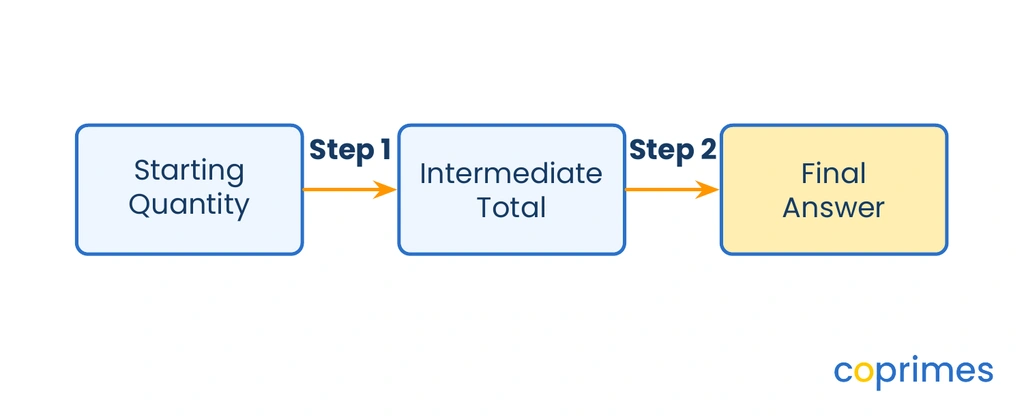
These problems might require you to multiply and then divide, divide and then multiply, multiply twice, or divide twice. Understanding the story is the key to choosing the right operations.
Find both operations
Word problems use specific language to indicate which operations are needed. You must look for clue words to determine the mathematical actions hidden in the story.
If a problem asks for a combined total based on equal groups, you have multiplication word problems. Look for phrases such as "times as many", "each", "total", or "in all".
If a problem requires sharing a total into equal groups or finding the number of equal groups, you have division word problems. Look for phrases such as "split equally", "divided by", "shared between", or "per group".
Choose a calculation order
Unlike a standard arithmetic equation where you follow strict order-of-operations rules, a word problem tells a narrative. The logical sequence of events in the story dictates your calculation order.
Identify what information is completely known at the beginning of the problem. If you know the size and number of initial groups, you must multiply first to find the total. If you start with a large known total that must be distributed before being expanded, you must divide first.
A learning plan shaped by your child, not the class
State-aligned Math plus our own Logic and English curriculum. An adaptive baseline test finds the gaps and fills them.
Use models and equation chains
Drawing a diagram helps organize the two operations visually. A bar model represents the quantities as rectangular blocks, making it easy to see whether you need to scale up through multiplication or partition down through division.
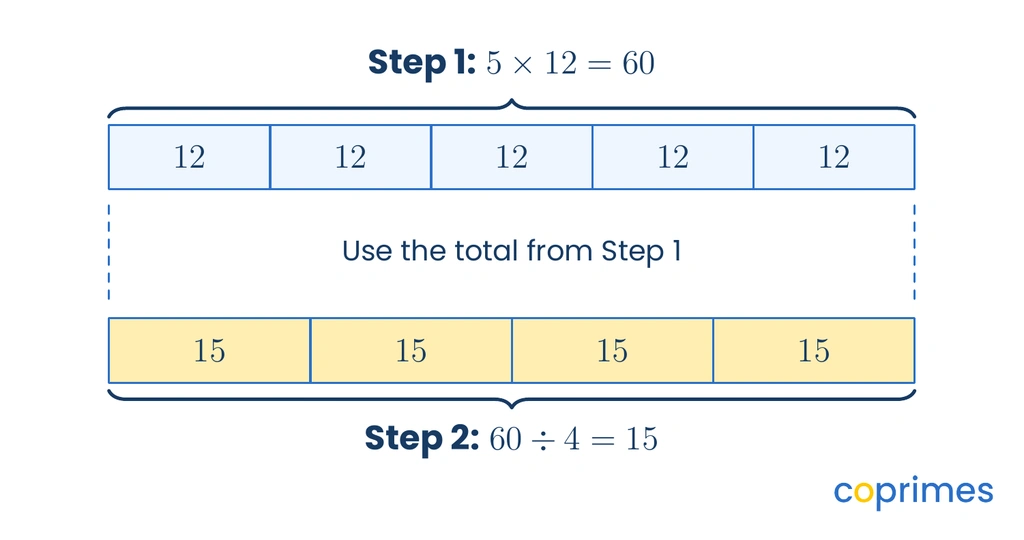
An equation chain records the logical steps algebraically. If a story states that you buy packs of pens and split all the pens equally among people, the chain linking the operations is , followed by .
Step-by-step solving method
Follow a consistent method to ensure you complete both steps accurately and do not stop after finding the first number.
- Read the problem carefully to understand the story.
- Identify the given numbers and the final goal.
- Determine the first operation and calculate the intermediate result.
- Use the intermediate result in the second operation to find the final answer.
- State the final answer with its correct units.
Interpret units and remainders
The unit of measurement will often change between the first and second steps. You might multiply packages to find a total number of items, and then divide those individual items into a completely different number of containers.
When the second step is division, you may encounter a remainder. Depending on the context of the story, you might need to drop the remainder, round up to the next whole number, or report it directly as a leftover quantity.

Worked examples
Example 1: Repacking items
Question: A store receives boxes of apples. Each box contains apples. The apples are then repacked into bags, with exactly apples in each bag. How many bags are needed?
Method:
- Find the total number of apples by multiplying the number of boxes by the apples per box.
apples
- Divide the total number of apples by the number of apples in each bag.
bags
Answer: The store needs bags.
Check: Multiply the bags by the apples per bag to verify you have the apples from the first step ().
Example 2: Sharing and scaling
Question: A baker makes cookies and splits them equally into display cases. A customer then buys all the cookies in of the display cases. How many cookies does the customer buy?
Method:
- Find the number of cookies in each display case by dividing the total by the number of cases.
cookies per case
- Multiply the amount in one case by the number of cases bought.
cookies
Answer: The customer buys cookies.
Check: Divide the purchased cookies by to verify there are cookies per case
().
Example 3: Interpreting a remainder
Question: A farmer harvests rows of carrots, with carrots in each row. The carrots are then bundled into bunches of . How many complete bunches can the farmer make, and how many carrots are left over?
Method:
- Find the total number of harvested carrots by multiplying.
carrots
- Divide the total by the bundle size to find the bunches and the remainder.
remainder
Answer: The farmer can make complete bunches with carrots left over.
Check: Multiply the bunches by and add the remainder of to confirm the starting total
().
Checking both steps
Mistakes often happen when transitioning from the first step to the second, or by choosing the wrong operation entirely. To verify your work, read the question again to ensure your calculation order matches the story. Then, work backward from your final answer using inverse operations.
You can apply multiplication and division fact families to confirm small calculations. For larger numbers, reverse the division algorithm and checking process by multiplying the quotient by the divisor and adding any remainder. If working backward returns the numbers you started with, your steps are correct.
Frequently asked questions
Why do I get the wrong answer even if my math is correct?
If your arithmetic is correct but your answer is wrong, you likely chose the wrong calculation order. Ensure you calculate the intermediate total first before sharing or scaling it further.
Can a two-step problem have the same operation twice?
Yes. A problem might require you to multiply to find a total and then multiply again to find a cost, or divide a group and then divide it again.
Practice questions
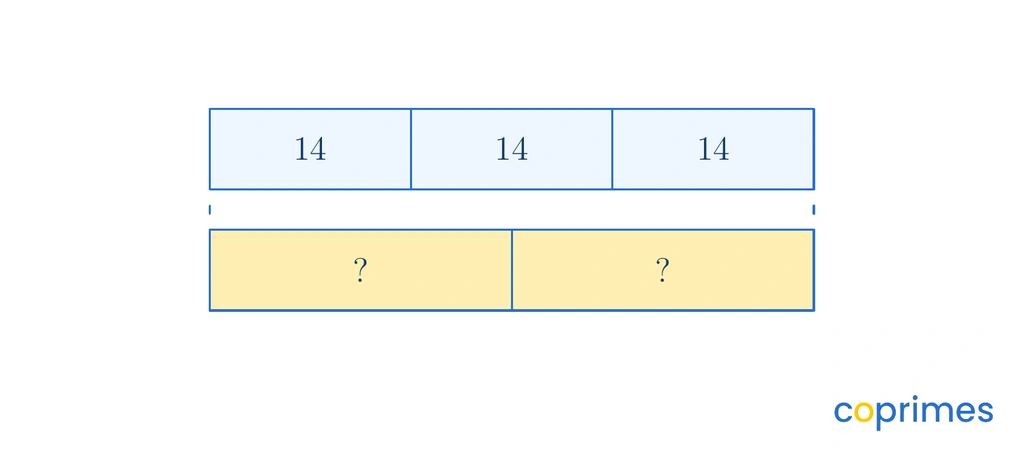
Based on the visual model, what is the final value of the unknown block?
A factory produces chairs per day and operates for days. The total chairs are then loaded equally onto trucks. How many chairs are on each truck?
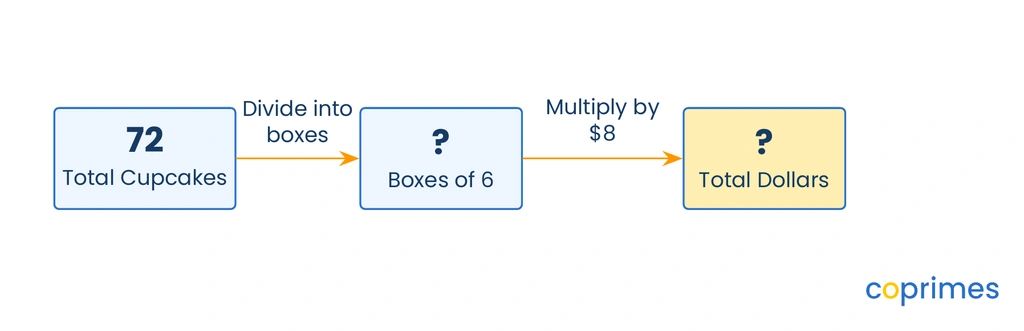
A baker follows the steps shown in the diagram. How much money is made from selling all the boxes?
dollars
dollars
dollars
dollars
dollars
Emma picks baskets of apples. Each basket has apples. She wants to give exactly apples to each of her friends. How many friends can she give apples to, and how many apples will she have left?
friends with apples left over
friends with apples left over
friends with apples left over
friends with apples left over
friends with apples left over
A library receives shipments of books. Each shipment contains books. The librarian places an equal number of these books onto empty shelves. Which equation chain shows how to find the number of books on each shelf?
, then
, then
, then
, then
, then