
Standard Long Multiplication Method
Long multiplication is a written method for multiplying multi-digit numbers by finding place-value-aligned partial products and adding them.
This standard algorithm breaks complex multiplication down into smaller, manageable steps. By organizing numbers into neat columns, you can accurately multiply large numbers without losing track of their values.
What is long multiplication?
Long multiplication is a formal procedure used to multiply two numbers when at least one of them has two or more digits.
It is also known globally as column multiplication, the standard multiplication algorithm, or written multiplication. In this method, the numbers being multiplied are called factors, and the final answer is called the product.
The algorithm calculates the total by multiplying the top number by each digit of the bottom number separately.
These separate calculations produce partial products. The partial products are then added together to find the total product.
Set up the columns
The first critical step in column multiplication is aligning the digits correctly according to their place value.
Write the number with the most digits on top. Write the second number underneath it, ensuring the ones digits are in the same vertical column, the tens digits are aligned, and so on. Draw a horizontal line beneath the bottom number to separate the factors from the calculation space.
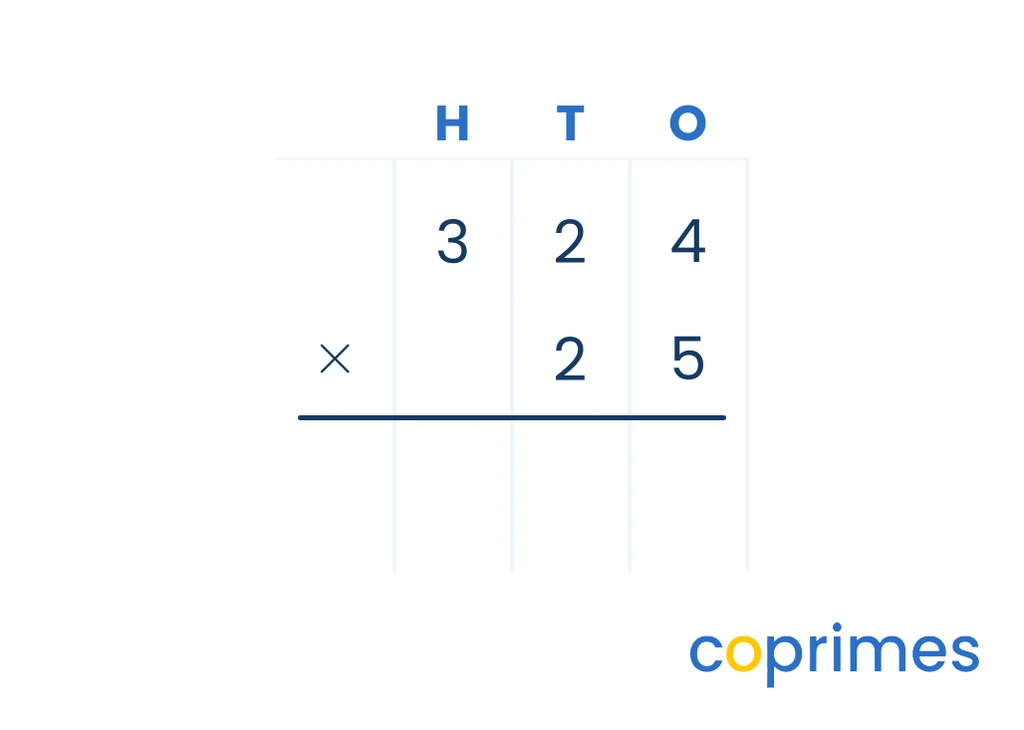
Aligning the numbers strictly by place value prevents errors during the addition phase.
Partial products and place value
A multi-digit calculation is solved by finding the product of each place value separately and combining them.
When calculating partial products, you must use multiplication with regrouping if the product of two single digits is or greater. The extra value is carried to the next column on the left and added after the next multiplication step.
For example, if you multiply , you first calculate . You write the in the ones column and regroup the ten into the tens column. Then you calculate , add the regrouped , and write .
A learning plan shaped by your child, not the class
State-aligned Math plus our own Logic and English curriculum. An adaptive baseline test finds the gaps and fills them.
Step-by-step long multiplication
Follow these structured steps to multiply any two numbers accurately.
- Write the numbers in columns, aligned by their final digit on the right.
- Multiply the top number by the ones digit of the bottom number. Write this first partial product beneath the line.
- Multiply the top number by the tens digit of the bottom number. Because this digit represents tens, write a zero placeholder in the ones column of the new row before multiplying.
- Continue this pattern for any hundreds or thousands digits in the bottom number, adding another zero placeholder for each shift left.
- Draw a line under all the partial products and add them together to find the final total.
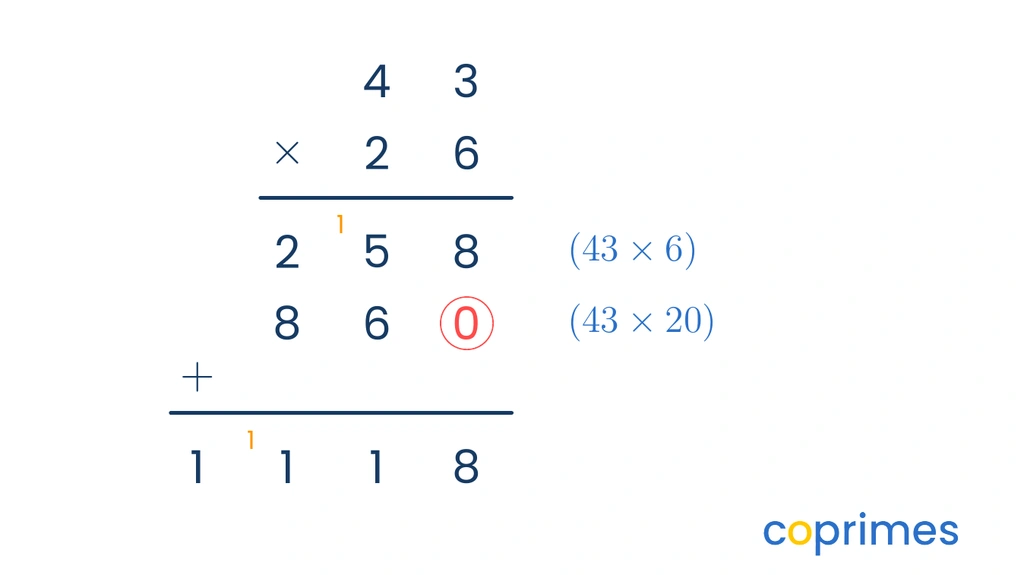
Always keep track of regrouped numbers by writing them slightly smaller above or below the answer line. Cross them out after adding them so they are not accidentally added again in the final step.
Why the placeholder has value
The most common step to forget is the zero placeholder in the second row of multiplication.
When you move to the tens digit of the bottom number, you are no longer multiplying by single units. In the calculation , multiplying by the actually means multiplying by .
The zero placeholder ensures the partial product shifts one column to the left, giving the digits their correct tens value.
If you multiply by hundreds, you must use two zero placeholders (). This preserves the actual magnitude of the partial product.
Long multiplication versus area model
You can solve multi-digit calculations using either the standard algorithm or an area model for multiplication. Both methods use the same partial products but present them differently.
The area model separates every digit into its expanded form and places them around a grid. Long multiplication calculates these sections vertically and combines some of the addition steps.
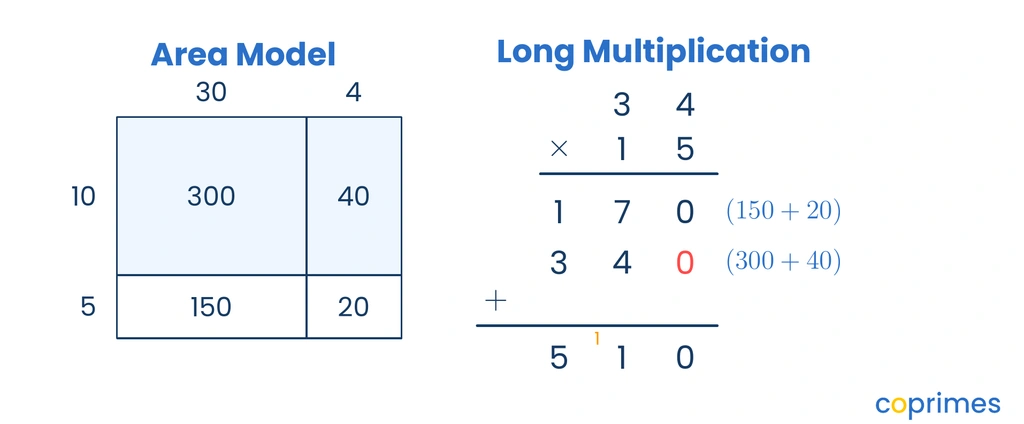
The standard algorithm is faster to write down and uses less page space, making it better for multiplying larger numbers. The area model is a strong visual way to understand why the partial products are calculated.

Worked examples
Review these examples to see the standard method applied to different calculation types.
Example 1: Multiplying a two-digit number by a two-digit number
Question: Calculate .
Method:
- Set up the columns: on top, below.
- Multiply by the ones digit (): . Calculate and . The first partial product is .
- Multiply by the tens digit (): Place a in the ones column. Calculate and . The second partial product is .
- Add the partial products: .
Answer: .
Check: Use checking multiplication and division by estimating: . The exact answer is close to the estimate.
Example 2: Multiplying a three-digit number by a two-digit number
Question: Calculate .
Method:
- Set up the columns, aligning the ones digits.
- Multiply by : (write , regroup ). , plus is . . The first partial product is .
- Multiply by : Place a placeholder. (write , regroup ). , plus is . . The second partial product is .
- Add the partial products: .
Answer: .
Check: Estimate . The result is reasonable.
Example 3: Real-world calculation
Question: A school buys textbooks that cost dollars each. What is the total cost?
Method:
- Set up the calculation to solve this multiplication word problem.
- Multiply by : .
- Multiply by : Place a placeholder. , so the partial product is .
- Add the partial products: .
Answer: The total cost is dollars.
Check: Estimate . The exact answer is slightly higher because is greater than .
Common mistakes
Recognizing common errors helps you avoid them in your own calculations.
The most frequent mistake is omitting the zero placeholder in the tens multiplication row. If you multiply and forget the zero when multiplying by the , your partial product will be instead of . The final total will be severely undersized.
Another common error is incorrectly tracking regrouped numbers. If you write a carried digit too large, you might accidentally include it again when adding the final partial products. Always keep carried digits small and cross them out once they are applied.
Finally, messy column alignment causes addition errors. Use grid paper or carefully space your digits vertically so you always add hundreds to hundreds and tens to tens.
Frequently asked questions
Why is it called long multiplication?
It is called "long" because writing out the partial products takes up multiple vertical rows, unlike single-digit short multiplication, which can usually be completed on a single row.
Can I use this method for decimals?
Yes. To multiply decimals, temporarily remove the decimal points and multiply the numbers using the standard procedure as if they were whole numbers. Once you find the total, count the total number of decimal places in the original question and insert the decimal point that many places from the right in your answer.
Does the order of the numbers matter?
Multiplication is commutative, meaning gives the same product as . However, writing the number with the most digits on top is much faster because it requires fewer rows of partial products.
Practice questions
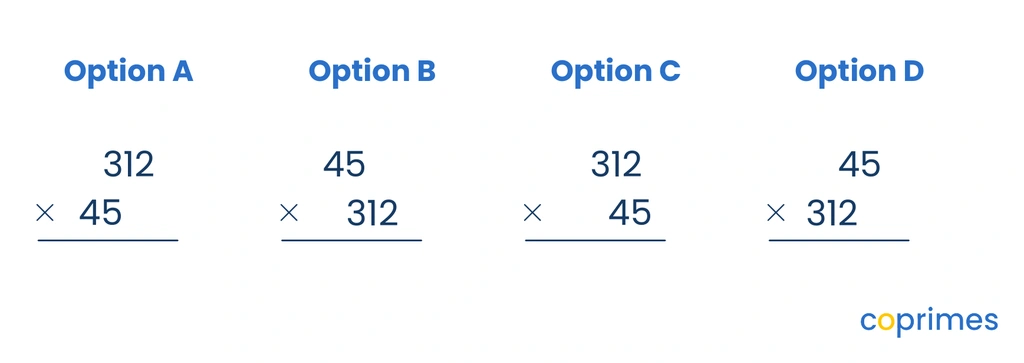
Which option shows the most efficient and correct column alignment for calculating ?
Option A
Option C
Option B
Option D
Option C
What is the product of ?
A student calculates and gets a final answer of . What common mistake did the student likely make?
They forgot to add the partial products together.
They forgot the zero placeholder when multiplying by the tens digit.
They added the carried digits into the multiplication steps incorrectly.
They misaligned the ones column in the initial setup.
They forgot the zero placeholder when multiplying by the tens digit.
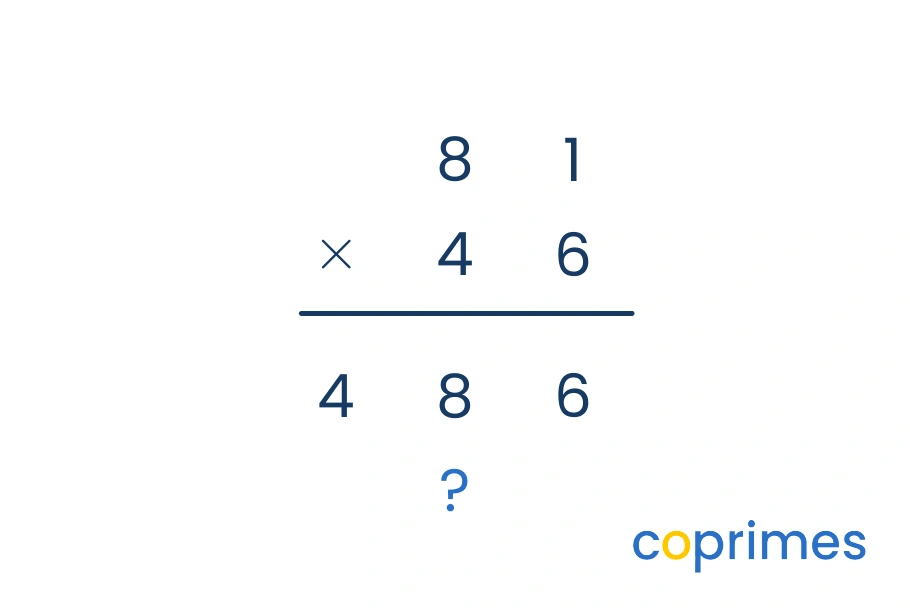
In the calculation , what should be written in the row marked with the question mark?
A hardware store orders boxes of nails. Each box costs dollars. What is the total cost of the order?
dollars
dollars
dollars
dollars
dollars