
Additive Inverse: Opposite Numbers and Properties
Two numbers are additive inverses when they have equal absolute values and their sum is zero. Each number in the pair is the opposite of the other.
If you are asked what is additive inverse, it is exactly this: the value you add to a given number to make the result zero. This concept is essential for solving algebraic equations and balancing values.
What Is Opposite Numbers and Additive Inverses?
An additive inverse is the opposite of a number. When you add a number and its additive inverse together, they cancel each other out completely, leaving zero.
By definition, these are numbers that sum to zero. Every number, except zero itself, has exactly one unique additive inverse. The opposite of a positive number is negative, and the opposite of a negative number is positive.
Because natural numbers are all strictly positive counting numbers, their additive inverses are always negative. When studying positive and negative numbers, you will frequently use opposites to find differences and balance equations.
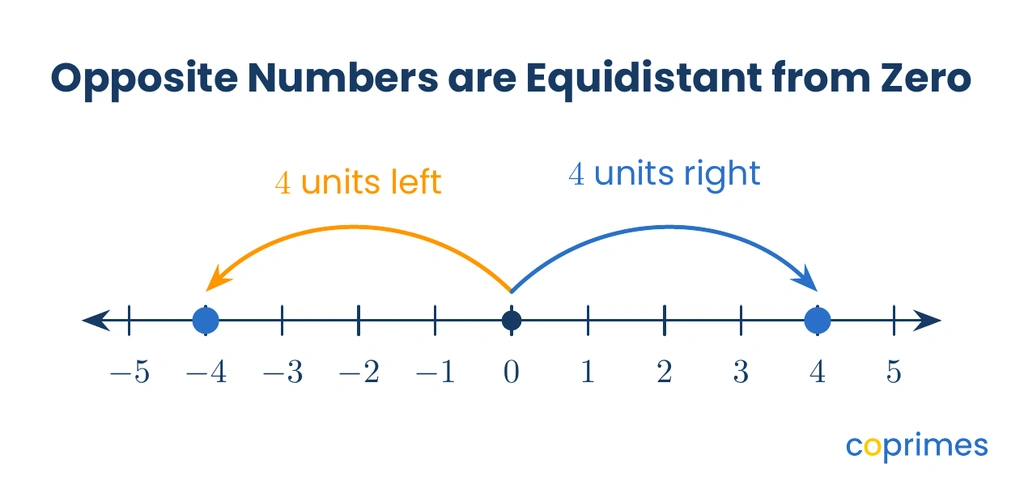
Key Ideas and Vocabulary
The fundamental rule of opposite numbers is known as the additive inverse property. It states that for any number , the equation is always true.
This property applies to all integers, which include positive whole numbers, their negative opposites, and zero. The rule also works perfectly for rational numbers, meaning every fraction and decimal has an opposite that cancels it out to zero.
Zero is a unique value in mathematics because it is neither positive nor negative. Therefore, the additive inverse of is simply . Adding to results in .
The additive inverse of zero is zero.
Visual Explanation
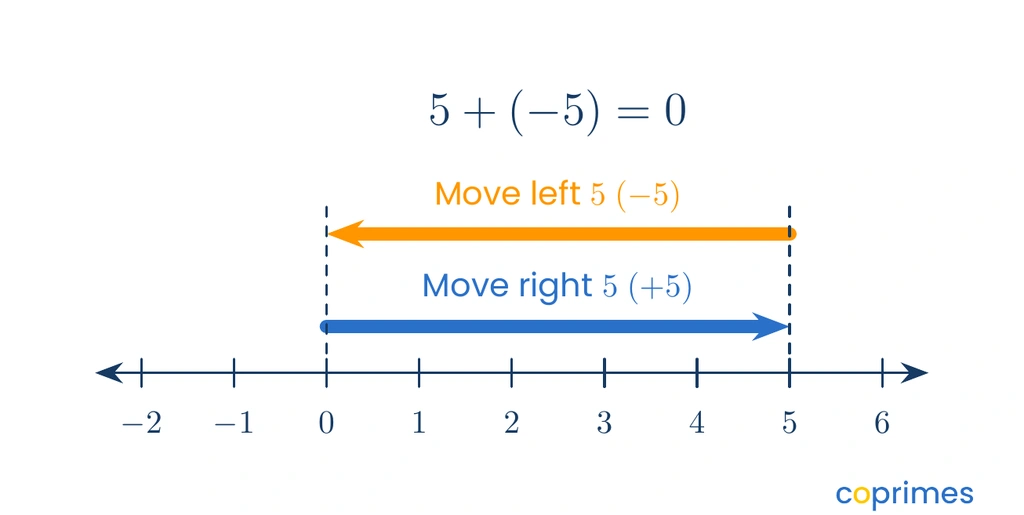
Plotting opposites on number line shows exactly how these values behave. An additive inverse acts like a mirrored reflection across zero.
If you travel a certain distance in the positive direction and then travel the exact same distance in the negative direction, you return directly to your starting point at zero. This continuous pairing of opposing movements is what defines an inverse relationship.
A learning plan shaped by your child, not the class
State-aligned Math plus our own Logic and English curriculum. An adaptive baseline test finds the gaps and fills them.
Worked Examples
Finding the opposite of a number requires flipping its sign. These additive inverse examples demonstrate how to apply the property to different types of numbers and basic equations.
Example 1: Finding opposites of integers
Question: What is the additive inverse of ?
Method:
- Identify the sign of the given number. The number is negative.
- Change the sign to its opposite. The opposite of negative is positive.
- Write the new number without changing its absolute value.
Answer: The additive inverse of is .
Check: Verify the additive inverse property by adding the two numbers: . The sum is zero, so the answer is correct.
Example 2: Applying the property to rational numbers
Question: What is the additive inverse of ?
Method:
- Identify the sign of the fraction. The fraction is positive.
- Change the sign to negative while keeping the fraction exactly the same.
Answer: The additive inverse of is .
Check: Add the original fraction and your answer together: .
Example 3: Using inverses to solve an equation
Question: What value of makes the equation true?
Method:
- Observe that adding and results in a sum of .
- Recall the additive inverse property: a number plus its opposite equals zero.
- Find the opposite of the given number, .
- The opposite of positive is negative .
Answer: .
Check: Substitute back into the original equation: .
Common Mistakes and Non-Examples
A very common mistake is confusing a number's opposite with its distance from zero, which is known as absolute value.
While opposite numbers share the same absolute value, they are not the same concept. Absolute value asks "how far away is this number from zero?" and is always positive or zero. The additive inverse asks "what number cancels this out?" and changes the sign.
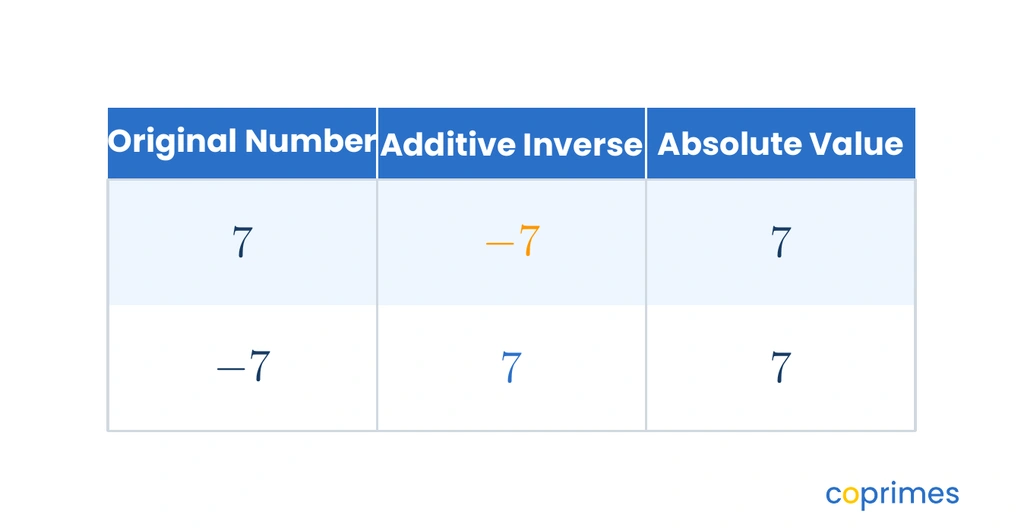
For example, the absolute value of is . The additive inverse of is also . However, the absolute value of remains , while the additive inverse of becomes .
Another common non-example is the multiplicative inverse, or reciprocal. The multiplicative inverse of is because they multiply to make . Do not confuse this with the additive inverse of , which is because they add to make .
Real-World Connections
You encounter additive inverses constantly in daily life, often representing physical balance or reversal.
If you earn a credit of points in a game, losing points acts as the additive inverse, bringing your total change back to zero. In science, if a chemical reaction raises the temperature by , a subsequent drop of is the exact mathematical opposite, restoring the original temperature.
Understanding this concept is the backbone of balancing financial ledgers, tracking altitude changes, and programming object movements in digital space.

Practice questions
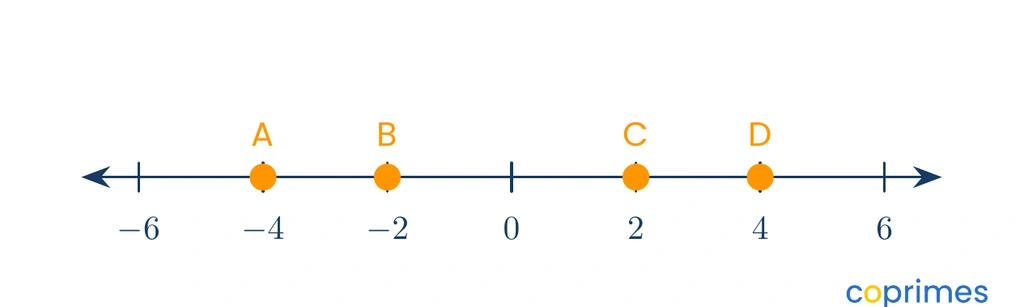
Look at the number line above. Which point represents the additive inverse of ?
Point A
Point B
Point C
Point D
Point C
What is the additive inverse of the fraction ?
Why is considered its own additive inverse?
Because adding zero to zero results in exactly zero.
Because zero has no absolute value.
Because zero is a natural counting number.
Because dividing any number by zero equals zero.
Because adding zero to zero results in exactly zero.
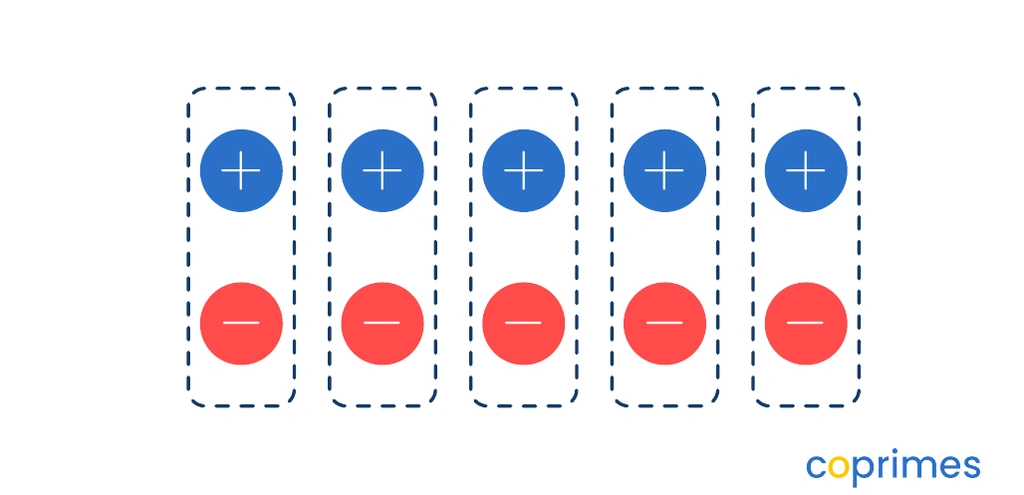
The model above pairs five positive values with five negative values. Which mathematical property guarantees that the total combined value of this model is ?
Absolute value
Additive inverse
Multiplicative inverse
Distributive property
Additive inverse
A deep-sea submersible explores the ocean at an elevation of meters. Which action represents the additive inverse of this position?
Descending an additional meters.
Staying at exactly meters for the duration of the dive.
Reversing direction and traveling exactly half the distance to the surface.
Rising meters in the positive direction to reach the surface.
Rising meters in the positive direction to reach the surface.