
Integers: Definition, Properties, and Examples
Integers are the positive whole numbers, their negatives, and zero; they do not include fractions or non-integer decimals. They provide a way to mathematically represent complete units in both positive and negative directions, such as gaining or losing complete points in a game.
What Is Integers?
When asking what is integers, we are referring to a foundational set of numbers used in mathematics. The integers definition states that they form a complete set containing positive counting numbers, their negative counterparts, and zero.
This mathematical set is widely denoted by the letter (from the German word Zahlen, meaning numbers) and can be written in set notation:
The set of integers is an extension of the natural numbers, which only include positive counting numbers. By adding zero and the exact opposites of the natural numbers, we create the complete integer family.
Key Ideas and Vocabulary
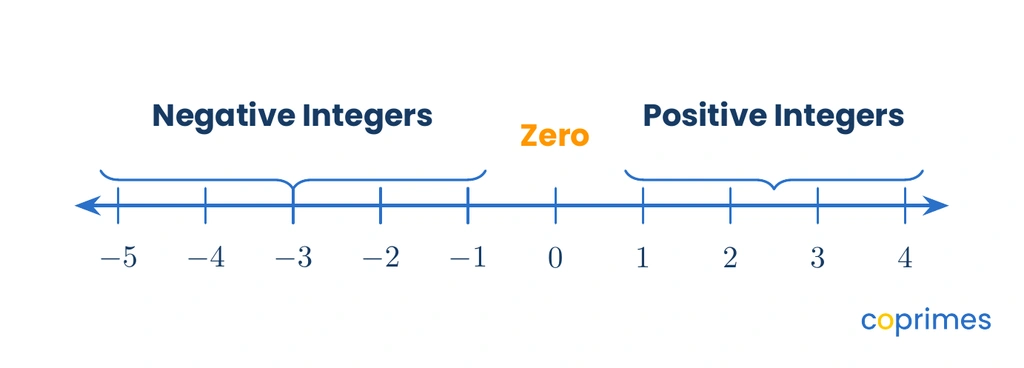
Understanding integers on a number line requires familiarity with positive and negative numbers. Positive integers are greater than zero, while negative integers are less than zero. Zero itself is neutral, being neither positive nor negative.
Every integer has an additive inverse, which is its opposite on the number line. When you add an integer and its additive inverse, the result is always zero.
The distance an integer is from zero is its absolute value. Since distance cannot be negative, the absolute value is always positive or zero.
Like other number systems, integers can be classified as even and odd numbers. Even integers are evenly divisible by , while odd integers leave a remainder of or .
Visual Explanation
A number line is the most effective way to visualize how integers are arranged and structured.
Moving to the right of zero gives increasingly larger positive values, while moving to the left gives increasingly smaller negative values.
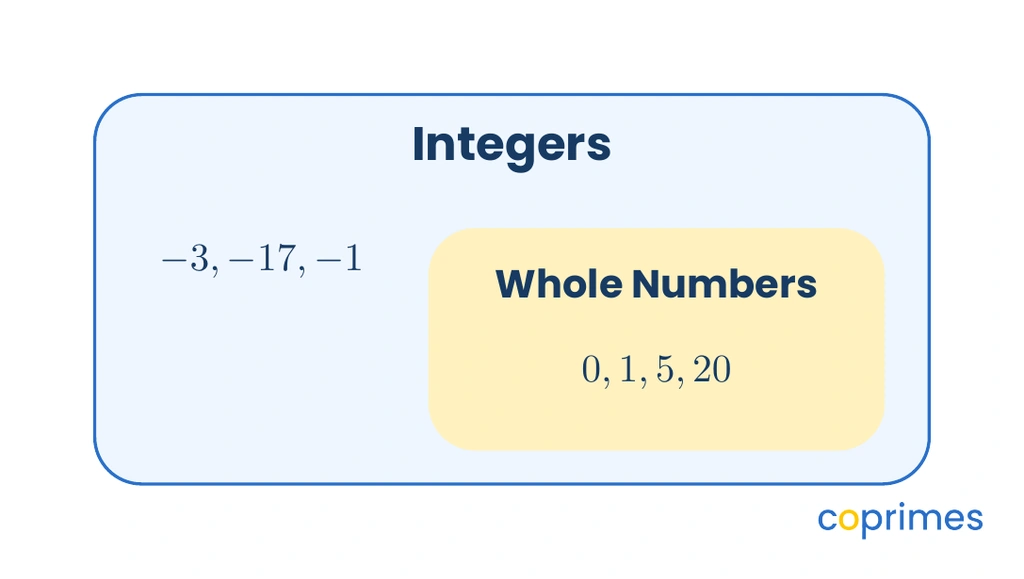
We can also visualize how integer sets relate to other mathematical number sets. Integers include all whole numbers but expand that group by including exact negative values.
A learning plan shaped by your child, not the class
State-aligned Math plus our own Logic and English curriculum. An adaptive baseline test finds the gaps and fills them.
Worked Examples
Looking at specific integers examples helps reinforce the definition and properties of this number set.
Example 1: Classifying values as integers
Question: Which of the values , , and are integers?
Method:
- Evaluate : It is a negative whole number, so it is an integer.
- Evaluate : It contains a decimal part, so it is not an integer.
- Evaluate : Simplify the fraction first. .
- Check the simplified value: is a positive whole number, so it is an integer.
Answer: The values and are integers.
Check: Verify that neither nor have fractional or decimal parts.
Example 2: Finding distance using absolute value
Question: What is the distance between and on a number line?
Method:
- Identify the concept: Distance on a number line is represented by absolute value.
- Write the absolute value expression for the integer: .
- Evaluate the expression: The distance from to is units.
Answer: The distance is .
Check: Distance is always a positive integer or zero. Since is positive, the result makes sense.
Example 3: Applying the additive inverse
Question: What is the result of ?
Method:
- Identify the relationship between the two integers.
- Notice that is a negative integer and is its positive opposite.
- Recall the additive inverse property: Adding any integer to its exact opposite results in zero.
Answer: The result is .
Check: Moving units to the right from on a number line lands exactly on .
Common Mistakes and Non-Examples
One of the most frequent errors is assuming that all negative numbers are integers. A value like is negative, but it has a decimal component, meaning it is not a whole unit. Therefore, it is not an integer.
Another mistake is forgetting that zero is an integer. Because it does not represent a positive or negative quantity, some learners exclude it. However, zero is a valid integer that marks the midpoint between positive and negative values.
Finally, do not rely purely on how a number is written. Fractions such as are not integers, but a fraction like simplifies to , which is an integer. Always simplify a value before deciding.
Real-World Connections
Integers are useful whenever we need to measure quantities that can go above or below a certain baseline.
Temperatures are commonly expressed as integers. A temperature of is a positive integer indicating warmth, while is a negative integer indicating it is freezing.
In banking and finance, integers track changes in account balances. Depositing money into an account is represented by a positive integer, while withdrawing money is tracked as a negative integer.
Elevation also relies on integers. The height of a mountain is a positive integer measured above sea level, while the depth of a submarine is represented as a negative integer below sea level.

Practice questions
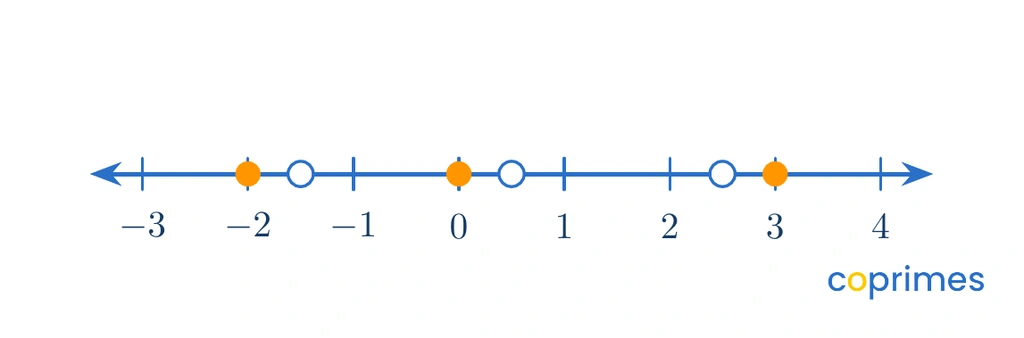
Which statement correctly describes the points plotted on the number line?
All of the plotted points represent integers.
Only the solid orange points represent integers.
Only the open blue circles represent integers.
None of the points shown represent integers.
Only the solid orange points represent integers.
Which of the following lists contains only integers?
, ,
, ,
, ,
, ,
, ,
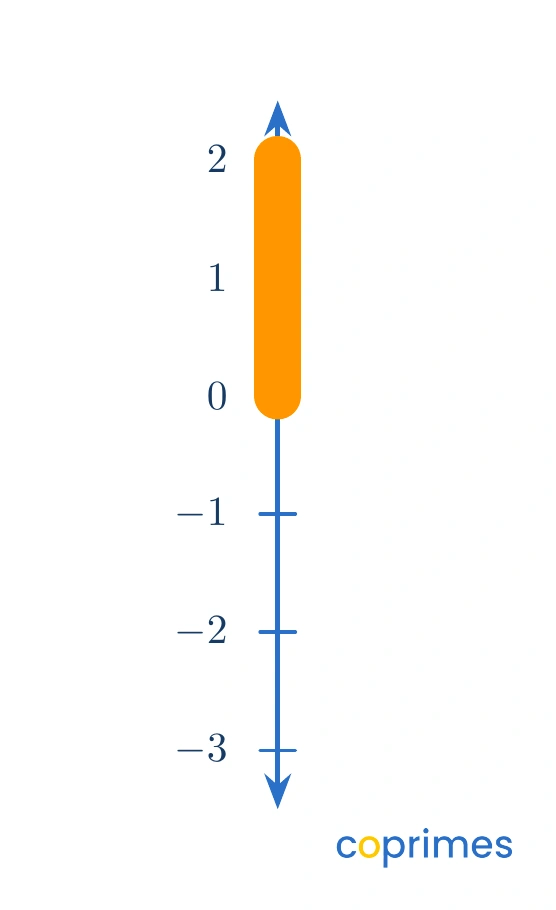
What integer is represented by the top of the shaded bar?
Which real-world situation can be accurately represented by the integer ?
A submarine ascending meters toward the surface.
A bank account receiving a deposit of .
A hiker descending meters into a valley.
A temperature rising by degrees.
A hiker descending meters into a valley.
If you start at the integer on a number line, what must you add to it so that the result is ?