
Positive and Negative Numbers: Guide and Examples
Positive numbers are greater than zero, negative numbers are less than zero, and zero is neither positive nor negative. Together, these numbers allow us to describe values above and below a reference point.
What Is Positive and Negative Numbers?
Positive and negative numbers are mathematical values that represent opposite directions or quantities relative to zero.
A positive number is any value greater than zero. It is written with or without a plus sign (). For example, and mean the same thing.
A negative number is any value less than zero. It must always be written with a minus sign (). For example, represents a value three units less than zero.
Zero () is the reference point or anchor. It is the only number that is neither positive nor negative.
Key Ideas and Vocabulary
Understanding how positive and negative numbers work requires knowing a few important natural numbers and broader number sets.
The counting numbers and so on are positive integers. When we include zero, we get the set of whole numbers. When we extend this set to include the negative counting numbers (), the complete collection is known as the integers.
- Signed numbers: This is another name for positive and negative numbers because they possess a specific sign ( or ) indicating their position relative to zero.
- Opposites: Two numbers that are exactly the same distance from zero but on opposite sides are called opposites. For instance, and are opposites. This relationship is also known as an additive inverse.
- Absolute value: The absolute value of a number is its total distance from zero, without considering direction. Because distance cannot be negative, absolute value is always positive or zero. We write the absolute value of as .
- Even and odd: Both positive and negative numbers can be classified as even and odd numbers. For example, and are both even, while and are both odd.
Visual Explanation
The most common way to visualize these values is by placing both positive and negative numbers on a number line. A number line is a straight line that extends endlessly in both directions, divided into equally spaced intervals.
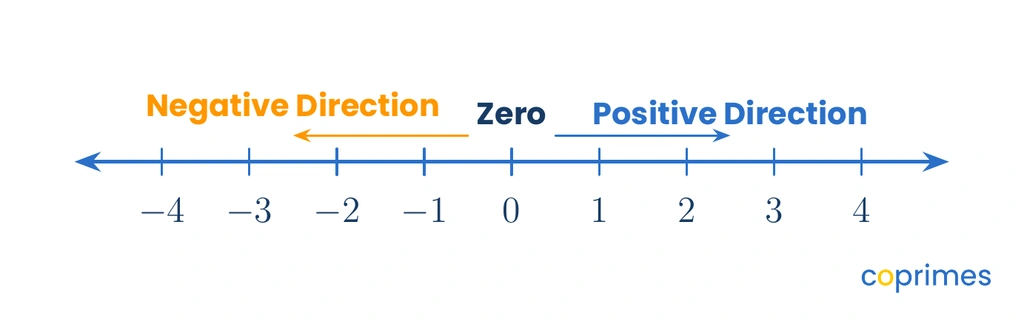
Zero sits at the center. Moving to the right of zero takes you through the positive numbers, which increase in value. Moving to the left of zero takes you through the negative numbers, which decrease in value. The further left a number sits, the smaller its value.
Number lines can also be drawn vertically. On a vertical number line, positive values go up, and negative values go down.

Worked Examples
In the positive and negative numbers examples below, we perform arithmetic by visualizing movement along the number line. Adding moves you right (or up), and subtracting moves you left (or down).
Example 1: Plotting values on a number line
Question: Where do the numbers , , and belong on a number line, and which has the lowest value?
Method:
- Draw a number line with zero near the center.
- For , start at zero and move units to the left. Plot a point.
- For , start at zero and move unit to the right. Plot a point.
- For , start at zero and move units to the left. Plot a point.
- Identify the point furthest to the left.
Answer: The number sits furthest to the left, so it has the lowest value.
Check: Since is a greater negative distance from zero than , its value is mathematically smaller.
Here is how adding a positive number looks on the number line:
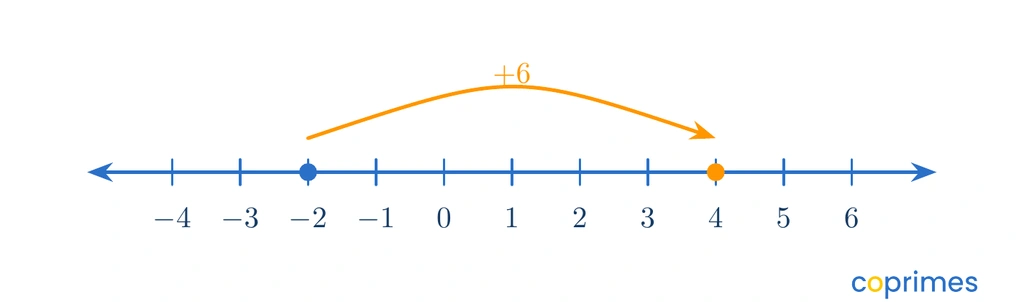
Example 2: Adding on the number line
Question: Calculate .
Method:
- Locate the starting number, , on the number line.
- Look at the operation. Adding a positive number means moving to the right.
- Move units to the right from .
Answer: Moving units right from lands on . Therefore, .
Check: Since we start at a negative number and add a larger positive amount, the result must be positive.
Example 3: Subtracting a negative number
Question: Evaluate .
Method:
- Locate the starting number, .
- The operation is subtraction, which normally moves left. However, subtracting a negative number reverses the direction.
- Move units to the right instead.
Answer: Moving units right from lands on . Therefore, .
Check: Subtracting a negative number is mathematically identical to adding its positive opposite: .
Common Mistakes and Non-Examples
Working with positive and negative numbers often introduces specific challenges. Watch out for these common errors.
- Confusing larger negative digits with larger values: A common mistake is believing that is greater than because is greater than . On the number line, is further to the left than . Therefore, is smaller than .
- Treating zero as a positive number: Zero is strictly neutral. A statement like "all numbers are either positive or negative" is a non-example of mathematical truth. The correct statement is "all non-zero numbers are either positive or negative."
- Forgetting to reverse direction when subtracting a negative: When calculating , a common error is to subtract and get . The negative sign on the reverses the subtraction direction, turning it into addition: .
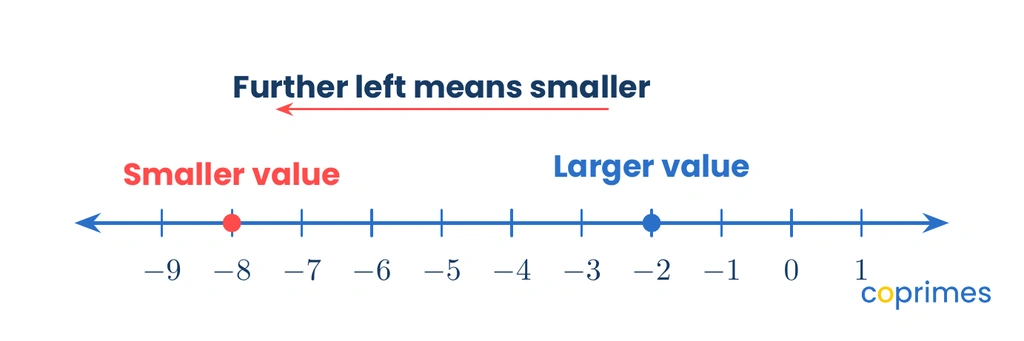
The further a negative number is from zero, the smaller its value.
Real-World Connections
Positive and negative numbers appear constantly in the real world to measure opposites. These numbers below zero describe physical states like freezing temperatures or deep elevations.
Temperature
Many regions experience temperatures below zero. If the temperature is , it is five degrees below the freezing point of water. If the temperature drops another , the new temperature is .
Elevation
Sea level represents an elevation of zero. The height of a mountain peak is a positive number, such as above sea level. The depth of an ocean trench is represented by a negative number, such as .
Account Balances
If a digital wallet has a positive balance of , those credits are available to spend. If the account becomes overdrawn by , the balance is recorded as , meaning the account is short by that amount.
A learning plan shaped by your child, not the class
State-aligned Math plus our own Logic and English curriculum. An adaptive baseline test finds the gaps and fills them.
Practice questions
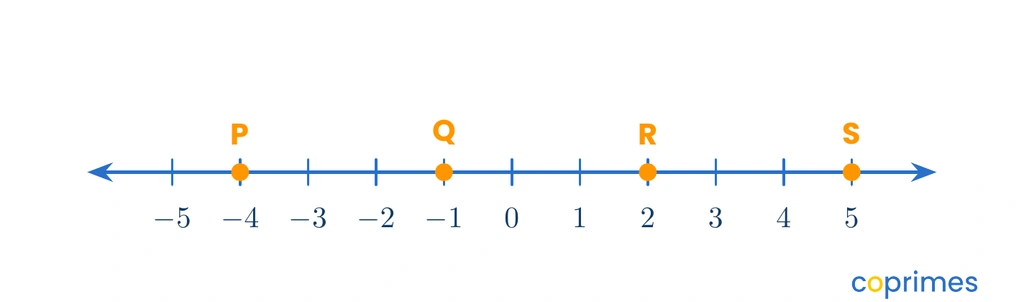
Which point on the number line represents the smallest value?
Point P
Point Q
Point R
Point S
Point P
Which of the following statements about zero is true?
Zero is the smallest positive number.
Zero is the largest negative number.
Zero is neither positive nor negative.
Zero has an absolute value of .
Zero is neither positive nor negative.
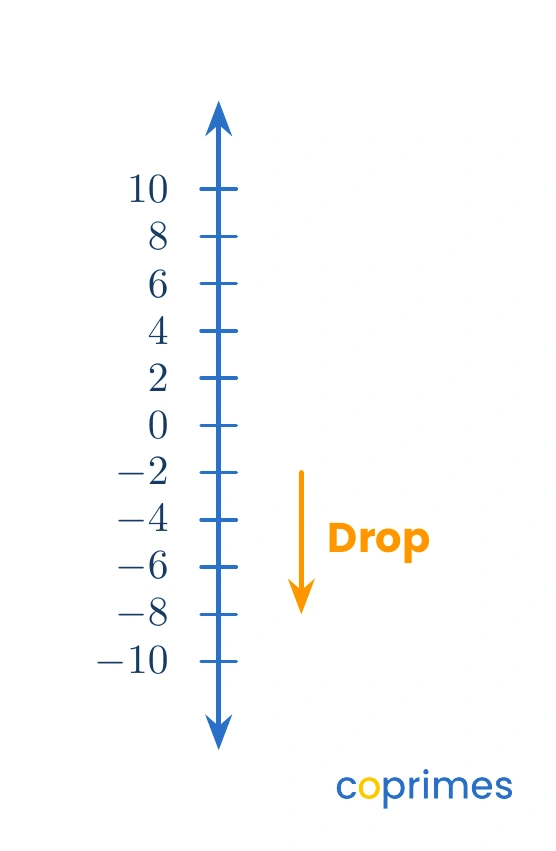
The temperature starts at and then drops by , as shown by the arrow. What is the final temperature?
What is the result of the calculation ?
Which list shows the numbers correctly ordered from smallest to largest?