
Population Density Formula: Calculation and Applications
Population density is a measure of how crowded a region is, calculated by dividing the total population of an area by the total land area. It represents the average number of people living in one square unit of space, such as a square kilometer or square mile.
Population density helps geographers, urban planners, and governments understand settlement patterns, allocate resources, and compare the crowding of different cities or countries.
What is population density?
Population density describes the relationship between a given population and the physical space it occupies. It is a specific type of rate that expresses how closely together people live in a specific region.
By calculating the population density, you establish a unit rate representing the number of individuals per single unit of area.
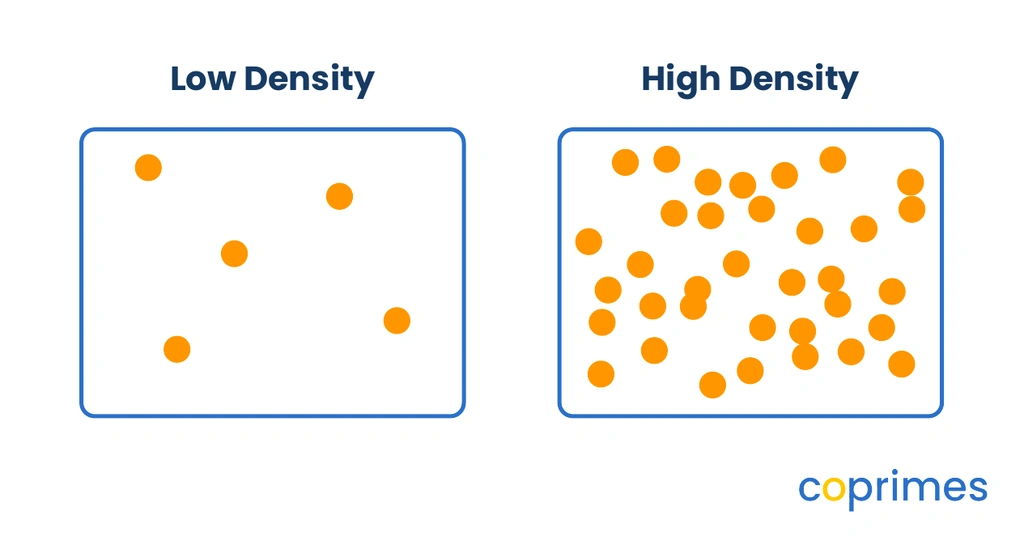
A region with a high population density has many people living in a relatively small space, such as a major city. A region with a low population density has fewer people spread across a large area, such as a rural farming community or a desert.
Use population divided by area
To find the population density of any region, divide the total number of people by the total area they occupy.
The standard mathematical formula is:
Always divide the number of people by the area, never the reverse.
For example, if a small island has a population of people and an area of square kilometers, you divide by . The population density is people per square kilometer.
When applying this method, check that the population and area correspond to the exact same geographical boundary. Do not mix the population of a city with the area of the surrounding state.
Find population, area or density
The population density equation connects three distinct variables. If you know any two of these values, you can rearrange the equation to solve for the missing third value. This is similar to the physical density formula used in science.
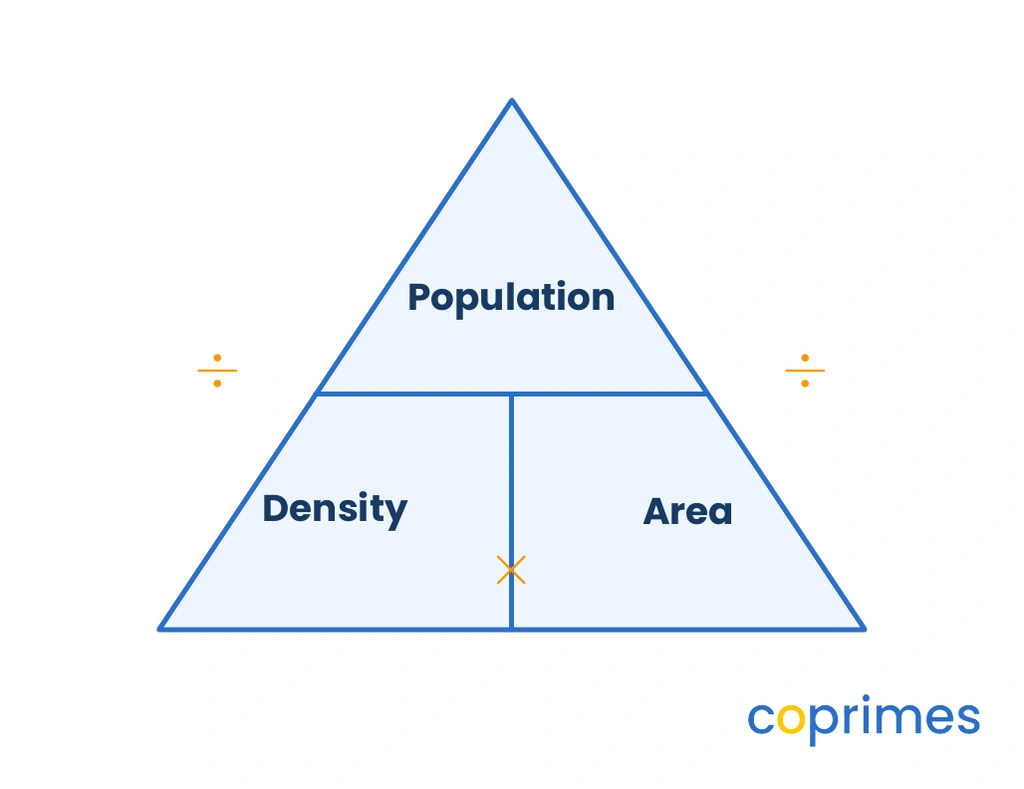
By isolating a different variable, you generate three useful forms of the equation:
- To find density:
- To find population:
- To find area:
Before substituting values into these formulas, identify which piece of information is missing from the problem.
A learning plan shaped by your child, not the class
State-aligned Math plus our own Logic and English curriculum. An adaptive baseline test finds the gaps and fills them.
Interpret units and scale
Population density requires a compound unit that combines a count of people with a unit of area. The most common global unit is people per square kilometer, often written as . In some regions, people per square mile () is used instead.
Because populations and land areas can both be extremely large numbers, division often produces decimals. It is standard practice to round the population density to a whole number or one decimal place, depending on the required precision.
A population density of is mathematically valid. It means that, on average, there is one person for every two square kilometers of land.
Compare density responsibly
When comparing the population density of two different regions, you are analyzing a proportion rather than looking at total size. A very small region can have a much higher density than a massive region, even if the total population of the small region is smaller.
Consider two fictional regions:
- Region A: Population of and an area of .
- Region B: Population of and an area of .
Although Region A has far more people, its population density is .
Region B has a population density of . Region B is much more crowded.
Worked examples
Working through structured examples helps reinforce the relationships between population, area, and density. This process is essential for solving math word problems correctly.
Example 1: Calculating population density
Question: A fictional province has a total population of people. The land area of the province is . What is the population density? Round to the nearest whole number.
Method:
- Identify the given values: and .
- Choose the correct formula: .
- Substitute the values: .
- Evaluate the division: .
Answer: The population density is .
Check: Multiply the density by the area to confirm the population: .
Example 2: Finding the total population
Question: A city district has an area of and an average population density of . What is the total population of the district?
Method:
- Identify the given values: and .
- Rearrange the formula to solve for population: .
- Substitute the values: .
- Evaluate the multiplication: .
Answer: The total population is people.
Check: Divide the calculated population by the area to confirm the density: .
Example 3: Finding the total area
Question: A conservation zone is designed to support a population of people with a target population density of exactly . How large must the conservation zone be?
Method:
- Identify the given values: and .
- Rearrange the formula to solve for area: .
- Substitute the values: .
- Evaluate the division: .
Answer: The total area must be .
Check: Divide the population by the calculated area: . The target density matches.

Common mistakes
When calculating density, area, or population, pay close attention to the details of the problem to avoid these frequent errors:
- Inverting the fraction: The most common mistake is dividing the area by the population instead of dividing the population by the area. Always place the number of people in the numerator.
- Forgetting to include units: A number alone does not represent density. You must state the units, such as , to give the answer meaning.
- Mismatched boundaries: Using the population of a metropolitan area but dividing it by the land area of just the city center will result in an incorrect, vastly inflated density.
Frequently asked questions
What does a high population density tell you?
A high population density indicates that many people live in a small area. This usually points to an urban environment with high-rise buildings, extensive public transportation networks, and concentrated resources.
Can population density be less than 1?
Yes. If an extremely large area is inhabited by a very small number of people, the density will be less than . For example, an area of with only residents has a density of .
Does population density account for uninhabitable land?
Standard population density divides the total population by the total land area, including mountains, lakes, and deserts. This can sometimes make a country appear less crowded than it actually is. Physiological density is a different measurement that divides the population by only the habitable or arable land.
Practice questions
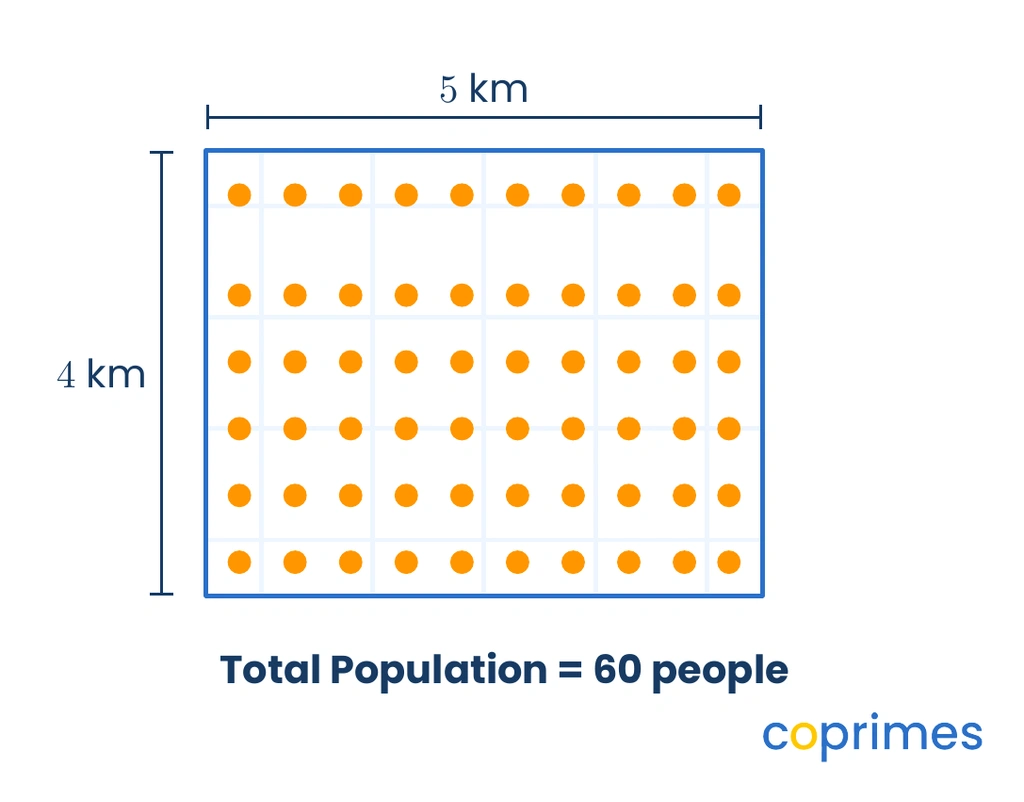
Based on the visual model, what is the population density of the mapped region?
A rural farming region has a population of people and covers an area of .
What is the population density of the region?
A coastal town covers and has a population density of .
What is the total population of the coastal town?
A new housing development is planned for people. Planners want the population density to be exactly .
How much land area is required for the development?
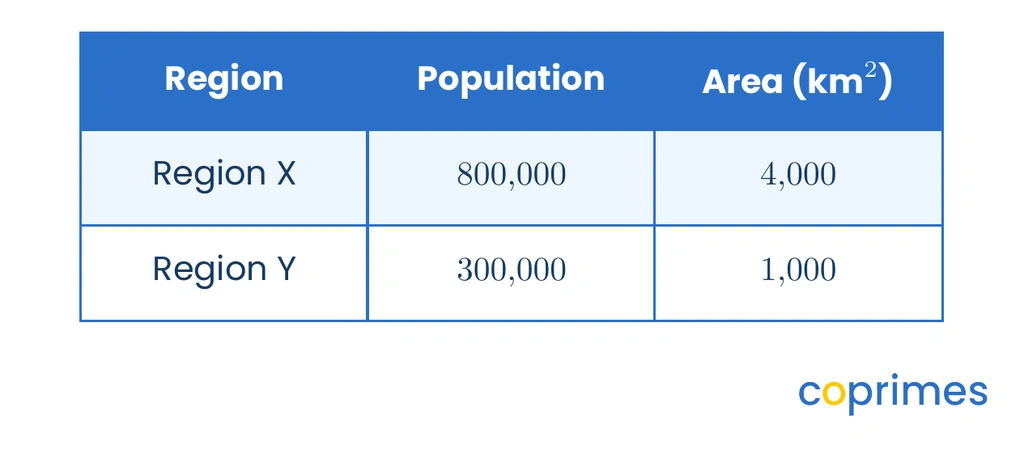
Based on the table provided, which statement accurately compares the two regions?
Region X is more crowded because its total population is people larger than Region Y.
Region X is more crowded because its population density is .
Region Y is more crowded because its population density is , which is higher than Region X.
Region Y is less crowded because it has fewer people and covers less land area.
Region Y is more crowded because its population density is , which is higher than Region X.