
Density Formula: Definition, Calculation, and Examples
Density is a measure of how much mass is contained within a specific volume. Calculate density by dividing the mass of an object by its volume, ensuring the units are compatible. The result is expressed as a compound measure, such as grams per cubic centimeter or kilograms per cubic meter.
What is density?
Density describes how tightly matter is packed together inside an object or substance. It is a specific type of rate that compares the amount of matter present to the amount of three-dimensional space it occupies.
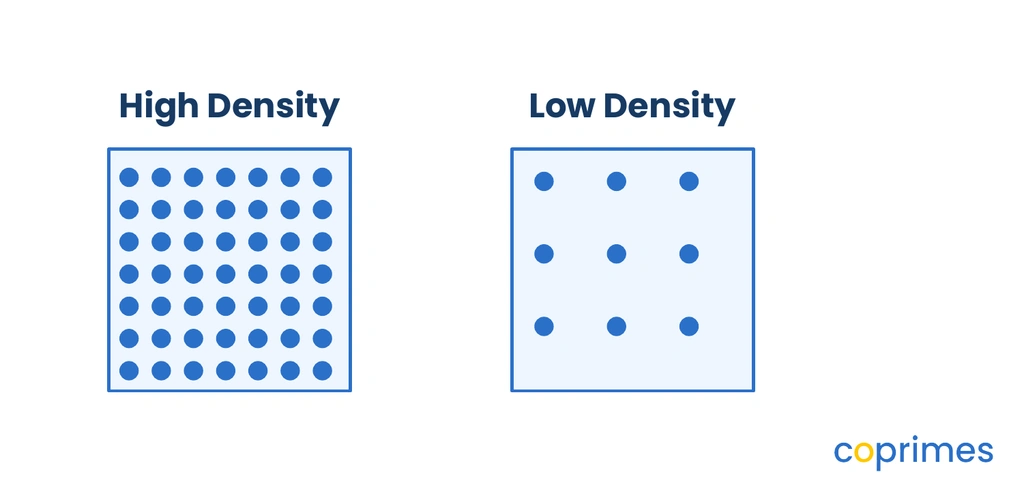
An object with a high density contains a large amount of mass in a small volume. An object with a low density contains a small amount of mass spread out over a larger volume.
The standard mathematical formula for density is:
Where represents density, represents mass, and represents volume.
Density is the ratio of an object's mass to its volume.
Use the density formula
To calculate the density of an object, you must determine both its mass and its volume, then apply the formula.
- Identify the mass of the object.
- Identify or calculate the volume of the object.
- Check that the units of mass and volume match the required density units.
- Divide the mass by the volume using .
- Write the final answer with a compound unit.
If the volume of a solid is not given directly, you must calculate it first. For example, to find the volume of a rectangular prism, multiply its length, width, and height.
Choose compatible units
Density is a compound measure, meaning its units are formed by combining a mass unit and a volume unit.
The most common units for density are:
- Grams per cubic centimeter () for small solids and liquids.
- Kilograms per cubic meter () for larger solids and gases.
Always check that your given values match the requested final units. If a question asks for the density in grams per cubic centimeter, but gives the mass in kilograms, you must convert the mass into grams before calculating.
Convert your units before substituting them into the formula.

Find density, mass or volume
The density equation relates three variables. If you know any two of the values, you can rearrange the formula to find the unknown third value.
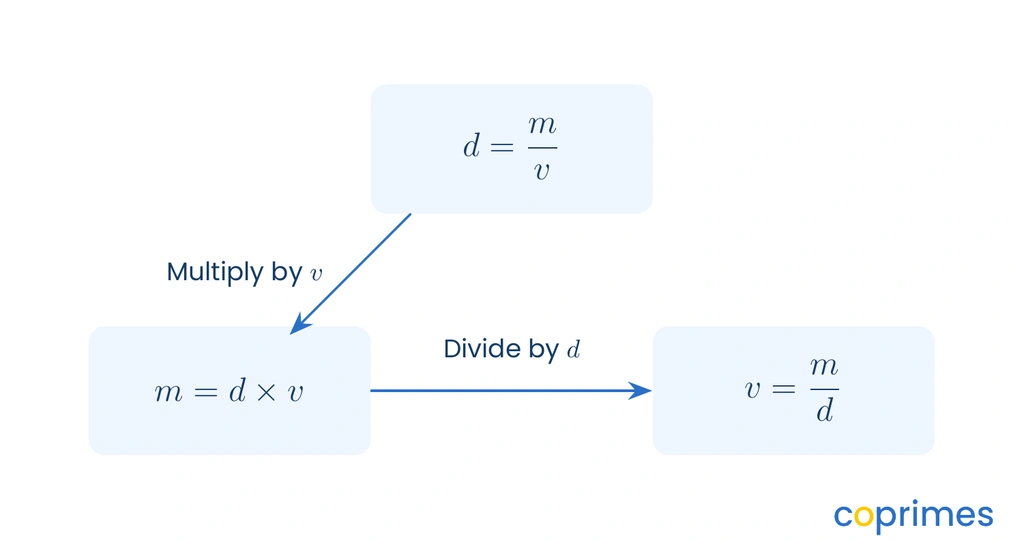
To calculate mass from density and volume, multiply both sides of the density equation by volume. This yields the formula .
To calculate volume when mass and density are known, divide the mass by the density. This yields the formula .
Interpret density in context
Density tells us how heavy an object is relative to its size. For example, a solid piece of iron feels significantly heavier than a piece of wood of the exact same size because iron possesses a higher density.
Understanding density conceptually is similar to finding a unit rate, where you determine the amount of mass contained in exactly one unit of volume. Other important compound measures in mathematics and science include flow rate and the pressure formula.
Worked examples
Example 1: Finding density from mass and volume
Question: A metal block has a mass of and a volume of . What is the density of the metal block?
Method:
- Identify the given mass and volume. The mass is and the volume is .
- Ensure the units are compatible. Both are standard metric units that form grams per cubic centimeter.
- Substitute the values into the formula .
- Calculate .
Answer: The density of the metal block is .
Check: Multiply the calculated density by the volume to see if it returns the original mass: .
Example 2: Finding volume from mass and density
Question: A liquid has a density of . If a beaker contains of this liquid, what is the volume of the liquid?
Method:
- Identify the known variables. The density is and the mass is .
- Choose the correct rearranged formula to find volume: .
- Substitute the values: .
- Perform the division.
Answer: The volume of the liquid is .
Check: Multiply the resulting volume by the density: . The calculation is correct.
Example 3: Applying the formula to populations
Question: A city covers an area of . If the city has a total population of people, what is the population density?
Method:
- Treat the population as the total amount (similar to mass) and the area as the space (similar to volume).
- Set up the ratio using the density concept: .
- Substitute the values: .
- Simplify the fraction.
Answer: The population density is .
Check: Multiply the population density by the total area: .
A learning plan shaped by your child, not the class
State-aligned Math plus our own Logic and English curriculum. An adaptive baseline test finds the gaps and fills them.
Common mistakes
Dividing the wrong values
A common error is dividing volume by mass instead of mass by volume. Always ensure that mass is the numerator (the top number) and volume is the denominator (the bottom number) when calculating density.
Ignoring unit mismatches
Using measurements with mixed prefixes, such as kilograms for mass and cubic centimeters for volume, without converting them first will result in an incorrect answer. Ensure all units align before using the formula.
Confusing density with weight
Density measures how concentrated the mass is, not just how heavy an object is. A large block of foam may be heavy overall but still have a very low density because its mass is spread over a huge volume.
Frequently asked questions
Does an object's density change if you cut it in half?
No, density is an intensive property. If you cut a block of wood in half, both the mass and the volume are halved, so the ratio between them (the density) remains exactly the same.
How does density determine if an object floats?
An object will float in a fluid if its density is less than the density of the fluid. It will sink if its density is greater than the density of the fluid.
Practice questions
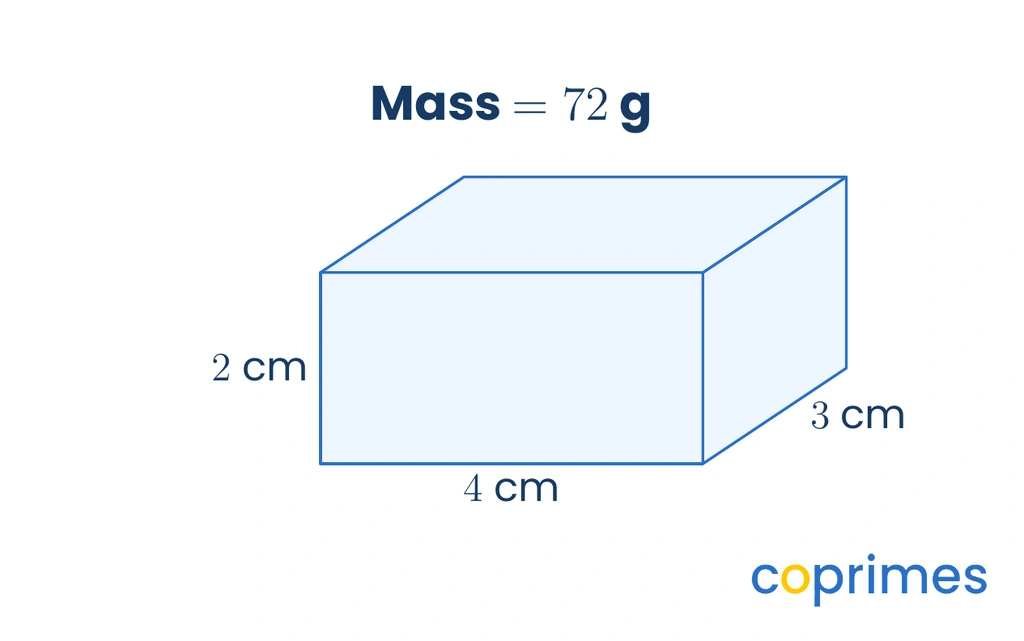
Based on the measurements shown in the diagram, what is the density of the block?
A piece of pure silver has a density of and a volume of . What is the mass of the piece of silver?
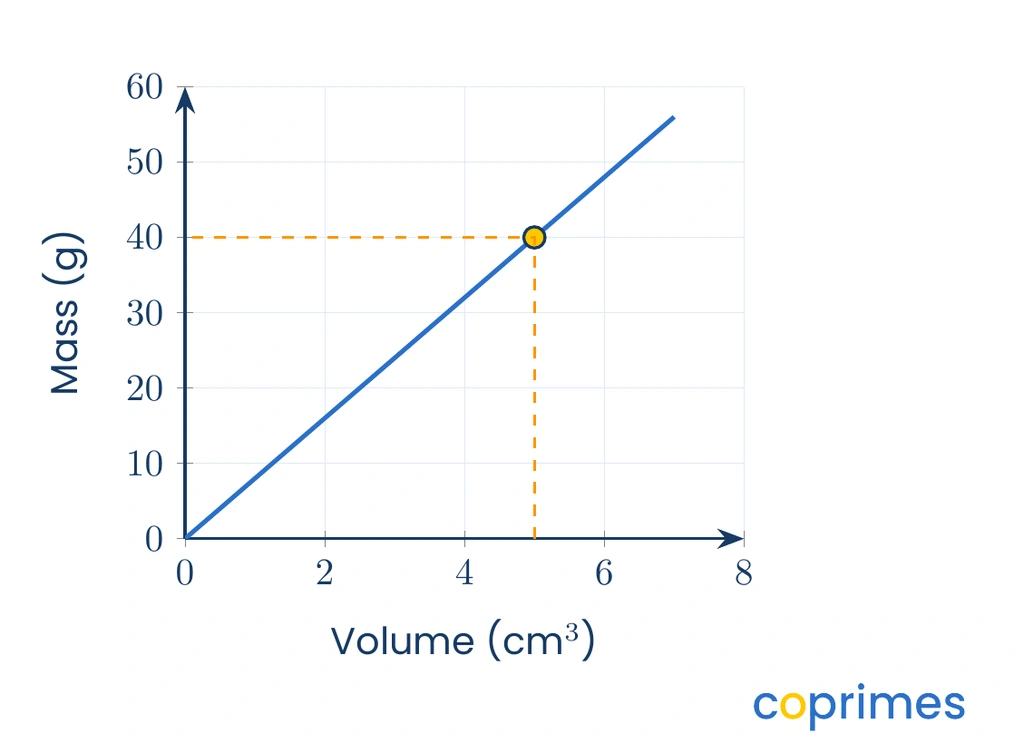
The graph shows the relationship between mass and volume for a specific material. What is the density of the material?
A block of wood has a mass of and a volume of . What is the density of the wood in ?
A plastic cylinder has a density of and a mass of . What is the volume of the plastic cylinder?