
Repeated Addition and Equal Groups
Repeated addition adds the same amount again and again, while equal groups show why that repeated addition can be written as multiplication. Together, these related concepts show how adding many identical sets is mathematically the same as multiplying.
Understanding this connection builds a bridge from basic addition to recognizing that multiplying is a faster, more efficient way to count totals. Before mastering these steps, learners should already be familiar with the core idea of multiplication.
What are equal groups?
Equal groups are collections that all contain the exact same number of items. They represent the foundation of multiplication because you can only use multiplication to find a total when every group has an identical quantity.
If you have three plates, and each plate holds exactly four apples, you have equal groups. This arrangement makes it easy to find the total without counting every single apple one by one. This concept is often called equal groups multiplication.
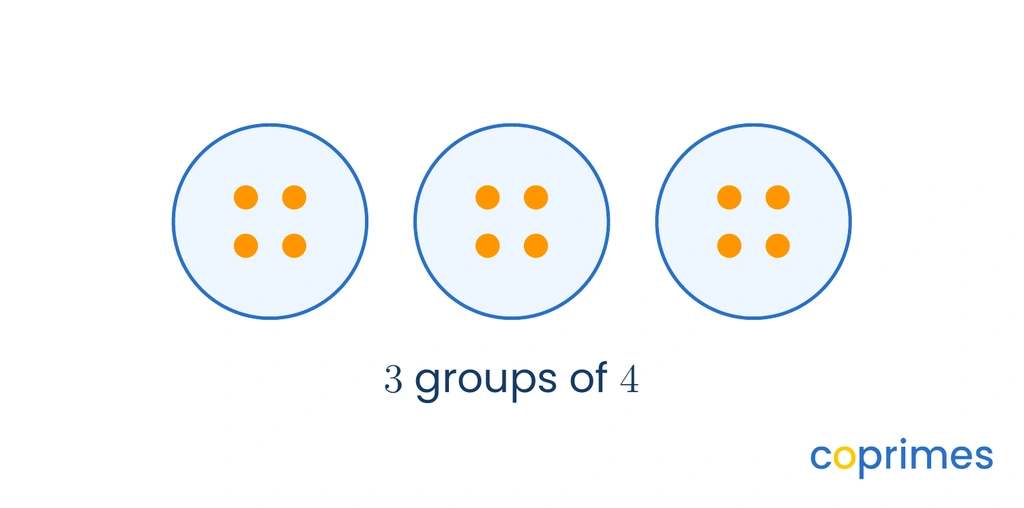
When you have unequal groups, such as one plate with four apples and another with three apples, you cannot use multiplication. You must add them normally.
How repeated addition becomes multiplication
Multiplication as repeated addition is the process of adding the same number multiple times to find the total of equal groups.
Instead of counting each item individually, you can use repeated addition. For example, if you have groups of , you can add the number four times:
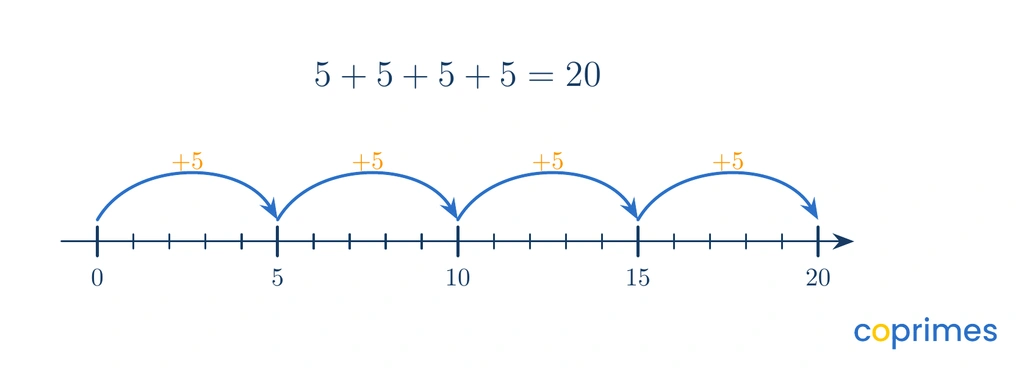
Because writing a long addition sequence takes time, we replace it with a multiplication sentence. The multiplication symbol () acts as a shortcut that means "groups of".
Using repeated addition examples like the number line jump above helps visualize why . Each jump represents adding one more group of the exact same size.
Write multiplication sentences
To write a multiplication sentence from a repeated addition equation or an equal groups model, you must identify two key numbers called factors.
The first factor is the number of groups, and the second factor is the size of each group.
For example, the repeated addition sentence shows the number being added three times.
- Find the number of groups: There are instances of the number.
- Find the size of the group: The number being added is .
- Write the multiplication sentence: .
While the order of factors does not change the final product, keeping this specific order perfectly matches the story told by the addition equation. Once you are comfortable writing these basic sentences, you can naturally progress to visually organizing them into multiplication arrays.

Count groups and group size
When faced with a visual diagram or a real-world scenario, you can quickly write a multiplication sentence by counting the groups and the group size in a specific order.
- Identify and count the distinct groups: Look for the larger containers, clusters, or rows.
- Count the items within one group: Verify that every group holds the same amount. If they do, count the items inside just one group.
- Multiply: Write the number of groups first, followed by the multiplication sign, and then the size of one group.
- Calculate the product: Use repeated addition or skip counting to find the total.
If a teacher places boxes on a table, and each box contains pencils, the boxes are the groups. There are groups. The pencils are the items. The group size is . The correct mathematical sentence is .
When repeated addition is useful
Repeated addition is an excellent strategy when you are first learning groups of multiplication or when you need to calculate a product but cannot remember the memorized fact.
It is particularly useful for building mental math strategies like skip counting. If you need to solve , you can skip count by four times: , , , . Repeated addition also visually proves important mathematical properties:
- Multiplying by zero: means groups of zero ().
- Multiplying by one: means groups of one ().
As you become more fluent, you will rely less on repeated addition and move toward memorizing multiplication facts and times tables for instant recall.
Worked examples
Example 1: Translating repeated addition
Question: Write the multiplication sentence for .
Method:
- Count how many times the number is added. It appears times. This is the number of groups.
- Identify the number being added. The number is . This is the size of each group.
- Write the multiplication sentence starting with the number of groups.
Answer: .
Check: groups of totals .
Example 2: Analyzing an equal groups scenario
Question: A baker puts muffins into each of boxes. Write the repeated addition and multiplication sentences to find the total number of muffins.
Method:
- Identify the groups. The boxes are the groups, so there are groups.
- Identify the group size. Each box holds muffins, so the group size is .
- Write the repeated addition by writing the number four times: .
- Calculate the total by adding.
- Write the matching multiplication sentence.
Answer: Repeated addition is . The multiplication sentence is .
Check: , and . The product is correct.
A learning plan shaped by your child, not the class
State-aligned Math plus our own Logic and English curriculum. An adaptive baseline test finds the gaps and fills them.
Common mistakes
A frequent error is mixing up the number of groups with the size of the group. While and both result in a total of , they tell different mathematical stories and look different when drawn.
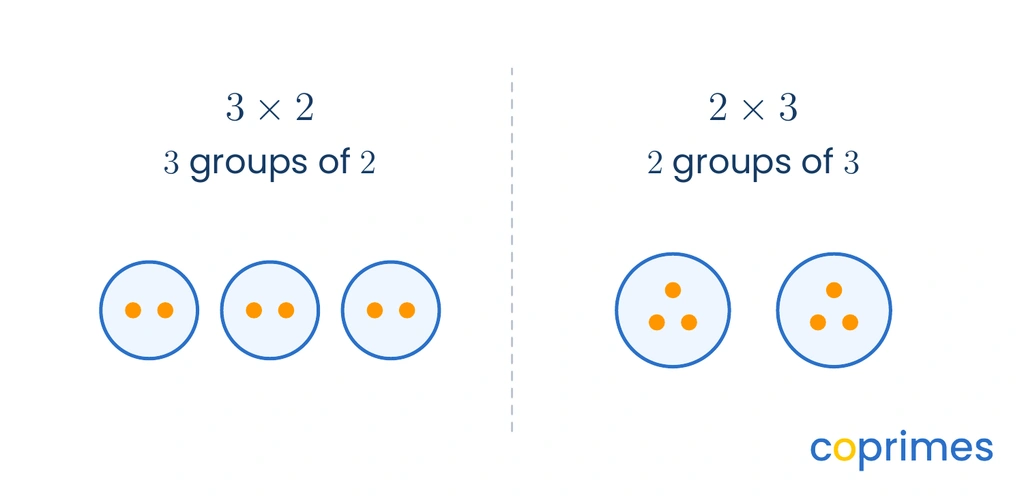
The model on the left shows , which is . The model on the right shows , which is . When solving word problems, reversing these numbers can lead to the wrong real-world conclusion, even though the final calculation is correct.
Another common mistake is trying to write a multiplication sentence for unequal groups. If you have groups of , , and , you can add them to get , but you cannot use multiplication because the groups do not share the exact same size.
Frequently asked questions
Does the order of the numbers in multiplication change the final answer?
No. The commutative property states that you can multiply numbers in any order and get the same product. However, changing the order does change the visual model and the repeated addition sentence.
Can I use repeated addition for any multiplication problem?
Yes, repeated addition works for any whole number multiplication. However, if the numbers are very large, such as , writing out forty-five times is extremely inefficient. In those cases, standard multiplication methods are much better.
How does skip counting relate to repeated addition?
Skip counting is a faster way to perform repeated addition in your head. Instead of saying , you say , , . Every skip represents adding one more equal group.
Practice questions
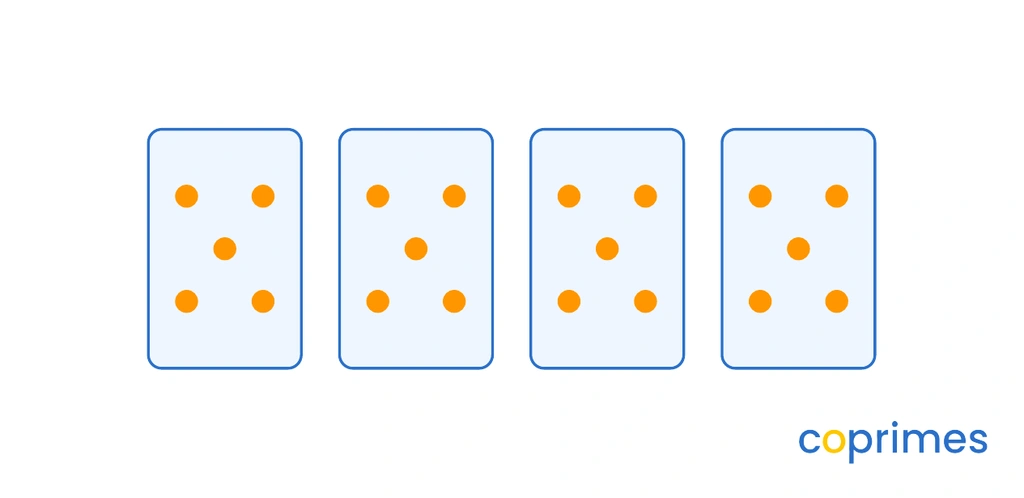
Which multiplication sentence correctly matches the equal groups shown in the diagram?
Which multiplication expression is equivalent to ?
Which repeated addition sentence correctly matches ?
A student writes the multiplication sentence . Which repeated addition sentence exactly matches this expression?
A teacher buys packets of markers. Each packet contains markers. Which pair of equations correctly represents the total number of markers?
and
and
and
and
and