
Multiplication Facts and Times Tables: Complete Guide
Multiplication facts are basic mathematical building blocks that show the product of two whole numbers, typically from to or . Organizing these facts into a times table helps learners quickly calculate, recognize patterns, and build a strong foundation for more advanced mathematics.
What are multiplication facts?
A multiplication fact is a mathematical statement showing the product of two numbers. These facts form the foundation of multiplication, allowing learners to solve problems efficiently without needing to count or use repeated addition every time.
Knowing basic facts, such as , is critical because these small products are used continuously in harder topics like long division, fractions, and algebra.
Memorizing facts is helpful, but understanding how the numbers connect is just as important.
How to read a times table
A times table is a grid that organizes multiplication facts. To find the product of two numbers, you find the intersection of the row for the first number and the column for the second number.
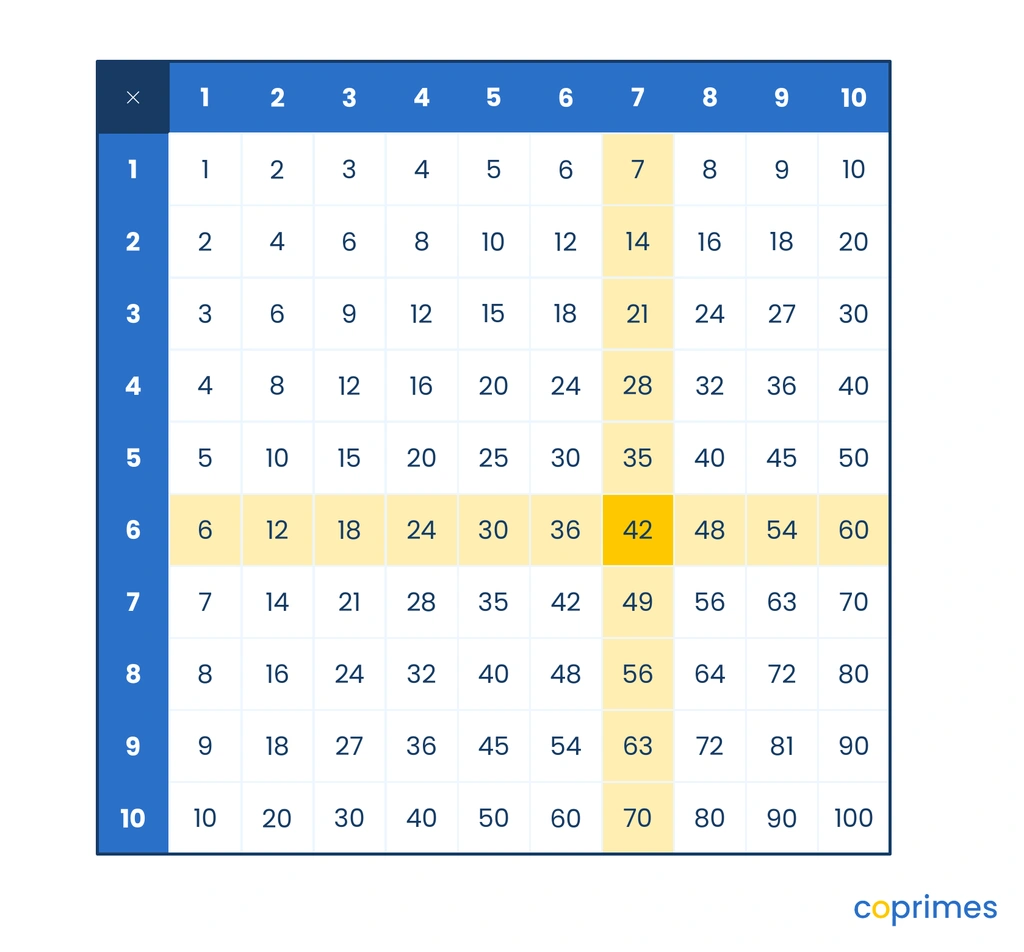
The table works in both directions. Finding the row for and the column for gives the same result as finding the row for and the column for .
Example 1: Finding a product using a times table
Question: Use the times table to find the product of and .
Method:
- Locate the number in the left-hand column.
- Locate the number in the top row.
- Follow the row to the right and the column down until they meet.
Answer: The intersection contains the number . The product is .
Check: You can verify this by checking the row and column. That intersection also contains .
Patterns in times tables
Times tables contain repeating visual and numerical patterns. Recognizing these patterns makes learning multiplication facts much faster and reduces the amount of straight memorization required.
- The times table: All products are even numbers ending in , or . Multiplying by is the same as doubling the number.
- The times table: Every product ends in either a or a . The sequence jumps by fives: , and so on.
- The times table: Every product ends in a . To multiply a whole number by , you shift its digits one place to the left, which places a zero in the ones place.
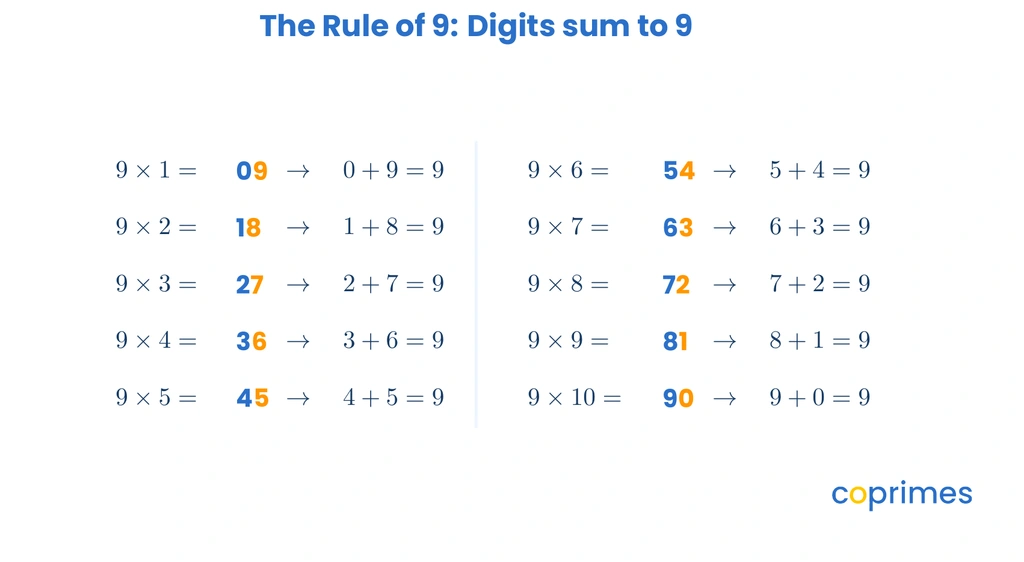
- The times table: The tens digit increases by one, and the ones digit decreases by one. Additionally, the sum of the digits for any fact up to always equals .
A learning plan shaped by your child, not the class
State-aligned Math plus our own Logic and English curriculum. An adaptive baseline test finds the gaps and fills them.
Use known facts to find new facts
If you forget a multiplication fact, you can easily figure it out by using facts you already know. The two most common strategies involve rearranging the numbers or splitting them apart.
The commutative property of multiplication means that reversing the order of the numbers does not change the product. If you cannot remember , you can calculate instead. This property nearly halves the number of facts you need to memorize.
You can also decompose, or break apart, a difficult fact into two simpler facts.
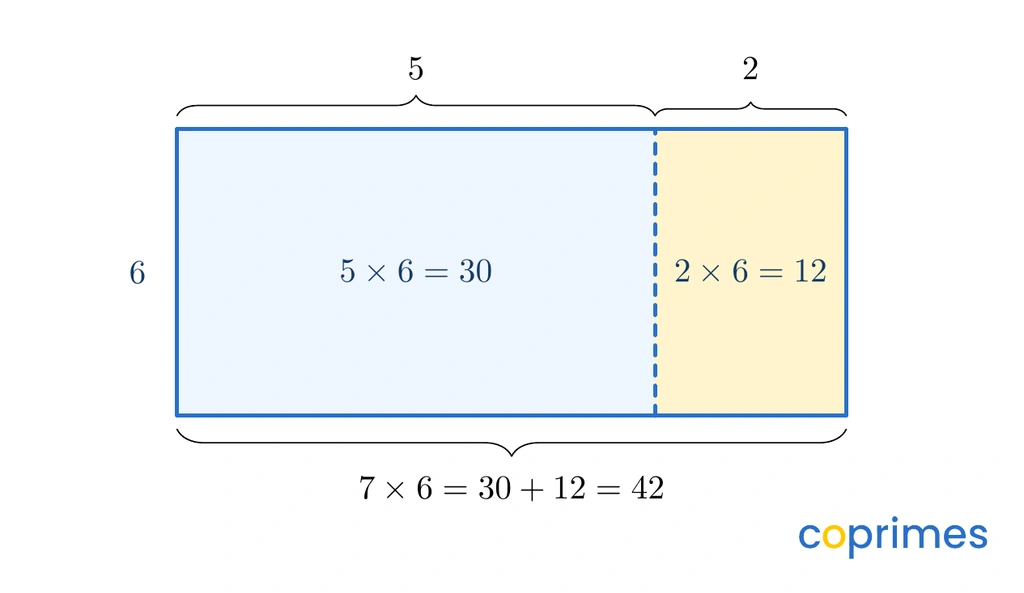
Example 2: Using decomposition to find a fact
Question: How can you use known facts to calculate ?
Method:
- Break the number into two smaller, easier numbers, such as and .
- Multiply both of those smaller numbers by .
- Calculate .
- Calculate .
- Add the two partial products together: .
Answer: .
Check: Using a times table, the intersection of row and column is .
Fact families
Multiplication and division are inverse operations. They undo each other. A fact family is a group of three numbers related by multiplication and division.
Understanding multiplication and division fact families allows you to solve division problems by thinking of the missing multiplication fact.
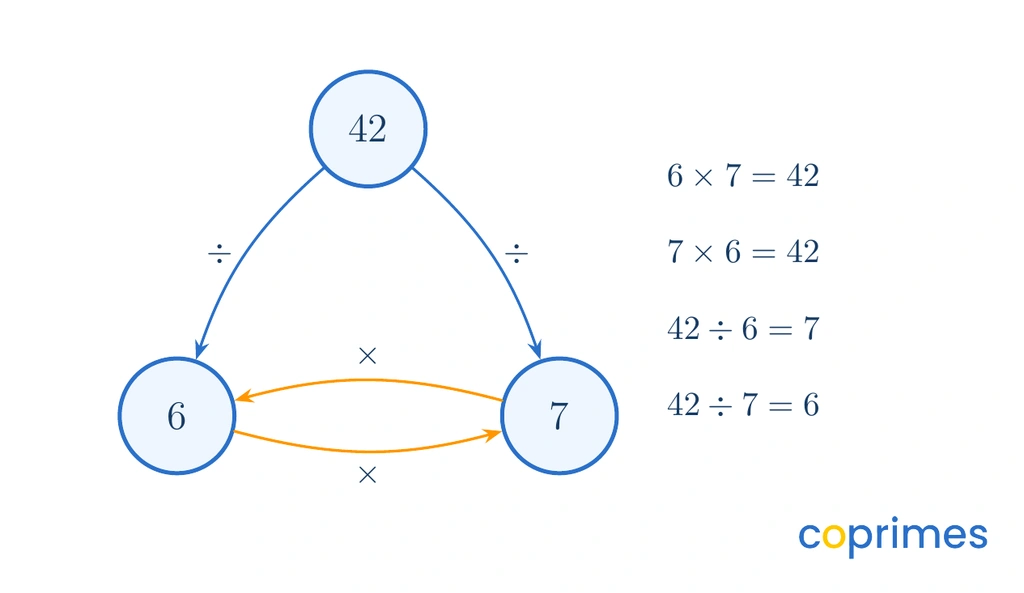
Example 3: Completing a fact family
Question: Write the missing equation for the fact family containing the numbers , and . The given equations are , , and .
Method:
- Identify the operations used in the family. A complete family has two multiplication facts and two division facts.
- Notice that both multiplication facts are provided.
- Notice that one division fact is provided: .
- The missing fact must be the second division equation, swapping the divisor and the quotient.
Answer: The missing equation is .
Check: Since , dividing into equal groups results in exactly per group.
Practice strategies
Practicing little and often is the most effective way to learn times tables. Rote repetition alone can be frustrating, so mixing strategies helps build both memory and understanding.
- Use visual models: Draw arrays (grids of dots) or area models to see the total number of items visually.
- Skip counting: Practice counting aloud by the number you are learning, such as .
- Focus on one table: Do not try to learn all tables at once. Master the , and times tables first before moving to more difficult numbers like and .
- Use flashcards: Write the fact on one side and the product on the back to test your memory.

Frequently asked questions
Why are multiplication facts important?
They are the basic building blocks for higher-level mathematics. Knowing them well prevents errors and saves time when solving fractions, area calculations, and long division.
Which times table is the hardest to learn?
Many learners find the and times tables challenging because they have fewer obvious visual patterns. Using decomposition (breaking into and ) helps simplify them.
Do I need to memorize times tables beyond ?
While many international charts go up to , learning up to is common because is heavily used in measurements like months in a year or items in a dozen. Beyond , standard written multiplication methods are more practical.
Practice questions

Which multiplication fact does this array show?
What is the product of ?
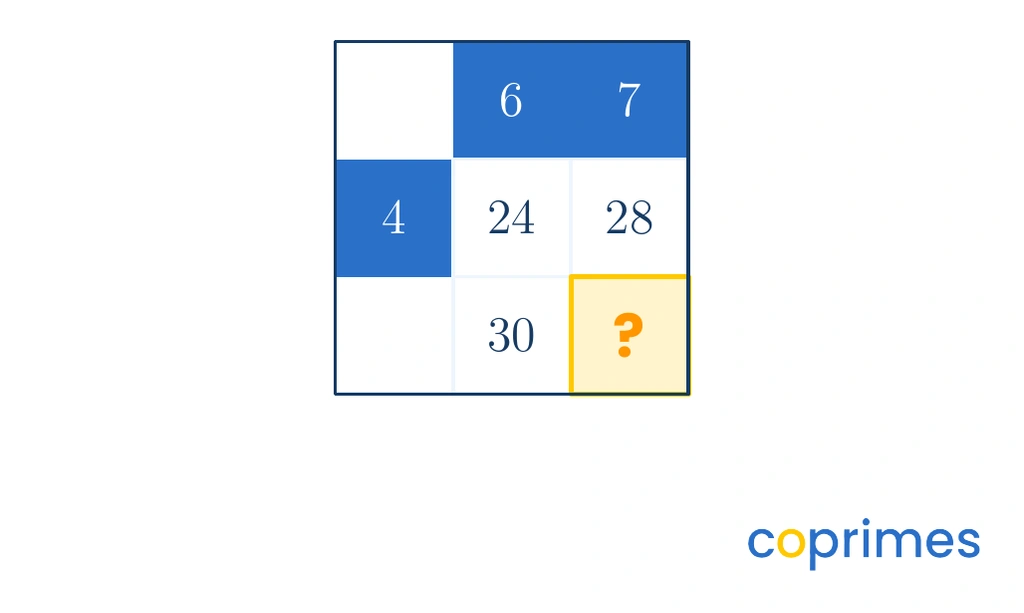
What number replaces the question mark in this times table snippet?
Which equation is NOT part of the fact family for , and ?
How can you use decomposition to find the fact ?
Add the products of and .
Add the products of and .
Multiply and subtract .
Multiply and add .
Add the products of and .