
Scale in Math: Definitions, Ratios, and Factors
A scale is a ratio comparing a model, map, or drawing with the actual object. A scale factor multiplies every corresponding length by the same number, preserving the shape's proportions. Understanding mathematical scale allows us to enlarge or reduce shapes consistently while keeping their geometry intact.
What is scale in math?
Scale describes how the size of a drawing, map, or model relates to the true size of the object it represents. When an object is too large to fit on a page or too small to see clearly, we use a scale to draw it proportionally.
The relationship between the drawing and the real object is expressed as a ratio. For example, a scale might show that one unit of length on paper represents a much larger number of units in the real world.
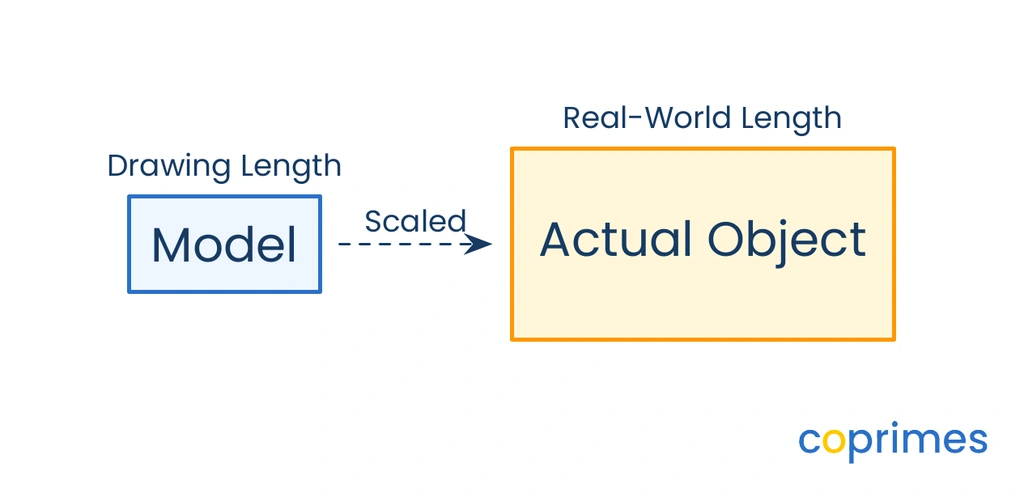
Every length in the scaled version changes by the exact same multiplier. This ensures the shape does not stretch or distort.
Read a scale ratio
A scale ratio compares the measurement on a model to the actual measurement. It is usually written in the format , meaning one unit on the drawing represents units in real life.
If a map scale is , then on the map represents in reality. Because both sides of the ratio use the same units, the scale applies equally to inches, meters, or any other measurement.
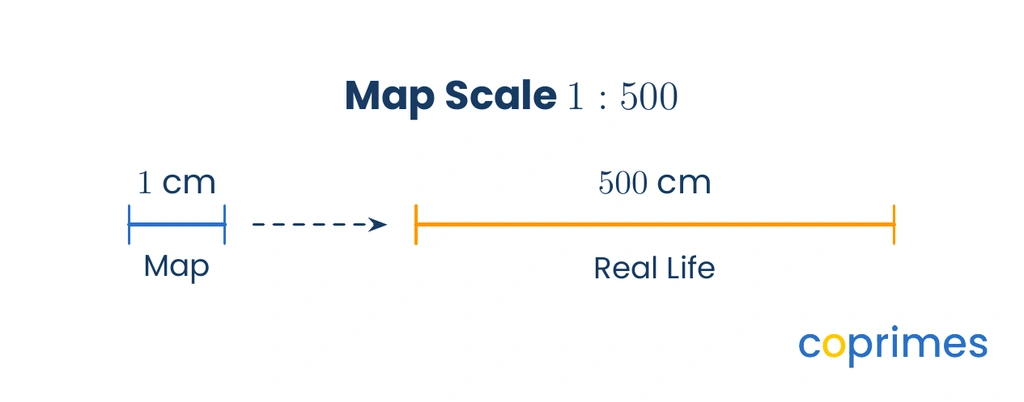
You can create equivalent ratios to find missing measurements. If represents , then represents . Multiplying both parts of the ratio by the same amount keeps the scale accurate.
Find a scale factor
A scale factor is the specific number used to multiply the original lengths to get the new lengths. While a scale ratio compares parts, the scale factor focuses on the operation of multiplication.
To find a scale factor, divide a length on the new shape by the corresponding length on the original shape.
Scale Factor Formula
Formula:
If an original square has a side length of and the scaled square has a side length of , the scale factor is . This means every side of the new shape is exactly three times as long as the original.

Enlarge and reduce consistently
Understanding scale factor basics allows you to predict whether a shape will grow or shrink. The multiplier determines the outcome of the scaling process.
- Enlargement: When the scale factor is greater than , the new shape is larger than the original.
- Reduction: When the scale factor is between and , the new shape is smaller than the original.
- Identical: When the scale factor is exactly , the shape remains unchanged.
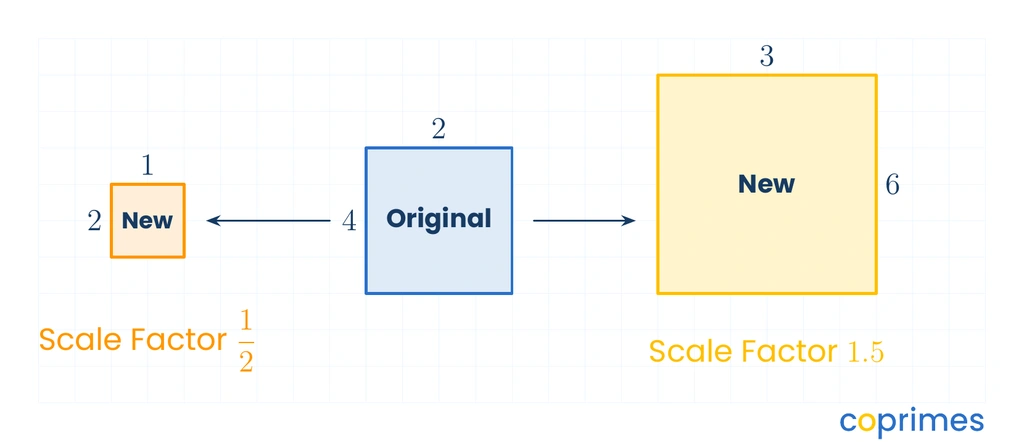
Every side must be multiplied by the same scale factor. If you multiply the height by but the width by , the shape distorts and the scaling is completely invalid.
Connect scale and similar shapes
When a shape is scaled correctly, the original shape and the new shape are mathematically similar. Similar shapes maintain a perfect proportion between their corresponding sides.
Two distinct geometric rules confirm that scaling creates similar shapes:
- Corresponding side lengths are proportional, connected by the exact same scale factor.
- Corresponding angles remain completely unchanged. A scaled right triangle still contains a angle, and an enlarged hexagon preserves all its interior angles.
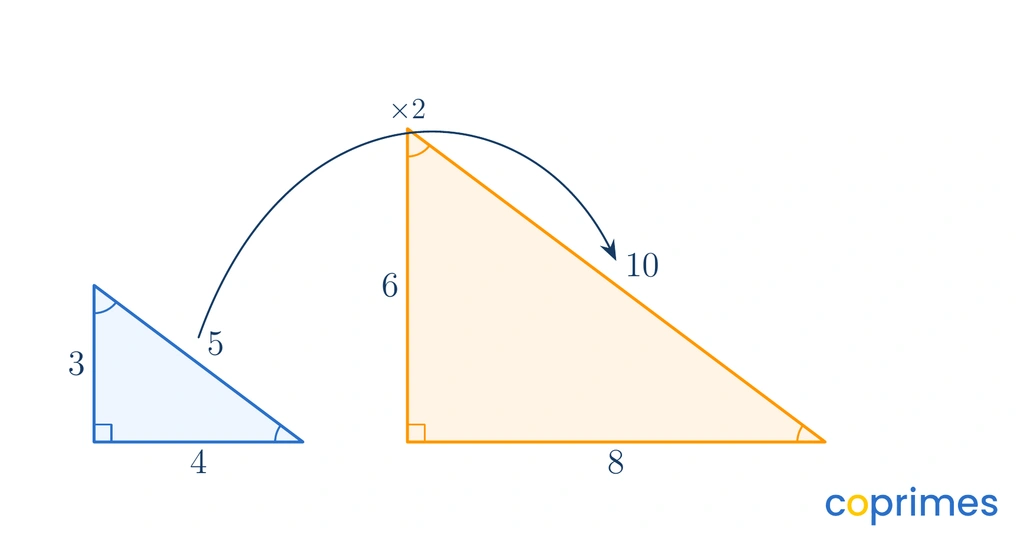
Understanding that scale strictly creates similar shapes guarantees that checking one side’s multiplier is enough to confirm the scale factor for the whole boundary.
Worked examples
These examples show how to interpret ratios, calculate scale factors, and determine real-world measurements accurately.
Example 1: Abstract rectangle enlargement
Question: A rectangle has a width of and a length of . It is enlarged by a scale factor of . What are the dimensions of the new rectangle?
Method:
- Identify the original dimensions: width , length .
- Identify the scale factor: .
- Multiply each original dimension by the scale factor.
New width:
New length:
Answer: The new dimensions are and .
Check: The ratio of the new sides is , which simplifies to the original proportions of . All corresponding lengths used the same multiplier.
Example 2: Using a map scale
Question: A map has a scale of . The distance between two towns on the map is . What is the actual distance in kilometers?
Method:
- Write the scale ratio: (map) represents (actual).
- Multiply the actual value by the map distance to find the real distance in centimeters.
- Convert centimeters to kilometers. Since there are in a meter and meters in a kilometer, there are in a kilometer.
Answer: The actual distance is .
Check: If is on the ground, then equals on the map. An extra () adds . . The logic holds.
Example 3: Finding a reduction scale factor
Question: A large portrait measures high and wide. It is reduced to fit onto a poster, where it measures high. What is the scale factor, and what is the new width?
Method:
- Use corresponding lengths to find the scale factor.
- Simplify the fraction.
or
- Apply the scale factor to the width to find the new width.
New width
Answer: The scale factor is and the new width is .
Check: and . Both the height and width have identical multipliers.
A learning plan shaped by your child, not the class
State-aligned Math plus our own Logic and English curriculum. An adaptive baseline test finds the gaps and fills them.
Common mistakes
When working with scale in math, avoid these common errors:
- Adding instead of multiplying: Scale is always multiplicative. If an original side is and the new side is , the rule is "multiply by ", not "add ". Adding the same amount to all sides distorts the shape.
- Reversing the formula: The scale factor is always the new length divided by the original length. Dividing the original length by the new length produces the inverse calculation, which gives the wrong result.
- Ignoring units in ratio scales: A scale expressed as a ratio like means units are identical on both sides. If you measure the drawing in inches, the actual length is inches. You cannot arbitrarily change one side to feet without performing a proper conversion.
Frequently asked questions
Do scale ratios need units?
No, a standard scale ratio like is unitless because it applies identically to any unit you choose. However, some scale drawings specify mixed units for convenience, such as "", which is treated as an equation rather than a strict ratio.
Can a scale factor be a fraction or a decimal?
Yes. A scale factor less than (like or ) indicates a reduction. Every length shrinks proportionally.
How do I handle complex scale conversions?
Using ratio tables can help organize the information. Place the drawing lengths in one column and the real-world lengths in another, then apply proportional reasoning to find missing values.
Practice questions
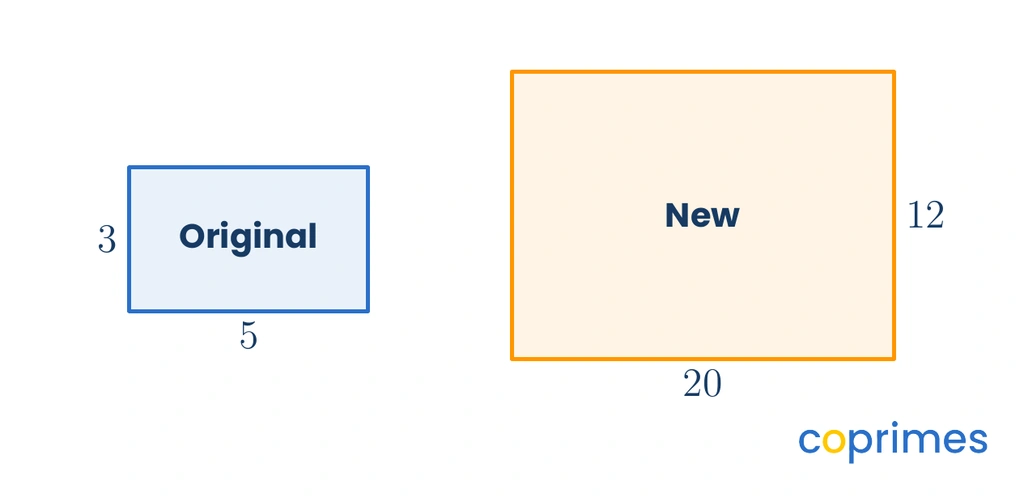
Based on the visual, what is the scale factor that maps the original rectangle to the new rectangle?
A map has a scale of . If a park on the map measures across, what is the true distance across the park in meters?
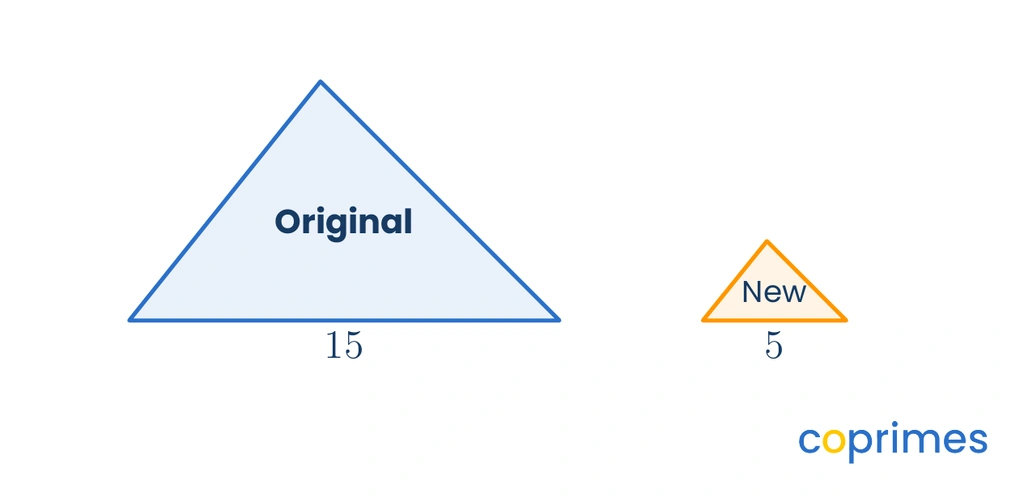
The original triangle is reduced to create the new triangle. What is the scale factor?
A student wants to create a scaled enlargement of a by rectangle. They decide to add units to both the width and the length, creating a by rectangle.
Which statement accurately describes the student's method?
The student correctly created an enlargement with a scale factor of .
The method works because adding the same amount preserves similarity.
The method is incorrect because scale factors require multiplying side lengths, not adding to them.
The method is incorrect because the student should have subtracted units instead.
The method is incorrect because scale factors require multiplying side lengths, not adding to them.
A model airplane has a length of . The true length of the actual airplane is . What is the scale ratio of the model to the actual airplane, written in simplest form?