
Understanding Square Numbers: Guide and Examples for Grades 5-8
A square number is the product of an integer multiplied by itself, and it can be physically represented as the area of a square array. Recognizing these special numbers is an essential mathematical foundation for calculating area, solving algebraic equations, and understanding the structure of multiplication.
What Are Square Numbers?
When you multiply any whole number by itself, the resulting product is a square number. Because their physical representations form perfect squares, these numbers are also commonly called perfect squares.
If you choose the integer and multiply it by , the product is . Therefore, is a square number.
A perfect square is the result of multiplying an integer by itself.
In mathematical notation, multiplying a number by itself is often written using exponents and powers. A small is placed to the top right of the base number, which is read aloud as "squared." For example, writing is exactly the same as writing .
Key Ideas and Vocabulary
The sequence of square numbers follows a predictable, growing pattern. The first five positive square numbers are , and . The gap between each consecutive square number increases by the next odd number.
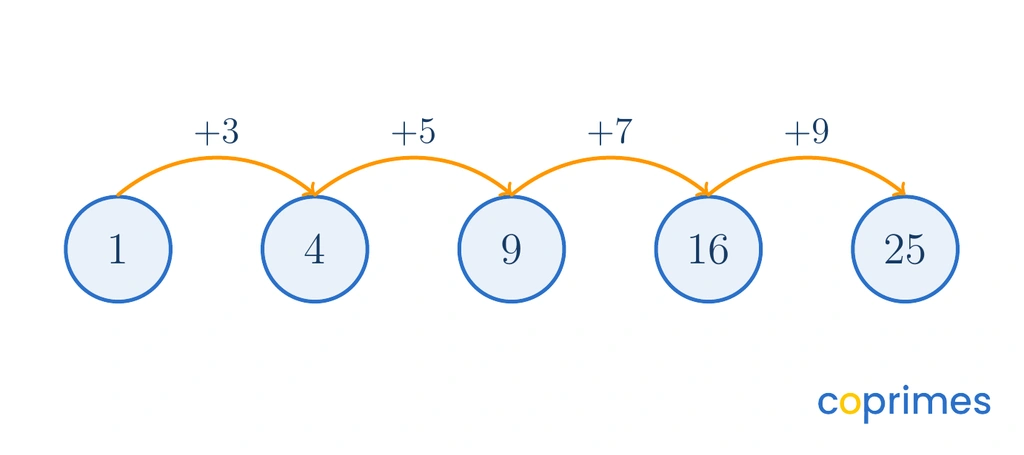
Every square number has an inverse relationship with square roots. While squaring a number builds it up through multiplication, finding the principal square root breaks it back down to its original positive integer base.
Because multiplying two negative numbers together results in a positive product, perfect squares can be generated from both positive and negative integers. For example, both and equal .
Visual Explanation
The term "square number" comes directly from geometry. If you take a perfect square number of objects, you can arrange them into a complete grid where the length and the width contain exactly the same number of items.
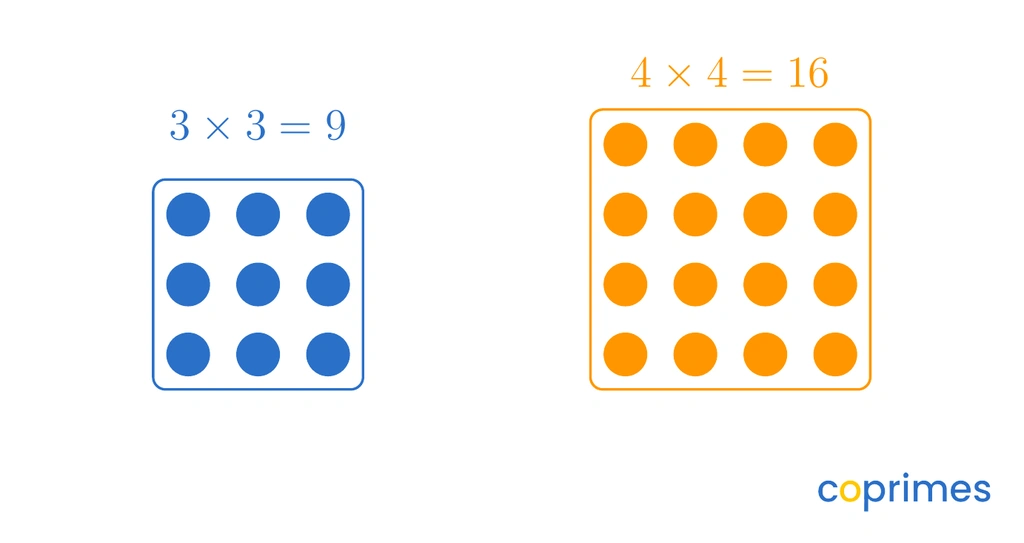
When a number is not a perfect square, its objects can only form rectangles or incomplete grids with leftover pieces. For example, objects can form a by rectangle, but they can never form a complete square grid.

Worked Examples
To find a square number, simply identify your base integer and multiply it by itself.
Example 1: Finding a square number
Question: What is the value of ?
Method:
- Identify the base number, which is .
- Multiply the base number by itself.
- Calculate the product of .
Answer: The value is .
Check: Use division to reverse the process. Since , the square calculation is verified.
Example 2: Continuing a pattern
Question: If the first three positive square numbers are , and , what is the fifth positive square number?
Method:
- Identify the base positions. The fifth square number comes from squaring the integer .
- Multiply by itself.
- Calculate .
Answer: The fifth square number is .
Check: Use the sequence difference pattern. The differences between the first squares are (from to ), (from to ), (from to ), and (from to ). The pattern holds perfectly.
Example 3: Squaring a negative integer
Question: What is the value of ?
Method:
- Identify the base, which is the negative integer .
- Set up the multiplication problem: .
- Multiply the numbers. Remember that a negative number multiplied by a negative number always results in a positive product.
- Calculate .
Answer: The square of is .
Check: Compare this to the positive integer square. Since and , the positive result is verified.
Common Mistakes and Non-Examples
A very common mistake is multiplying the base number by instead of multiplying the base number by itself. For example, a student might quickly calculate as . This is incorrect. The expression means , which is .
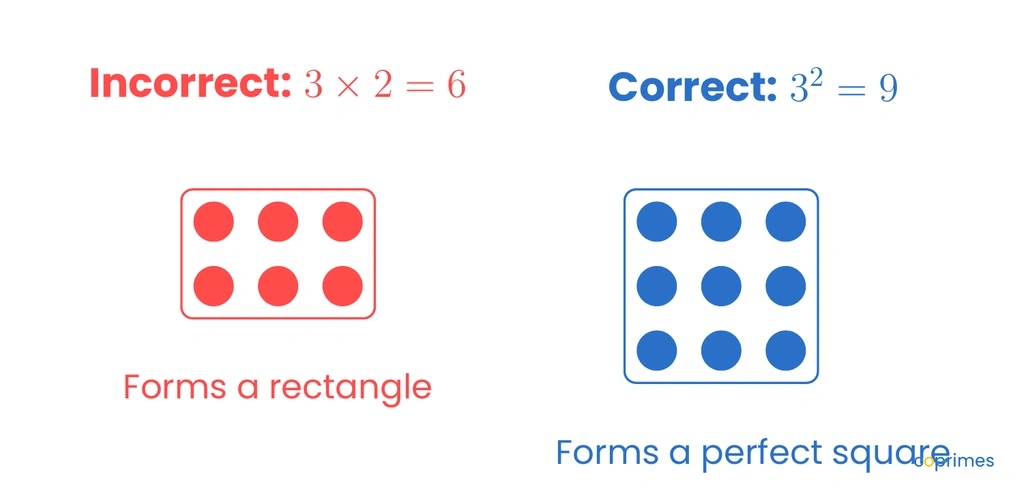
Always verify your answer by thinking about the area of a square. An area of creates a rectangle, which immediately tells you is a non-example and cannot be the correct answer for .
Real-World Connections
You use perfect squares whenever you calculate the area of a square room or the surface of a chessboard. Because a standard chessboard has squares along its length and squares along its width, it contains exactly total squares.
When you need to find a side length from a known area in geometry, you work backward by finding the square root. Advanced algebra heavily relies on these relationships when simplifying radicals. Once you master square numbers, you can explore three-dimensional volume by studying cube numbers, which involve multiplying a number by itself three times.
A learning plan shaped by your child, not the class
State-aligned Math plus our own Logic and English curriculum. An adaptive baseline test finds the gaps and fills them.
Practice questions
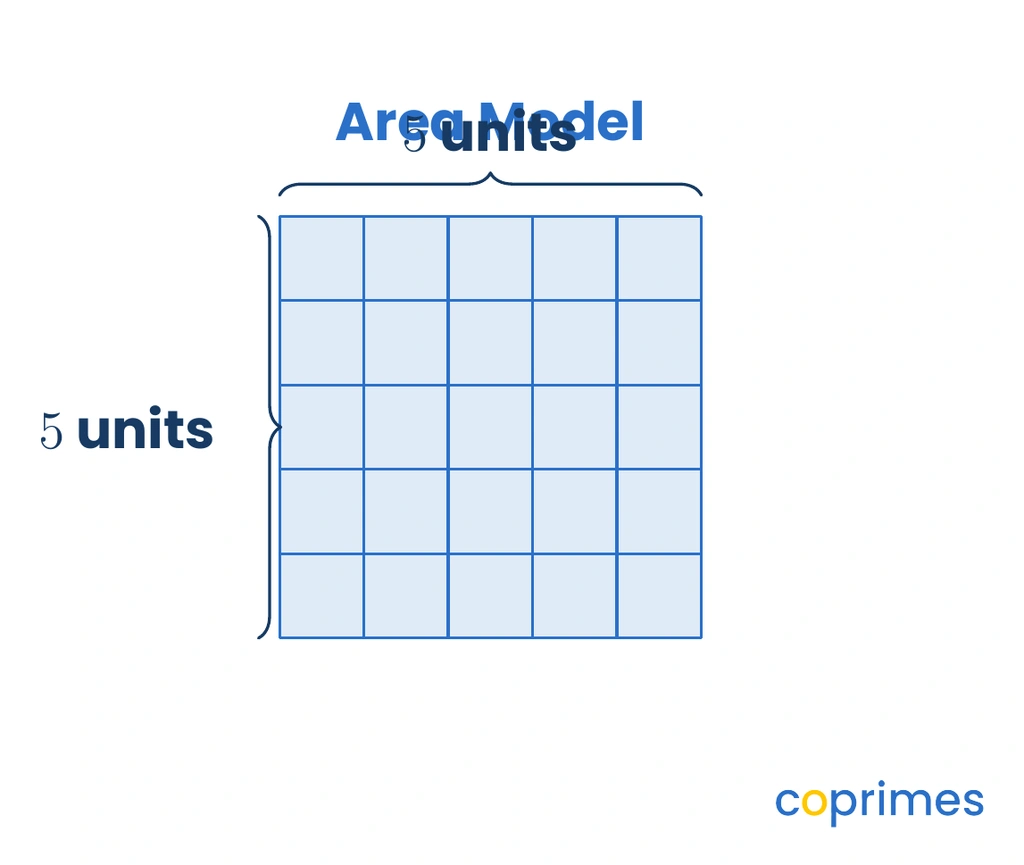
The visual shows a square array of blocks. What square number does this model represent?
Calculate the value of .
Which of the following is NOT a square number?
What is the difference between and ?
Why is the number considered a non-square number?
It cannot be arranged into a perfect square array.
It is an even number, and square numbers are always odd.
It is a multiple of , which cannot be squared.
It is too small to be a perfect square.
It cannot be arranged into a perfect square array.