
Cube Numbers: Guide and Examples
A cube number is the product of an integer used as a factor three times and can be represented by a cube of unit blocks.
When you multiply a whole number by itself, and then by itself again, the result is a cube number.
What Is Cube Numbers?
To understand cube numbers, you first need to know how exponents and powers work.
Cubing a number means raising it to the power of .
For example, cubing the number means calculating .
The small raised is the exponent, written as .
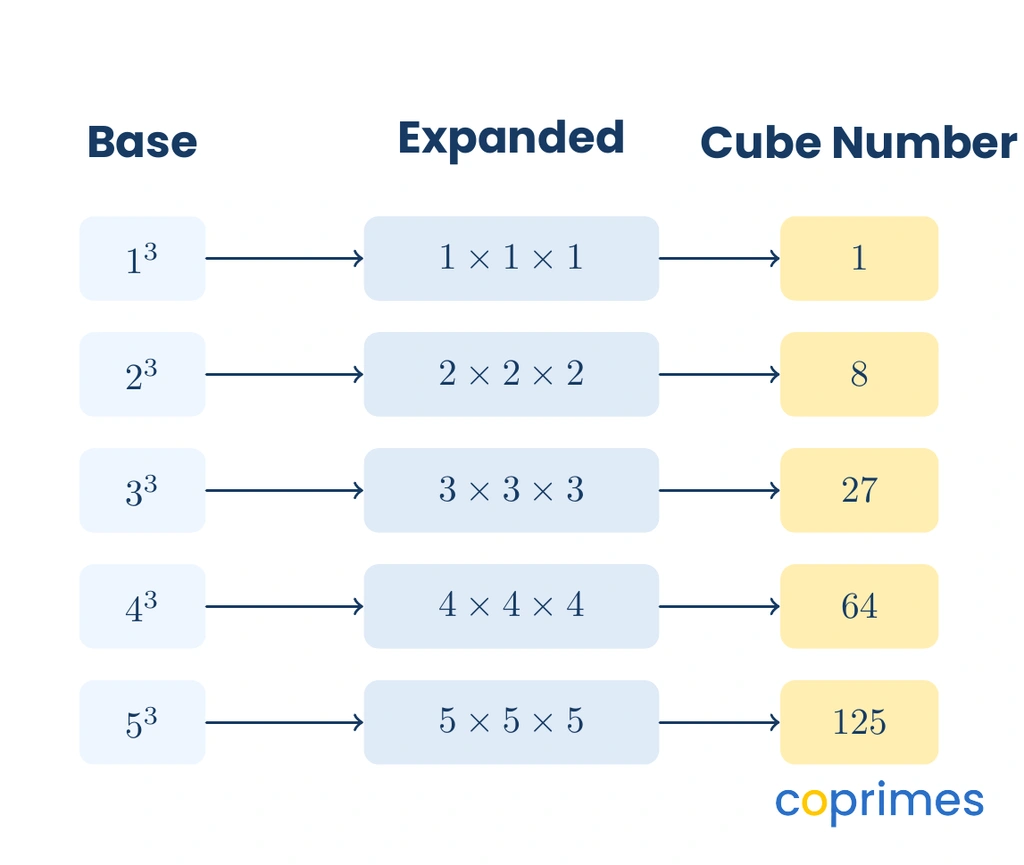
The first few positive cube numbers are , , , , and .
Because numbers go on forever, there is an infinite number of cube numbers.
Key Ideas and Vocabulary
Cube numbers are frequently referred to as perfect cubes or cubed numbers.
Just as square numbers are created by multiplying an integer by itself once (), perfect cubes require multiplying the integer as a factor three times ().
Cube numbers can also be negative.
When you multiply a negative integer by itself three times, the final product is negative. For instance, .
The reverse process of cubing a number is finding its cube roots, which identifies the original base integer.
This is similar to how square roots reverse squaring, a foundational skill you will use when simplifying radicals.
Visual Explanation
The name "cube number" comes directly from geometry.
If you build a solid cube out of smaller unit blocks, the total number of blocks you need will always be a perfect cube.
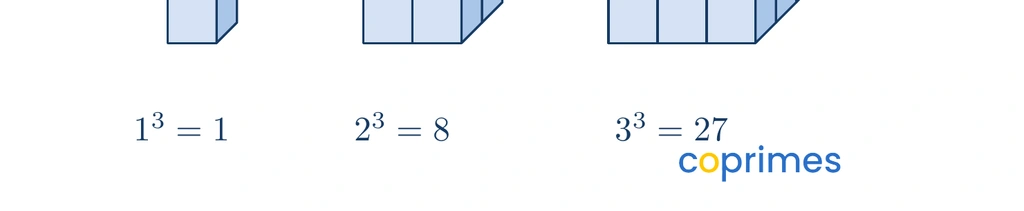
A cube with a side length of units requires exactly unit blocks to build ().
A cube with a side length of units requires exactly unit blocks to build ().
A learning plan shaped by your child, not the class
State-aligned Math plus our own Logic and English curriculum. An adaptive baseline test finds the gaps and fills them.
Worked Examples
These progressively harder cube numbers examples demonstrate how to correctly calculate and verify perfect cubes.
Example 1: Cubing a positive integer
Question: What is the value of ?
Method:
- Write the base number as a factor three times.
- Multiply the first two numbers together.
- Multiply that result by the third number.
First, write .
Next, calculate .
Finally, calculate .
Answer: .
Check: The volume of a geometric cube with a side length of is , which confirms the mathematical answer.
Example 2: Cubing a negative integer
Question: What is the value of ?
Method:
- Write the expression out fully: .
- Multiply the first two numbers: . (A negative times a negative equals a positive).
- Multiply by the third number: . (A positive times a negative equals a negative).
Answer: .
Check: You know that . Because a negative base raised to an odd power must be negative, the answer is correct.
Example 3: Checking for a perfect cube
Question: Is a perfect cube?
Method:
- Identify known cube numbers near the target number.
- Calculate : .
- Calculate : .
The number falls between the perfect cubes and .
Because there is no integer between and , no integer can be cubed to make exactly .
Answer: No, is not a perfect cube.
Check: If you factor , you get . A perfect cube requires every prime factor to appear in groups of three.
Common Mistakes and Non-Examples
The most common mistake when evaluating powers is multiplying the base by the exponent instead of using the base as a repeated factor.
For example, some students see and calculate .
However, actually means , which equals .
Non-Example: Mistaking multiples for powers
The number is a multiple of , but it is a non-example of a perfect cube.
There is no integer you can multiply by itself three times to equal .
Real-World Connections
Cube numbers are essential when calculating volume in the real world.
Any time a storage container, shipping box, or water tank has equal length, width, and height, its total volume is a perfect cube.

If a cubic box measures on all sides, its volume is or .
This principle is also used in manufacturing standard dice, ice cubes, and sugar cubes, ensuring they are symmetrical in all three dimensions.

Practice questions

Based on the visual, which cube number represents the total number of small blocks used to build this object?
What is the correct value of ?
Which of the following numbers is a perfect cube?
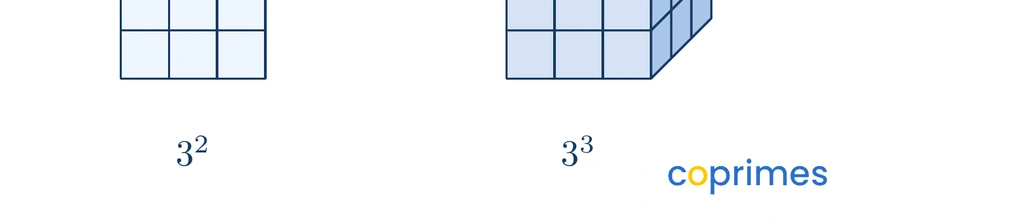
Which of the following statements correctly describes the difference between and as shown in the diagram?
The expression means , while means .
The expression creates a flat square of units, while creates a solid cube of units.
Both expressions represent a flat square shape, but is a larger square.
The expression has units, and has units.
The expression creates a flat square of units, while creates a solid cube of units.
A cubic container holds exactly of liquid. If all of its side lengths are equal whole numbers, what is the length of one side?