
Unit Price: Finding Cost Per Unit
Unit price is the cost for one unit of an item or quantity. Divide the total cost by the number of items or amount, keep the cost-per-unit label, and compare like units when choosing between options.
Knowing the cost of a single unit helps you make smart decisions when shopping or solving mathematical problems.
What is unit price?
The unit price, often called the unit cost, is the exact cost for one single unit of an item or measurement. A unit can be one individual item, one unit of mass like a kilogram, or one unit of volume like a liter.
Unit price is a type of unit rate that specifically involves money. Finding this value allows you to understand exactly what you are paying for every single piece or amount you receive in a larger package.
A unit price always describes the cost of exactly one unit.
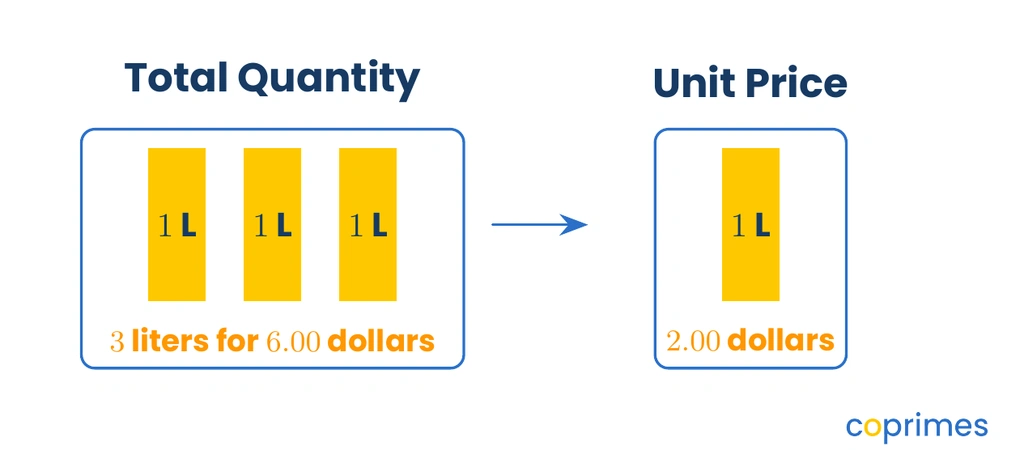
For example, if you buy a large bag of apples, the total price is what you pay for the whole bag. The unit cost is the amount you pay for just one apple inside that bag.
Calculate a price per one unit
To calculate the cost per unit, divide the total cost by the total quantity.
The process for finding a unit rate works the same way when money is involved. You will always set up a division problem where the total cost is the numerator and the total amount is the denominator.
Formula: Unit Price = Total Cost ÷ Total Quantity
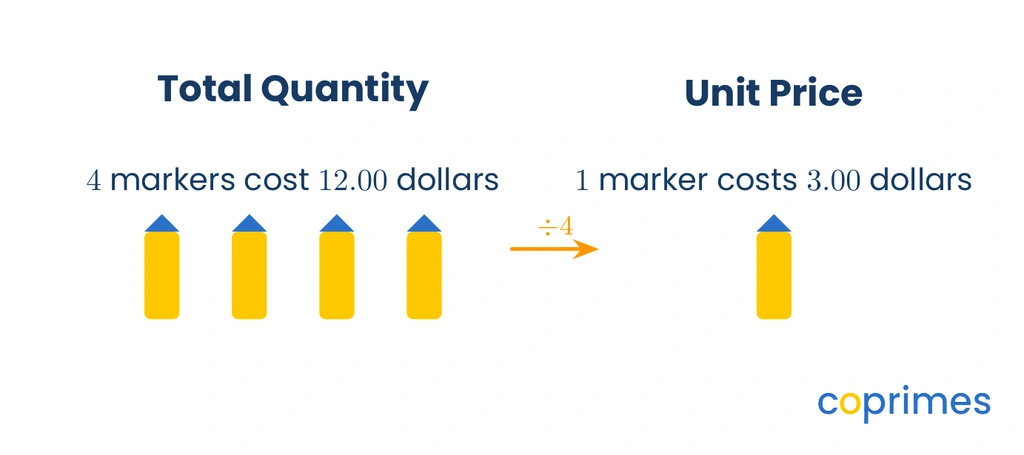
Always keep the descriptive label on your final answer so it is clear what you found. If you divide dollars by liters, your answer is in dollars per liter.
Compare like units
When evaluating different options, you must ensure both items are measured using the exact same units before you compare them.
By comparing ratios in their simplified unit forms, you can instantly see which deal offers the most value. You cannot fairly compare a price per gram to a price per kilogram without converting one of them first.
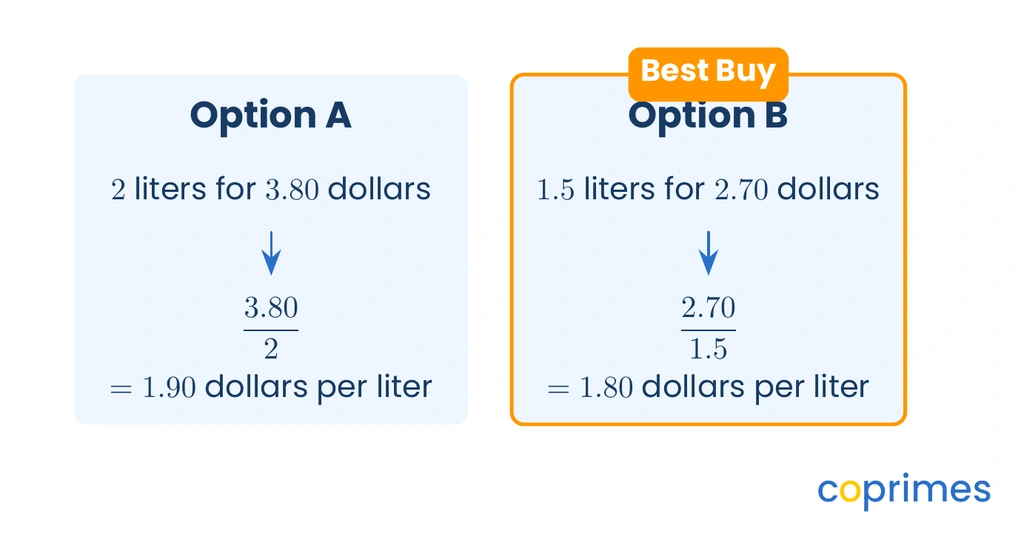
Once both prices are calculated using the exact same unit size, the comparison becomes straightforward and accurate.
A learning plan shaped by your child, not the class
State-aligned Math plus our own Logic and English curriculum. An adaptive baseline test finds the gaps and fills them.
Choose a best buy carefully
Comparing unit prices allows you to determine the best buy or the most value for your money.
The mathematically best buy is always the option that has the lowest cost per unit. Finding it requires doing the division for every available option, because the total price alone can be misleading.
Consider context beyond price
The lowest price per unit is not always the best choice in everyday situations. While finding the best buy is mathematically sound, you must also evaluate your real-world needs.
If you buy a large quantity of fresh food because it has a lower unit cost, it might spoil before you can eat it. Storing bulk items also requires physical space that you might not have. The mathematically best buy is only a true bargain if you actually need and can use the entire amount before it goes to waste.
Worked examples
Applying these steps to math word problems will help you practice finding the true cost of items.
Example 1: Finding a basic unit price
Question: A box containing identical toy cars costs dollars. What is the unit price of one toy car?
Method:
- Identify the total cost ( dollars) and the total quantity ( cars).
- Divide the total cost by the quantity to find the price for one unit: .
Answer: The unit price is dollars per car.
Check: Multiply the unit price by the number of cars: dollars.
Example 2: Choosing the best buy
Question: Which is the better deal: liters of milk for dollars, or liters of milk for dollars?
Method:
- Calculate the unit price for the first option: dollars per liter.
- Calculate the unit price for the second option: dollars per liter.
- Compare the two unit prices to find the lower cost per liter.
Answer: The liters of milk for dollars is the best buy because dollars is less than dollars.
Check: Find the cost of liters for both options by multiplying. First option: dollars. Second option: dollars. The first option remains cheaper.
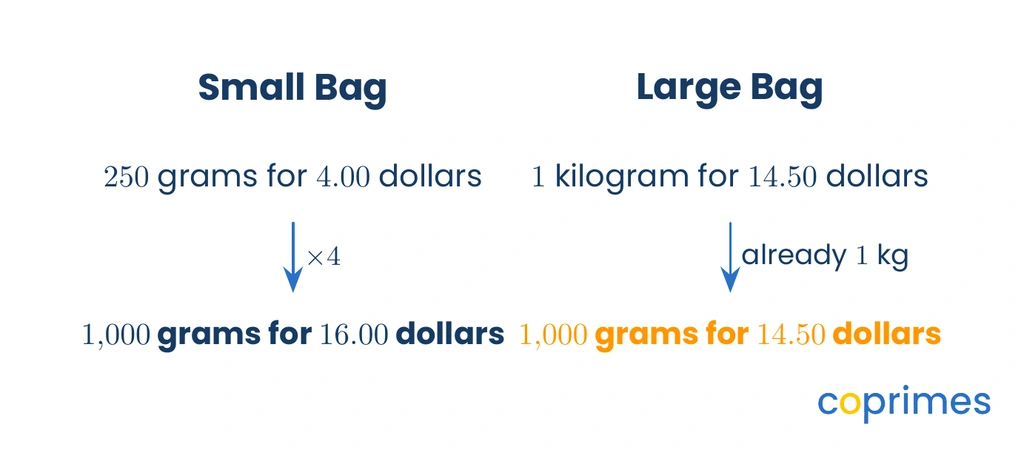
Example 3: Comparing with different unit sizes
Question: A -gram bag of almonds costs dollars. A -kilogram bag of the same almonds costs dollars. Which is the best buy?
Method:
- Convert the units so they match. Since kilogram equals grams, find the price per kilogram for the small bag.
- The small bag is grams, which is of a kilogram. Multiply its price by : dollars per kilogram.
- The unit price of the large bag is already dollars per kilogram.
- Compare the two prices per kilogram.
Answer: The -kilogram bag for dollars is the best buy.
Check: Compare based on grams instead. For the larger bag, dollars per grams, which is less than dollars.

Common mistakes
Dividing the quantity by the total price.
The correct formula for a price per unit requires the cost to be the numerator. If you divide the quantity by the price, you are calculating how many items you get for one dollar, not how many dollars it costs for one item.
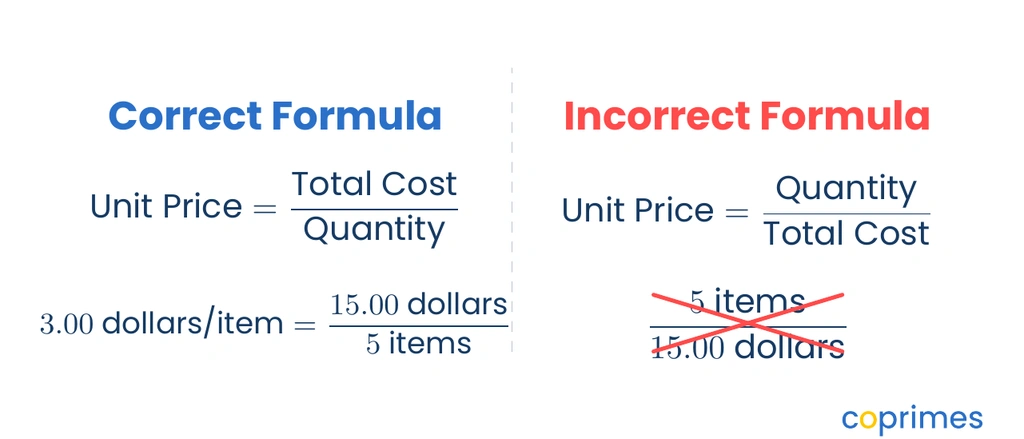
Assuming a lower total price guarantees a lower unit price.
A small package usually costs less overall than a large package, but its price per unit is often higher. You must always do the mathematical division to know for sure.
Failing to convert different units.
You cannot accurately compare a price per gram directly to a price per kilogram without converting one of the measurements first.
Frequently asked questions
How is unit price different from total price?
Total price is the complete amount you pay for a group of items or an entire package. Unit price breaks that total down to show exactly what one single piece, liter, or kilogram inside that package costs.
Can unit price be a decimal?
Yes. Because money is frequently divided into smaller parts like cents, a unit cost is very often represented as a decimal.
Is unit cost the same as unit price?
Yes. Both terms describe exactly the same mathematical concept: the specific amount of money required to buy exactly one unit of a product.
Practice questions
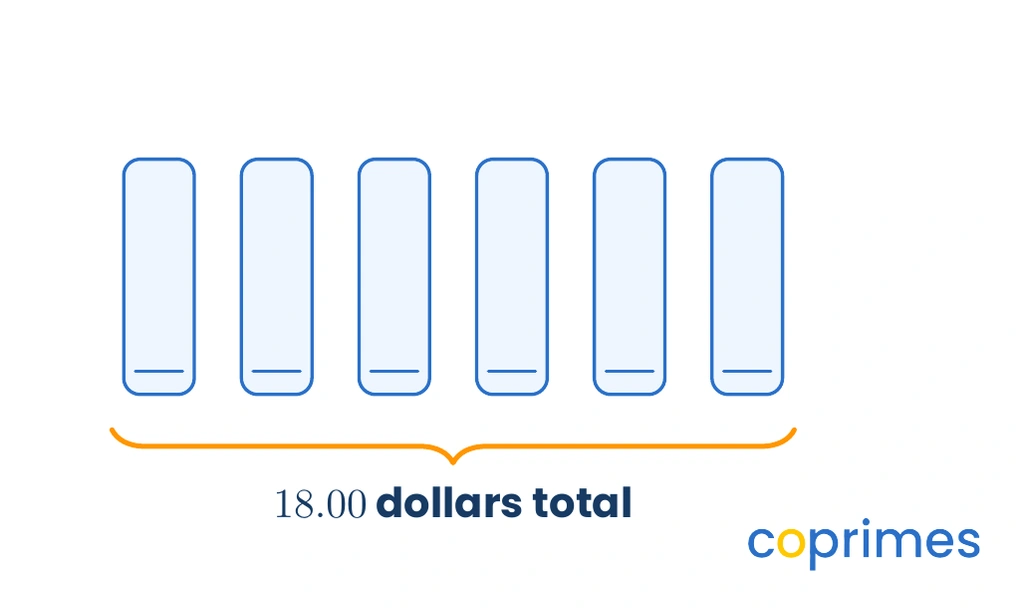
A store sells identical notebooks for dollars. What is the unit price of one notebook?
dollars
dollars
dollars
dollars
dollars
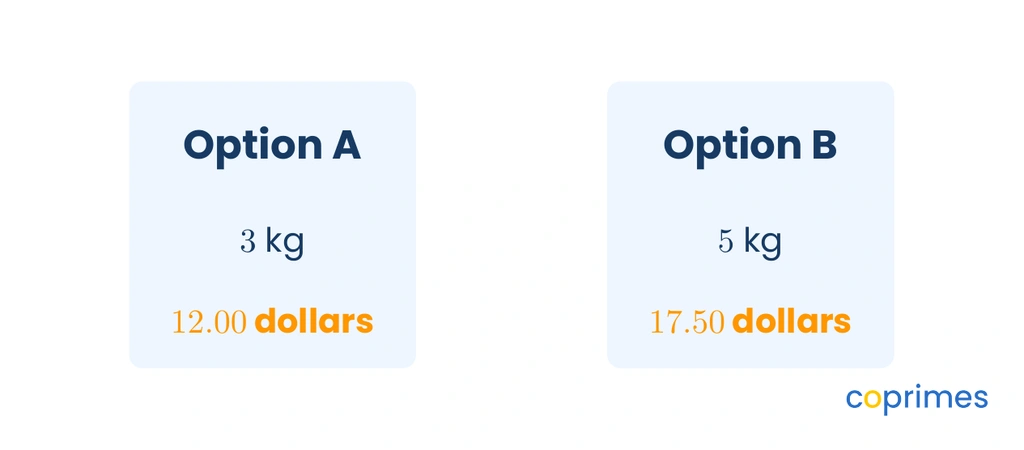
Which option shown in the diagram is the mathematically best buy?
Option A because the total price is lower.
Option A because the unit price is dollars per kg.
Option B because the unit price is dollars per kg.
Option B because you get more mass.
Option B because the unit price is dollars per kg.
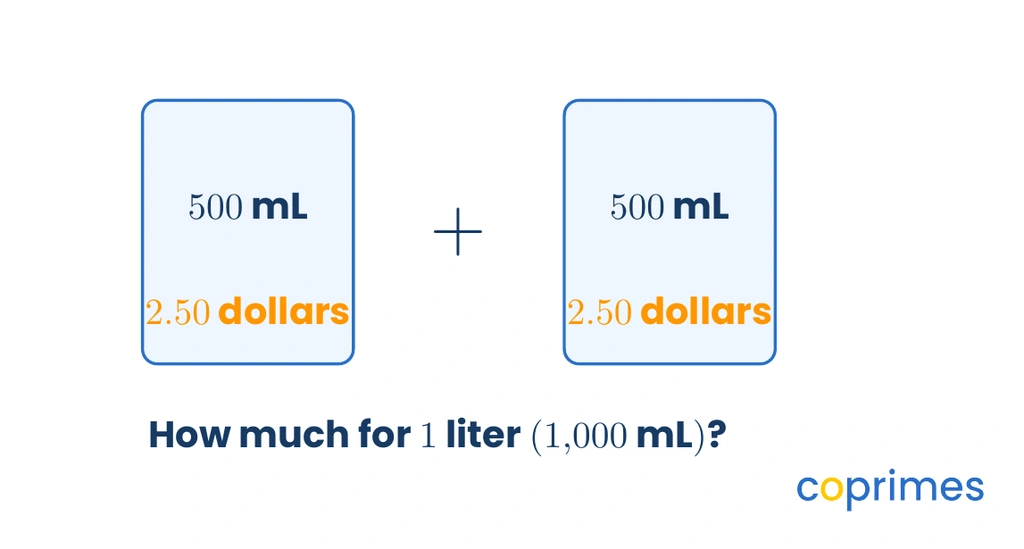
A bottle contains milliliters of juice and costs dollars. What is the unit price per liter?
dollars per liter
dollars per liter
dollars per liter
dollars per liter
dollars per liter
A student calculates the unit price of pencils that cost dollars by dividing by , getting dollars per pencil. What is the error?
The student should have multiplied by .
The student divided the quantity by the total price instead of the total price by the quantity.
The unit price should be pencils per dollar.
There is no error; the calculation is correct.
The student divided the quantity by the total price instead of the total price by the quantity.
A streaming service costs dollars for months. A second streaming service costs dollars for months. Which service has the lower unit price per month, and what is it?
The first service at dollars per month.
The second service at dollars per month.
Both services cost the same per month.
The second service at dollars per month.
The second service at dollars per month.