
Benchmark Fractions: Definition, Estimation, and Comparison
Benchmark fractions are familiar, easy-to-visualize reference values, such as , , and , that help make sense of other fractions. They allow you to quickly estimate, compare, and order fractions without needing exact calculations or common denominators.
What are benchmark fractions?
Benchmark fractions act as mathematical signposts. When a fraction contains large or unusual numbers, visualizing its exact size can be difficult. By comparing it to a known benchmark fraction, you can easily grasp its approximate value.
A benchmark fraction is a standard reference point used to estimate the size of other fractions.
For example, it is hard to picture exactly how much is. However, because is exactly
half of , you know that equals . Therefore, is just slightly larger than one half.
Common benchmarks: zero, one half and one
While any familiar fraction like or can serve as a benchmark, the most common benchmarks used in estimating calculations are , , and .
Visual models, such as fraction strips, show how these benchmarks relate to one another and help identify equivalent fractions. For instance, the benchmark covers the exact same area as , , or .
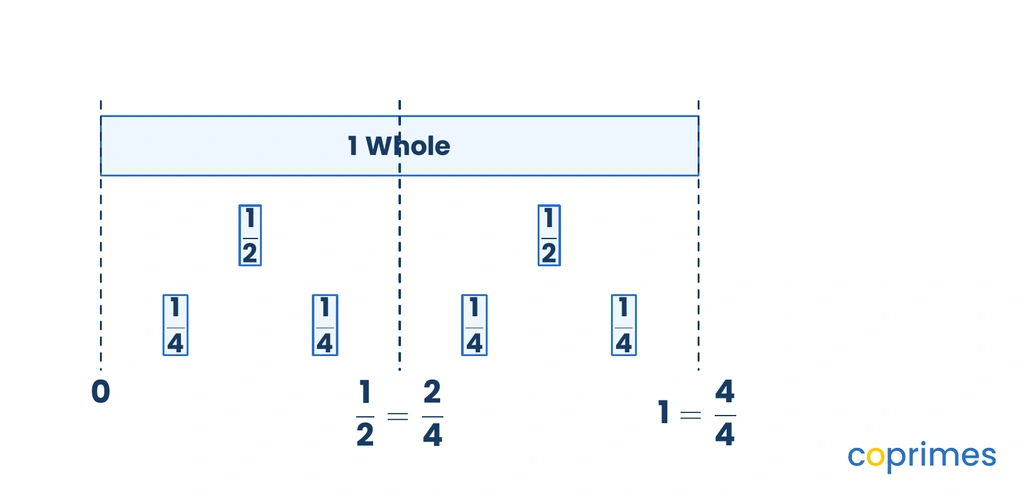
When comparing a fraction to these core benchmarks, consider the relationship between the numerator and the denominator:
- Close to : The numerator is very small compared to the denominator. For example, or .
- Close to : The numerator is about half of the denominator. For example, or .
- Close to: The numerator is very close in size to the denominator. For example, or .
Compare to one half
Comparing a fraction to one half is the most powerful benchmark strategy. Because every number has a halfway point, you can evaluate any fraction by finding half of its denominator.
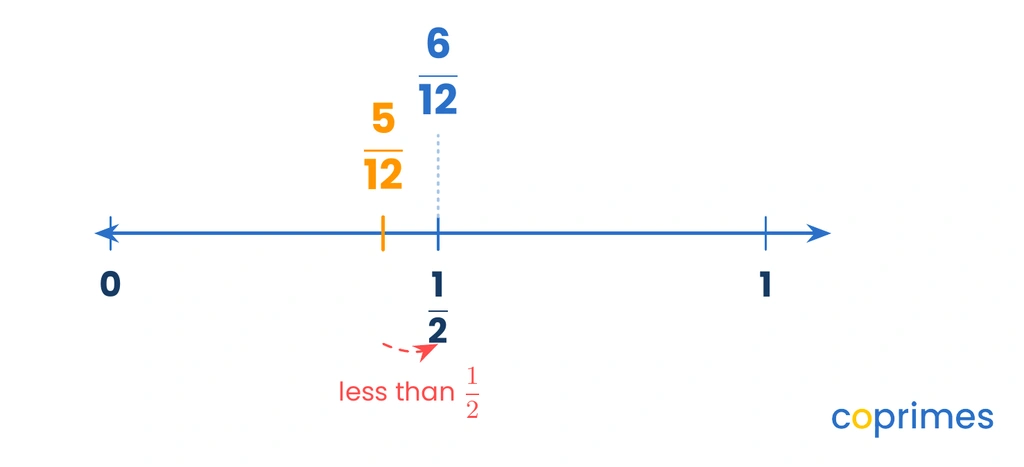
To compare a fraction to :
- Find half of the fraction's denominator.
- Form an equivalent fraction representing using that denominator.
- Compare the original numerator to your new halfway numerator.
If the original numerator is smaller, the fraction is less than . If it is larger, the fraction is greater than .
A learning plan shaped by your child, not the class
State-aligned Math plus our own Logic and English curriculum. An adaptive baseline test finds the gaps and fills them.
Estimate with benchmarks
When working with messy fractions, rounding them to the nearest benchmark fraction simplifies addition and subtraction. To decide which benchmark is closest, check where the fraction falls in relation to , , and .
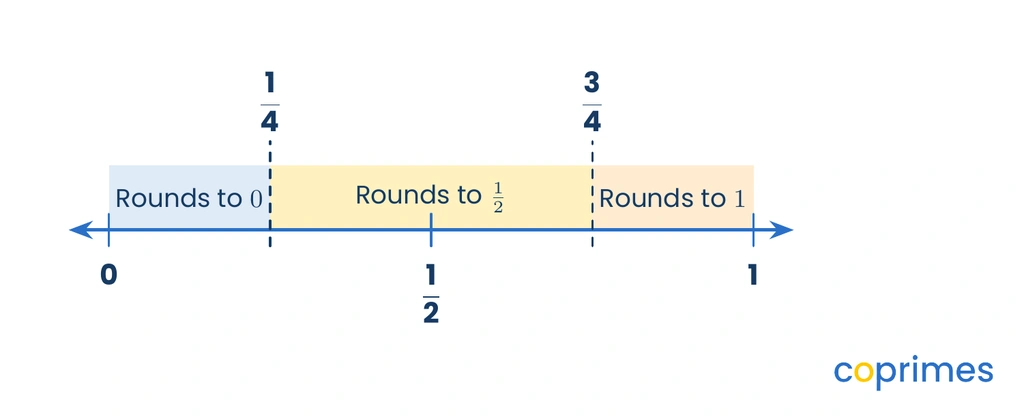
- Fractions smaller than round to .
- Fractions between and round to .
- Fractions greater than round to .
For example, rounds to , rounds to , and rounds to .
Use benchmarks on a number line
Plotting fractions on a number line becomes much easier when you use benchmarks as guideposts. Before marking the exact position of a fraction, always mark , , and .
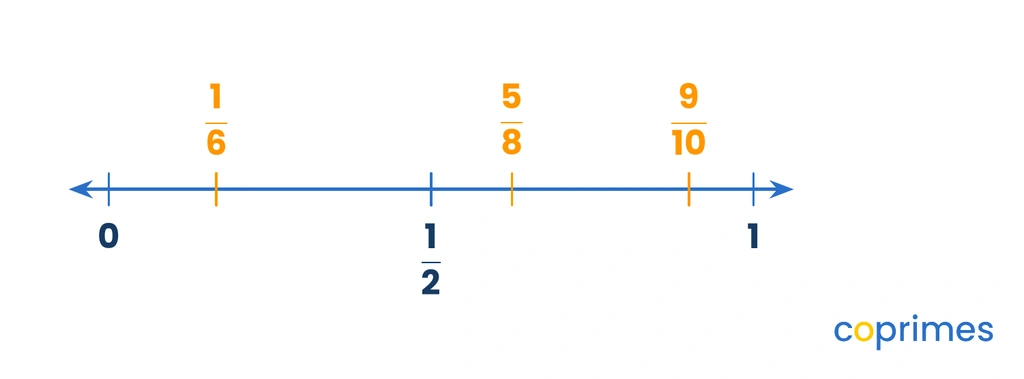
Once the benchmarks are in place, determine which two benchmarks the fraction falls between. This prevents major placement errors and shows relative size immediately, helping with comparing fractions and effectively ordering fractions.
Worked examples
Example 1: Comparing to a benchmark
Question: Is less than, greater than, or equal to ?
Method:
- Identify the benchmark fraction you need, which is .
- Find an equivalent fraction for that has the same denominator as . Half of is , so .
- Compare the numerators: is less than .
Answer: is less than .
Check: Since is less than half of , the fraction must naturally be smaller than one half.
Example 2: Rounding to the nearest benchmark
Question: Round to the nearest common benchmark fraction.
Method:
- Determine the common benchmarks: , , and .
- Express the benchmarks using the denominator : , , and .
- Compare the given numerator () to the benchmark numerators (, , and ).
- The numerator is only unit away from , making it closest to .
Answer: rounds to .
Check: On a number line, is well past the halfway mark of and is just one piece away from a complete whole.
Example 3: Ordering using benchmarks
Question: Order the fractions , , and from least to greatest using benchmarks.
Method:
- Compare each fraction to the benchmarks , , and .
- : The numerator is very small compared to , so it is close to .
- : The numerator is almost equal to the denominator, so it is close to .
- : Half of is . Since is very close to , the fraction is close to .
- Order the fractions based on their benchmark values: near , near , near .
Answer: From least to greatest, the order is , , and .
Check: Finding an exact common denominator for , , and would be slow, but benchmark estimation confirms the relative sizes securely.

Common mistakes
- Overusing benchmarks for close fractions: Benchmarks are tools for estimation. If two fractions are on the same side of a benchmark and very close in value (such as and ), comparing them to will not reveal which is larger. Both are slightly less than . In these cases, you must find a common denominator.
- Ignoring the denominator: Some learners assume that a numerator of always means the fraction is close to . While is close to , is exactly half. The numerator must always be evaluated relative to its specific denominator.
Frequently asked questions
What is the purpose of using fraction strips?
Fraction strips provide a concrete visual model that helps you see the actual size of a fraction. They make it easier to understand how smaller pieces combine to make a whole and clearly show equivalent fractions aligned directly with benchmarks.
What does comparing fractions using benchmarks mean?
It means using familiar reference fractions to decide if one fraction is less than, greater than, or equal to another, rather than calculating exact common denominators.
What is the difference between benchmark fractions and benchmark numbers?
Benchmark fractions are reference parts of a whole, such as or . Benchmark numbers refer to familiar whole numbers, often multiples of or , used to easily estimate large sums and differences.
Practice questions
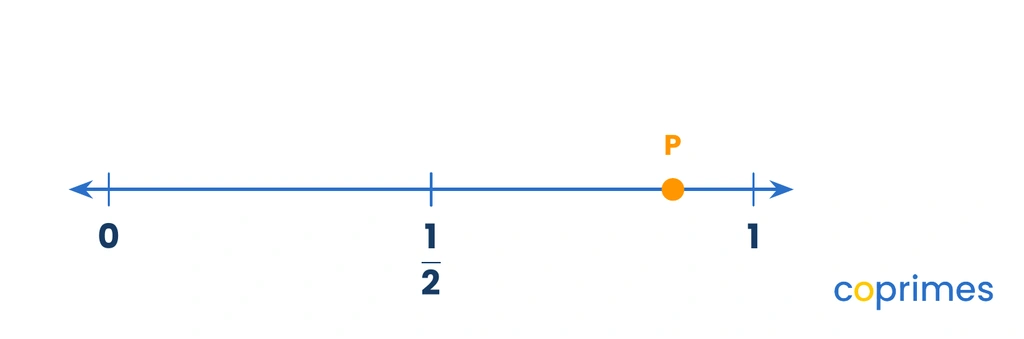
Which benchmark fraction is point P plotted closest to?
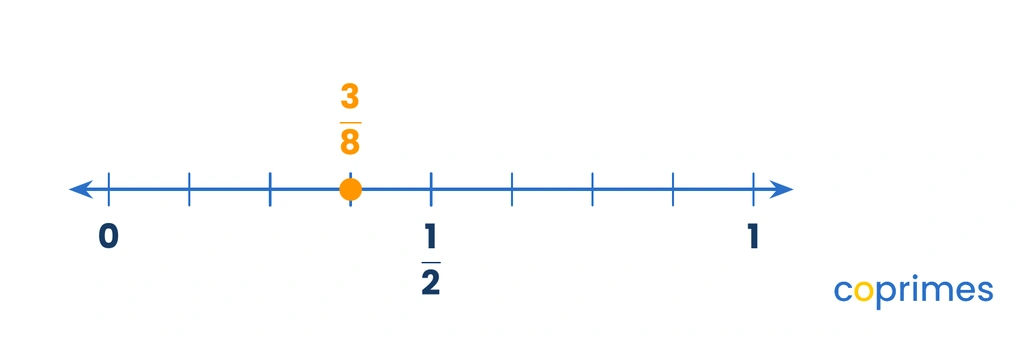
Use the number line to determine which statement correctly compares to the benchmark .
because is greater than .
because is less than the equivalent fraction .
because both fractions are less than .
because eighths are larger than halves.
because is less than the equivalent fraction .
Which fraction rounds to the benchmark ?
Why is it unhelpful to use the benchmark to compare and ?
Both fractions are greater than , so the benchmark does not separate them.
Both fractions are less than , so the benchmark does not separate them.
Benchmarks can only be used with even denominators.
The fraction is equivalent to , but is not.
Both fractions are less than , so the benchmark does not separate them.
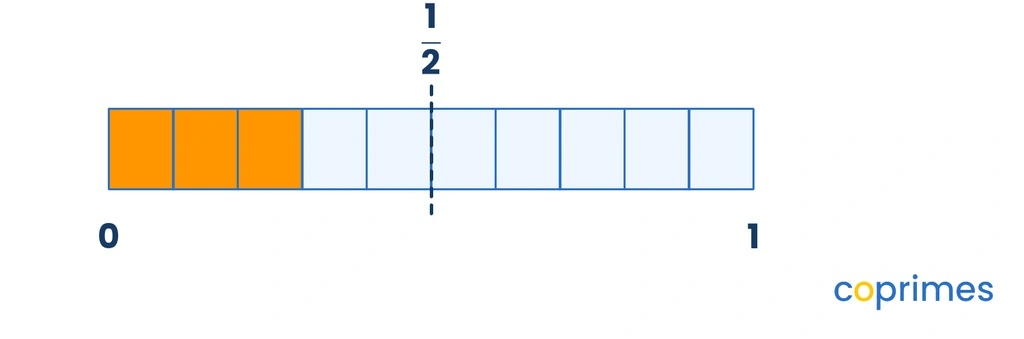
The fraction strip above is divided into ten equal parts with a shaded section. How does the shaded fraction compare to the benchmark ?
It is greater than because parts are shaded.
It is less than because the shaded area does not reach the halfway line.
It is exactly equal to .
It is greater than because tenths are small pieces.
It is less than because the shaded area does not reach the halfway line.