
Comparing Fractions: Definition, Method and Examples
To compare fractions is to determine which fraction represents a larger, smaller, or equal portion of the same whole. You can determine the greater value by using visual models, comparing to a benchmark, finding a common denominator, or plotting the fractions on a number line.
How do you compare fractions?
Comparing fractions means checking their sizes against one another using inequality symbols. Once you understand how to compare two values, you can apply the same rules for ordering fractions in a longer list.
When comparing fractions, the pieces must refer to the same-sized whole. For example, half of a large pizza is physically larger than half of a small pizza, even though both represent of their respective pizzas.
We use standard mathematical symbols to state the relationship:
- means strictly greater than.
- means strictly less than.
- means exactly equal to.
Always verify that fractions refer to the same whole before comparing them.
Same denominators
When two fractions have the same denominator, their pieces are the exact same size.
To compare them, you only need to look at the numerators. The fraction with the greater numerator is the larger fraction because it has more of those equal-sized pieces.
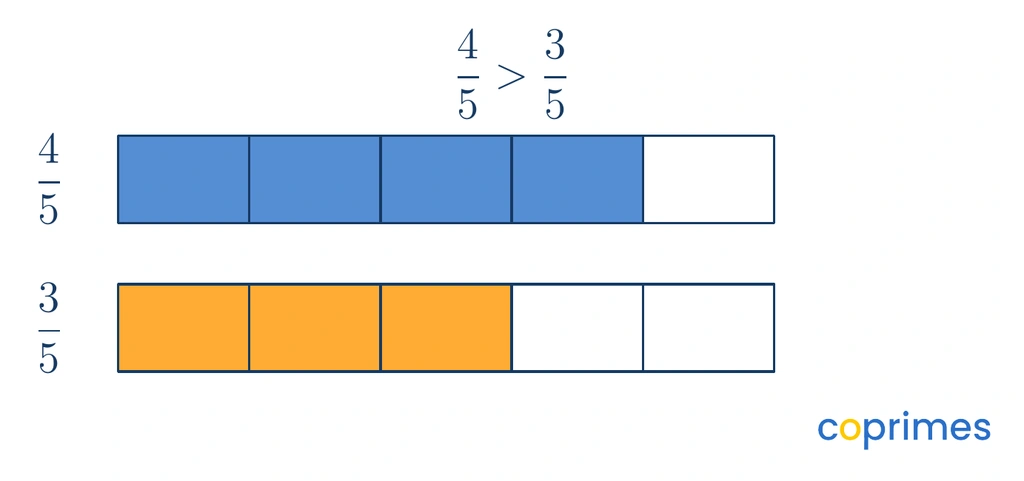
Since the denominators in and are both , the pieces are the same size. Because is greater than , is the larger fraction.
Same numerators
If two fractions have the same numerator, you are comparing the same number of pieces.
However, the pieces are different sizes. A larger denominator means the whole is divided into more pieces, making each individual piece smaller. Therefore, when the numerators are identical, the fraction with the smaller denominator is actually the larger fraction.
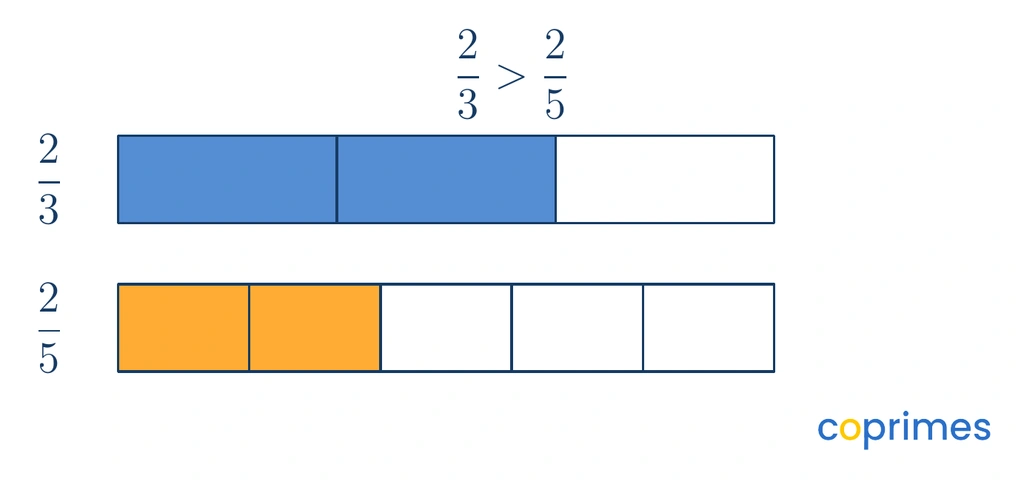
In and , both fractions represent two parts. Because thirds are larger pieces than fifths, is greater than .

Compare to benchmarks
When two fractions have different numerators and denominators, you can often compare them to familiar benchmark fractions such as or .
For example, to compare and , consider their relationship to :
- Half of is , so is exactly . This means is less than .
- Half of is , so is exactly . This means is greater than .
Because is less than half and is more than half, you can conclude without further calculation that .
Compare unlike denominators
If you cannot easily use a benchmark, you must rewrite the fractions so they share a common denominator. This gives the fractions pieces of identical size, allowing direct comparison.
To do this, use equivalent fractions to change the denominator of one or both numbers.
- Find a common multiple for both denominators.
- Multiply the numerator and denominator of each fraction by the factor needed to reach that common multiple.
- Compare the new numerators.
For example, to compare and , find a common multiple of and . The number is a multiple of both.
Convert : multiply the numerator and denominator by to get .
Convert : multiply the numerator and denominator by to get .
Now compare and . Since is greater than , is larger. Therefore, .
Use a number line
Another powerful method is placing the fractions on a number line. This visual approach connects fraction values directly to distance from zero.
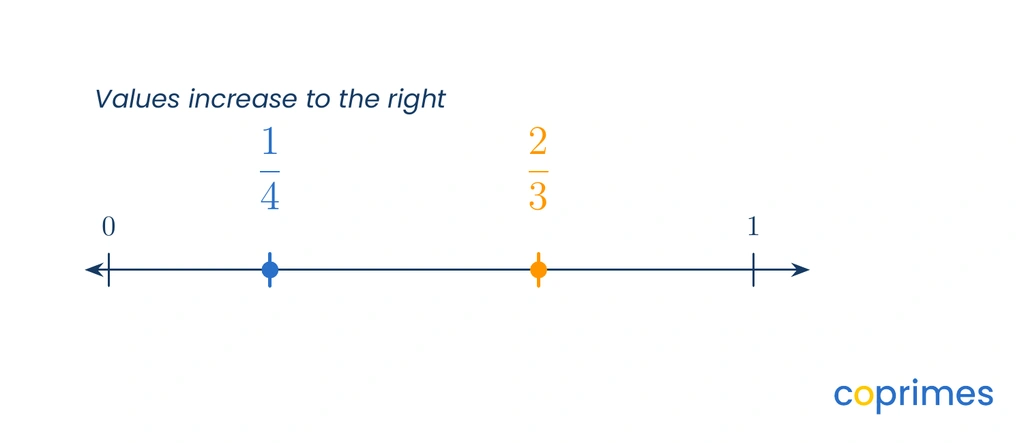
Any fraction positioned further to the right on a horizontal number line represents a greater value. By evaluating and , you can visually confirm that is further from zero, meaning .
A learning plan shaped by your child, not the class
State-aligned Math plus our own Logic and English curriculum. An adaptive baseline test finds the gaps and fills them.
Worked examples
Review these examples to see fraction comparison strategies applied step by step.
Example 1: Using the same numerator rule
Question: Which is greater: or ?
Method:
- Observe that both fractions have the same numerator, .
- Compare the denominators. The denominators are and .
- Because is less than , eighths are larger pieces than twelfths.
Answer: is greater.
Check: Since pieces of a larger size are more than pieces of a smaller size, the logic holds.
Example 2: Finding a common denominator
Question: Compare and using a common denominator.
Method:
- Identify a common multiple for and . The number is the lowest common multiple.
- Convert by multiplying the numerator and denominator by : .
- Convert by multiplying the numerator and denominator by : .
- Compare the new fractions: .
Answer: .
Check: Using decimals, and . Since , the answer is correct.
Common mistakes
When analyzing unlike fractions, watch out for these frequent reasoning errors.
Larger denominator always means larger fraction
Many learners mistakenly assume that a larger denominator makes the fraction larger. In fact, a larger denominator means the whole is broken into more pieces, making each individual piece smaller. Always find a common denominator or use a benchmark if the numerators differ.
Adding numerators and denominators
Never add or subtract straight across to compare fractions. Finding that and does not tell you the relationship between and . You must use equivalent fractions to make the pieces equal in size.
Practice questions
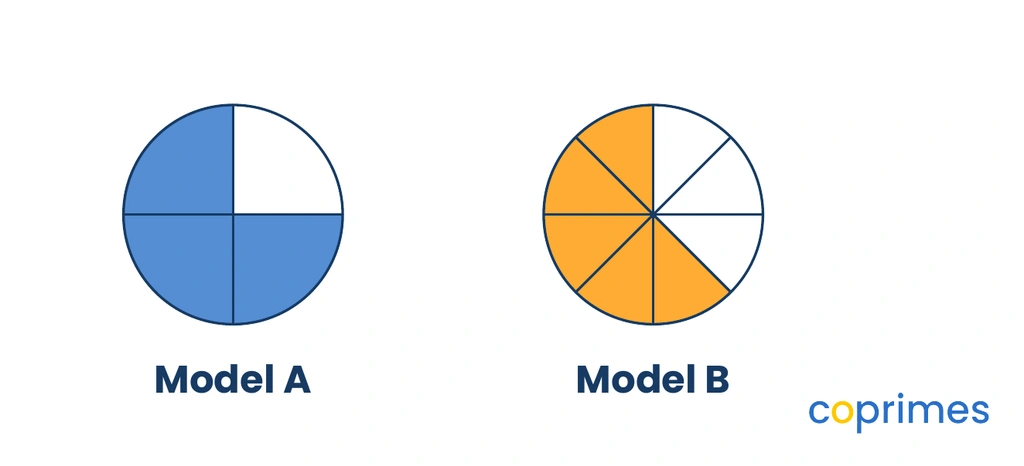
Which statement correctly compares the fractions shown in Model A and Model B?
Which is the correct comparison between and ?
Which fraction is greater than ?
Convert and to a common denominator to determine which fraction is greater. Which is the correct comparison?
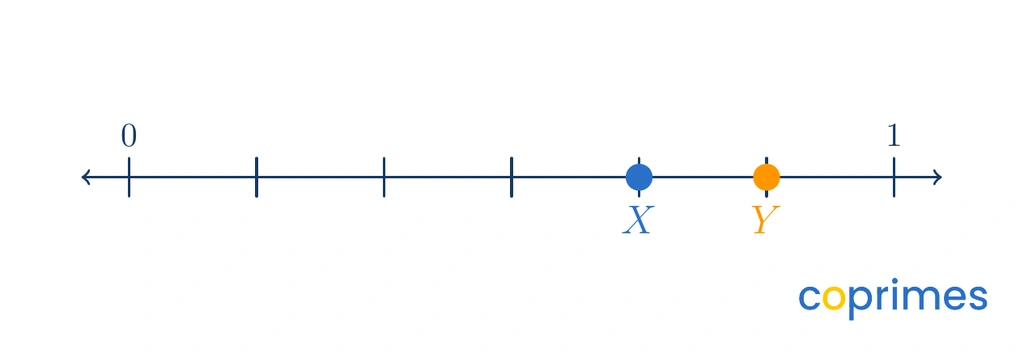
Based on the number line, which inequality is correct?