
Column Subtraction: Definition, Method and Examples
Column subtraction is a formal written method used to subtract one number from another. By stacking numbers vertically and aligning their place values, you can systematically subtract each column one at a time, moving from right to left.
Always subtract the bottom number from the top number in every column.
What is column subtraction?
Column subtraction, also known as vertical subtraction or the standard algorithm for subtraction, is a reliable method for solving multi digit subtraction problems. Instead of subtracting numbers mentally, you write them down in a structured column format.
Every subtraction problem has three distinct parts:
- The minuend: The starting amount, which is placed on top.
- The subtrahend: The amount being taken away, which is placed on the bottom.
- The difference: The final answer, written below the line.
When setting up the problem, every digit must be aligned according to a place value chart. The ones sit in the ones column, the tens sit in the tens column, and so forth. This ensures you only subtract digits of the same value.
How to set out column subtraction
Setting up the calculation correctly is the most important part of the standard subtraction algorithm. If the numbers are not aligned properly, the final difference will be incorrect.
Write the larger number (the minuend) on the top. Write the smaller number (the subtrahend) directly underneath it. Align the digits on the right side so that the ones line up perfectly.
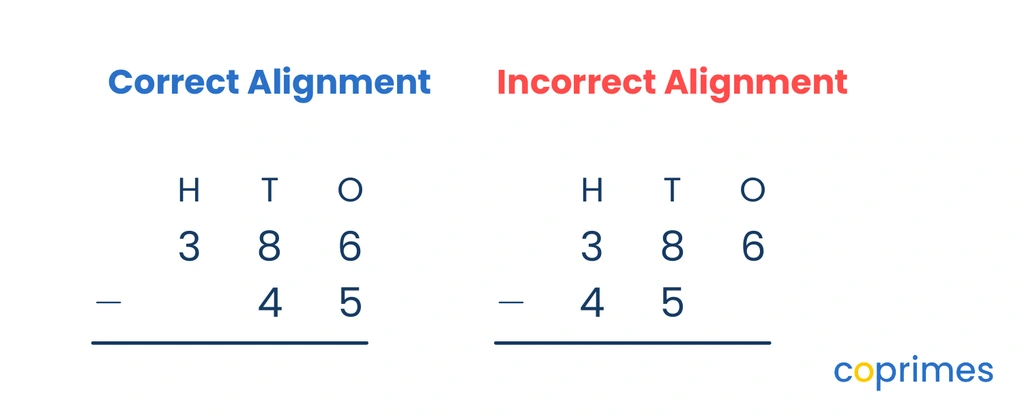
Place a subtraction sign on the left side of the bottom row, and draw a horizontal line underneath. The difference will be written beneath this line.
Step-by-step algorithm
Once the numbers are accurately stacked, follow a consistent sequence to find the difference. You must always work from right to left, starting with the smallest place value.
- Write the larger number vertically above the smaller number, aligning place values on the right.
- Start in the ones column on the far right.
- Subtract the bottom digit from the top digit, and write the result directly underneath the line.
- Move one column to the left (to the tens column) and repeat the process.
- Continue moving left until every column has been subtracted.
If the top digit in a column is smaller than the bottom digit, you cannot simply subtract the other way around. You must regroup before continuing.
A learning plan shaped by your child, not the class
State-aligned Math plus our own Logic and English curriculum. An adaptive baseline test finds the gaps and fills them.
Column subtraction without regrouping
When every digit in the top number is greater than or equal to the corresponding digit in the bottom number, the problem can be solved without regrouping.
In these straightforward cases, simply subtract each column moving right to left. The value in each place is large enough to have the subtrahend taken away smoothly.
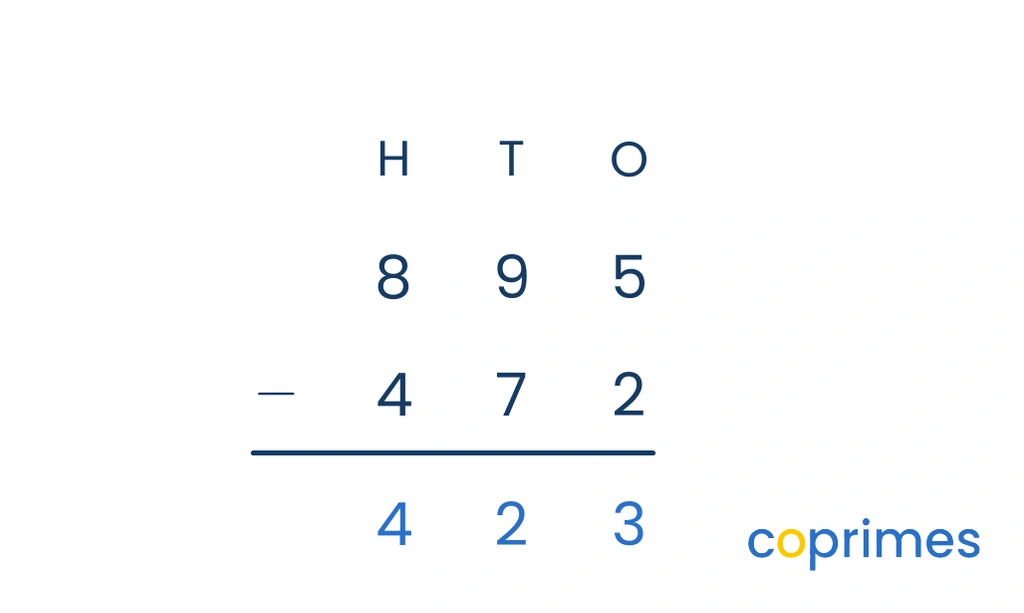
For example, in , the ones column , the tens column , and the hundreds column . The difference is .
Column subtraction with regrouping
If a top digit is smaller than the bottom digit in the same column, you must perform subtraction with regrouping. Regrouping is sometimes called borrowing or exchanging.
To regroup, move to the next column on the left and exchange one unit from that column for ten units in your current column. Cross out the digit on the left, reduce it by one, and add ten to the smaller digit on the right.
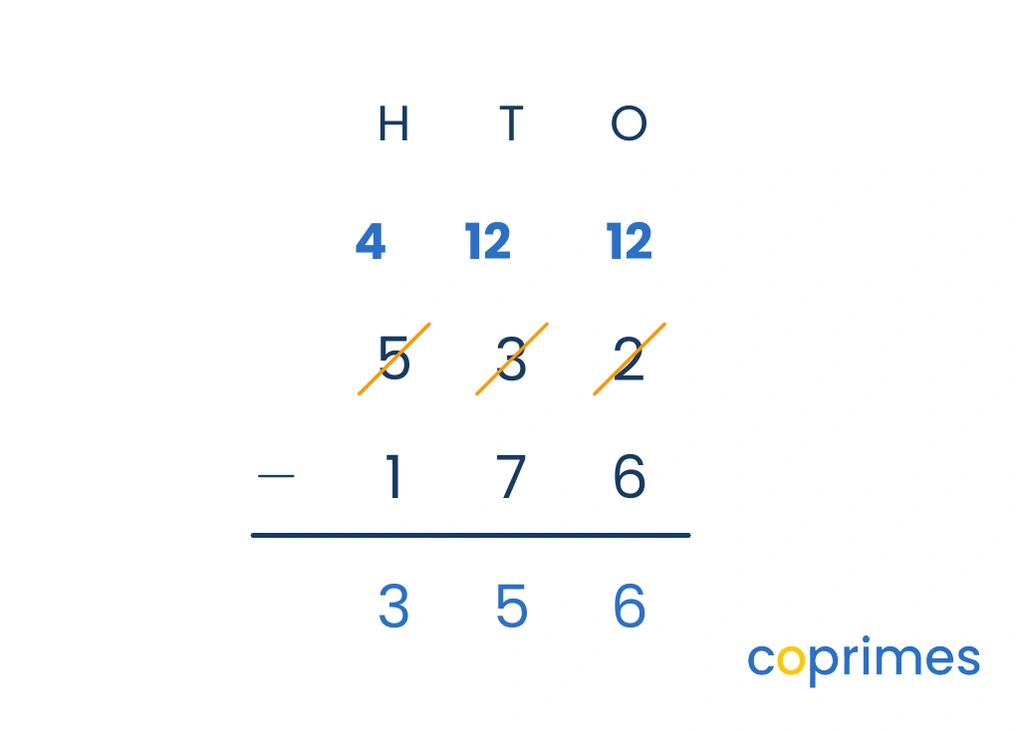
Once the regrouping is recorded, subtract the column using the new, larger value and proceed to the next column on the left.
Subtracting across zeros
Sometimes, you need to regroup, but the digit immediately to the left is a zero. Since you cannot take any value from a zero, you must continue moving to the left until you find a non-zero digit to regroup from.
This process requires a chain reaction. Take from the non-zero column, regroup to the right, and then regroup again until the value reaches the column that initially needed it.
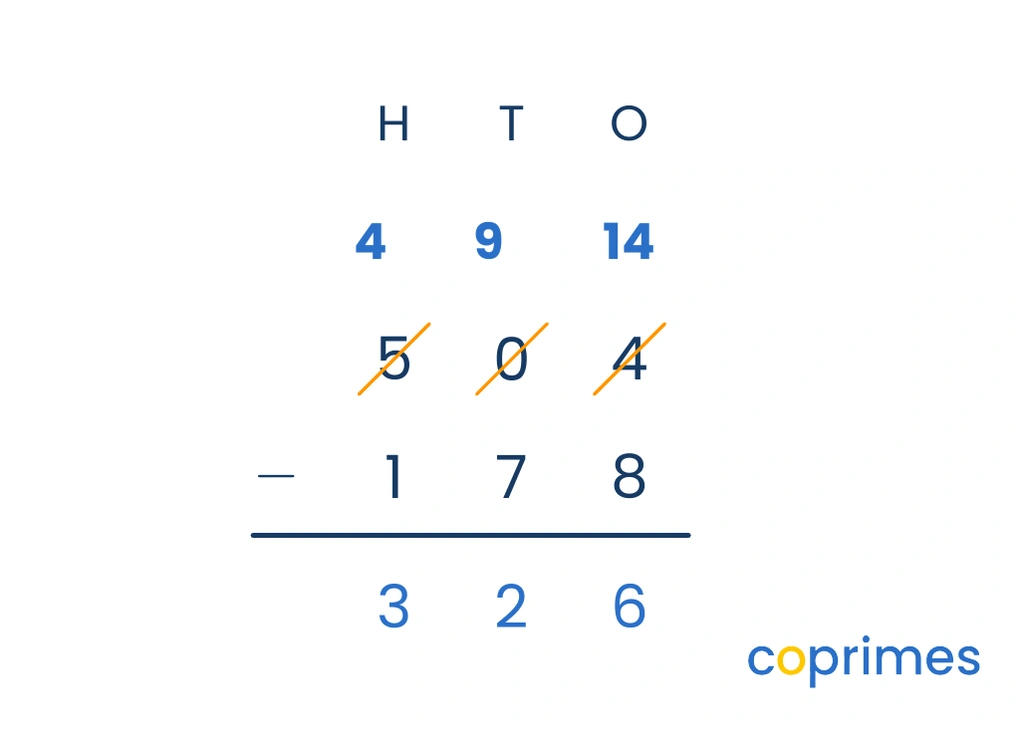
In , the ones column needs more value. Because the tens column is , you must take from the hundreds column, changing the to a . This turns the tens into tens. Next, cross out the and leave , so the ones can become ones.

Worked examples
Here are complete examples ranging from standard calculations without regrouping to those requiring regrouping across zeros.
Example 1: Subtraction without regrouping
Question: What is ?
Method:
- Align the numbers vertically so the ones sit on the right edge.
- Start at the ones column: . Write in the answer space.
- Move to the tens column: . Write .
- Move to the hundreds column: . Write .
Answer: .
Check: Add the answer to the bottom number to verify: .
Example 2: Subtraction with standard regrouping
Question: What is ?
Method:
- Align the numbers vertically.
- In the ones column, calculate . Because is smaller, regroup by taking ten from the tens column, leaving tens. The ones become ones. Subtract: .
- In the tens column, calculate . Since is smaller, regroup by taking hundred from the hundreds column, leaving hundreds. The tens become tens. Subtract: .
- In the hundreds column, calculate .
Answer: .
Check: Use checking subtraction techniques by adding the difference back to the subtrahend: .
Example 3: Subtraction word problem across zeros
Question: An arena holds seats. During a concert, seats were empty. How many seats were occupied?
Method:
- Recognize this as a subtraction word problems scenario requiring you to find .
- Set up the columns vertically.
- In the ones column, you cannot calculate . The tens and hundreds columns are both , so you must regroup from the thousands column.
- Change the thousands to , giving to the hundreds column. Change the hundreds to , giving to the tens column. Change the tens to , giving to the ones column. The ones column becomes .
- Subtract the ones: .
- Subtract the tens: .
- Subtract the hundreds: .
- Subtract the thousands: .
Answer: seats were occupied.
Check: Add and to confirm the total is .
Common mistakes
The most common mistakes in column subtraction occur when numbers are misaligned or when digits are subtracted out of order.
A frequent error is always subtracting the smaller digit from the larger digit in a column, regardless of which number is on top. This completely skips the regrouping step and results in an incorrect answer.
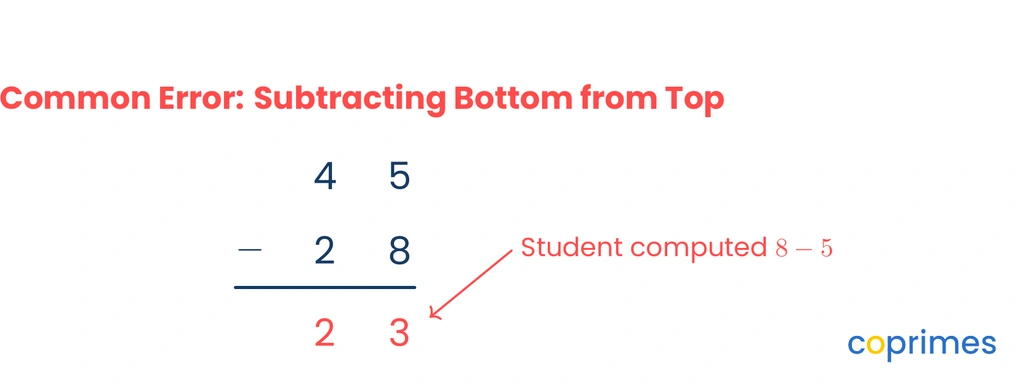
In the example above, the student encountered in the ones column. Instead of regrouping from the tens column, they simply calculated . This is mathematically incorrect. The top number represents what you possess, and you can only take away what is directly beneath it.
Frequently asked questions
Is regrouping the same as borrowing?
Yes. The term "borrowing" was historically used to describe taking value from a leftward column. Today, the term "regrouping" or "exchanging" is preferred because the value is simply shifted to a different place value column and never returned.
What happens if the top number has more digits than the bottom number?
When the top number has more digits, align the ones columns together on the right side. The leftmost digits of the top number will have blank spaces underneath them. You can treat these blank spaces as zeros and subtract normally.
How can I check if my column subtraction is correct?
The most reliable way to check subtraction is to use inverse operations. Add your final difference back to the bottom number (the subtrahend). If your calculation was correct, the total will perfectly match the top number (the minuend).
Practice questions
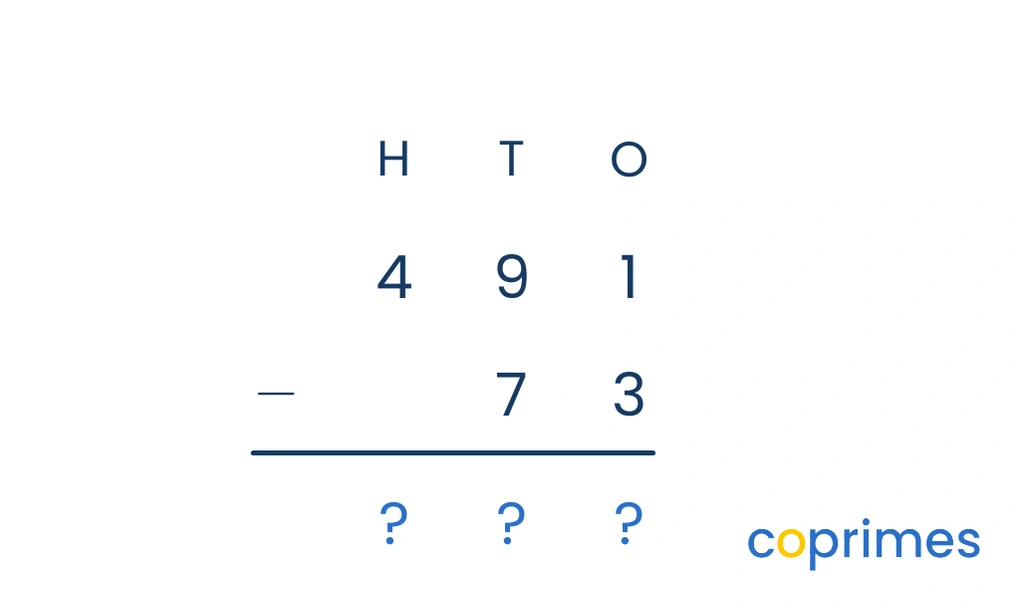
When setting up the problem vertically, which digit is in the tens column of the subtrahend?
Calculate .
Calculate .
A student calculates and gets a final answer of . What mistake did the student make?
They forgot to subtract the hundreds column completely.
They added the ones column instead of subtracting it.
They subtracted the smaller digit from the larger digit in the ones column.
They aligned the digits incorrectly before starting.
They subtracted the smaller digit from the larger digit in the ones column.
What is the difference of ?