
Cube Roots: Guide and Examples
A cube root of a number is the value that produces the original number when multiplied by itself three times.
Just as cubing a number means multiplying it as a factor three times, finding the cube root reverses that process to discover the original foundational value.
What Is Cube Roots?
Evaluating a cube root is the mathematical inverse of cubing a number. When you multiply an integer by itself three times, the result belongs to the set of cube numbers.
For example, . Therefore, is a perfect cube, and its cube root is exactly . Every real number has exactly one real cube root.
Key Ideas and Vocabulary
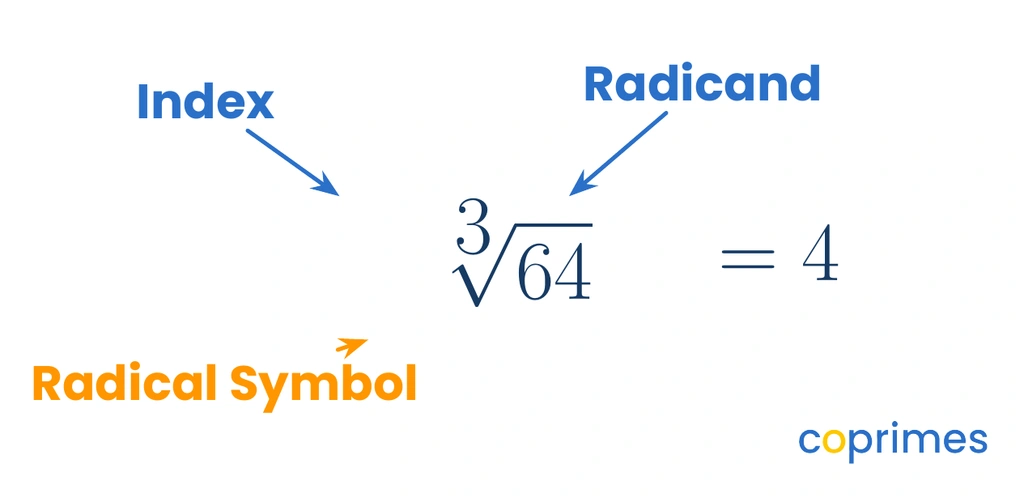
The symbol used to represent this operation is the radical sign with a small placed in the notch, written as .
The number inside the symbol is called the radicand, and the small is the index. The index explicitly tells you to find the number that must be multiplied three times.
Unlike square roots, which cannot evaluate negative numbers in the real number system, cube roots can effortlessly handle negative values. Because a negative times a negative times a negative equals a negative, the cube root of a negative number is simply a negative number.
For instance, , which means that .
Visual Explanation
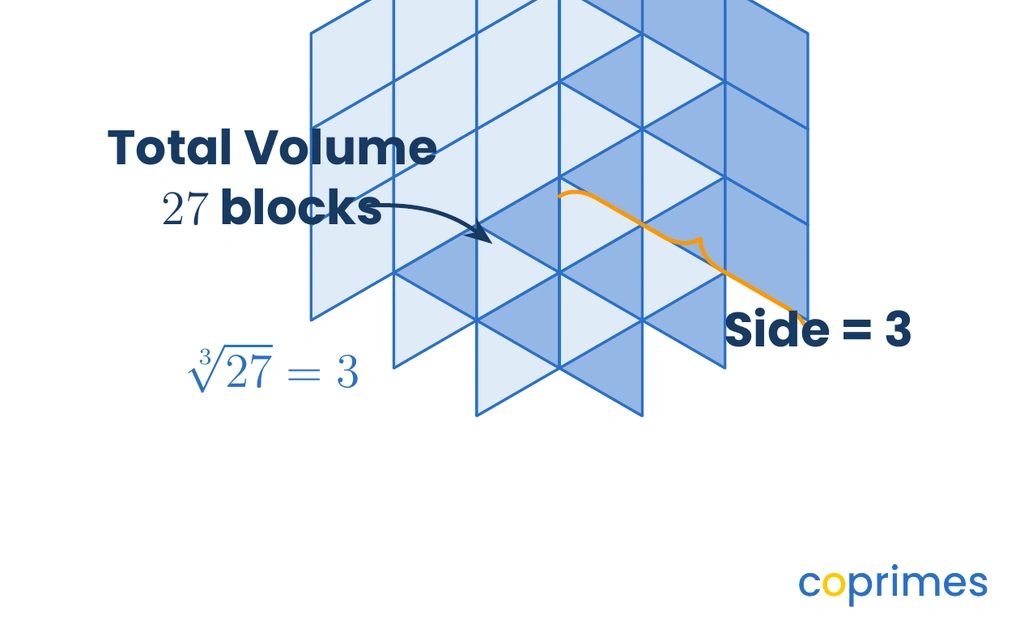
The word "cube" comes directly from geometry. If you build a solid cube out of small blocks, the total number of blocks represents the volume (the radicand), and the number of blocks along one straight edge represents the cube root.
A learning plan shaped by your child, not the class
State-aligned Math plus our own Logic and English curriculum. An adaptive baseline test finds the gaps and fills them.
Worked Examples
Review these step-by-step solutions to understand how to correctly identify and estimate cube roots in different mathematical situations.
Example 1: Finding a positive perfect cube root
Question: Evaluate .
Method:
- Identify the number that, when multiplied by itself three times, equals .
- Test small integers: .
- Test the next integer: .
Answer: .
Check: Multiply the answer exactly three times: .
Example 2: Evaluating negative numbers
Question: What is the value of ?
Method:
- Recognize that the radicand is negative. The cube root of a negative number must be a negative number.
- Determine the cube root of the positive version, .
- Since , apply the negative sign to the base.
Answer: .
Check: .
Example 3: Prime factor grouping
Question: Use prime factorization to find .
Method:
- Break into its prime factors: .
- Continue factoring : .
- The complete prime factorization is .
- Group identical factors into sets of three. You have one full set of s and one full set of s.
- Take one number from each set and multiply them together: .
Answer: .
Check: Calculate . First, . Next, .
Example 4: Estimating non-perfect cubes
Question: Estimate the value of to the nearest whole number.
Method:
- Identify the perfect cubes just below and just above .
- and . Therefore, must be between and .
- Determine which perfect cube is closer to .
- The distance from to is . The distance from to is .
- Because is closer to , the cube root is closer to .
Answer: .
Check: Check , which confirms the true root is close to .
Common Mistakes and Non-Examples
The most frequent mistake students make is confusing a root with division. Many mistakenly calculate because . However, , which proves this method is entirely incorrect. A cube root requires finding a repeated factor, not dividing by .
Another common error is applying the rules for squares to cubes, specifically thinking that negative roots do not exist. While has no real solution, is a perfectly valid expression that equals .
Real-World Connections
Cube roots are heavily used in packaging, architecture, and science whenever three-dimensional space is involved. If an engineer knows the required volume of a shipping container, they use a cube root to determine the exact side lengths needed to construct it.
Understanding these roots also builds a solid foundation for mastering exponents and powers. Later on, you will learn to use the laws of exponents to manipulate these expressions algebraically. While a zero exponent always collapses a term to , fractional exponents are actually alternate ways to write roots, where an exponent of is identical to a cube root.

Practice questions
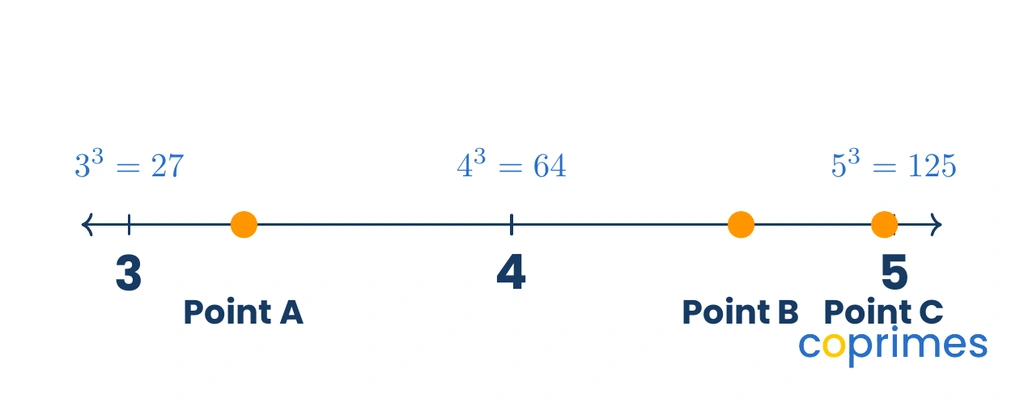
Based on the number line provided, which point best represents the estimated value of ?
Point A
Point B
Point C
None of these points
Point B
What is the exact value of ?
No real solution
A solid steel cube has a total volume of cubic centimeters. What is the exact length of one of its sides?
centimeters
centimeters
centimeters
centimeters
centimeters
A student claims that because . Why is this mathematical reasoning incorrect?
A cube root requires dividing the radicand by , not .
A cube root finds the number multiplied by itself three times, meaning the answer should be .
The student forgot to add the negative sign to the final answer.
A cube root means multiplying the number by , so the answer should be .
A cube root finds the number multiplied by itself three times, meaning the answer should be .
Between which two consecutive whole numbers does lie?
and
and
and
and
and