
Decimal Place Value: Meaning, Chart and Examples
Decimal place value tells the exact value of each digit based on its position in a number. In a base-ten system, the decimal point separates whole numbers from fractional parts. As you move one place to the right, the value of a position is divided by ten, creating tenths, hundredths, thousandths, and even smaller places.
Understanding these positions is essential for writing decimal numbers, interpreting measurements, and making precise calculations.
What is decimal place value?
Decimal place value is the value a digit holds because of its specific location to the right of the decimal point. The decimal point acts as a visual anchor, clearly showing where the whole number ends and the fractional part begins.
In standard decimal notation, the base-ten pattern continues forever in both directions. Moving one position to the left multiplies the place value by ten. Moving one position to the right divides the place value by ten.
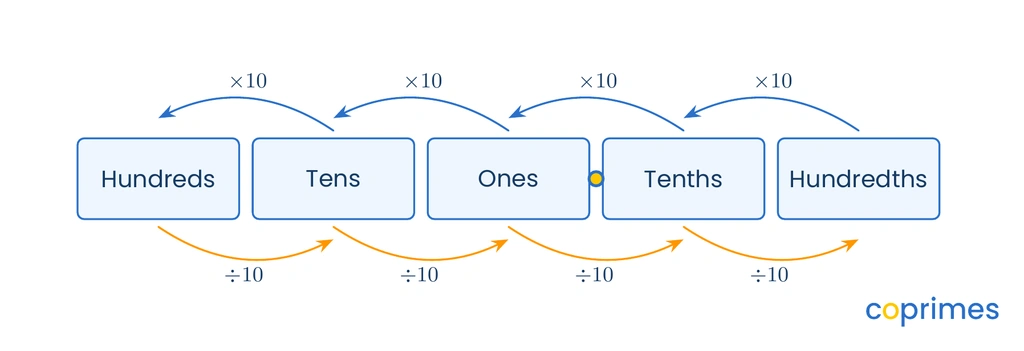
The digits of a decimal represent quantities smaller than one whole. This base-ten relationship applies everywhere; ten hundredths group together to make one tenth, just as ten ones group together to make one ten.
Use a decimal place-value chart
A decimal place value chart organizes digits by their positions, making it easy to see their exact fractional values. The decimal point always sits between the ones and the tenths.
For example, in the number , the chart separates the whole number from the fraction.
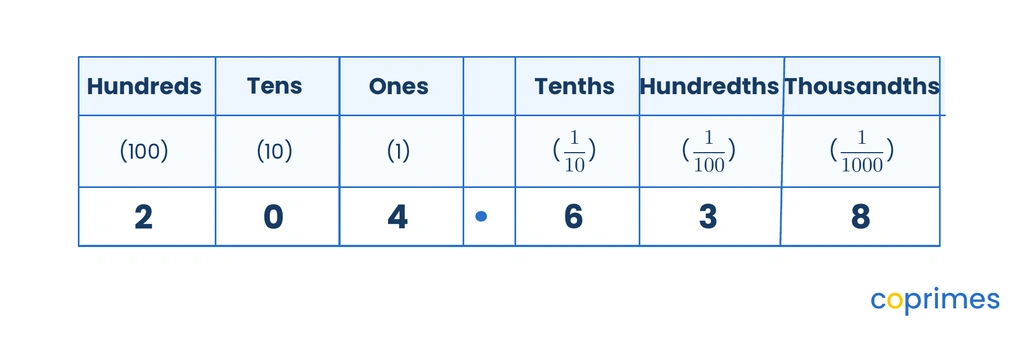
The digit is in the tenths place, meaning its value is six tenths, or . The digit acts as a placeholder in the tens column, showing there are no tens in this number.
Name tenths, hundredths and thousandths
Decimal places are fractions based on powers of ten. When reading and writing decimals, the position immediately to the right of the decimal point is the tenths place. The next column is the hundredths place, and the third column is the thousandths place.
Visual models clarify these fractions. If one large square represents a whole unit, dividing it into ten equal strips creates tenths. Dividing the same square into one hundred small boxes creates hundredths.
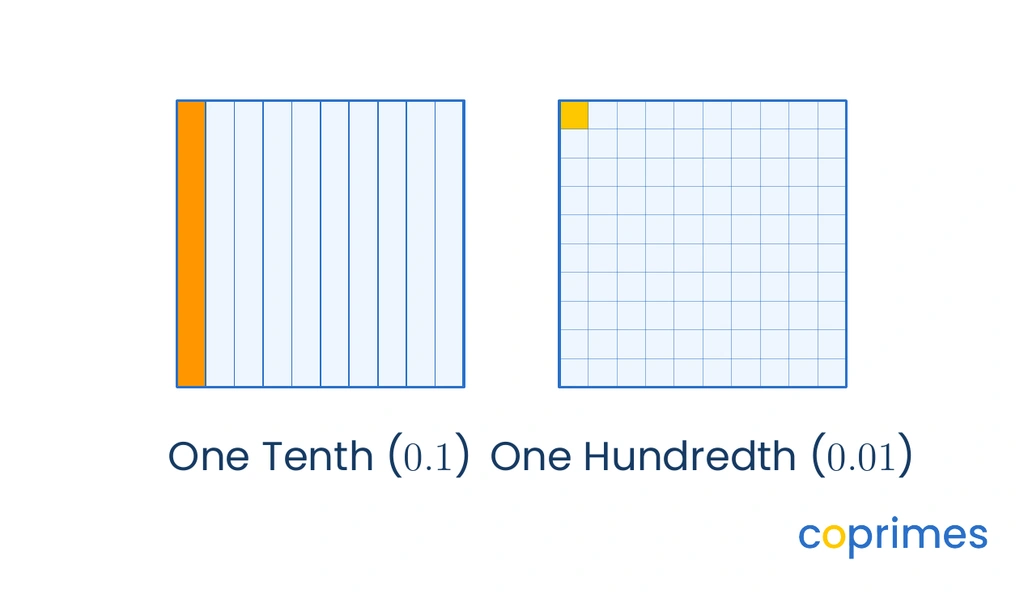
Because they are parts of a whole, decimal fractions get smaller as you move further to the right. A thousandth () is ten times smaller than a hundredth ().

Find the value of a digit
To find the value of a digit in a decimal, combine its face value with the place it occupies. The face value is simply the numeral itself, such as or . The place value defines its worth.
A digit's total value is its face value multiplied by its place value.
If the digit is in the hundredths place, its total value is eight hundredths, written as or . A zero is often required to hold empty places between the decimal point and the significant digit. For example, in , the zero holds the tenths place so the remains accurately in the hundredths place.
Compare place values
When comparing decimals, you must analyze the digits from left to right, focusing on the largest place value first. The number with the greater digit in the highest place value is always the larger number, regardless of how many digits follow it.
For example, to compare and , compare the tenths column first. Eight tenths () is greater than four tenths (), even though the number appears longer than . Comparing place values carefully prevents the common mistake of treating decimals like whole numbers.
Visual worked examples
Example 1: Identifying digit value with placeholders
Question: What is the value of the digit in ?
Method:
- Locate the decimal point as the starting reference.
- Move right from the decimal point: the first place is tenths, and the second place is hundredths.
- The digit is in the second place to the right.
Answer: The value of the is three hundredths, or .
Check: We can see that a is holding the tenths place, confirming the is properly in the hundredths position.
Example 2: Constructing a decimal
Question: What number consists of five tens, nine ones, two tenths, and four thousandths?
Method:
- Write the whole number part: five tens and nine ones makes .
- Place the decimal point after the ones place:
- Write the tenths digit: . The number is now .
- There is no hundredths digit mentioned. Use as a placeholder: .
- Write the thousandths digit: .
Answer: The final number is .
Check: Read the positions backward from the end: thousandths, hundredths, tenths, ones, tens. This perfectly matches the original question.
Example 3: Translating expanded form
Question: Convert the following decimals in expanded form into standard form: .
Method:
- Identify the whole number: . Write
- Look for the tenths place. There is no fraction with a denominator of . Write a in the tenths place: .
- Look for the hundredths place. The fraction is . Write a in the hundredths place: .
- Look for the thousandths place. The fraction is . Write a in the thousandths place.
Answer: The standard form is .
Check: Expand to confirm. , which equals .
A learning plan shaped by your child, not the class
State-aligned Math plus our own Logic and English curriculum. An adaptive baseline test finds the gaps and fills them.
Common mistakes
Many mistakes happen when decimal rules are confused with whole-number rules.
- Thinking longer decimals are larger. A student might see and think it is larger than because is larger than . Remember to compare the highest place value first: seven tenths is greater than three tenths.
- Forgetting the placeholder zero. When writing "four and five hundredths", students often write . The correct number is , using the zero to hold the tenths place empty.
- Believing in "oneths". The sequence of fractions begins with tenths immediately to the right of the decimal point. There is no "oneths" place because dividing a single unit by ten directly creates tenths.
Frequently asked questions
What is the difference between place and value?
Place refers to the name of the column where the digit sits, such as the tens column or the hundredths column. Value refers to how much that digit is worth in that specific location, such as or .
How many decimal places are in a number?
The number of decimal places is simply the count of digits that appear to the right of the decimal point. For example, has three decimal places, while has one decimal place.
Practice questions
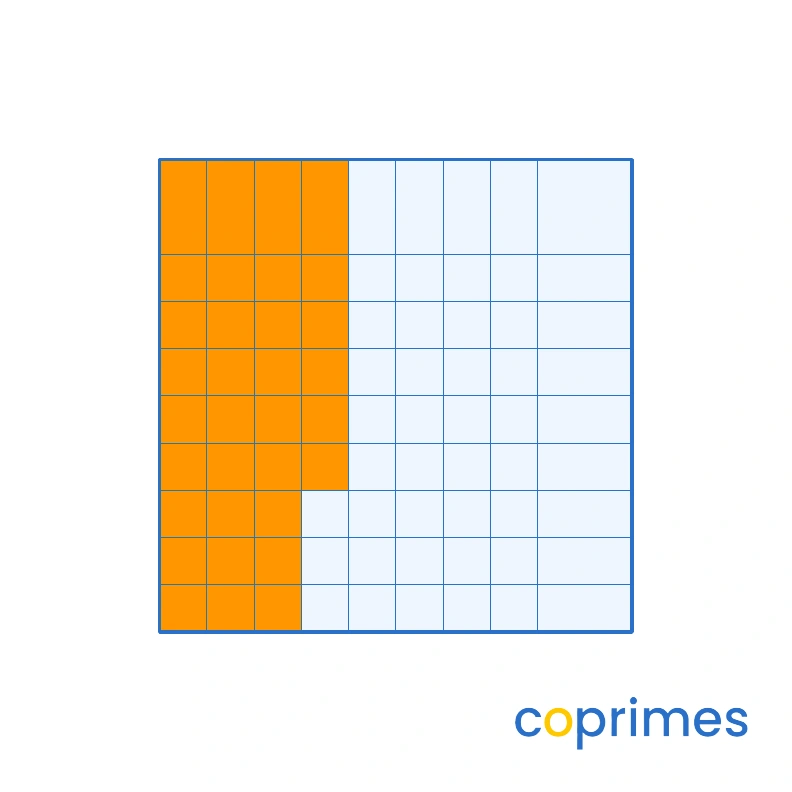
If the entire grid represents one whole unit, what decimal is shaded?
What is the value of the digit in the number ?
tenths
hundredths
thousandths
tens
hundredths
Which of the following numbers is the largest?
Which of the following numbers has a in the hundredths place?
How is written in expanded form?