
Comparing Decimals
To compare decimals, align the decimal points and compare digits from the greatest place value to the right until a difference appears. Trailing zeros can be added without changing the value. Understanding decimal place value is essential for accurate comparisons.
How do you compare decimals?
Comparing decimal numbers means determining which number has a greater value, which has a smaller value, or if the two numbers are strictly equal.
This skill is required before you can begin ordering decimals in a sequence from least to greatest.
To evaluate which decimal is greater, you must compare the values of the digits in each specific place value position, rather than just counting how many digits each number has.
Align decimal points
The most reliable first step when you compare decimals is to write the numbers vertically.
Stack the numbers so that the decimal points line up exactly one on top of the other. This ensures that the ones line up with the ones, the tenths with the tenths, and the hundredths with the hundredths.
If you do not align the decimal points perfectly, you might accidentally compare a digit in the tenths place with a digit in the hundredths place, leading to an incorrect result.
Compare place values from left to right
Once the decimal points are aligned, begin comparing the digits starting from the furthest left position, which represents the greatest place value.
Compare the whole numbers first. If the whole numbers are different, the number with the larger whole number is the greater decimal.
If the whole numbers are identical, move one position to the right and compare the digits in the tenths place. If they match, move right again to the hundredths place. Continue this process until you find two digits in the same column that are different.
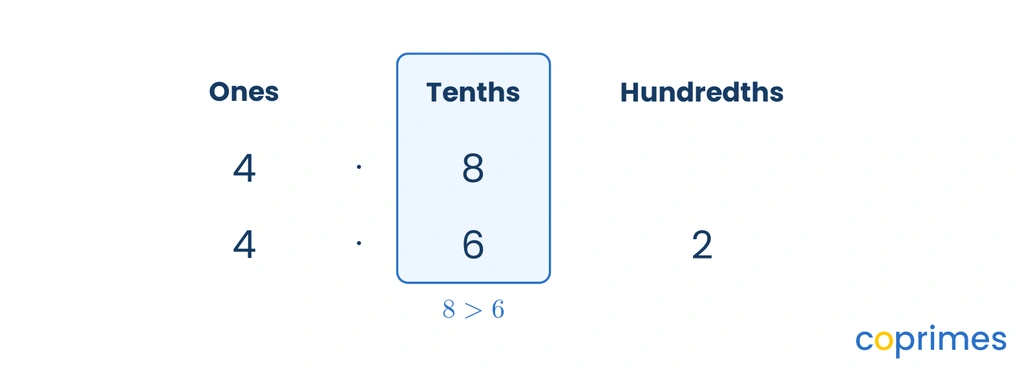
The decimal with the larger digit in the first differing column is the greater number.
A learning plan shaped by your child, not the class
State-aligned Math plus our own Logic and English curriculum. An adaptive baseline test finds the gaps and fills them.
Use trailing zeros
When you compare decimals of different lengths, you can write trailing zeros at the end of the shorter decimal.
Adding zeros to the far right of a decimal after the decimal point does not change its mathematical value. For example, is exactly equal to and .
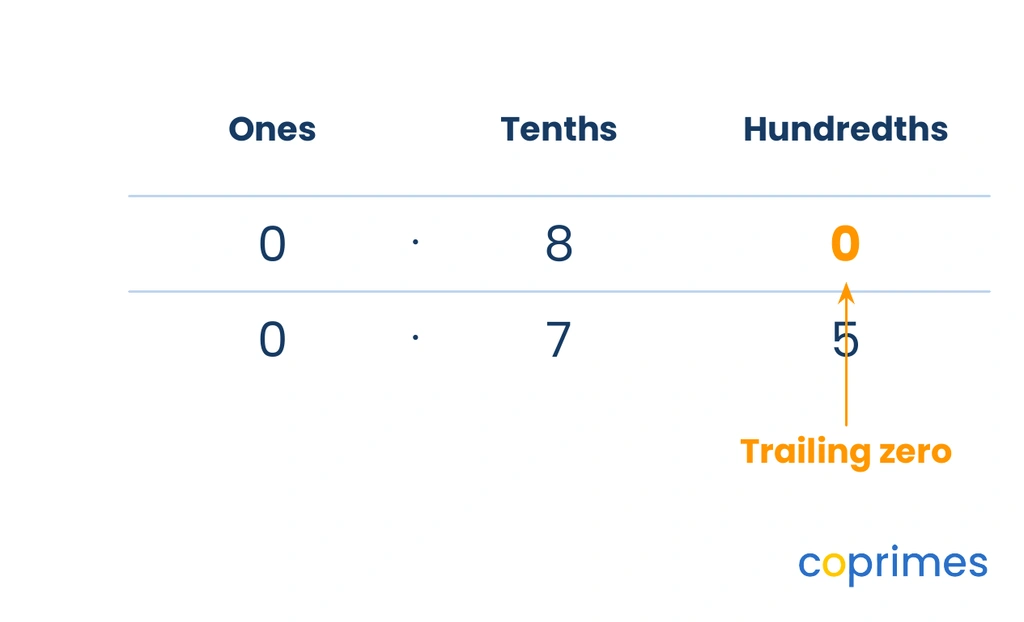
Using trailing zeros makes both numbers the same length, which helps prevent the mistake of thinking a longer decimal is automatically a larger decimal.
Use number lines and symbols
Standard mathematical symbols are used to record greater than and less than decimals comparisons:
- means "is greater than".
- means "is less than".
- means "is equal to".
Plotting decimals on a number line provides a strong visual check. The number that lies further to the right on a horizontal number line is always the greater number.
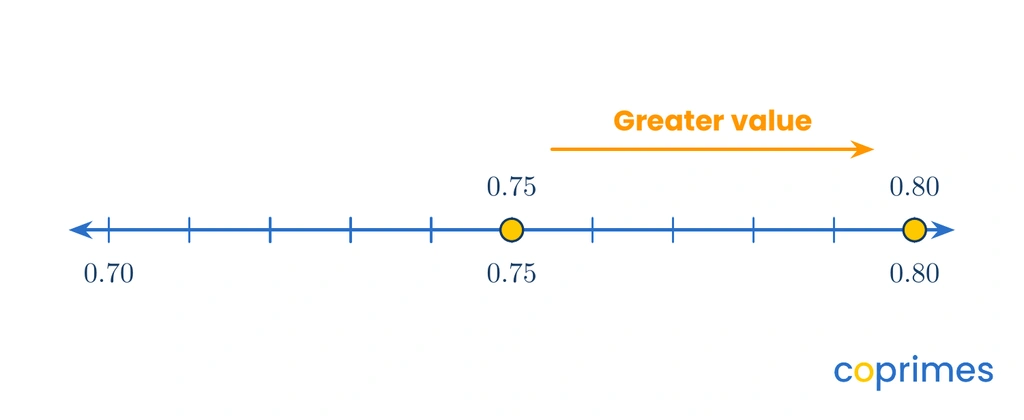
For example, because is completely to the right of , we write .
Worked examples
Example 1: Using trailing zeros to compare
Question: Which decimal is greater, or ?
Method:
- Align the decimal points vertically.
- Add a trailing zero to so both numbers have the same number of digits.
- Compare from left to right. The ones place is identical ().
- Compare the tenths place. is greater than .
Answer: is greater than . We write .
Check: is forty hundredths, and is thirty-eight hundredths. Forty is more than thirty-eight.
Example 2: Comparing with different whole numbers
Question: Compare and . Use the correct inequality symbol.
Method:
- Align the decimal points.
- Begin comparing at the largest place value, which is the tens place.
- has a in the tens place. has nothing in the tens place (which is equal to ).
Answer: .
Check: The whole number is larger than the whole number , so the decimal parts do not change which number is larger overall.
Example 3: Checking equivalent values
Question: Which symbol belongs between and ?
Method:
- Align the decimal points vertically.
- Ensure both numbers have the same number of decimal places by adding a trailing zero to .
- Compare the columns from left to right.
- Ones: . Tenths: . Hundredths: .
Answer: .
Check: Both numbers represent three wholes and four tenths.

Common mistakes
A frequent error is assuming that a number with more digits is automatically larger. For example, a student might mistakenly think because the whole number is greater than . This ignores place value. You must compare the tenths place first, where is greater than .
Another mistake occurs when checking place values out of order. Always evaluate decimals strictly from left to right.
When comparing fractions that are converted to decimals, remember that the decimal system is just another way to express fractions based on powers of ten (). Ensuring you match place values preserves the correct fraction denominator sizes. Finally, do not use rounding decimals to compare close values; rounding and to the nearest tenth makes them look equal (), even though is strictly greater.
Frequently asked questions
What is the rule for comparing decimals?
Always align the decimal points first, then compare digits from left to right starting with the largest place value. Stop at the first column where the digits differ.
Does adding a zero at the end of a decimal change its value?
No, adding a zero to the far right of a decimal point (a trailing zero) does not change the value. Writing as simply rewrites five tenths as fifty hundredths, which are mathematically equivalent.
How do you compare decimals place value if the numbers have different lengths?
Add trailing zeros to the shorter number until both decimals have the same number of decimal places. This aligns the columns perfectly and prevents you from mistakenly comparing tenths to hundredths.
Practice questions
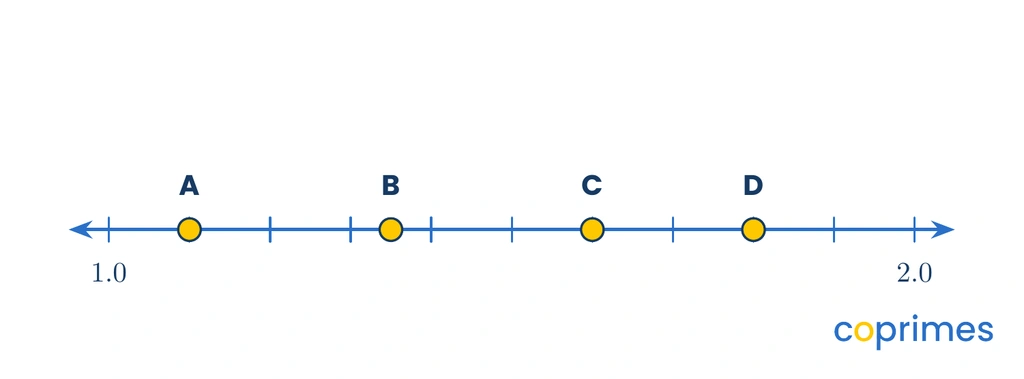
Based on the number line provided, which point represents the greatest decimal value?
Point A
Point B
Point C
Point D
Point D
Which of the following inequality statements is true?
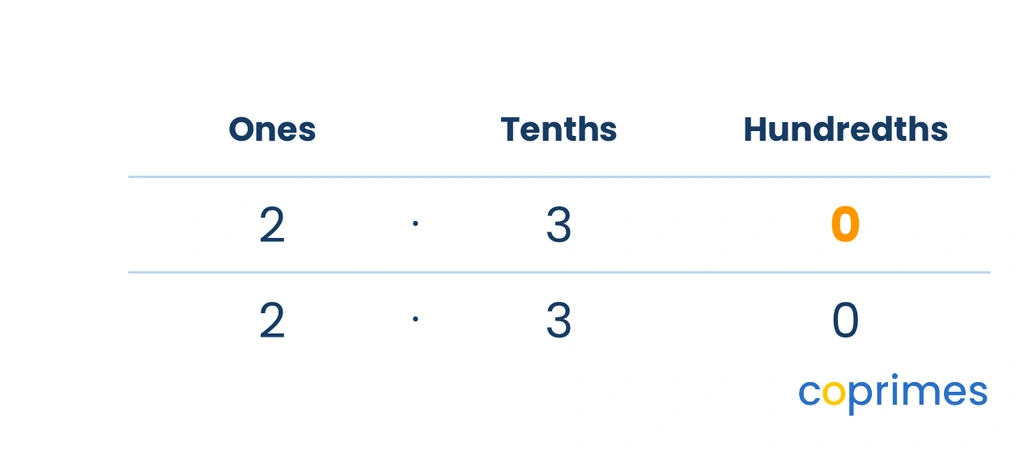
Look at the place value chart comparing and . Which statement best describes the relationship between the two numbers?
is greater because it has more digits.
They are equal because adding a trailing zero does not change the value.
is greater because tenths are larger than hundredths.
They cannot be compared because they have a different number of digits.
They are equal because adding a trailing zero does not change the value.
A student claims that because is a larger number than . Why is this reasoning incorrect?
The student forgot to compare the whole numbers first.
The student should have rounded both decimals to the nearest whole number.
The student compared the total digits instead of comparing the highest place value columns from left to right.
The student placed the inequality symbol facing the wrong direction.
The student compared the total digits instead of comparing the highest place value columns from left to right.
Four athletes run a race. Their finish times are listed below. The winner is the athlete with the lowest time. Who won the race?
- Elena: seconds
- Marcus: seconds
- Sofia: seconds
- David: seconds
Elena
Marcus
Sofia
David
Sofia