
Decimal Word Problems: Definition, Method and Examples
Decimal word problems describe quantities with decimal values. To solve these problems successfully, identify the quantities and units, model their mathematical relationship, choose the correct operation, calculate the result accurately, and check that the final answer makes sense in the real-world context.
What are decimal word problems?
Decimal word problems are real-world scenarios that require mathematical operations on numbers containing a fractional part expressed as a decimal.
They apply the foundational skills of math word problems to continuous measurements such as mass, length, time, and generic prices where whole numbers are insufficient to describe the exact amount.
Identify quantities, units and the unknown
The first step in solving a word problem is reading the text carefully to extract the known information and identify the missing value.
Identify the quantities and ensure they share the same units. If a problem provides a length in meters and another length in centimeters, you must convert them to a single common unit before performing any calculation involving decimals.
Clearly define the unknown value you are trying to find. Writing down a short statement such as "Total mass = ?" helps focus your reasoning on the final goal.
Choose an operation from the relationship
Rather than relying on isolated keywords, analyze how the quantities relate to one another.
Use addition when combining parts into a single total. You can apply adding decimals to find combined lengths, total mass, or cumulative time.
Use subtraction when finding a difference, a missing part, or an amount remaining. You can apply subtracting decimals to compare two decimal values or find how much of a resource is left.
Use multiplication when scaling a value or combining multiple identical groups. You can apply multiplying decimals when a single item has a decimal value and you need the total for several items, or when finding a fraction of a decimal amount.
Use division when splitting a total into equal parts or finding a rate. You can apply dividing decimals to distribute a total mass evenly or to find the cost of a single unit.

Model with an equation or visual
Translating the text into a visual model makes the relationships obvious. Bar models and number lines are powerful tools for representing decimal word problems.
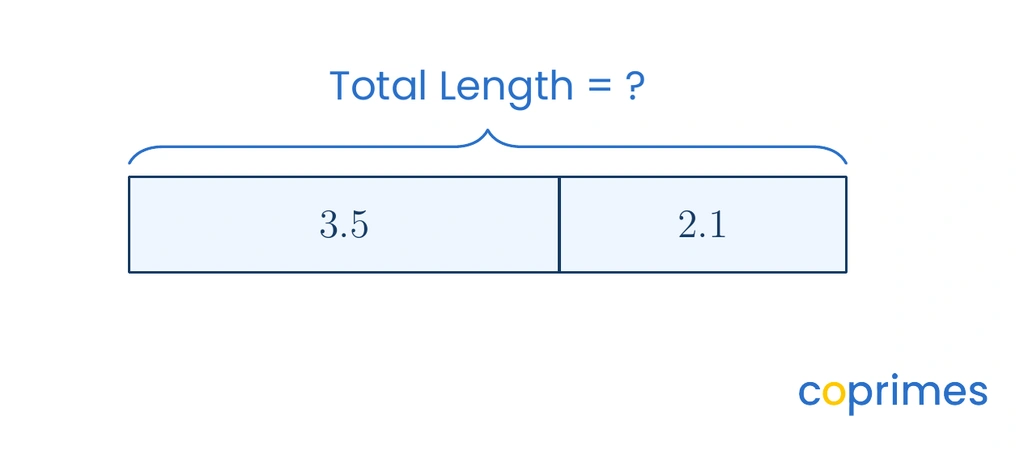
Once the model is drawn, writing the equation becomes straightforward. For the model above, the equation is .
Check decimal size and units
After calculating, use estimation to verify your result. Round the decimals to the nearest whole number and perform the operation mentally.
If a problem asks for the cost of items that are dollars each, round to . The estimate is dollars. If your calculated answer is dollars, the decimal point is misplaced, and the answer is unreasonable.
Always verify that your final answer includes the correct units described in the scenario.
Worked examples by operation
Review these step-by-step examples covering different operations and multi-step reasoning.
Example 1: Multi-step addition and subtraction
Question: A water tank contains liters of water. A gardener uses liters for indoor plants and liters for outdoor plants. How much water is left in the tank?
Method:
- Identify the total amount of water used by adding the two amounts together. Ensure the decimal points are aligned.
- liters.
- Subtract the total water used from the original amount in the tank.
- liters.
Answer: There are liters of water left.
Check: Add the remaining water to the used water to see if it matches the original amount: . The calculation is correct.
Example 2: Multiplication with decimals
Question: A machine cuts metal pipes into sections that are meters long. What is the total length of identical pipe sections?
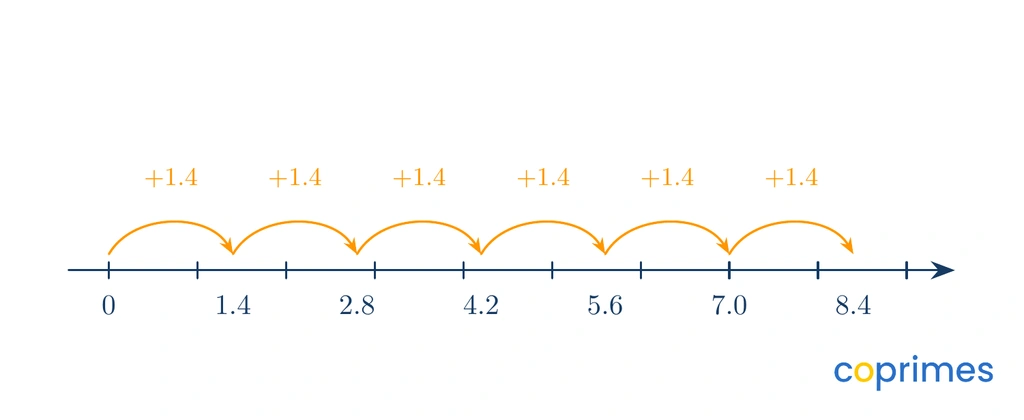
Method:
- Identify the relationship: finding the total of multiple identical groups requires multiplication.
- Set up the equation:
- Multiply the numbers as if they were whole numbers: .
- Count the total number of decimal places in the factors. There is decimal place in .
- Place the decimal point in the product so it has decimal place: .
Answer: The total length is meters.
Check: Estimate the answer by rounding down to . . Rounding up to gives . The answer is safely between and .
Example 3: Division with decimals
Question: A spool holds meters of electrical wire. If a technician cuts the wire into equal pieces that are exactly meters long, how many pieces will they have?
Method:
- Identify the relationship: splitting a total amount into equal-sized parts requires division.
- Set up the equation:
- Move the decimal point one place to the right in both the divisor and the dividend to make the divisor a whole number. This changes the problem to .
- Perform the division: .
Answer: The technician will have pieces of wire.
Check: Multiply the number of pieces by the length of one piece: .
A learning plan shaped by your child, not the class
State-aligned Math plus our own Logic and English curriculum. An adaptive baseline test finds the gaps and fills them.
Common mistakes
Watch out for these frequent errors when modeling and solving:
- Misaligning decimal points: When adding or subtracting, failing to line up the decimal points changes the place value of the digits, resulting in an incorrect calculation.
- Assuming more decimal places means a larger number: is not larger than just because it has more digits. Comparing decimals requires checking the tenths place first.
- Placing the decimal point incorrectly in a product: When multiplying, the product must have the same number of decimal places as the sum of the decimal places in the factors.
- Forgetting to convert units: Subtracting centimeters from meters directly () is incorrect. You must use common units, such as meters.
Frequently asked questions
How do I know whether to multiply or divide decimals in a word problem?
Look at the relationship between the quantities. If you are given the size of one item and asked for the total of many identical items, you multiply. If you are given a total amount and asked to split it into equal groups or find the size of one item, you divide.
What should I do if a decimal word problem has whole numbers and decimals?
You can write the whole number with a decimal point and trailing zeros to match the place value of the other number. For example, to add and , write as so the columns align perfectly.
Does a word problem always use the exact numbers written in the text?
No. Some numbers describe the setting rather than the calculation. For example, "A -door car traveled kilometers" contains the number , but it is descriptive and likely not part of the calculation. Always identify the quantities that relate directly to the unknown value.
Practice questions
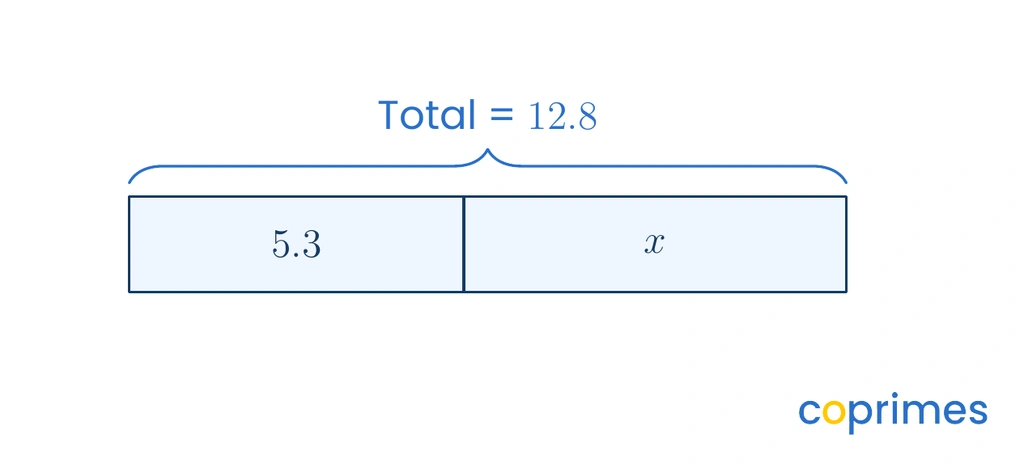
Which calculation correctly finds the unknown value shown in the visual model?
A chef buys kilograms of flour. They use kilograms to bake bread. Which equation represents how to find the amount of flour remaining?
A worker earns dollars for every hour they work. If they work for hours, which statement correctly describes how to find their total earnings?
Multiply by because the worker earns the hourly rate multiple times.
Add and because both numbers represent time and money earned.
Divide by to split the hourly wage into equal parts.
Subtract from to find the difference between the rate and hours.
Multiply by because the worker earns the hourly rate multiple times.
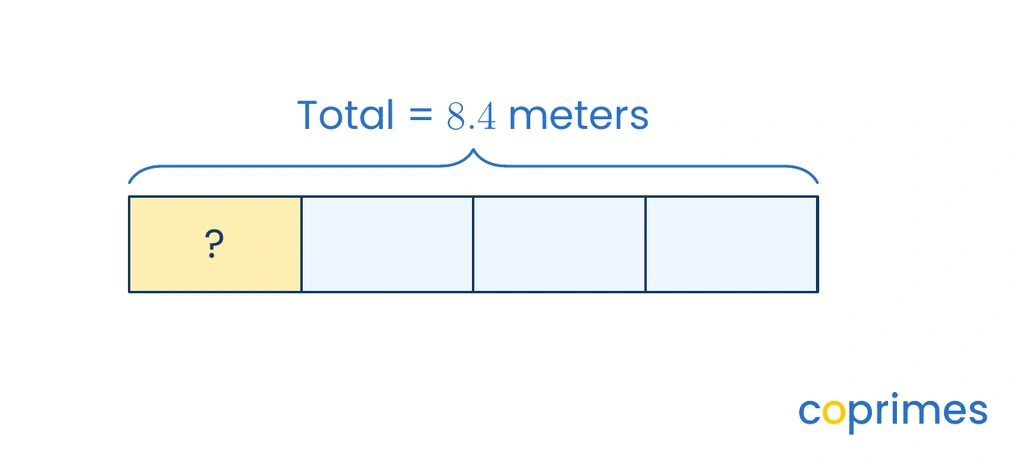
A wooden board is exactly meters long. It is cut into equal pieces as shown in the model. What is the length of each piece?
meters
meters
meters
meters
meters
A customer buys a sandwich for dollars and a juice for dollars. They pay with a -dollar bill. How much change should they receive?
dollars
dollars
dollars
dollars
dollars