
Dividing Decimals: Methods and Applications
To divide decimals, first use decimal place value to make any decimal divisor into a whole number. Multiply both the dividend and the divisor by the same power of ten, then divide as usual and check the quotient's size.
How do you divide decimals?
Dividing decimals involves sharing a decimal value into equal groups or finding how many groups of a certain size fit into a number.
Understanding decimal place value is the first step to successful decimal calculation.
When dividing by a whole number, you can use standard methods and align the decimal point.
When the divisor is a decimal, you must adjust the calculation so the divisor becomes a whole number before you calculate.
The visual below shows divided into equal groups, resulting in per group.
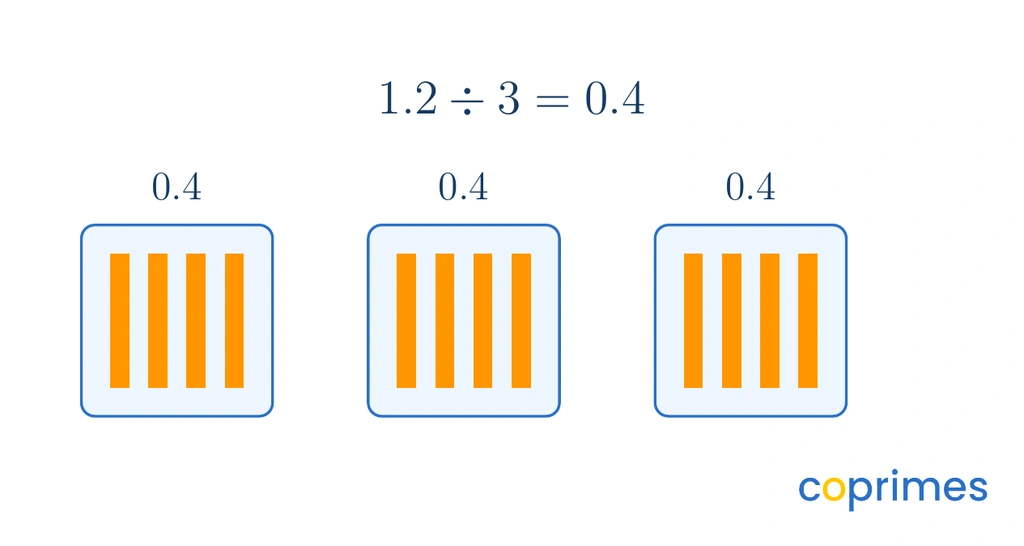
Divide a decimal by a whole number
When dividing a decimal by a whole number, perform the calculation as if both numbers were whole numbers, but preserve the position of the decimal point.
The standard algorithm for division applies directly.
Place the decimal point in the quotient exactly above the decimal point in the dividend.
- Write the problem using standard long division layout.
- Bring the decimal point straight up from the dividend into the quotient area.
- Divide the numbers exactly as you would with whole numbers.
- Add trailing zeros to the dividend if you need to continue calculating to avoid a remainder.
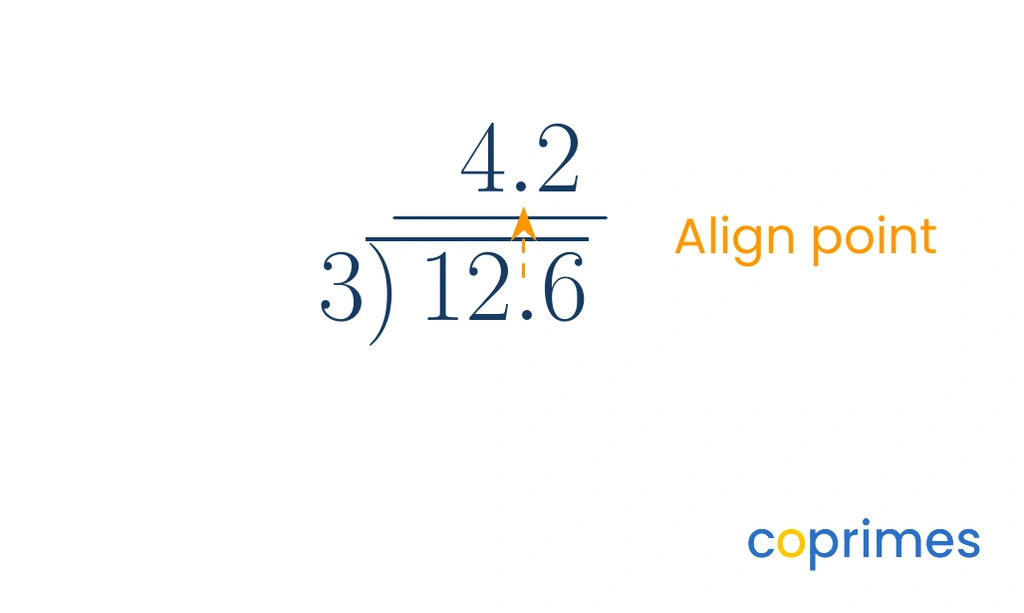
Always place the decimal point before you begin dividing.
Divide by a decimal
To divide by a decimal, transform the problem so that the divisor is a whole number.
You cannot easily divide by a decimal value like using standard long division.
Instead, multiply both the dividend and the divisor by , , or to shift the decimal point until the divisor is a whole number.
This process is directly related to multiplying and dividing decimals by powers of ten, which shifts digits across place values uniformly.
If the divisor is , multiply by to make it .
If the divisor is , multiply by to make it .

Scale both numbers equally
When you multiply the divisor by a power of ten, you must multiply the dividend by the exact same power of ten.
Think of the division problem as a fraction.
If you multiply both the numerator and the denominator by the same number, the value of the fraction remains unchanged.
For example, becomes when both numbers are multiplied by .
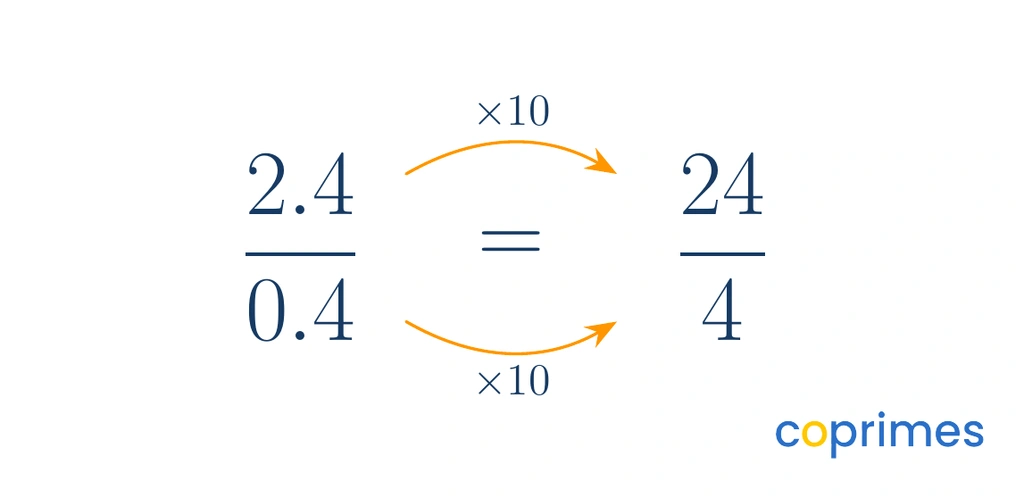
The dividend does not need to become a whole number.
If you divide by , you only need to multiply by because the divisor only needs one shift. The calculation becomes .
Use long division and estimation
After setting up the equivalent whole-number division, use standard long division to find the answer.
Estimate the answer before or after calculating to verify that your decimal placement is correct.
For example, evaluate .
First, multiply both values by to yield .
Before calculating, estimate .
The actual result should be near .
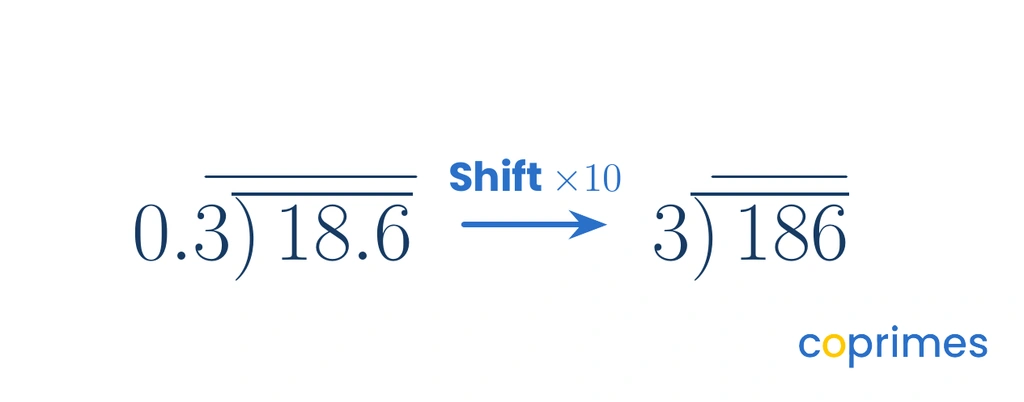
Calculating yields , which matches the estimate perfectly.
Worked examples
Reviewing completed problems helps secure the steps. Like with multiplying decimals, careful tracking of place value prevents errors.
Example 1: Divide by a decimal
Question: Evaluate .
Method:
- Identify the divisor, which is .
- Multiply both the divisor and the dividend by to make the divisor a whole number.
- The new expression is .
- Place the decimal point above the division bracket and divide.
- with a remainder of . Bring down the to make .
- . The final quotient is .
Answer: The answer is .
Check: Estimate , which means finding how many halves are in . The answer is . Since is close to , the result is correct.
Example 2: Adding zeros to the dividend
Question: Evaluate .
Method:
- Identify the divisor, which is .
- Multiply both numbers by to clear the two decimal places in the divisor.
- The dividend multiplied by becomes .
- The new expression is .
- Perform the division: with a remainder of . Bring down the to make .
- .
Answer: The answer is .
Check: Multiply the quotient by the original divisor: , which matches the original dividend.
You will frequently encounter decimal word problems when finding unit costs, speeds, or sharing measurements.
Example 3: Measurement application
Question: A ribbon is meters long. It is cut into sections that are each meters long. How many sections are created?
Method:
- Set up the division: .
- Multiply both numbers by to make the divisor a whole number.
- The new expression is .
- Divide by to get with a remainder of . Bring down the to make .
- Divide by to get .
Answer: There are sections of ribbon.
Check: Multiply . Since and , adding them gives . The logic holds.
A learning plan shaped by your child, not the class
State-aligned Math plus our own Logic and English curriculum. An adaptive baseline test finds the gaps and fills them.
Common mistakes
Watch out for these frequent errors when dividing decimal values.
- Multiplying by different powers of ten: You must multiply both the dividend and the divisor by the identical number. Changing into is incorrect. You must multiply both by to get .
- Making the dividend a whole number instead of the divisor: It is not necessary for the dividend to be a whole number. Only the divisor dictates what power of ten to use.
- Misplacing the decimal point in the quotient: When dividing by a whole number, always write the decimal point in the answer space before beginning to compute.
Never shift the decimal point in only one number.
Frequently asked questions
Can a quotient be larger than the dividend?
Yes. When you divide by a decimal strictly between and , the quotient will be greater than the dividend. For example, .
What do I do if there is a remainder?
When dividing decimals, do not write a traditional remainder. Add a zero to the end of the dividend and continue dividing until the decimal terminates or begins a repeating pattern.
Does the power of ten depend on the larger number?
No. You choose the multiplier strictly based on how many places the divisor needs to move to become an integer.
Practice questions
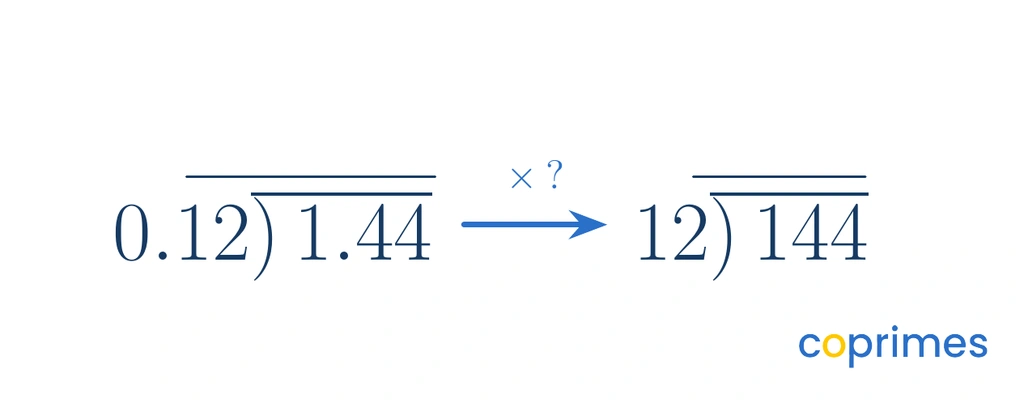
The diagram shows a division problem being converted to use a whole-number divisor. By what factor must both numbers be multiplied?
What is the quotient of ?
Which division expression is mathematically equivalent to ?
A student evaluates and states the answer is . Why is this incorrect?
The student did not multiply both numbers by ten before dividing.
The quotient should be smaller than the dividend when dividing decimals.
The student misplaced the decimal; dividing tenths by tenths yields whole groups.
The student should have divided seven by twenty-one.
The student misplaced the decimal; dividing tenths by tenths yields whole groups.
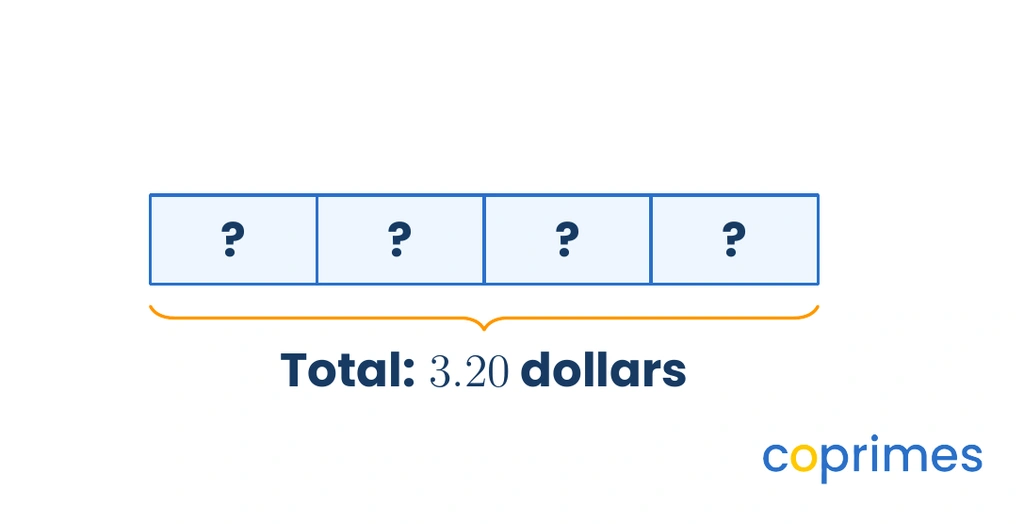
Four friends equally share a cost of dollars. How much does each person pay?
dollars
dollars
dollars
dollars
dollars