
Multiplying Decimals
To multiply decimals, multiply as whole numbers, use the total number of decimal places in the factors to place the decimal point in the product, and estimate to check that the product has a sensible size.
Understanding how to multiply decimal values allows you to solve real-world problems involving continuous measurements.
This process builds directly on standard multiplication methods.
Instead of learning a completely new operation, you simply apply the whole-number algorithm and then use decimal place value rules to format the final answer.
How do you multiply decimals?
Multiplying decimals involves ignoring the decimal points temporarily, finding the product of the digits, and then placing the decimal point in the correct final position.
Follow these three steps to multiply any two decimals:
- Count the total number of decimal places in both factors.
- Multiply the numbers exactly as you would multiply whole numbers, ignoring the decimal points.
- Place the decimal point in your answer so that the product has the exact same number of decimal places as the total you counted in the first step.
For example, when calculating , the first factor has one decimal place and the second factor has two.
The product must have three decimal places.
Since , you write the answer as to ensure there are three digits after the decimal point.
Understand decimal products with area models
An area model helps visualize why multiplying two decimals less than one results in an even smaller product.
You can represent decimal multiplication on a hundredths grid, which is a square divided into smaller equal squares.
The entire grid represents one whole, and each small square represents one hundredth, or .
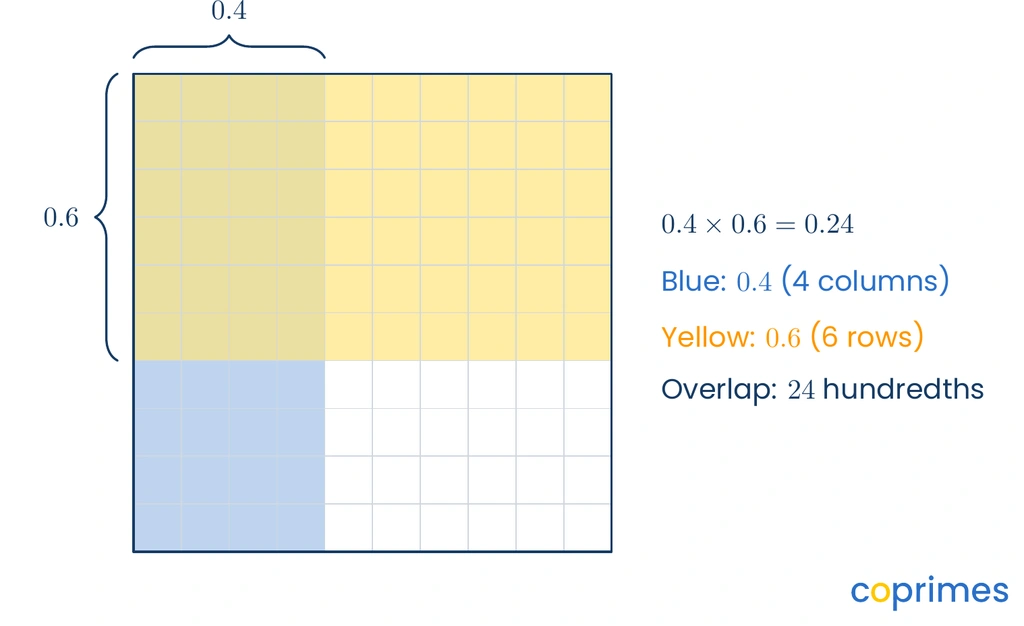
To find , shade columns to represent .
Then shade rows to represent .
The overlapping rectangular section contains exactly small squares.
Because each small square is one hundredth, the product is .
Multiply a decimal by a whole number
When multiplying a decimal by a whole number, you are combining equal groups of a decimal value.
For example, calculating means finding the total of three groups, each containing .
You can represent this as a series of jumps on a number line.
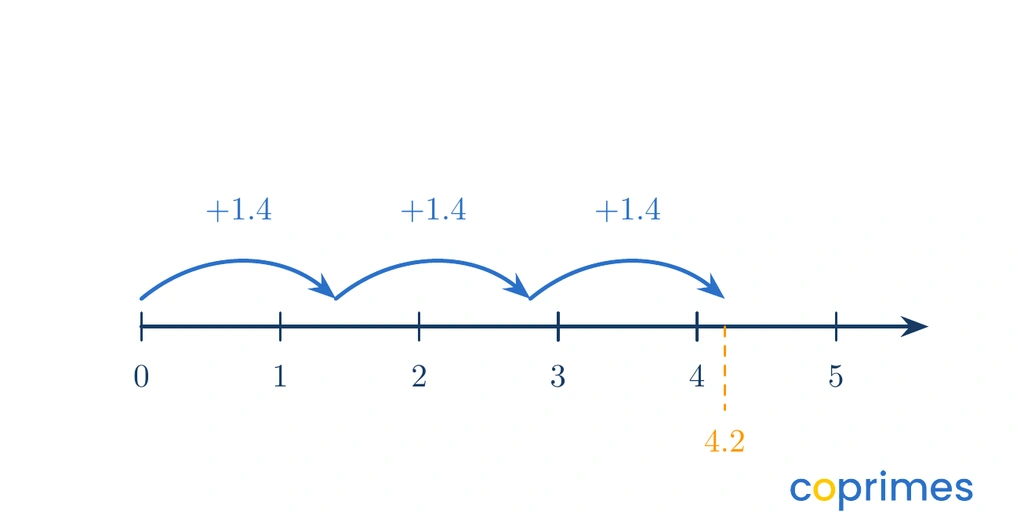
Using the standard algorithm, count the decimal places first.
The number has one decimal place, and has zero. The product requires exactly one decimal place.
Multiply , then insert the decimal point one position from the right to reach .

Multiply two decimals
When both factors are decimals, align the numbers by their rightmost digits, not by their decimal points.
To calculate , set up the calculation as if multiplying .
Multiply the digits to find the whole-number product.
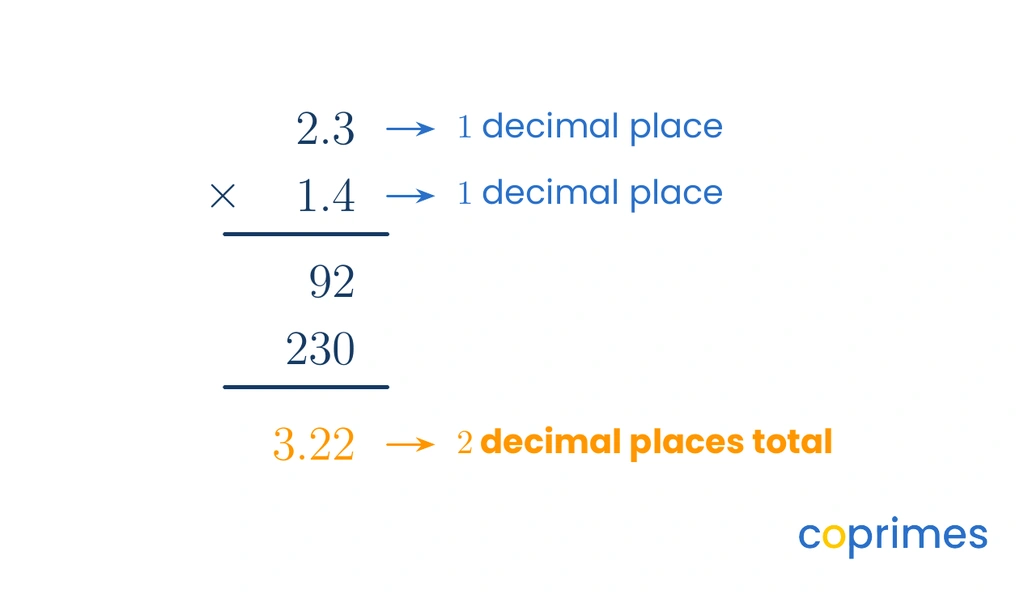
The sum of the decimal places in (one place) and (one place) requires the final product to have exactly two decimal places.
Applying this rule to the whole-number product of yields a final answer of .
Place the decimal point
Counting total decimal places works because decimals are fractions based on powers of ten.
When you multiply by , you are multiplying three tenths by four tenths.
In fraction form, this is .
Multiplying the numerators gives , and multiplying the denominators gives .
The result is , which is written as .
The sum of the decimal places matches the number of zeros in the denominator of the fraction product.
If one factor has two decimal places (hundredths) and the other has one decimal place (tenths), the product will be in thousandths because .
Estimate and check
Estimating before calculating provides a reliable way to check that you placed your decimal point correctly.
Round each factor to the nearest whole number or to one significant figure.
If you are multiplying , round up to and round down to .
Your estimate is .
If you execute the standard algorithm and write or , comparing it to your estimate of immediately reveals a place-value error.
The correct product is , which is very close to .
Estimation is equally valuable when checking solutions for dividing decimals.
A learning plan shaped by your child, not the class
State-aligned Math plus our own Logic and English curriculum. An adaptive baseline test finds the gaps and fills them.
Worked examples
Use these structured examples to practice the standard algorithm with various types of decimal values.
Example 1: Multiplying a decimal by a whole number
Question: Calculate .
Method:
- Count the total decimal places. There is one decimal place in and zero in , totaling one decimal place.
- Multiply the numbers as whole numbers: .
- Place the decimal point so the answer has one decimal place.
Answer:
Check: Estimate by rounding to . The estimate is close to , confirming the result.
Example 2: Multiplying two decimals less than one
Question: Calculate .
Method:
- Count the total decimal places. There are two decimal places in and one in , totaling three decimal places.
- Multiply as whole numbers: .
- The answer needs three decimal places. You must add a placeholder zero in front of the to create enough places.
Answer: (which simplifies to )
Check: In fractions, , which equals .
Example 3: Solving a geometric application
Question: A rectangular room has a length of meters and a width of meters. What is the area of the room?
Method:
- Finding area requires calculating .
- Count the decimal places: one in and two in , totaling three.
- Multiply using a standard vertical layout. This gives .
- Place the decimal point so there are three decimal places.
Answer: The area is square meters, which simplifies to square meters.
Check: Estimate . The answer is reasonable. This process is standard for decimal word problems.
Common mistakes
Avoid these frequent errors to ensure accurate decimal multiplication.
Lining up the decimal points
A common misconception is treating multiplication like addition and subtraction by aligning the decimal points vertically.
This often leads to incorrect place-value alignments and makes the whole-number calculation unnecessarily difficult.
Always align the factors by their rightmost digits, completely ignoring the decimal point until the final step.
Forgetting zero placeholders
When the whole-number product has fewer digits than the required number of decimal places, you must insert zeros immediately to the right of the decimal point.
For instance, produces a whole-number product of .
Because the factors have a total of two decimal places, you must write the answer as , not .
Frequently asked questions
Does multiplying decimals always result in a smaller number?
No. A product is only smaller than its starting value if you multiply by a decimal between zero and one.
Multiplying by a decimal greater than one always produces a larger number.
For example, (which is smaller than ), but (which is larger).
How does multiplying by 10, 100, or 1,000 work?
When finding products involving powers of ten, you do not need the full written algorithm.
Instead, you can shift the digits to the left for each zero in the power of ten.
This specific shortcut applies only to multiplying and dividing decimals by powers of ten.
Practice questions
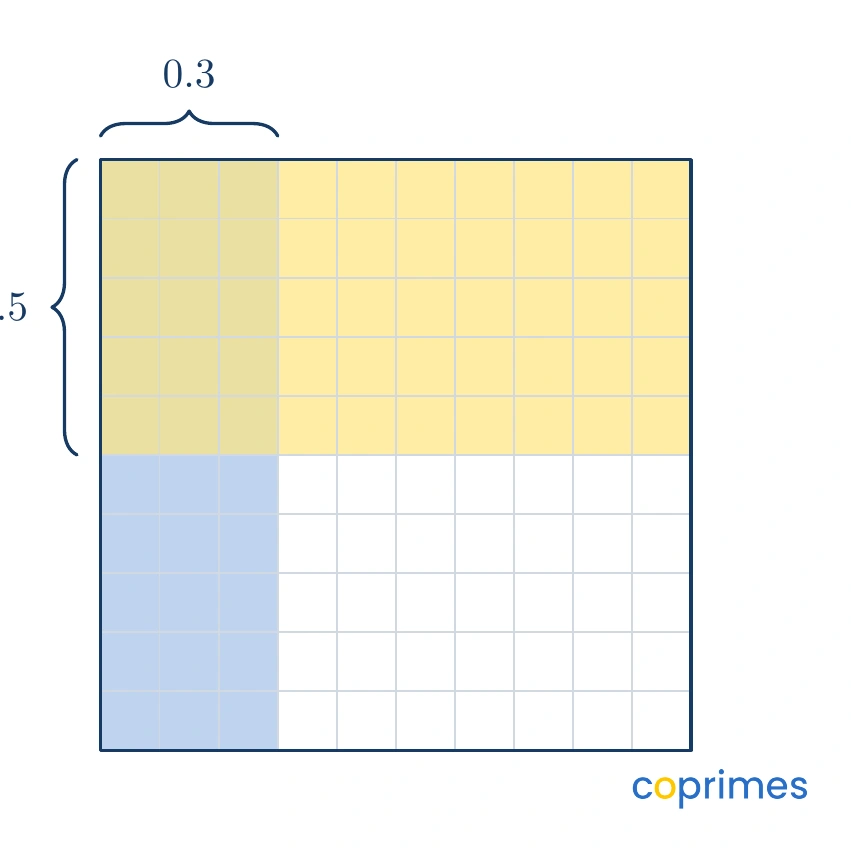
What product is represented by the overlap in the area model?
Calculate .
If , what is the value of ?
Calculate .
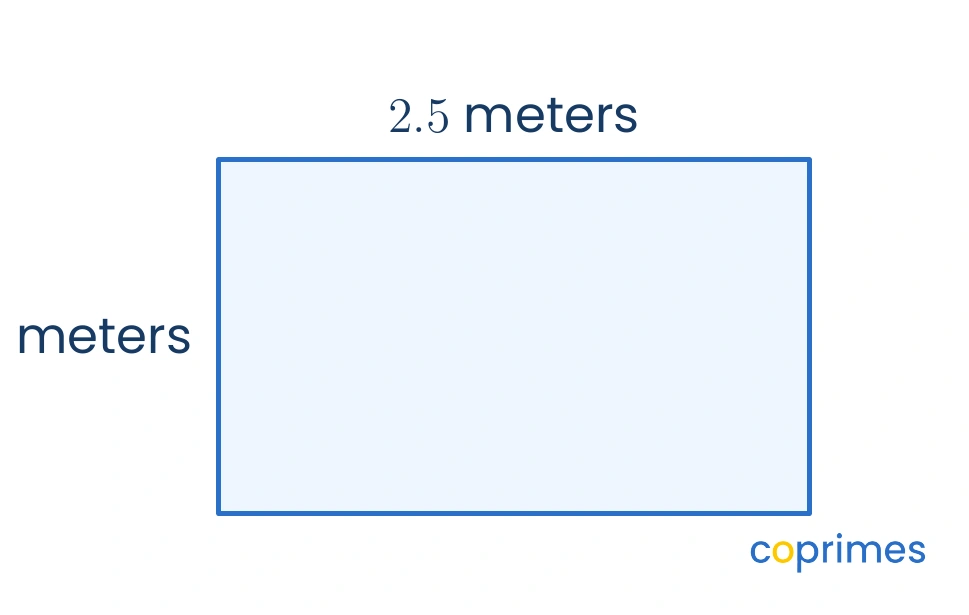
What is the area of the rectangle in square meters?