
Division as Sharing and Grouping
Learning division as sharing and grouping reveals two distinct ways to interpret a single mathematical operation. Sharing division finds the size of each equal group, while grouping division finds how many groups of a known size can be made. Both methods break a total into equal parts but answer different questions.
What are sharing and grouping division?
Sharing and grouping are the two main ways to think about division. Every division equation begins with a total amount, called the dividend. The difference lies in what the divisor and the quotient represent in the real world.
In a sharing problem, the divisor represents a predetermined number of groups, and the quotient is the amount placed into each group. In a grouping problem, the divisor represents the size of each group, and the quotient is the total number of groups created. Both methods ensure fairness by breaking a total amount into perfectly equal parts.
Equal-sharing model
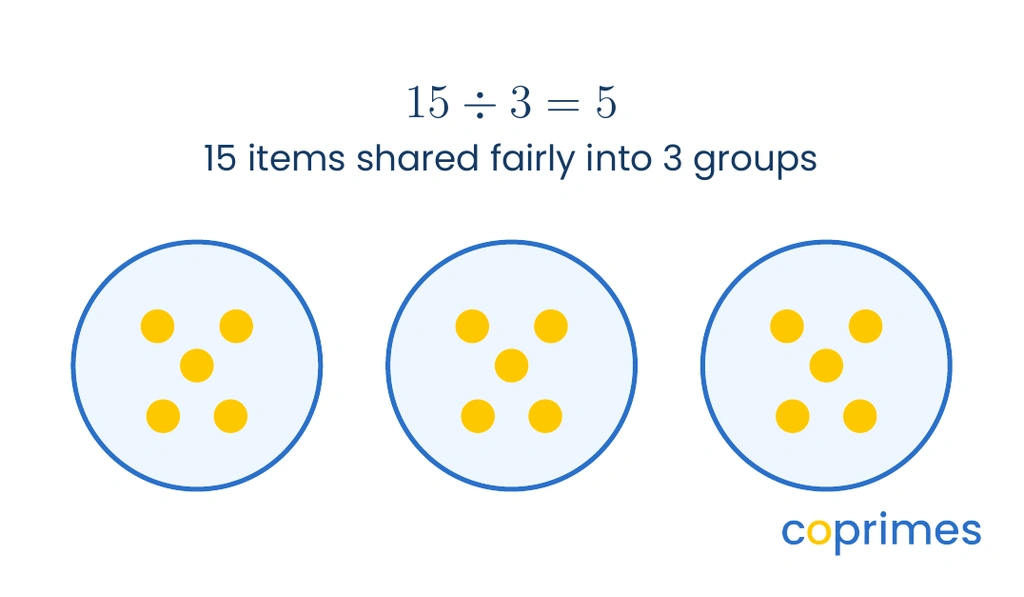
The equal-sharing model, also called partitive division, is used when a total amount is distributed evenly among a known number of groups. The goal is to find out exactly how many items belong in one single group.
For example, if you have items and boxes, you share the items equally by placing one item into each box in turn until all items are gone. The total () is the dividend, and the number of boxes () is the divisor.
In sharing division, the quotient tells you the size of one equal group.
Equal-grouping model
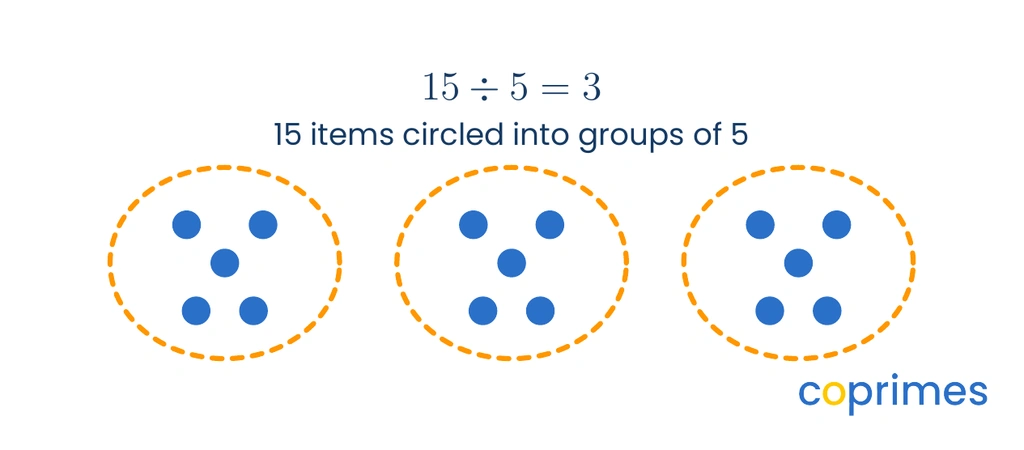
The equal-grouping model, also known as quotative division or measurement division, is used when a total amount is separated into groups of a specific size. The goal is to find out exactly how many groups can be formed.
For example, if you have items and each box must hold exactly items, you measure out groups of until the items run out. The total () is the dividend, and the size of each group
() is the divisor.
In grouping division, the quotient tells you the total number of groups created.
A learning plan shaped by your child, not the class
State-aligned Math plus our own Logic and English curriculum. An adaptive baseline test finds the gaps and fills them.
Compare the two question types
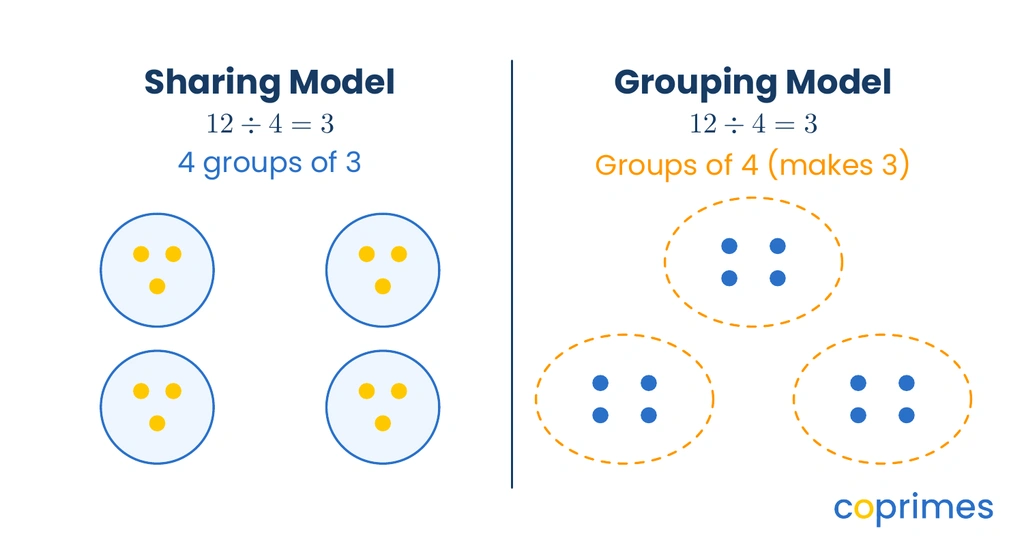
The exact same division fact can be modeled as either sharing or grouping, depending on the story context. Consider the mathematical equation .
Sharing Interpretation
Context: cards are dealt to players. How many cards does each player get?
Representation: Create distinct hands, placing card into each hand until all cards are distributed. The final result is cards per player.
Grouping Interpretation
Context: cards are packed into sets of cards. How many sets can be made?
Representation: Count out exactly cards to form one set, then another for the next set, until all cards are grouped. The final result is distinct sets.
Draw and write equations
Visual models translate perfectly into mathematical equations. To write an equation from a picture model, identify the total number of objects, the number of groups, and the amount inside each group.
- First, count the total number of objects in the entire diagram. This is your dividend.
- Next, identify the known part. In a sharing model, the divisor is the number of containers drawn. In a grouping model, the divisor is the specific size circled together.
- Finally, record the result. The quotient is the unknown piece of information the diagram solves.
Because division physically separates a total amount into equal parts, it always reverses the process of finding a total. Every division picture model also represents a multiplication fact, which is why drawing these visuals helps build a strong understanding of multiplication and division fact families.
Worked examples
These structures apply directly to solving division word problems. Recognizing the correct mathematical structure ensures you interpret the final answer accurately.
Example 1: Identifying the division model
Question: A baker has cookies and puts exactly cookies into each box. Does this situation require sharing division or grouping division?
Method:
- Identify what is known. The total dividend is cookies. The exact size of each group is cookies.
- Identify what is unknown. The unknown is the final number of boxes (the number of groups).
- Match the unknown to the correct model structure. Finding the number of groups is the defining feature of grouping division.
Answer: This situation requires grouping division.
Check: Counting out groups of until is reached gives exactly groups, which mathematically makes sense for counting boxes.
Example 2: Writing a sharing equation
Question: A teacher divides pencils equally among students. Write the division equation that matches the story.
Method:
- Identify the total dividend. There are pencils.
- Identify the known part. The pencils are distributed fairly to students, which represents the predetermined number of groups. This confirms it is a sharing problem.
- Write the structure: .
- Deal the pencils visually or use related multiplication () to find the missing quotient.
Answer: The correct equation is . Each student receives pencils.
Check: If students each receive pencils, they have pencils in total. The numbers balance.

Common mistakes
A frequent mistake is drawing the wrong type of visual model for a word problem. If a problem asks how many groups can be formed (grouping division), but you draw a sharing model with a predetermined number of circles, you will immediately get stuck because the number of circles is exactly what you are trying to find.
Another common error is writing the divisor first. Always ensure the total starting amount is written as the dividend at the very beginning of the division equation, regardless of whether it is a sharing or grouping context.
Frequently asked questions
Can sharing and grouping methods be used for large numbers?
Yes. However, drawing out hundreds of individual dots quickly becomes inefficient. For larger numbers, these core grouping concepts are transferred to area models, place-value charts, and algorithms, where you manipulate place values instead of single units.
What happens if the items cannot be grouped or shared evenly?
If the total dividend cannot be separated completely into perfectly equal groups, a remainder is left over. The remainder represents the remaining units that do not fit the established pattern. This concept is explored further in division with remainders.
Practice questions
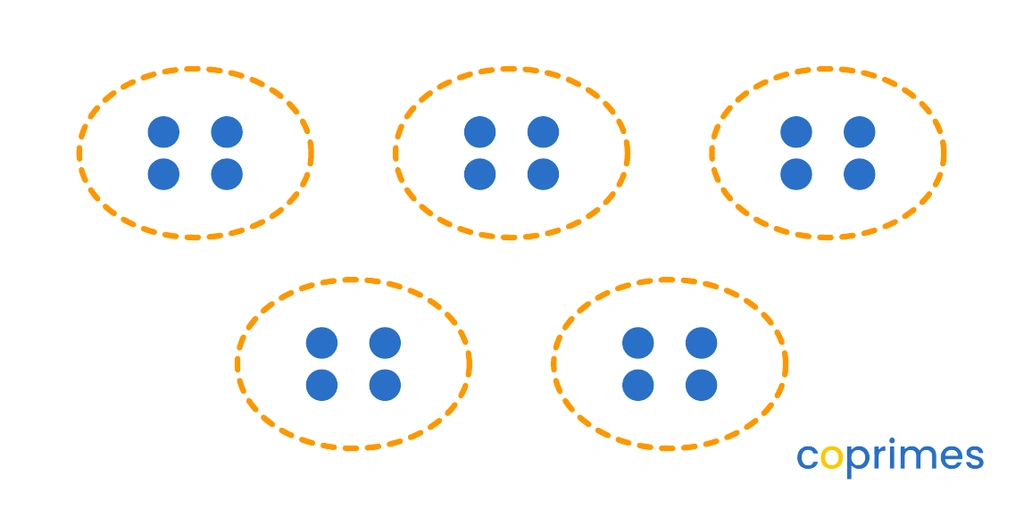
Does the visual model show sharing division or grouping division, and what is the matching equation?
It shows grouping division for the equation .
It shows sharing division for the equation .
It shows grouping division for the equation .
It shows sharing division for the equation .
It shows grouping division for the equation .
A farmer has apples and puts exactly apples into each basket. Which conceptual model represents this mathematical problem?
Equal-sharing, because the size of each group is known.
Equal-grouping, because the size of each group is known.
Equal-grouping, because the number of groups is known.
Equal-sharing, because the number of groups is known.
Equal-grouping, because the size of each group is known.
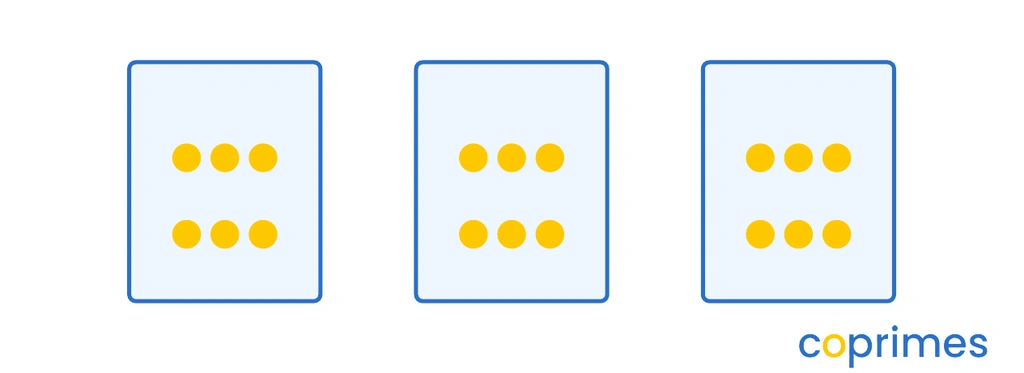
Which division equation and conceptual model type are shown in the diagram?
using the equal-sharing model
using the equal-sharing model
using the equal-grouping model
using the equal-grouping model
using the equal-sharing model
In a sharing division mathematical problem, what does the quotient represent?
The total number of groups
The number of items in each group
The total number of items
The number of items left over
The number of items in each group
Which mathematical word problem accurately describes the grouping division equation ?
books are distributed fairly among students. How many books does each student get?
books are packed into boxes, with exactly books in each box. How many boxes are used?
books are given to students, and then more books are added. How many books are there?
books are packed into each of boxes. How many boxes are used?
books are packed into boxes, with exactly books in each box. How many boxes are used?