
Division With Remainders
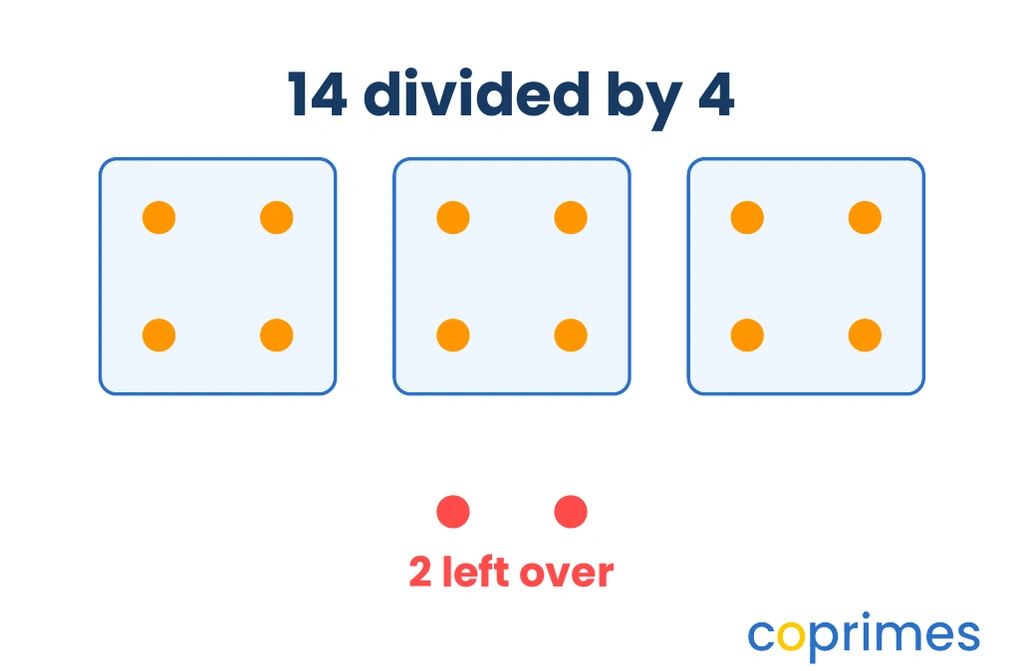
A remainder is the amount left after making as many equal groups as possible; it is always less than the divisor for whole-number division. When dividing objects or numbers into equal parts, you often find division leftovers that do not make a complete group.
Understanding division with remainders allows you to accurately interpret grouping problems, share quantities fairly, and calculate fractional parts of a whole.
What is a remainder?
A remainder is the exact quantity left over when a total amount cannot be divided into equal groups without fractions.
When you share items equally, you use a dividend, divisor and quotient. The dividend is the total amount, the divisor is the size of each group, and the quotient is the number of full groups.
The remaining amount that is too small to form another full group is the remainder. Non-exact division always results in a remainder.
The remainder is the exact number of items left over after forming full groups.
Write a division-with-remainder equation
You can write a division equation showing the quotient and the remainder clearly. The capital letter R is commonly used to indicate the remainder.
For example, dividing by gives complete groups and left over. You write this as:
You can also express the leftover amount as a fraction. The remainder becomes the numerator, and the divisor becomes the denominator. This represents the fractional part of a full group.
To verify your answer, you can use the division algorithm and checking relationship. Multiplying the divisor by the quotient and adding the remainder must always equal the original dividend.
Why the remainder is smaller than the divisor
When you divide, you are creating groups of a specific size. If the remainder is equal to or larger than the divisor, you can make at least one more complete group.
The remainder must always be smaller than the number you are dividing by.
For example, if you calculate as , the remainder is larger than the divisor . This means the leftover group of contains enough items to make another full group of .
The correct division finds the maximum possible number of full groups. You make full groups of , leaving only . The correct equation is .

Represent a remainder
You can model non-exact division by drawing jumps on a number line. This representation visually connects division leftovers to repeated addition and distance.
To model , you jump forward from in identical steps of until you can no longer fit a full jump before passing .
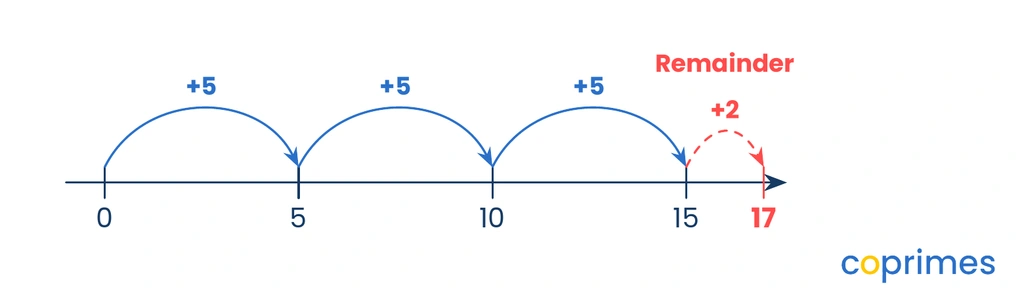
The diagram clearly shows large jumps of covering a distance of . The remaining space before reaching has a length of , verifying the result .
Interpret remainders in context
When solving real-world word problems, learning how to interpret remainders is essential. The final answer to a division problem depends entirely on what the remainder represents.
There are three common ways to treat a remainder in context:
- Keep the remainder: If you are packing objects into boxes and want to know exactly how many objects are left unpacked, the remainder is your answer.
- Round up the quotient: If you are booking buses for a school trip and there are leftover people, you cannot leave them behind. You must add one more bus to accommodate the remainder.
- Divide into fractions: If you are sharing continuous items like pizzas, you do not leave the remainder untouched. You slice the leftover pizzas so everyone gets a fractional piece.
Worked examples
These examples show division remainder examples applied to different methods and contexts.
Example 1: Short division with a remainder
Question: Calculate .
Method:
- Recall the multiples of to find the largest multiple that is less than or equal to .
- The multiples are .
- The closest multiple without exceeding is .
- Find the number of groups: .
- Subtract to find the remainder: .
Answer: .
Check: .
Example 2: Interpreting a remainder to round up
Question: A teacher has students. They are placed into teams of . How many teams are needed so that every student is on a team?
Method:
- Set up the division: .
- Find the largest multiple of within . That is , because .
- Calculate the remainder: .
- The division gives . This means there are full teams and students left over.
- Since the students must also be on a team, an extra team is needed.
Answer: The teacher needs teams.
Check: .
Example 3: Larger division using formal methods
Question: Use long division or short division to calculate .
Method:
- Divide the hundreds: with a remainder of .
- Carry the to the tens, making . Divide the tens: with a remainder of .
- Carry the to the ones, making . Divide the ones: with a remainder of .
- Combine the quotient digits to get and record the remainder of .
Answer: .
Check: .
A learning plan shaped by your child, not the class
State-aligned Math plus our own Logic and English curriculum. An adaptive baseline test finds the gaps and fills them.
Common mistakes
When working with non-exact division, watch out for these frequent errors.
Leaving a remainder larger than the divisor
If you calculate and write , your remainder is too big. Because is greater than , another full group can be formed. The correct result is .
Forgetting to add the remainder during the check
To verify a division answer, you multiply the divisor by the quotient. Students often forget the final step: you must add the remainder back to the product to match the original dividend.
Ignoring the context of the problem
If an elevator holds people and people are waiting, the mathematical division is . A common error is answering that elevators are needed. The remaining people also need a ride, so elevators are actually required.
Frequently asked questions
Can a remainder be zero?
Yes. When a number divides evenly without any leftovers, the division is exact and the remainder is . For example, , which is simply written as .
What is the remainder when dividing a smaller number by a larger number?
If you divide a smaller number by a larger number, you can make full groups, so the entire dividend becomes the remainder. For instance, .
Are remainders and fractions the same?
They are closely related but not identical. A whole-number remainder represents the leftover objects. A fraction compares that leftover amount to the divisor. In , the leftover is objects. As a fraction, the answer is , meaning the remainder is three-fourths of a complete group.
Practice questions
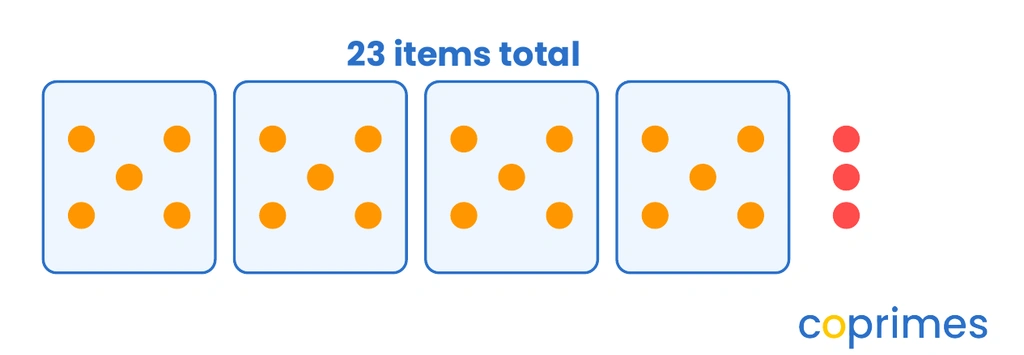
Which division equation represents the grouping shown in the diagram?
What are the quotient and remainder when is divided by ?
A bakery packs cookies into boxes of . If they have cookies, how many full boxes will they pack, and how many cookies will be left over?
full boxes with cookies left over
full boxes with no cookies left over
full boxes with cookies left over
full boxes with cookies left over
full boxes with cookies left over
When dividing a whole number by , what is the largest possible whole-number remainder?
How can the division equation be rewritten using a fraction?