
Fractional Exponents: Guide and Examples
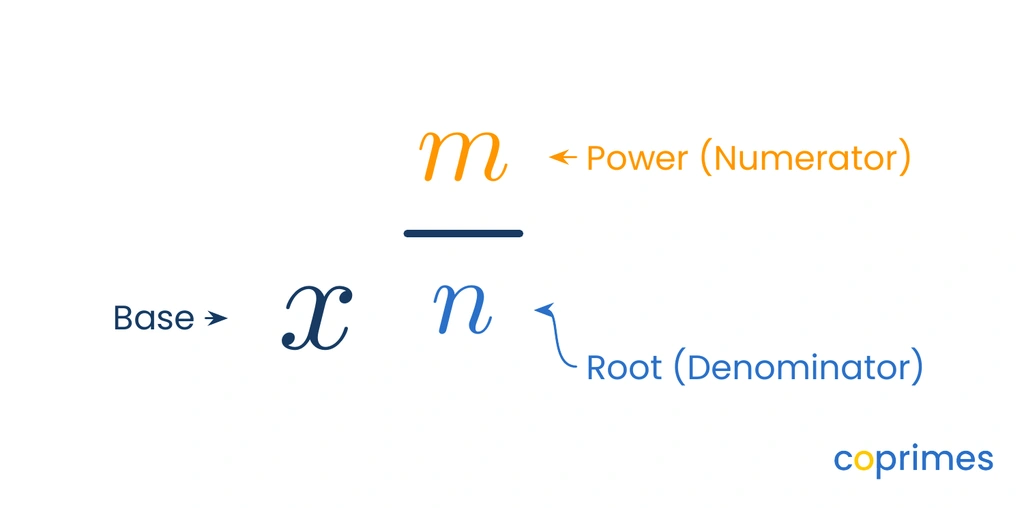
When asking what is fractional exponents, the definition is straightforward: a fractional exponent represents a root and a power. The denominator gives the root, and the numerator gives the power.
Fractional exponents provide a powerful way to write radicals using standard exponent notation. They are a core part of exponents and powers, allowing you to calculate complex expressions seamlessly.
What Are Fractional Exponents?
A fractional exponent, or rational exponent, is an exponent written in the form of a fraction, .
The base is raised to the power of the numerator , and the -th root is taken according to the denominator .
Unlike a zero exponent which always simplifies a non-zero base to , a fractional exponent transforms the base into a root.
For an exponent with a numerator of , such as , the expression simply represents the -th root of the base: .
For example, means the square root of , which is .
The denominator determines the root, and the numerator determines the power.
When to Use It
Fractional exponents are used to simplify expressions that contain multiple roots and powers.
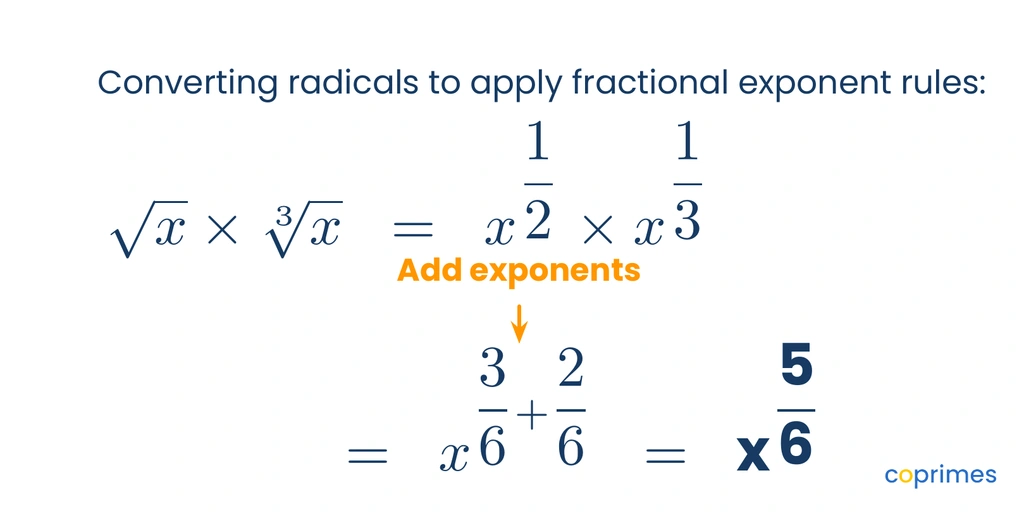
This mathematical approach shows you how to convert radicals to exponents and apply fractional exponent rules. By converting radical symbols into fraction powers, you can use standard multiplication and division rules for exponents.
They are especially useful when analyzing an order of magnitude or scaling geometric models, because exponents behave smoothly during addition and multiplication.
There is one important restriction: if the denominator of the fraction is an even number, you cannot take that root of a negative base within the real numbers.
Step-by-Step Method
When evaluating , you can choose to apply the root first or the power first. Both sequences produce the identical result.
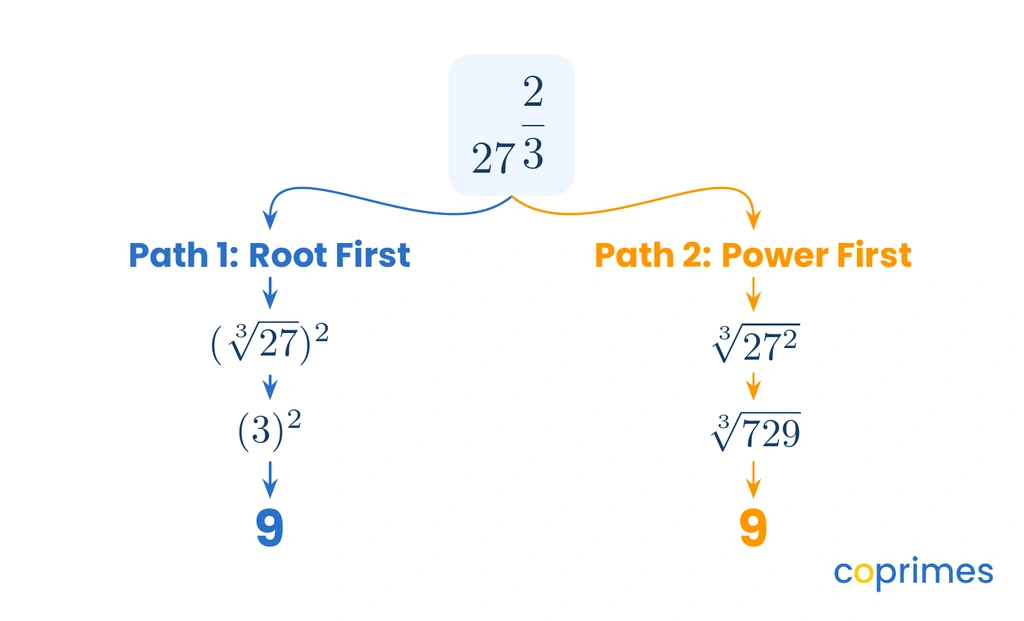
Path 1: Root First (Recommended)
- Find the -th root of the base: .
- Raise that result to the -th power: .
This path is usually easier because it shrinks the number before you multiply it.
Path 2: Power First
- Raise the base to the -th power: .
- Find the -th root of that large result: .
A learning plan shaped by your child, not the class
State-aligned Math plus our own Logic and English curriculum. An adaptive baseline test finds the gaps and fills them.
Visual Worked Examples
Applying the step-by-step method to various problems reveals how different bases and fractions interact. These rational exponent examples demonstrate the standard procedures.
Example 1: Positive base with a fraction
Question: Evaluate .
Method:
- Identify the root from the denominator: the cube root of .
- Apply the root: .
- Identify the power from the numerator: square the result.
- Apply the power: .
Answer: .
Check: Reverse the operation by raising to the reciprocal power: .
Example 2: Negative base with an odd root
Question: Evaluate .
Method:
- Identify the root from the denominator: the cube root of .
- Apply the root: .
- Identify the power from the numerator: square the result.
- Apply the power: .
Answer: .
Check: Evaluate using the power-first path. . The cube root of is . Both paths match.
Example 3: Identifying a real-number restriction
Question: Evaluate over the real numbers.
Method:
- Identify the root from the denominator: the -th root.
- Note the base is negative ().
- Recognize that an even root of a negative number is not a real number.
Answer: The expression has no real solution.
Check: No real number raised to the -th power yields , because any real number to an even power is positive or zero.
How to Check the Answer
Verifying your evaluation of a fractional exponent ensures you applied the root and power correctly.
The most direct method is to reverse the process using the reciprocal of the exponent. If you evaluated , check this by raising your answer to the flipped exponent .
If returns your original base , your calculation is correct. For example, if you claim that , check it by evaluating .
The square root of is , and . The original base is recovered, confirming the answer is correct.
Mastering this verification method helps prepare you for advanced topics like scientific notation, where balancing exponents is critical.
Common Mistakes
Misunderstanding the position of the digits is the most frequent error when working with fractional exponents.
Do not multiply the base by the fraction. For instance, is the square root of , which is . It is not .
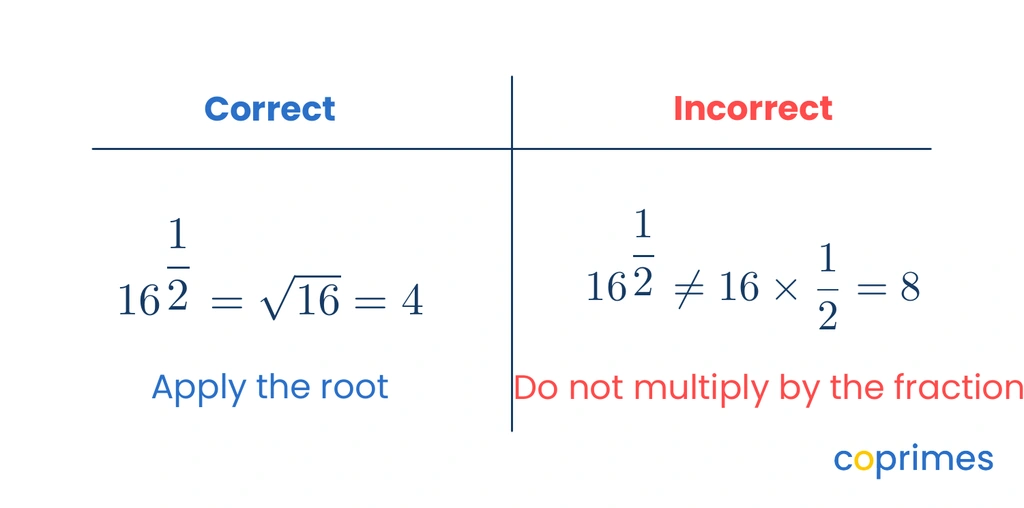
The exponent tells you the power and root, not a multiplication factor.
Do not confuse fractional exponents with negative exponents. A negative exponent creates a reciprocal, while a fractional exponent creates a radical.
Always remember that the denominator represents the root. Flipping the fraction changes the meaning entirely: is , but is .

Practice questions

Convert the radical shown above to a fractional exponent.
Evaluate .
Which sequence of operations correctly evaluates ?
Take the cube root of , then multiply by .
Divide by , then square the result.
Square , then divide by .
Take the cube root of , then square the result.
Take the cube root of , then square the result.
Evaluate .
No real solution
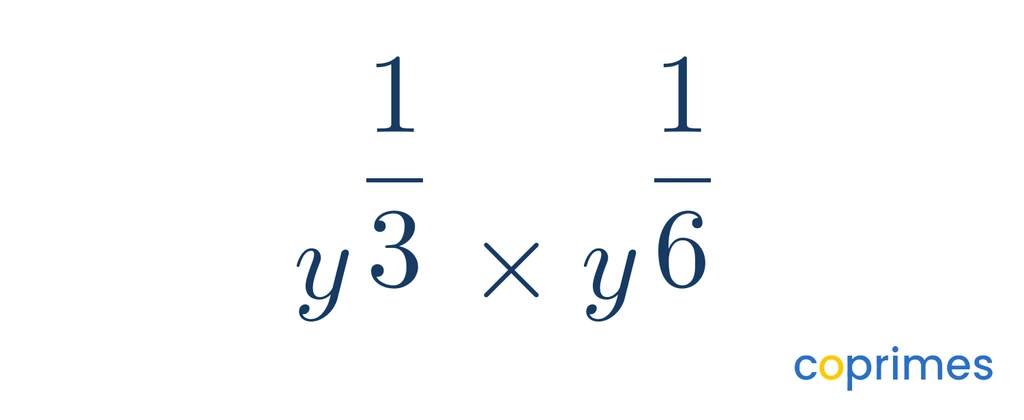
Based on the laws of exponents, what is the simplified form of the expression shown above?