
Understanding the Laws of Exponents: Guide and Examples for Grades 7-10
The laws of exponents describe how powers combine under multiplication, division, powers of powers, products, and quotients when their conditions are met. These rules provide mathematical shortcuts, allowing you to simplify complex algebraic expressions without having to write out long strings of repeated multiplication.
Laws of Exponents: Definition and Notation
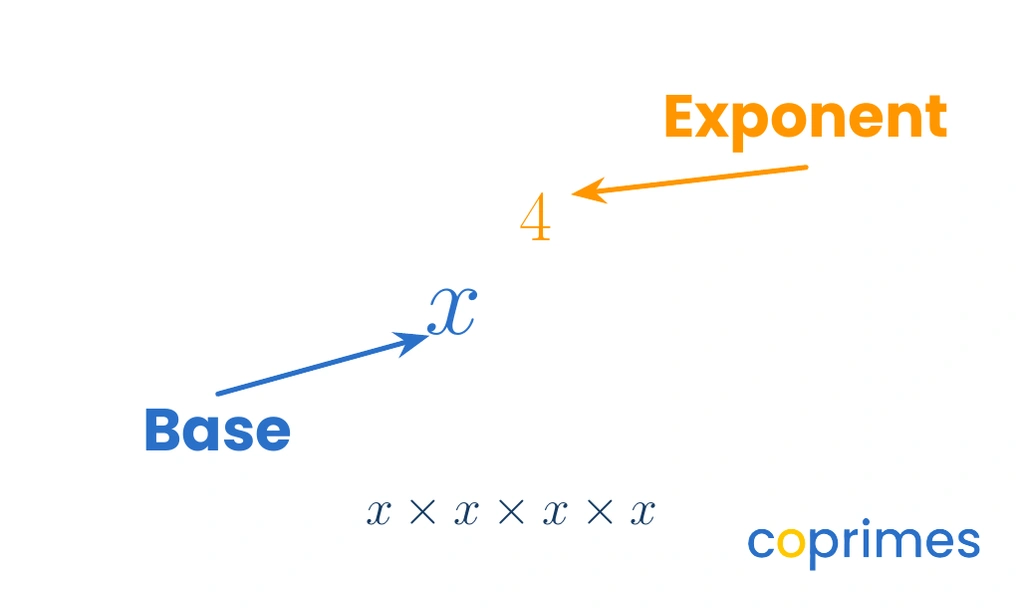
Before applying the laws, you must understand the structure of exponents and powers. A power consists of two parts: the base and the exponent.
The base is the large number or variable being multiplied. The exponent, which is written as a small raised number to the right, indicates exactly how many times the base is multiplied by itself. Depending on where you study, the laws of exponents are also known internationally as exponent rules, laws of indices, or index laws.
Every exponent rule requires a specific condition to be met before you can apply it. The most common requirement is that the bases must be identical. You can combine and , but you cannot combine and into a single power.
Rules or Reference Table
Use this summary table as a quick reference for the five core laws of exponents. Each rule describes a shortcut for a specific operation.
Law Name | Algebraic Rule | Numerical Example |
Product Rule | ||
Quotient Rule | ||
Power of a Power | ||
Power of a Product | ||
Power of a Quotient |
When dividing, the denominator base can never equal zero, as division by zero is undefined. As you advance, you will also apply related rules for a zero exponent and negative exponents, which follow the exact same underlying logic shown above.
Why It Works
The exponent rules are not random tricks; they are direct results of expanding powers into repeated multiplication. Deriving these rules manually proves why adding or subtracting exponents works.
To derive the product rule exponents, expand . The first power is , and the second power is . Multiplying them together strings all five variables into a single chain: . Because there are exactly five copies of the base, the result is . This proves that adding the exponents () achieves the same result as manual expansion.
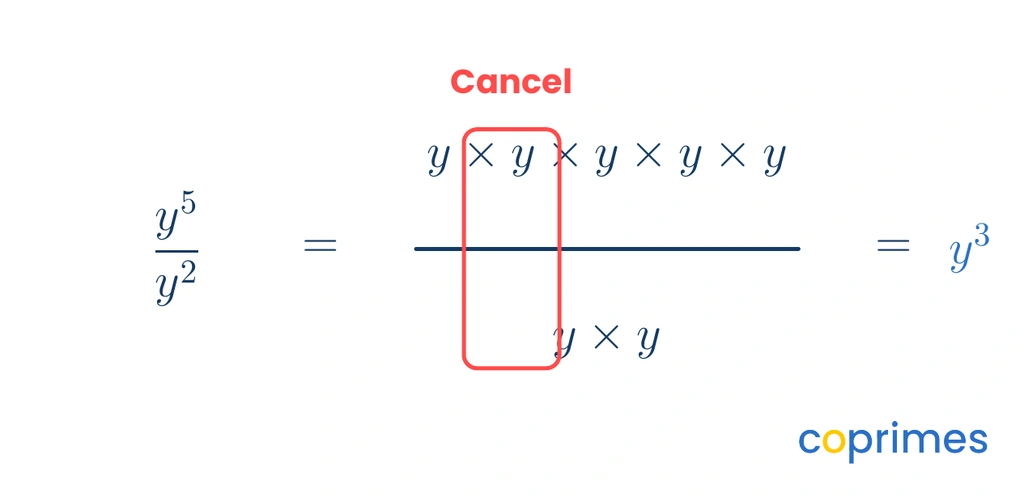
The quotient rule exponents work by cancelling pairs of matching factors from the numerator and the denominator. For every factor in the bottom, one matching factor in the top is removed, which is mathematically identical to subtraction.
A learning plan shaped by your child, not the class
State-aligned Math plus our own Logic and English curriculum. An adaptive baseline test finds the gaps and fills them.
Visual Worked Examples
When evaluating complex expressions, follow the order of operations and select the correct rule for each step. Use the decision table below to choose the correct rule.
Operation | Matching Condition | Exponent Rule |
Multiplying powers | Bases are identical | Add exponents |
Dividing powers | Bases are identical | Subtract exponents |
Raising a power to a power | Single base, double exponents | Multiply exponents |
Power of a product | Multiple bases in parentheses | Distribute exponent |
Example 1: Using the product rule exponents
Question: Simplify the expression .
Method:
- Multiply the numerical coefficients together: .
- Identify that the identical base is .
- Apply the product rule by adding the exponents: .
Answer: .
Check: Group the terms manually. . The coefficient is and there are exactly nine copies of , matching .
Example 2: Distributing a power of a product
Question: Simplify the expression .
Method:
- Recognize that the exponent outside the parentheses applies to every factor inside.
- Raise the numerical coefficient to the power: .
- Apply the power of a power rule to the variable by multiplying the exponents: .
Answer: .
Check: Expand the expression into a product. .
Example 3: Combining multiple rules
Question: Simplify the expression .
Method:
- Simplify the numerator first. Apply the power of a power rule by multiplying the exponents: . The numerator becomes .
- The expression is now .
- Apply the quotient rule by subtracting the denominator's exponent from the numerator's exponent: .
Answer: .
Check: Substitute a simple value like . The numerator is . The denominator is . Dividing gives . The simplified expression also equals , proving the rules were applied correctly.
Common Mistakes and Exceptions
A frequent mistake is applying the product rule to addition problems. It is mathematically false that . Exponent rules only apply to multiplication and division. If you are adding powers, you can only combine them if both the base and the exponent are identical (like terms).
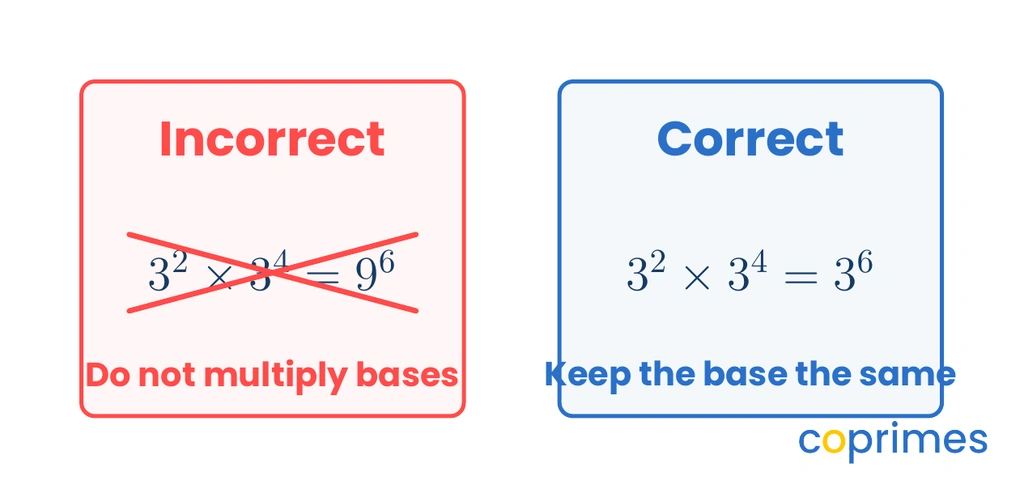
Another common error is multiplying the bases together when they are identical. For example, is equal to , not . The base represents the number being repeated; multiplying the bases alters the core value entirely.
Applications
The laws of exponents are essential for manipulating polynomials in algebra and calculating large values in scientific notation. Scientific notation relies heavily on the product and quotient rules to easily multiply and divide massive quantities by adding and subtracting powers of .
These rules are not limited to whole numbers. When you study square roots and cube roots, you will discover that radicals can be rewritten using fractional exponents. Every exponent law you learned here applies equally to fractions, providing a powerful system for simplifying roots.

Practice questions
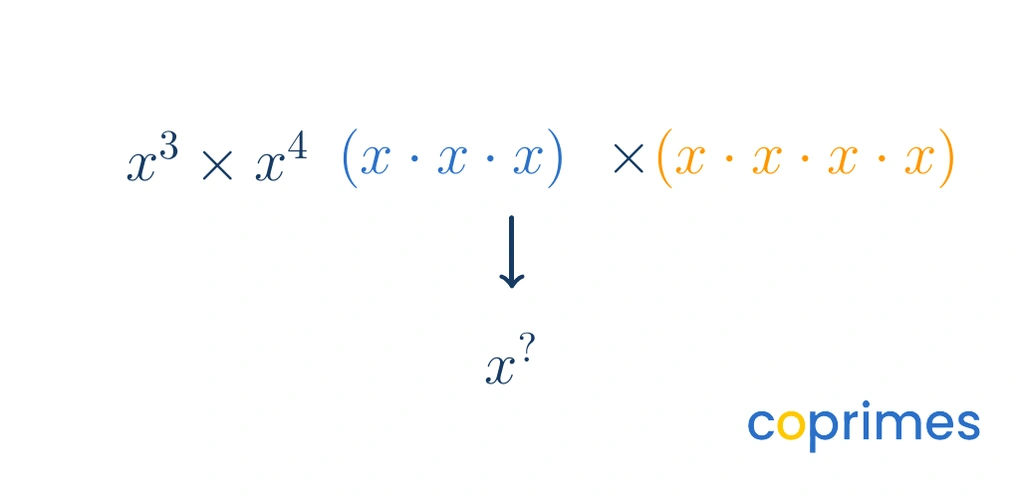
Based on the visual expansion, simplify the expression .
Simplify the expression .
Apply the power of a power rule to simplify .
Simplify the expression .
Which of the following statements about the laws of exponents is true?
You can add bases together when multiplying expressions with identical exponents.
The product rule states that .
When using the quotient rule, the denominator base can be zero.
The product rule can only be applied when the bases being multiplied are identical.
The product rule can only be applied when the bases being multiplied are identical.