
Zero Exponent: Meaning, Rules, and Examples
A zero exponent indicates that a value is raised to the power of zero. According to the zero exponent rule, any nonzero base raised to the zero power equals . The expression zero to the zero power requires separate treatment and should not be simplified by this rule. Understanding what is zero exponent and why anything to power zero is one is foundational for algebra, simplifying equations, and working with scientific notation.
What Is Zero Exponent?
The zero exponent rule states that , provided . This might seem surprising at first, but we can prove this rule using the laws of exponents.
The quotient rule tells us that when we divide identical bases, we subtract their exponents:
If we divide a number by itself, the result is always . For example, dividing five squared by five squared equals . Applying the quotient rule to the exact same expression yields a zero exponent:
Since both mathematical expressions evaluate the same initial division, must equal .
Key Ideas and Vocabulary
When working with exponents and powers, it is important to identify exactly which part of the expression is the base.
The zero exponent rule only affects the specific base it is directly attached to.
To avoid mistakes with numbers raised to zero, review the definitions of the mathematical terms involved:
- Base: The number or variable being raised to a power. In , the base is .
- Exponent: The power that indicates how many times to use the base in a multiplication pattern.
- Coefficient: A number multiplying a variable. In , the coefficient is .
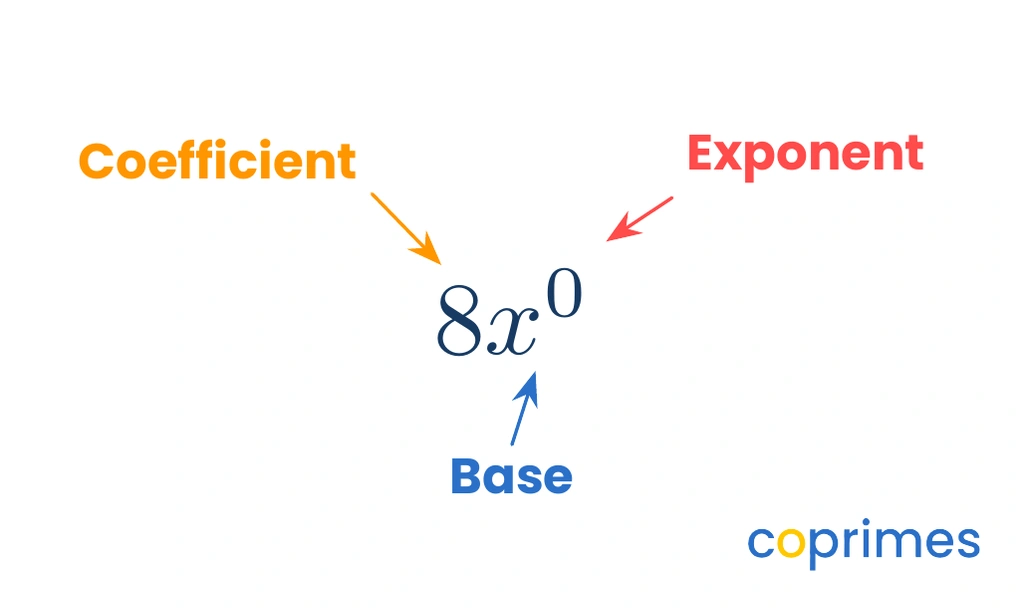
When a coefficient is present, the exponent applies only to the variable unless parentheses are used to group the terms. For example, , whereas .
Visual Explanation
Another way to understand zero exponent examples is by observing the pattern of decreasing powers. Each time an exponent decreases by , the value of the expression is divided by the base.
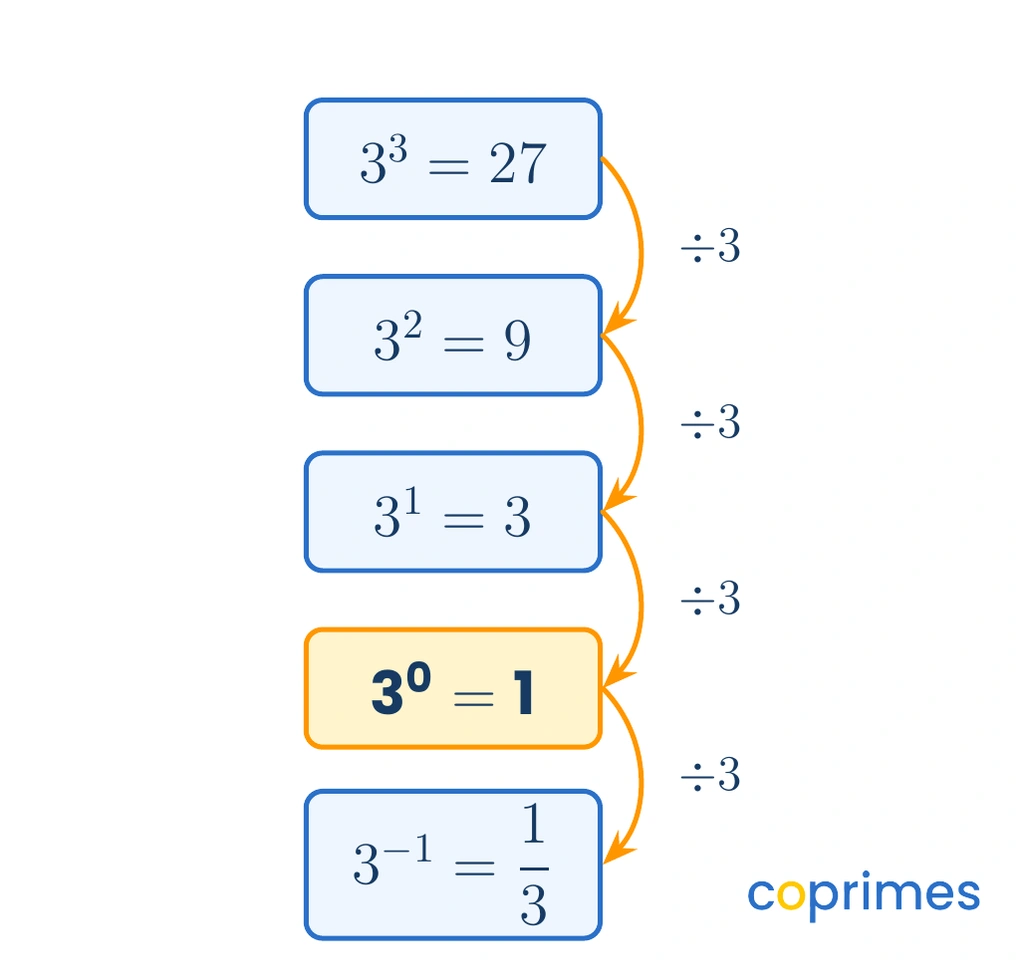
If we follow this sequence, dividing by the base yields exactly . Continuing this division pattern leads directly to negative exponents, demonstrating that the mathematical progression remains consistent.
A learning plan shaped by your child, not the class
State-aligned Math plus our own Logic and English curriculum. An adaptive baseline test finds the gaps and fills them.
Worked Examples
Before solving expressions, remember that the zero exponent rule often appears alongside other concepts. You will routinely apply it to expressions involving fractional exponents, which represent values like square roots or cube roots. Let's look at three essential examples.
Example 1: Applying the rule to variables and coefficients
Question: Simplify the expressions and .
Method:
- Identify the exact base for each exponent.
- Apply the zero exponent rule exclusively to the corresponding base.
Answer: , and .
Check: Substitute a value like . Then , and . The numerical results match the simplified expressions perfectly.
Example 2: Combining exponent rules
Question: Simplify the expression .
Method:
- Apply the quotient rule by subtracting the exponents for identical bases.
- Simplify the resulting zero exponents.
- Multiply the final terms together.
Answer: The simplified expression is .
Check: Since the variable cluster is divided exactly by itself, it equals . Multiplying by the coefficient confirms the final answer .
Example 3: Fractional exponents and zero powers
Question: Simplify the expression .
Method:
- Evaluate the fractional exponent by finding the cube root of the first base.
- Apply the zero exponent rule to the entire second grouped term.
- Multiply the two simplified values.
Answer: The simplified expression is .
Check: because . The term . Multiplying gives .
Common Mistakes and Non-Examples
There are a few recurring errors to avoid when working with powers of zero.
- Assuming the answer is zero: A frequent error is thinking that . The exponent represents a multiplicative pattern, not multiplying the base by zero.
- Confusing zero powers with fractional powers: A zero exponent yields , while a fractional exponent represents a root. Do not confuse with operations like square roots.
- Mishandling negative bases without parentheses: The expression is not . The exponent applies only to the , making it .