
Order of Magnitude: Scale and Comparisons
An order of magnitude describes the approximate size of a value by the nearest or relevant power of ten, depending on the stated convention. It is a mathematical tool used to estimate and compare quantities that range from incredibly small microscopic measurements to massive astronomical distances. Understanding what is order of magnitude helps scientists and mathematicians communicate scale quickly without relying on exact digits.
What Is Order of Magnitude?
To find a number's magnitude in powers of ten, we first write it in scientific notation as , where . The order of magnitude is the power of ten that best approximates the number.
Because the powers of ten scale is multiplicative, the halfway point between (which equals ) and (which equals ) is not . Instead, it is exactly the square root of . We can use fractional exponents to write this as , which is approximately .
Using this logarithmic midpoint, the standard rounding convention is:
- If , the order of magnitude is simply the exponent .
- If , the value is closer to the next power of ten, so the order of magnitude is .
For example, has an order of magnitude of because is less than .
However, has an order of magnitude of because is greater than .
Key Ideas and Vocabulary
When learning about exponents and powers, you will frequently encounter terms related to relative size.
- Base 10: The numbering system foundation used to define orders of magnitude.
- Logarithmic Scale: A scale where each step represents a multiplication by rather than the addition of a fixed amount.
- Orders of Magnitude Difference: A way to compare orders of magnitude by subtracting their exponents.
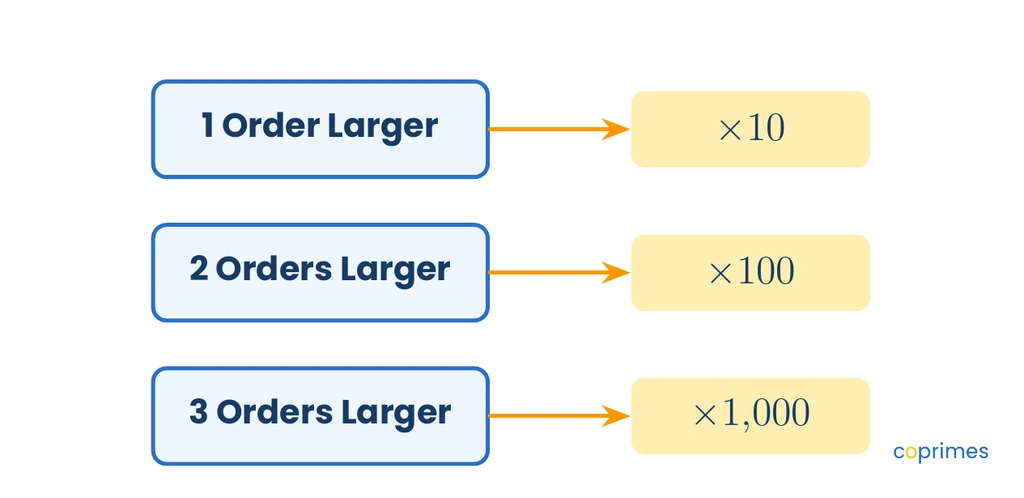
When a problem states that one object is "three orders of magnitude larger" than another, it means the object is approximately , or , times larger.
Visual Explanation
On a standard linear number line, the distance between and is the same as the distance between and . However, the powers of ten scale operates logarithmically, where each equal distance on the axis represents multiplying by .
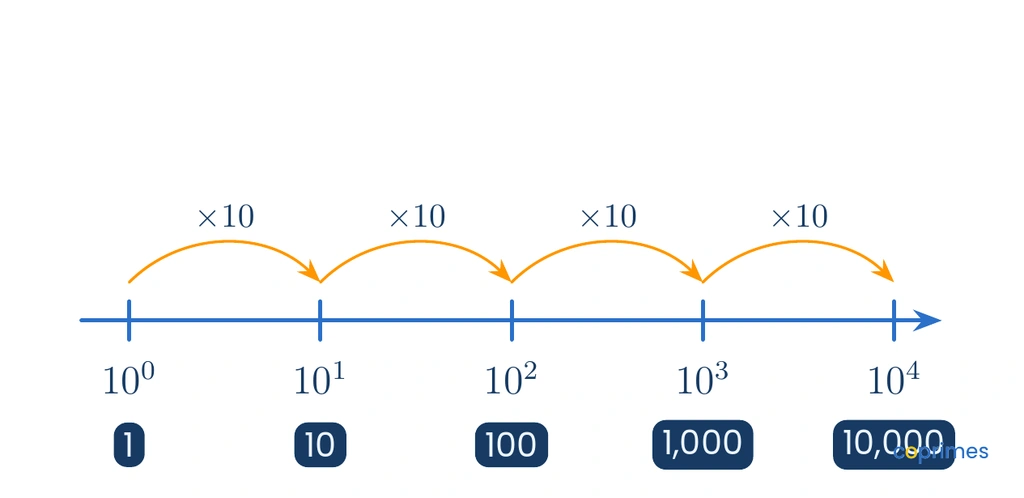
Every jump along this line adds to the exponent, which mathematically translates to multiplying the actual value by . A movement of three jumps to the right represents an increase of three orders of magnitude, or a multiplication by .
A learning plan shaped by your child, not the class
State-aligned Math plus our own Logic and English curriculum. An adaptive baseline test finds the gaps and fills them.
Worked Examples
Review these order of magnitude examples to see how the mathematical rounding rules apply to various quantities.
Example 1: Finding the order of magnitude for large quantities
Question: Determine the order of magnitude of .
Method:
- Write the number in scientific notation. We move the decimal point places to the left, resulting in .
- Identify the coefficient and the exponent .
- Compare the coefficient to the threshold.
- Since , we add to the exponent. The calculation is .
Answer: The order of magnitude is .
Check: We can evaluate and . Logarithmically, is much closer to than it is to , confirming our result of .
Example 2: Small numbers and negative exponents
Question: What is the order of magnitude of ?
Method:
- Write the number in scientific notation. Move the decimal point places to the right to get .
- The coefficient is and the exponent is .
- Compare to the threshold.
- Since , the exponent remains unchanged.
Answer: The order of magnitude is .
Check: The number lies between () and (). It is much closer to , so the order of magnitude correctly aligns with .
Example 3: Comparing orders of magnitude
Question: A planet has a mass of kg, and a moon has a mass of kg. How many orders of magnitude larger is the planet's mass?
Method:
- Determine the order of magnitude for the planet. The coefficient , so the order is .
- Determine the order of magnitude for the moon. The coefficient , so the order is .
- Subtract the moon's order from the planet's order: .
Answer: The planet's mass is orders of magnitude larger.
Check: Divide the masses directly: .
The coefficient , so the order of magnitude of the ratio is . Wait, estimating orders independently before finding the difference can sometimes yield a slightly different check than dividing first. The difference in their rounded orders is , while the order of their exact ratio is .
When comparing quantities directly, the most mathematically rigorous approach is to find the order of magnitude of their ratio. Using the ratio method, the difference is orders of magnitude.
Common Mistakes and Non-Examples
A common misconception is thinking that "one order of magnitude larger" means adding . An order of magnitude is strictly multiplicative. A tree that is one order of magnitude taller than a -meter bush is meters tall, not meters tall.
Another frequent error involves the rounding threshold. In standard arithmetic, we round up at . However, the logarithmic scale midway point is . While working with radicals and surds, you will see that many square roots produce long decimals. The rule for simplifying radicals shows that and . The value of is an irrational number approximately equal to .
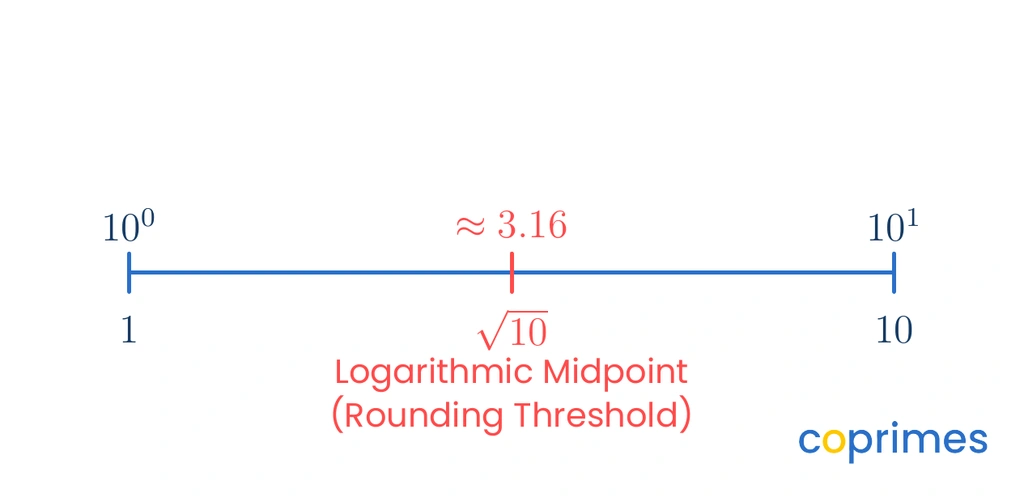
Do not round the coefficient using the number . If a scientific notation coefficient is , it is greater than , so the order of magnitude rounds up to the next power of ten.
Real-World Connections
Orders of magnitude are universally applied in physics and astronomy to classify objects into manageable categories. Rather than saying the observable universe is roughly meters across, a physicist will simply say its size is on the order of meters.
By stripping away the precision of the coefficient, researchers can quickly evaluate whether two quantities belong to the same scale. If a new particle is discovered to be three orders of magnitude heavier than an electron, scientists instantly know its mass is approximately times greater without performing complex multiplication.

Practice questions
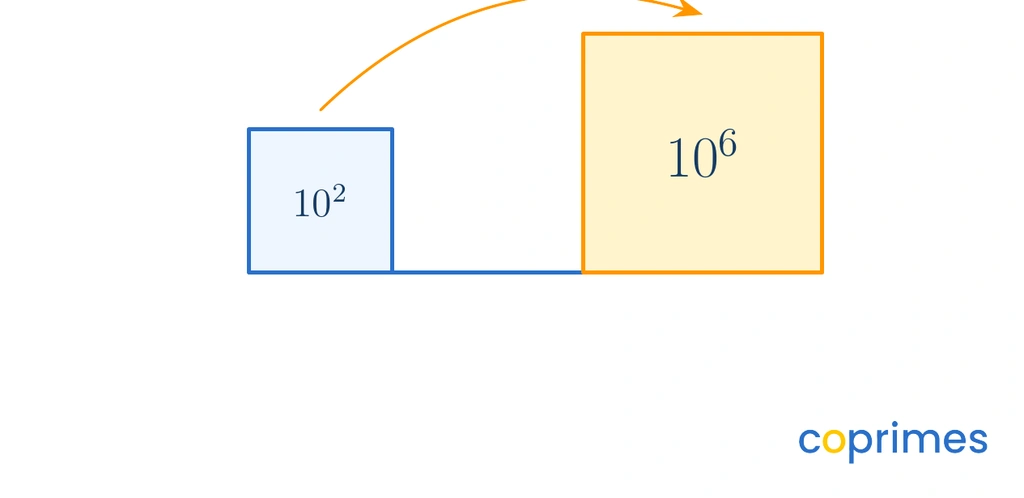
Based on the visual, how many orders of magnitude larger is the right block compared to the left block?
What is the order of magnitude of ?
If a microscopic measurement is described as being "two orders of magnitude smaller" than a reference length, what does this mathematically mean?
It is divided by exactly .
It is divided by exactly .
It is divided by exactly .
It is divided by exactly .
It is divided by exactly .
Find the order of magnitude for the decimal .
A bacteria cell is approximately meters long. A nearby grain of sand is meters long. By determining the exact ratio, how many orders of magnitude larger is the grain of sand?