
Negative Exponents: Rules, Examples, and Step-by-Step Method
A negative exponent represents the reciprocal of the corresponding positive power for a nonzero base. Also known as negative powers or negative indices, negative exponents indicate how many times to divide by the base, rather than multiply by it. Understanding the negative exponent rule is a key part of working with exponents and powers.
What Are Negative Exponents?
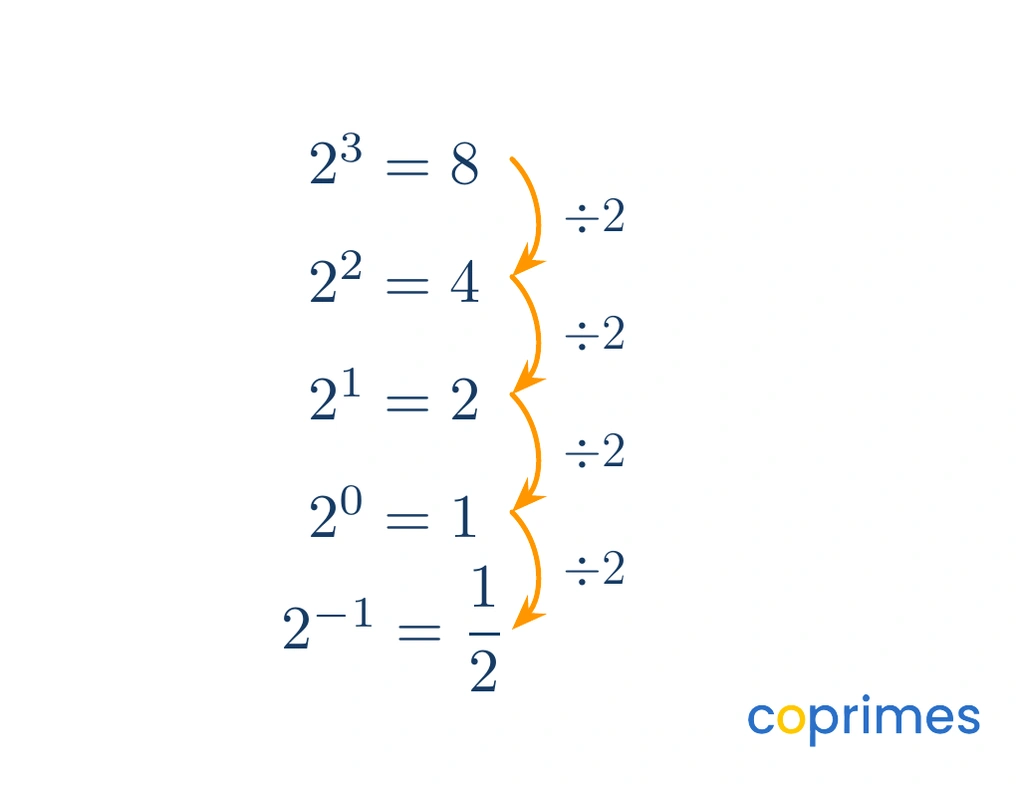
A positive exponent tells you how many times to multiply a base by itself. A negative exponent does the exact opposite: it tells you how many times to divide by the base.
The rule for negative exponents states that any non-zero base raised to a negative power is equal to divided by that base raised to the corresponding positive power. Mathematically, this is written as:
where
A negative exponent creates a fraction by moving the base to the denominator.
When to Use It
Negative exponents appear whenever you need to express very small values or simplify algebraic fractions. You will use them to write microscopic measurements in scientific notation, such as expressing as .
They are also essential when applying the laws of exponents to algebraic expressions. If you divide a smaller power by a larger power with the same base, subtracting the exponents produces a negative result.
Step-by-Step Method
To learn how to solve negative exponents and simplify an expression, follow these steps:
- Identify the non-zero base and the negative exponent.
- Write the reciprocal of the base.
- Change the negative exponent to positive.
- Simplify the resulting power.
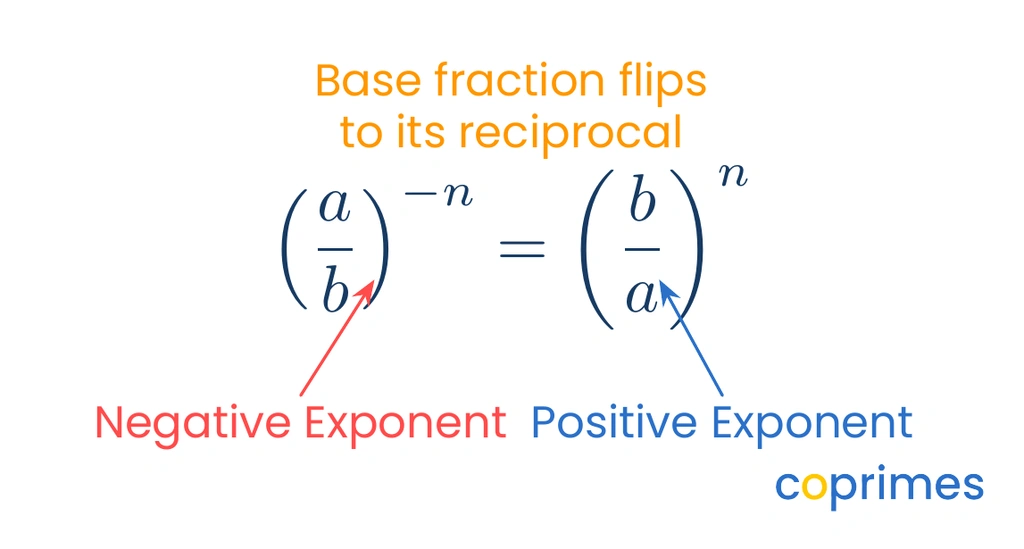
If the base is already a fraction, applying a negative exponent flips the numerator and denominator: .
A learning plan shaped by your child, not the class
State-aligned Math plus our own Logic and English curriculum. An adaptive baseline test finds the gaps and fills them.
Visual Worked Examples
Example 1: Evaluating an integer base
Question: Evaluate .
Method:
- Identify the base () and the negative exponent ().
- Write the expression as a reciprocal with a positive exponent: .
- Simplify the denominator by multiplying: .
Answer:
Check: Multiply by . The result is , confirming the reciprocal relationship.
Example 2: Evaluating expressions with negative signs
Question: Evaluate and .
Method:
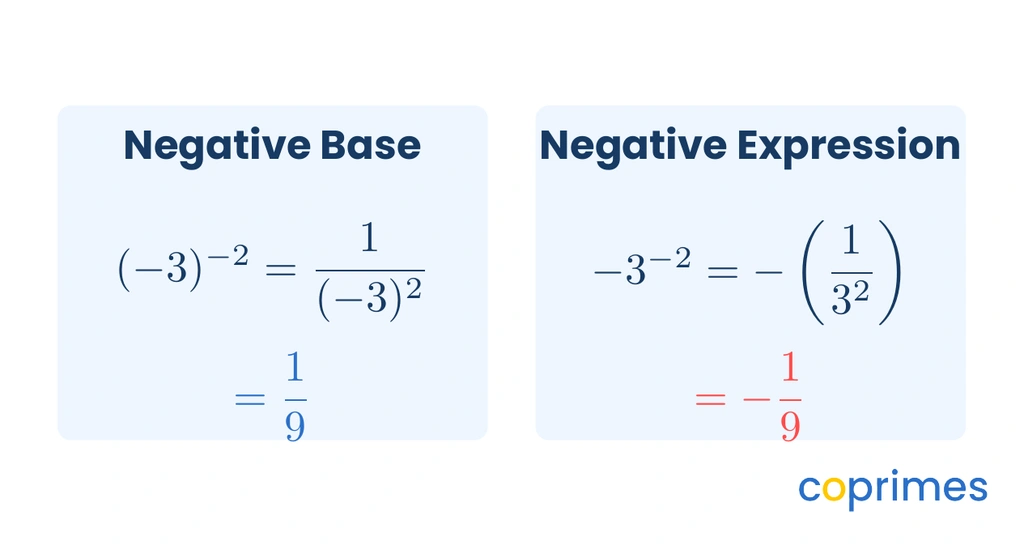
- For the first expression, identify that the negative sign is inside the parentheses. The base is .
- Write the reciprocal with a positive exponent: .
- Square the negative base: , giving an answer of .
- For the second expression, notice the absence of parentheses. The base is , and the negative sign applies to the whole expression.
- Evaluate the power first: .
- Apply the negative sign to the result.
Answer: and .
Check: Observe that is a positive , while is . This confirms the signs will be different for an even power.
Example 3: Simplifying a fractional base with variables
Question: Simplify where .
Method:
- Identify the fractional base and the negative exponent .
- Flip the numerator and denominator to create the reciprocal base .
- Change the negative exponent to a positive .
- Cube both the numerator and the denominator: .
Answer:
Check: Multiply by the original fraction cubed, . The product is , confirming the property is correct.
How to Check the Answer
You can verify your evaluation of a negative exponent by multiplying your fractional result by the same base with the corresponding positive exponent. The product must always equal , which follows the zero exponent property ().
For example, if you evaluate as , check it by multiplying by :
.
Once you are comfortable checking negative powers, you can confidently move on to evaluating fractional exponents.
Common Mistakes
The most frequent error is assuming a negative exponent produces a negative number. A negative exponent only indicates division or finding a reciprocal; it does not change the sign of the base. As a counterexample, equals , not .
Another common mistake is applying a negative sign to the wrong part of an expression. Remember that is completely different from .
Finally, remember that the base can never be zero. Expressions like are undefined because they would require dividing by zero (), which is mathematically impossible.

Practice questions
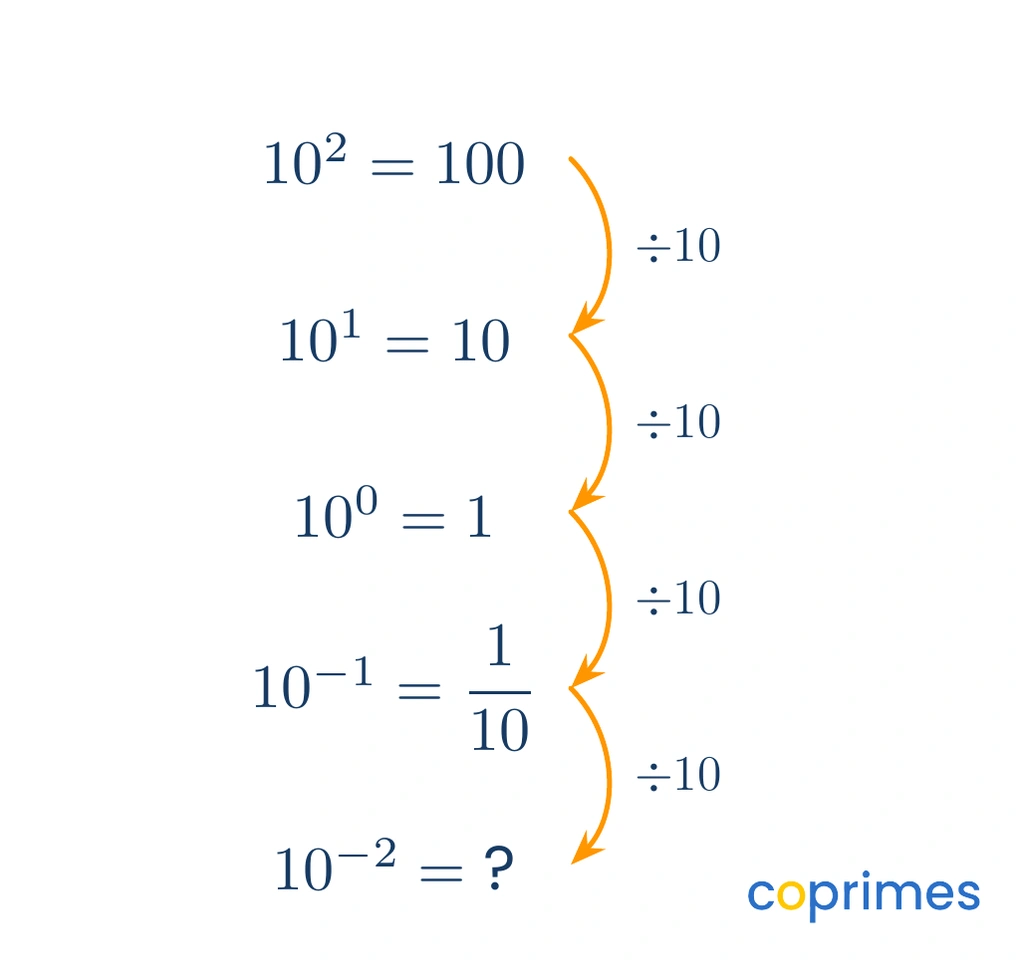
What is the missing value in the pattern?
Evaluate .
Evaluate .
Which expression is equivalent to ?
Simplify .