
Mental Math Strategies: Definition, Method and Examples
Mental math strategies are techniques that reorganize numbers using known facts, place value, and operation properties so a calculation can be completed efficiently and checked for sense. Strategies such as making tens, breaking apart, and using compensation allow you to solve problems accurately without writing down a standard algorithm.
What are mental math strategies?
Mental math strategies are structured ways to manipulate numbers in your head. They are not simply about memorizing final answers, but instead rely on understanding how numbers relate to one another.
Mental math relies on number relationships rather than memorized procedures.
By applying these strategies, learners can break complex calculations into simpler, manageable steps. Before using these methods, having a strong foundation in foundational mental math facts is highly recommended, as basic addition and multiplication recall makes the strategies faster and more reliable.
Make tens and hundreds
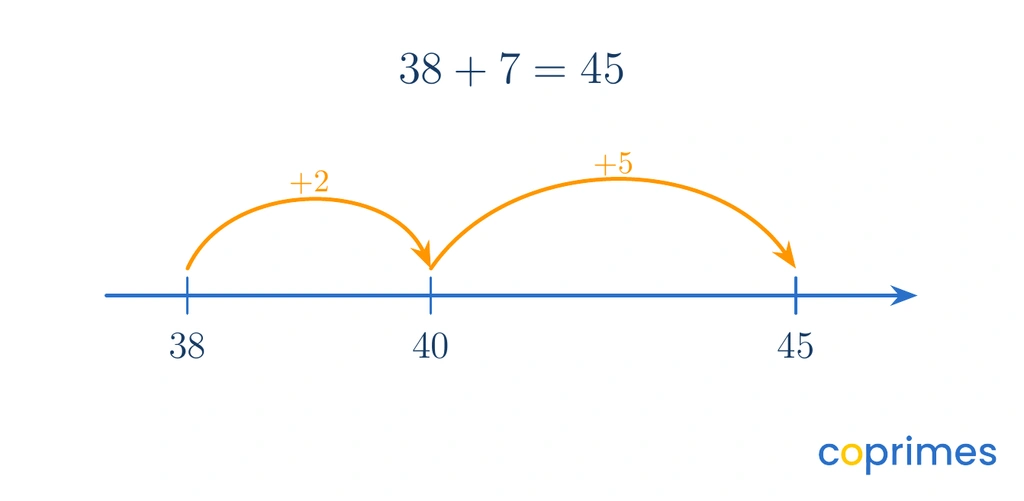
Numbers ending in zero are simpler to add, subtract, multiply, and divide. The making tens or making hundreds strategy involves splitting one number into smaller parts to reach the nearest multiple of ten or a hundred first.
For example, to calculate , you can break the into and . Adding to brings you to the friendly number . Then, add the remaining to reach .
Break apart and regroup
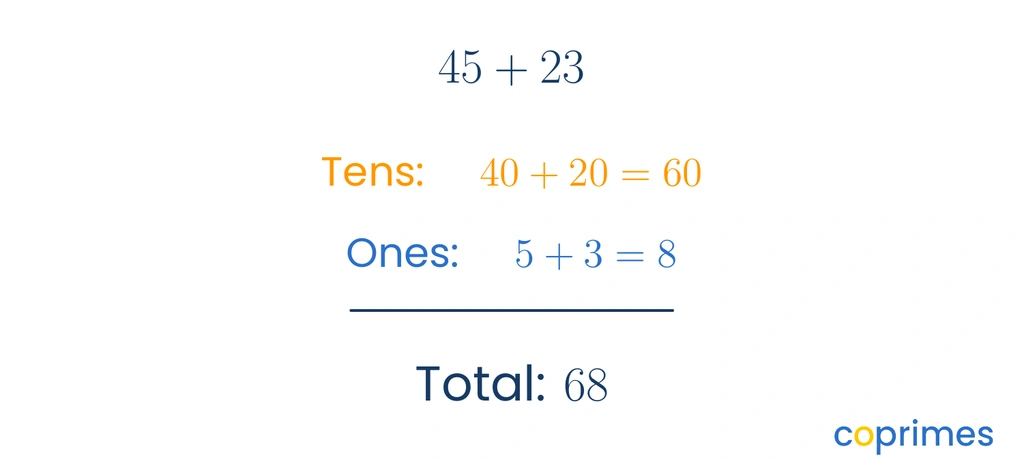
The break apart and regroup strategy uses place value to split numbers into their hundreds, tens, and ones. It is extremely effective for multi-digit addition and subtraction.
When adding , you can partition both numbers. First, add the tens together: . Next, add the ones together: . Finally, combine the totals to get . This method transforms one difficult calculation into three easy steps.
A learning plan shaped by your child, not the class
State-aligned Math plus our own Logic and English curriculum. An adaptive baseline test finds the gaps and fills them.
Use compensation
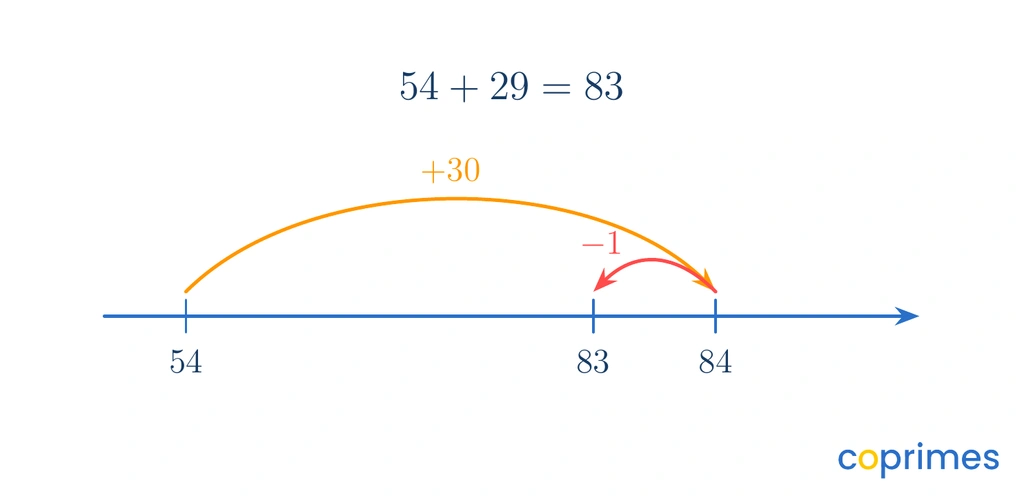
When a number is close to a multiple of ten or a hundred, it is often easier to round it, perform the operation, and then adjust the answer. This adjustment is called compensation.
To solve , notice that is just less than . You can add to to easily reach . Because you added too many, you must compensate by subtracting at the end, resulting in an answer of .
Use known facts and properties
Understanding the mathematical properties of operations simplifies complex mental calculations.
The associative property of addition allows you to group numbers differently. For example, adding is easier if you group the friendly pair first: .
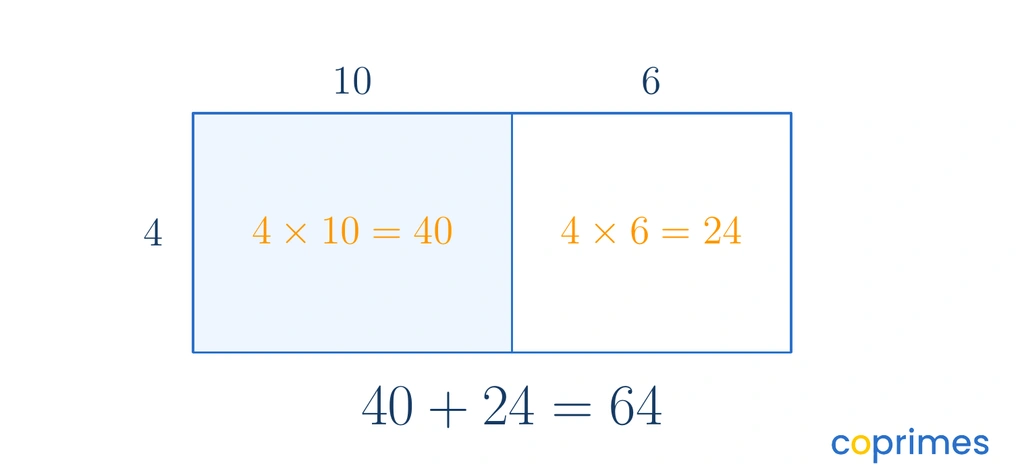
The distributive property of multiplication breaks a large multiplication problem into smaller, known facts. To calculate , split the into and . Multiply each part by , then add the partial products together. Mastery of multiplication facts and times tables is essential for this strategy to work smoothly.
Choose the right strategy
Not every math problem should be solved mentally. You should choose a mental math strategy when the numbers are simple or can be easily rounded to compatible numbers that work well together.
Use standard written methods when calculations involve many steps, large decimal values, or complex digits that are difficult to track in your head. Practising a variety of mental strategies builds flexible number sense, helping you recognize the most efficient approach for any given problem.

Worked examples
Three worked examples demonstrate how these strategies apply to different operations.
Example 1: Break apart and regroup
Question: Calculate mentally.
Method:
- Break apart both numbers into tens and ones: and .
- Add the tens: .
- Add the ones: .
- Combine the totals: .
Answer: .
Check: Subtraction gives .
Example 2: Using compensation
Question: Calculate mentally.
Method:
- Identify that is close to the friendly number .
- Subtract instead of : .
- Since you subtracted too many, add back to adjust the result: .
Answer: .
Check: Addition gives .
Example 3: Distributive property
Question: Calculate mentally.
Method:
- Break apart into tens and ones: .
- Multiply by the tens: .
- Multiply by the ones: .
- Add the two partial products: .
Answer: .
Check: Division gives .
Frequently asked questions
What is the difference between mental math and written methods?
Mental math involves solving problems in your head using number relationships and strategies, while written methods rely on standard step-by-step algorithms recorded on paper.
Why is it important to learn multiple mental math strategies?
Different problems require different approaches. Knowing multiple strategies allows you to choose the most efficient and accurate method for the specific numbers involved.
Can compensation be used for multiplication?
Yes. For example, to solve , you can calculate , and then subtract one group of to get .
Practice questions
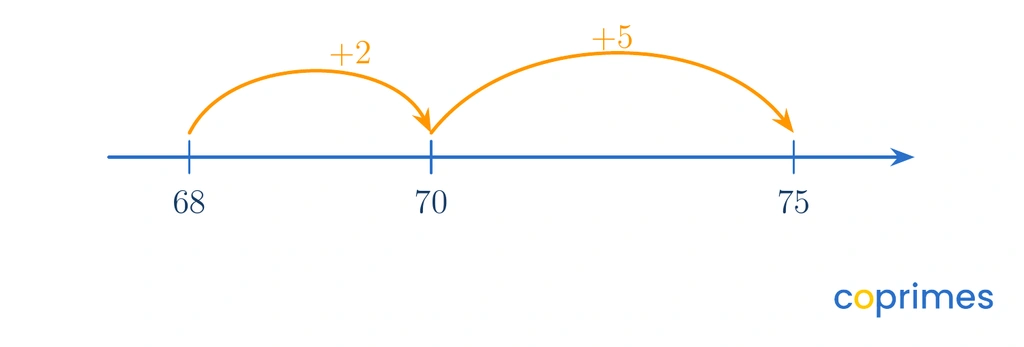
What addition problem does this number line model solve?
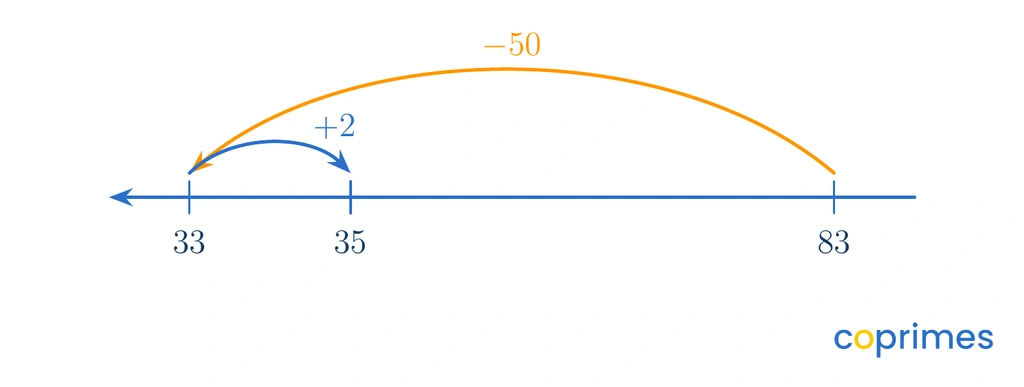
Which expression represents the compensation strategy shown on the number line to solve ?
To solve , a student calculates and , then adds . Which strategy is the student using?
Making tens and hundreds
Breaking apart and regrouping
Using compensation
The commutative property
Breaking apart and regrouping
When multiplying , a student first calculates , and then multiplies . Which property makes this valid?
Associative property of multiplication
Distributive property of multiplication
Using compensation
Breaking apart and regrouping
Associative property of multiplication
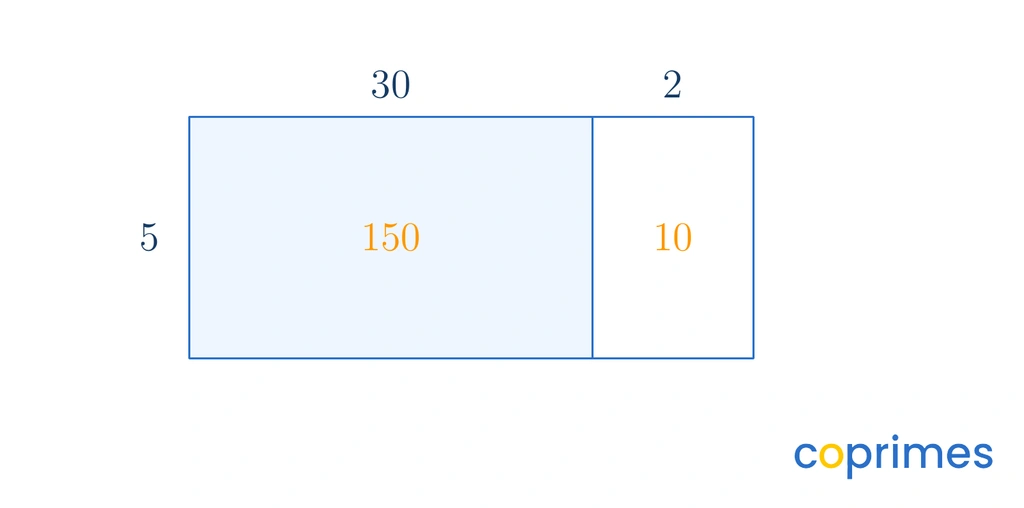
What multiplication problem does this area model help solve mentally?