
Mental Math: Definition, Methods, and Strategies
Mental math is calculating or estimating without relying on a written algorithm or calculator by using number facts, place value, properties, and efficient strategies.
Performing calculations in your head builds number sense and helps you solve everyday problems quickly.
What is mental math?
Mental math refers to the process of performing mathematical calculations entirely in your head.
Instead of setting up columns on paper or reaching for a device, you manipulate numbers using logical reasoning.
This process relies on recognizing patterns and breaking down complex problems into simpler, manageable pieces.
When mental math is useful
Mental math is highly practical for everyday tasks where precise written calculations are unnecessary or inconvenient.
You use these skills when calculating the total cost of items while shopping, determining the final score in a game, or splitting a bill.
It is also an essential tool for verifying written work.
Before committing to a long calculation on paper, a quick mental estimate helps confirm whether the final written answer is reasonable.
Number facts and place value
A strong foundation in mental calculation begins with instantly recalling basic number facts, such as single-digit multiplication tables and number bonds that add to or .
Once you know these core facts, you can apply an understanding of place value to solve much larger problems without writing them down.
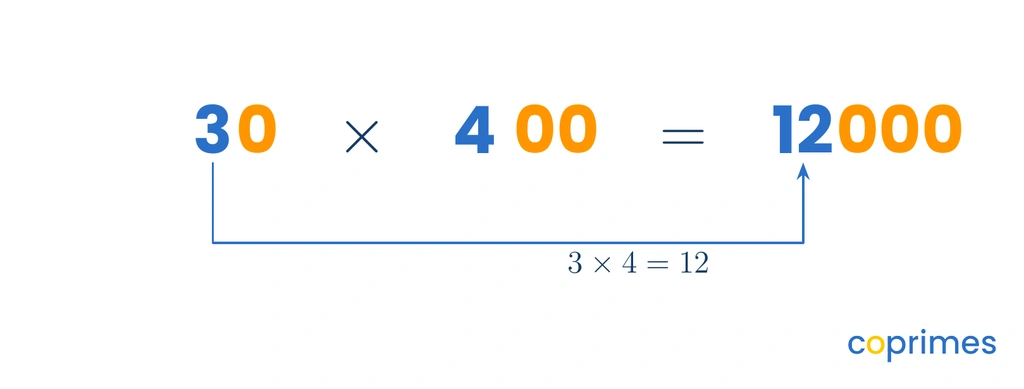
When multiplying numbers with trailing zeros, you can multiply the non-zero digits first and then attach the correct number of zeros based on their place value.

Choose an efficient strategy
The best mental calculation approach depends entirely on the numbers involved in the specific problem.
Flexibility is key; rather than forcing one rigid method, you can select from various mental math strategies that make the arithmetic easier.
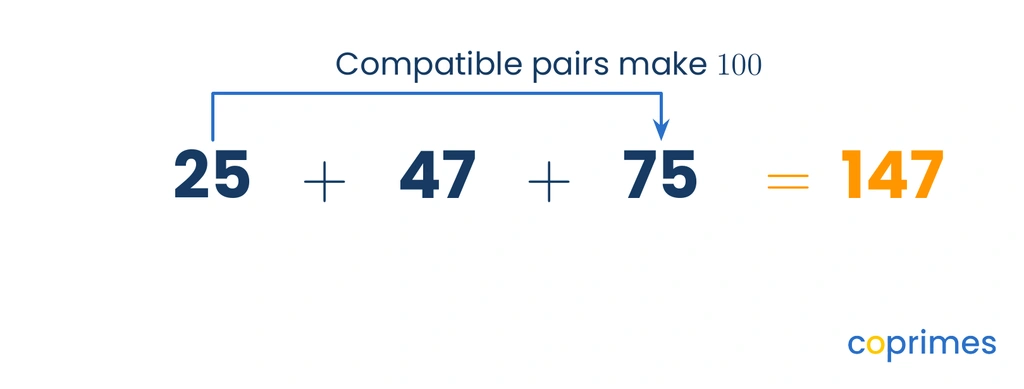
One highly effective approach is identifying compatible numbers, which are pairs of numbers that easily combine to form multiples of ten or one hundred.
You can also use the properties of multiplication and addition to rearrange the order of the numbers.
Because the order of addition does not change the sum, reordering the numbers to group compatible pairs first makes the total much easier to calculate mentally.
Mental math versus exact written methods
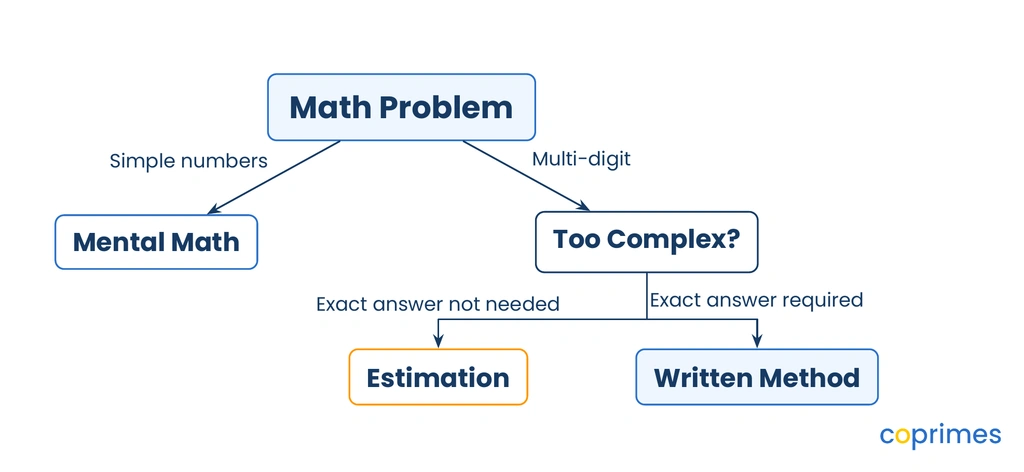
Mental math is not meant to completely replace careful written work, especially for highly complex or multi-digit problems.
When a problem involves many steps or requires a precise exact answer that is difficult to hold in working memory, using a standard written algorithm or a calculator is the correct choice.
If an exact answer is not strictly required, applying estimation strategies provides a close approximation with much less mental effort.
Worked examples
Review these examples to see how mental strategies simplify different types of calculations.
Example 1: Adding with compensation
Question: Calculate mentally.
Method:
- Round up to to create a simpler number by adding .
- Because you added to the first number, subtract from to keep the total balanced, making it .
- Add the two adjusted numbers together: .
Answer: .
Check: Use standard place value addition: and , then .
Example 2: Multiplying using place value
Question: Find the product of and .
Method:
- Identify the non-zero digits in both numbers: and .
- Multiply these single digits together: .
- Count the total number of trailing zeros in the original problem. There is one zero in and two zeros in , making three zeros in total.
- Attach these three zeros to the product from step two.
Answer: .
Check: Multiply sequentially by powers of ten: , then .
Example 3: Subtracting in chunks
Question: Calculate mentally.
Method:
- Break the number into smaller, manageable chunks: and .
- Subtract the tens first: .
- Subtract the remaining ones: .
- Count back from to reach the final answer.
Answer: .
Check: Add the difference back to the subtracted amount: .
A learning plan shaped by your child, not the class
State-aligned Math plus our own Logic and English curriculum. An adaptive baseline test finds the gaps and fills them.
Common mistakes
A frequent error in mental math is misaligning place values when numbers look similar.
For example, when calculating , a student might incorrectly group the non-zero digits and answer instead of the correct answer, .
Always visualize the place value of each digit before combining them.
Another common mistake is trying to hold too many intermediate steps in your working memory.
If a problem has four or five complex steps, your brain may lose track of a middle total, leading to an incorrect final answer.
When a problem feels too overwhelming to track mentally, switch to a written method to ensure accuracy.
Frequently asked questions
Is mental math just memorizing answers?
No. While knowing basic facts from memory is helpful, mental math is primarily about applying properties and understanding how numbers can be broken apart and reassembled logically.
Should I always calculate in my head?
No. Mental calculation is a tool for efficiency and estimation. If you require a precise answer for a multi-digit calculation, written algorithms are safer and more reliable.
Can anyone improve at mental math?
Yes. Mental arithmetic is a skill that improves significantly with practice. By learning specific strategies, such as compensation and reordering, calculations that once seemed difficult become much easier.
Practice questions
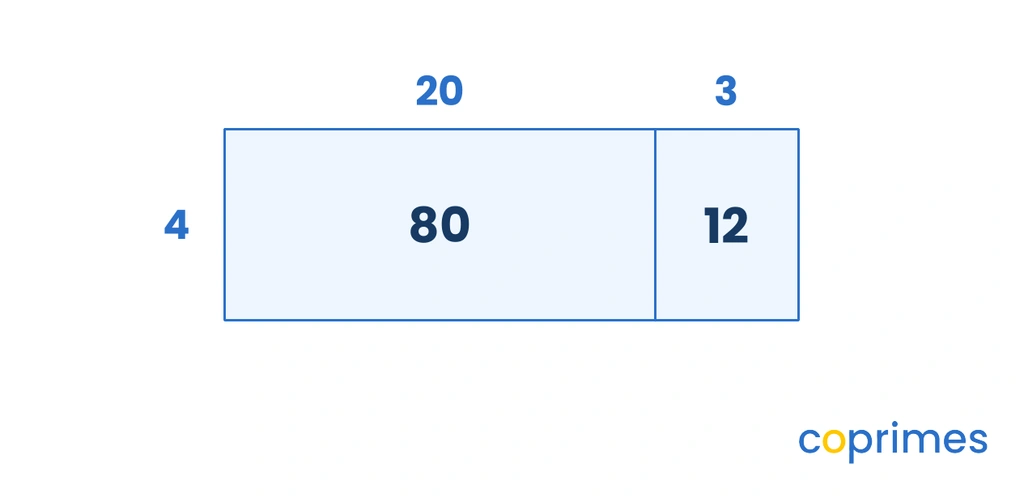
Which mental calculation does this area model represent?
What is the exact mental product of and ?
Which pair of numbers is the most compatible for quick mental addition?
and because they combine to form exactly one hundred.
and because they are consecutive numbers.
and because their digits are reversed.
and because they share a common starting digit.
and because they combine to form exactly one hundred.
A student calculates mentally and gets an answer of . What error did the student likely make?
Subtracting the values instead of adding them together.
Adding the leading digits without aligning their place values.
Forgetting to attach trailing zeros after multiplying the numbers.
Regrouping the tens place when it was not necessary.
Adding the leading digits without aligning their place values.
You have dollars. You purchase one item for dollars and a second item for dollars. How many dollars in change should you receive?