
Numerical Expressions: Definition, Method and Examples
A numerical expression is a mathematical phrase that combines numbers, operation symbols, and sometimes grouping symbols or powers. It represents a single value but does not contain an equals sign or any variables.
Examples include , , and . Because they involve numbers and operations, they form the foundation of arithmetic.
What is a numerical expression?
A numerical expression is a combination of numbers and operations (such as addition, subtraction, multiplication, and division) that can be evaluated to find a specific value.
Unlike a full sentence, an expression is just a phrase. It states a quantity but does not make a complete mathematical statement on its own. For instance, is a numerical expression that represents the quantity .
Parts of a numerical expression
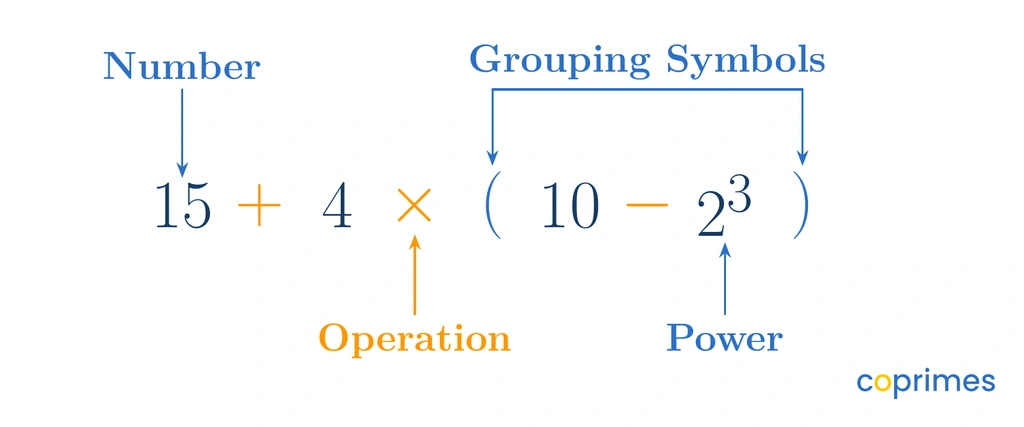
A numerical expression contains different components that work together.
- Numbers: The mathematical values being operated on.
- Operations: The symbols that tell you what to do, such as addition () or multiplication ().
- Grouping symbols: Parentheses , brackets , or braces that group parts of the expression and change the standard order of calculation.
- Powers: Exponents that indicate repeated multiplication.
Expression versus equation
It is common to confuse an expression with an equation, but they have different mathematical rules and components.
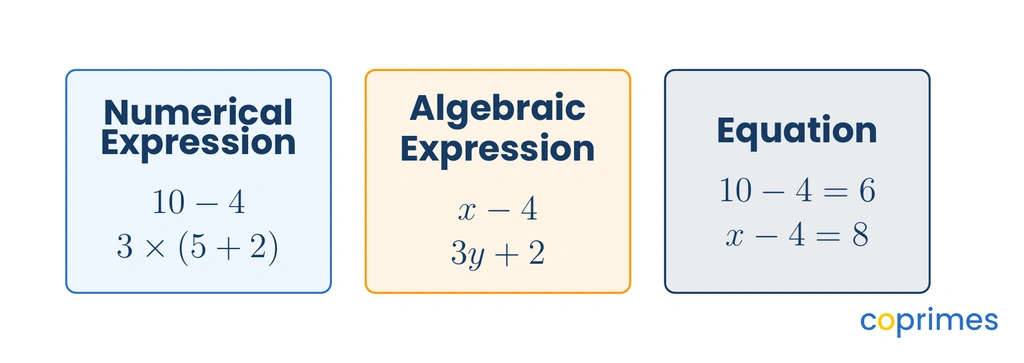
- Numerical expression: Contains only numbers and operations. It represents a single quantity and has no equals sign. Example: .
- Equation: Contains an equals sign () and shows that two expressions have the exact same value. Example: .
- Algebraic expression: Contains variables (letters representing unknown numbers) along with numbers and operations. Example: .

Write expressions from words
To translate word problems or verbal descriptions into mathematical phrases, match the action words to their corresponding mathematical operators.
- Addition (): sum, increased by, more than, combined.
- Subtraction (): difference, decreased by, less than, minus.
- Multiplication (): product, times, twice, doubled.
- Division (): quotient, divided by, half of, shared equally.
Here are three verbal situations translated into numerical expressions:
- "The sum of and , multiplied by " translates to .
- "Twenty decreased by the product of and " translates to .
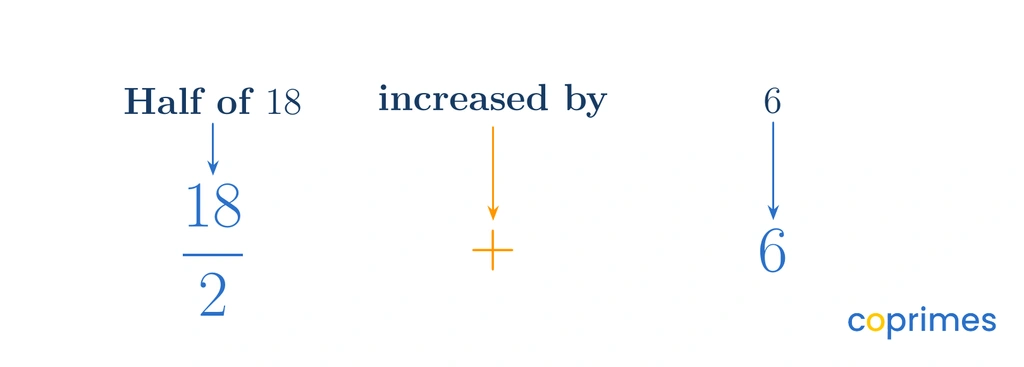
- "Half of , increased by " translates to .
Evaluate numerical expressions
To evaluate an expression, perform the calculations to find its final single value. Because expressions often contain multiple operations, you must always follow the order of operations (often remembered as PEMDAS or BODMAS):
- Parentheses (and other grouping symbols).
- Exponents (powers).
- Multiplication and Division (from left to right).
- Addition and Subtraction (from left to right).
A numerical expression simplifies to a single number when evaluated correctly using the standard order of operations.
Worked examples
Example 1: Identifying expressions
Question: Which of the following is a numerical expression: , , or ?
Method:
- Check for variables. The phrase has a variable, so it is an algebraic expression.
- Check for an equals sign. The phrase has an equals sign, so it is an equation.
- Verify the remaining option contains only numbers and operators. The phrase fits.
Answer: is a numerical expression.
Check: The expression contains no equal signs and no letters, confirming it is purely numerical.
Example 2: Translating words into numbers
Question: Write a numerical expression for "the difference between and , divided by ".
Method:
- Identify the first operation: "difference between and " means subtraction, written as .
- Because the entire difference must be divided, wrap it in grouping symbols: .
- Identify the second operation: "divided by " means division, written as .
Answer: .
Check: Translating the mathematical expression back gives "the difference of and , divided by ", which matches the original problem perfectly.
Example 3: Evaluating an expression
Question: A baker starts with cookies. He sells boxes of cookies each and gives cookies away. Write and evaluate a numerical expression for the number of cookies left.
Method:
- Start with the initial amount: .
- Subtract the amount sold: .
- Subtract the amount given away: .
- Combine these steps into one expression: .
- Evaluate using the order of operations. First, multiply: .
- Substitute the product back into the expression: .
- Subtract from left to right. , then .
Answer: The expression evaluates to .
Check: This uses the logic from addition and subtraction word problems to confirm that each subtraction correctly reduces the starting total.
A learning plan shaped by your child, not the class
State-aligned Math plus our own Logic and English curriculum. An adaptive baseline test finds the gaps and fills them.
Common mistakes
- Treating an expression like an equation: Expressions do not have two sides and cannot be "solved" for a variable. They are "evaluated" or simplified to a final number.
- Ignoring the order of operations: Calculating strictly from left to right without prioritizing multiplication or division changes the value. For example, in , adding first gives , but multiplying first gives the correct value of .
- Forgetting grouping symbols: When a verbal description requires an operation out of the normal order, parentheses are required. "Double the sum of and " must be written as , not .
Frequently asked questions
Can a numerical expression be just one number?
Yes. A single number like is the simplest numerical expression. It requires no operations to evaluate.
Do numerical expressions have variables?
No. If an expression contains a letter like or , it becomes an algebraic expression instead.
Can an expression have exponents and powers?
Yes. A number raised to a power represents repeated multiplication, so it is a valid part of a numerical expression.
What is the difference between simplifying and evaluating numerical expressions?
In mathematics, they usually mean the same thing. Both instruct you to perform the operations in the correct order to find the final numerical value.
Practice questions
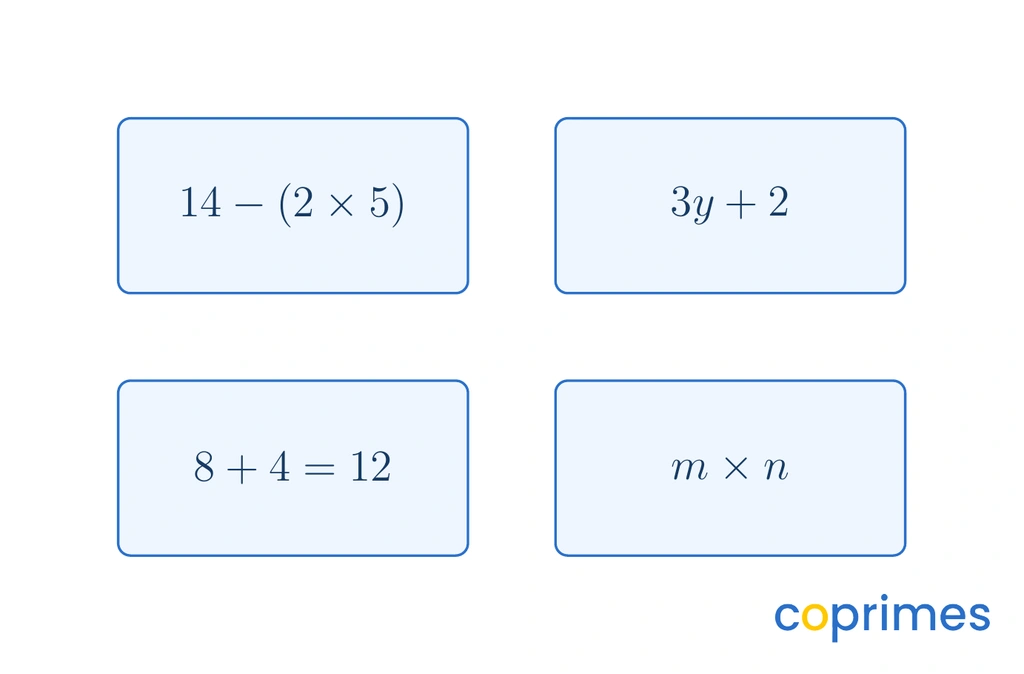
Which of the expressions shown on the cards is a numerical expression?
Write a numerical expression for: "Five more than the product of four and six."
Evaluate the numerical expression:
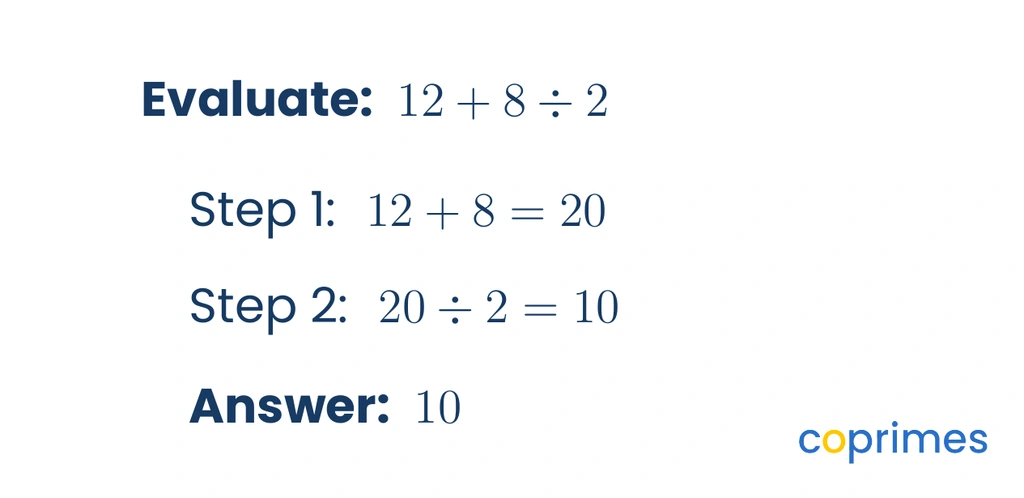
A student evaluated the expression as shown. What mistake did they make?
They added before dividing.
They divided incorrectly.
They should have subtracted first.
They ignored an exponent.
They added before dividing.
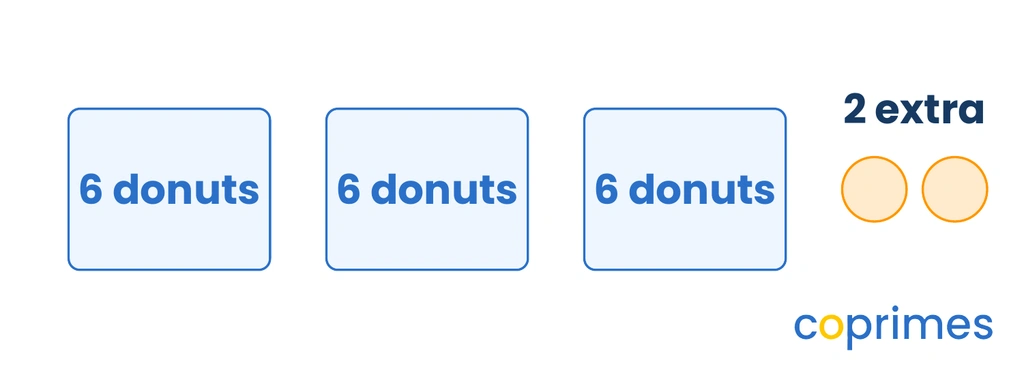
Which numerical expression represents the total number of donuts shown in the image?