
Reciprocal of a Fraction: Definition, Method and Examples
The reciprocal of a nonzero fraction is found by swapping its numerator and denominator. When you multiply a number by its reciprocal, the result is always . Every number except zero has a reciprocal, making it an essential tool for solving equations and dividing fractions.
The reciprocal is formed by turning a fraction upside down.
What is a reciprocal?
A reciprocal is the mathematical complement of a number that, when multiplied by the original number, yields exactly . It is also called the multiplicative inverse.
For fractions, finding the reciprocal is as simple as flipping the fraction. The top number, called the numerator, becomes the bottom number. The bottom number, called the denominator, becomes the top number.
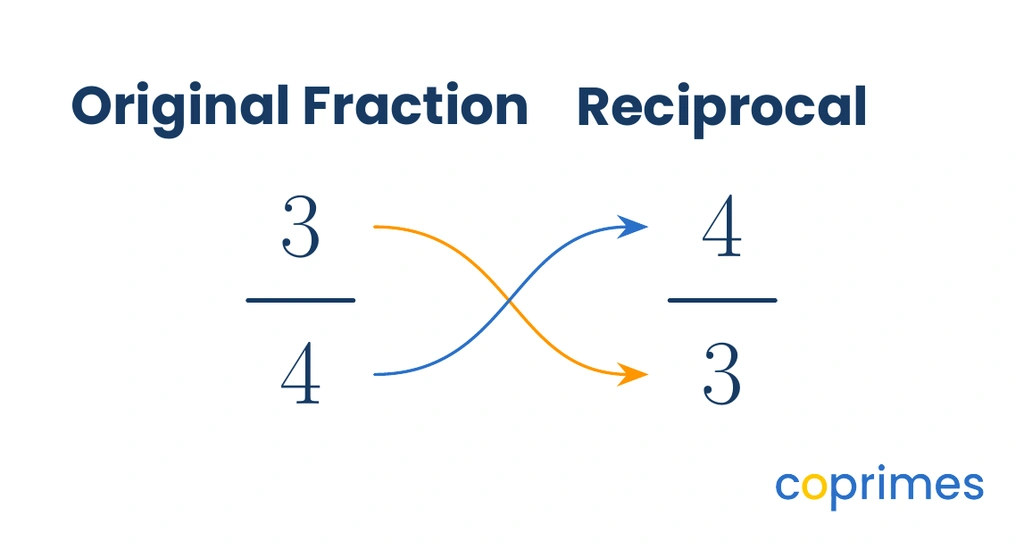
If you have a fraction like , its reciprocal is . The values have just traded places.
Find a fraction's reciprocal
To find the reciprocal of any standard fraction, you only need one step: swap the numerator and the denominator.
- Identify the numerator (top digit) and the denominator (bottom digit).
- Move the denominator to the top.
- Move the numerator to the bottom.
For example, the reciprocal of is . The reciprocal of is . This process works exactly the same way whether the fraction is proper or improper.
Reciprocals of whole numbers
You can find the reciprocal of a whole number by first writing it as a fraction. Any whole number can be expressed as a fraction by placing it over .
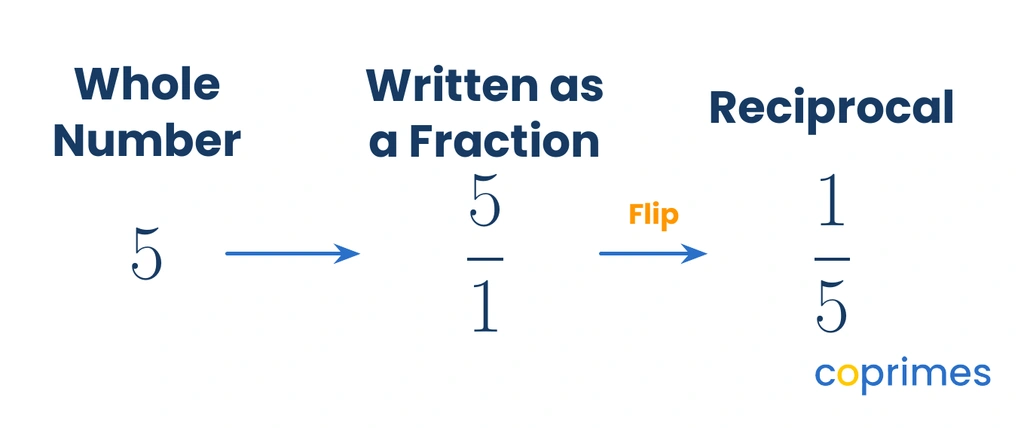
Once the whole number is written as a fraction, swap the top and bottom values. This always results in a unit fraction, which is a fraction with as its numerator.
The number is the only number that does not have a reciprocal. If you write as and try to flip it, you get . Division by zero is undefined in mathematics, so zero has no multiplicative inverse.
A learning plan shaped by your child, not the class
State-aligned Math plus our own Logic and English curriculum. An adaptive baseline test finds the gaps and fills them.
Reciprocals of mixed numbers
To find the reciprocal of a mixed number, you cannot simply flip the fraction part and leave the whole number alone. You must first convert mixed numbers to improper fractions.
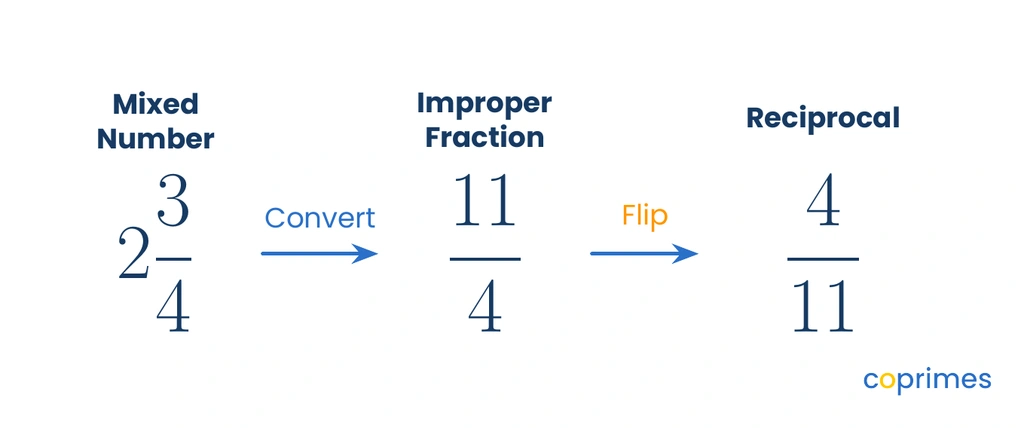
- Multiply the whole number by the denominator.
- Add the numerator to get the new top number.
- Keep the original denominator.
- Flip this new improper fraction to find the reciprocal.
Always change a mixed number to an improper fraction before finding its reciprocal.
Why reciprocal pairs multiply to one
The defining property of a reciprocal is that a number multiplied by its reciprocal always equals . This happens because of how multiplying fractions works.
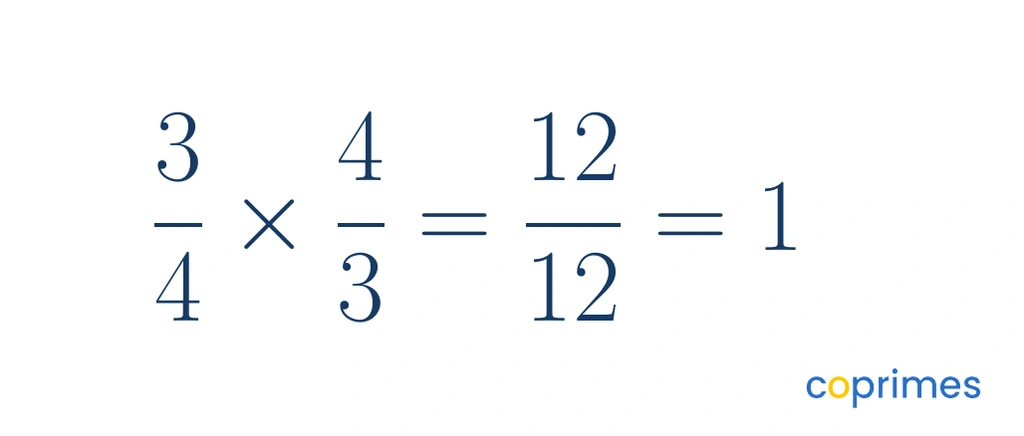
When you multiply two fractions, you multiply straight across. For a fraction and its reciprocal , the product is . Since the numerator and denominator of the product are identical, the result simplifies to .
This property is the foundation of dividing fractions. Dividing by a fraction is mathematically identical to multiplying by its reciprocal.
Worked examples
Example 1: Finding the reciprocal of a whole number
Question: What is the reciprocal of ?
Method:
- Write the whole number as a fraction by placing it over . This gives .
- Swap the numerator and denominator.
Answer: The reciprocal is .
Check: Multiply the original number by the reciprocal: .
Example 2: Finding the reciprocal of a proper fraction
Question: What is the reciprocal of ?
Method:
- Identify the numerator () and the denominator ().
- Swap their positions.
Answer: The reciprocal is .
Check: .
Example 3: Finding the reciprocal of a mixed number
Question: What is the reciprocal of ?
Method:
- Convert the mixed number to an improper fraction: , so the fraction is .
- Swap the numerator and the denominator.
Answer: The reciprocal is .
Check: .

Common mistakes
Flipping only the fraction part of a mixed number
It is a common error to leave the whole number alone and only flip the fraction. For example, claiming the reciprocal of is . You must convert the entire mixed number to an improper fraction first (), then flip it ().
Confusing reciprocal with additive opposite
A reciprocal is a multiplicative inverse, not an additive inverse. To find the reciprocal, you flip the fraction; you do not change its sign. The reciprocal of is , not .
Claiming the reciprocal of zero is zero
Zero does not have a reciprocal. Writing as and flipping it results in , which is undefined.
Frequently asked questions
Can a reciprocal be negative?
Yes. If the original fraction is negative, its reciprocal is also negative. The reciprocal of is . When you multiply them, the two negative signs cancel out to produce a positive .
What is the reciprocal of ?
The reciprocal of is . If you write as and swap the numerator and denominator, it remains , which equals . The number shares this special property; its reciprocal is also .
How do I find the reciprocal of a decimal?
Convert the decimal to a fraction first. For example, is , which simplifies to . The reciprocal is then .
Practice questions
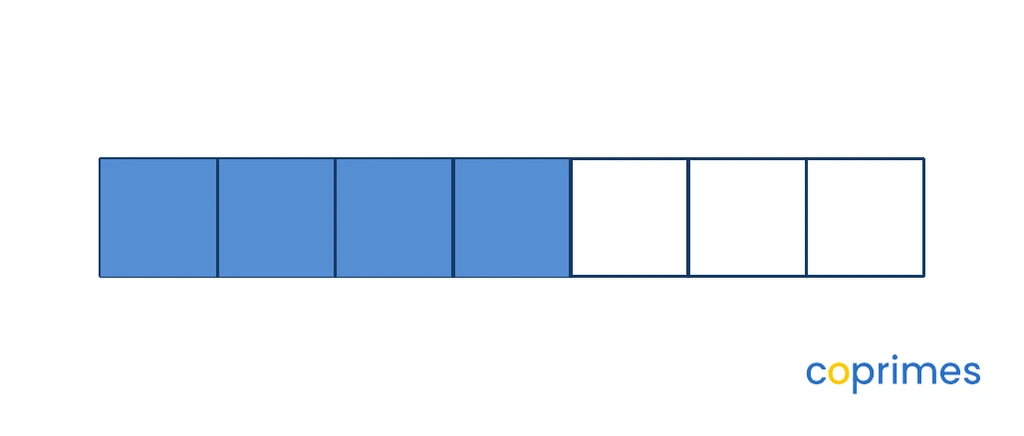
What is the reciprocal of the fraction shown in the model?
What is the reciprocal of ?
Which property is always true about a number and its reciprocal?
Their sum is always zero.
They are always both positive.
Their product is always exactly .
Their difference is always .
Their product is always exactly .
What is the reciprocal of ?
Undefined
Undefined
Dividing by gives the exact same result as multiplying by which value?