
How to Divide Fractions: Methods and Examples for Grades 5–10
To divide by a nonzero fraction, multiply by its reciprocal: keep the first fraction, replace division with multiplication, invert only the divisor, multiply, and simplify.
Dividing fractions follows a logical mathematical rule that transforms a division problem into a straightforward multiplication problem.
What does dividing fractions mean?
Dividing fractions means determining how many equal fractional parts fit into a given quantity.
When you calculate a division problem, you are answering a specific question. The dividend is the total amount you start with, and the divisor is the size of the group you are dividing by. The result is the quotient.
For example, evaluating is mathematically the same as asking, "How many portions fit into ?"
Use measurement and sharing models
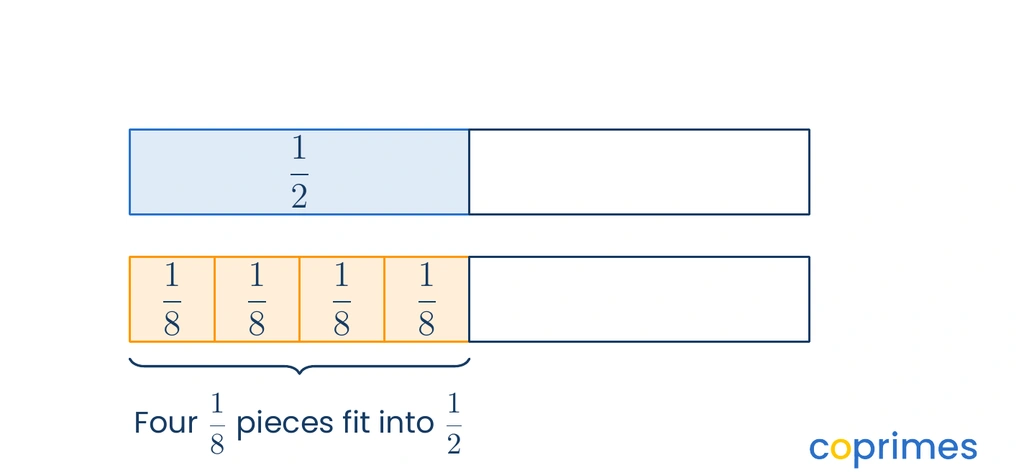
Measurement models help visualize fraction division by comparing the sizes of different fractional parts side by side.
If you have half of a whole shape, you can measure how many one-eighth pieces fit exactly into that half. Because four one-eighth pieces combine to form exactly one half, the quotient is four.
Why multiply by the reciprocal
To divide by a nonzero fraction, you multiply by its reciprocal because division and multiplication are inverse operations.
A fraction instructs you to multiply by its numerator and divide by its denominator. When you divide by a fraction, that logic reverses: you divide by the numerator and multiply by the denominator. This is identical to multiplying by the inverted fraction, which is called the reciprocal of a fraction.

Division steps
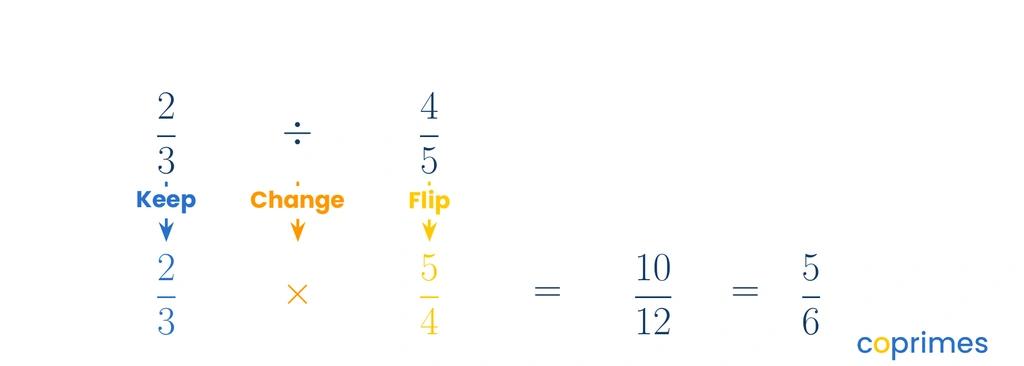
The standard method for fraction division transforms the expression into a multiplication problem using three main steps: keep, change, and flip.
To divide by a fraction, keep the dividend, change the operation, and flip the divisor.
Here is the complete procedural method:
- Keep the first fraction exactly as it is written.
- Change the division sign to a multiplication sign.
- Flip the second fraction upside down to find its reciprocal.
- Multiply the numerators together and the denominators together, just as you would when multiplying fractions.
- Reduce the final result by simplifying fractions to their lowest terms.
Divide fractions and whole numbers
You can use the reciprocal method when a division expression includes whole numbers by first rewriting the whole number as a fraction.
Any integer can be written as a fraction by placing it over a denominator of . Once both values are written in fractional form, apply the standard keep-change-flip steps. This technique applies universally when dividing fractions with whole numbers, whether the whole number is the dividend or the divisor.
Worked examples
These examples demonstrate how to apply the reciprocal method to fraction expressions and fraction word problems.
Example 1: Dividing a fraction by a fraction
Question: Evaluate .
Method:
- Keep the first fraction as it is.
- Change the division operation to multiplication.
- Flip the second fraction to its reciprocal .
- Multiply the numerators and denominators.
- Simplify the fraction if possible.
Answer:
Check: Multiply the quotient by the original divisor: .
Example 2: Whole number divided by a fraction
Question: A baker has cups of sugar. A recipe requires of a cup of sugar per batch. How many batches can the baker make?
Method:
- Write the whole number as the fraction .
- Set up the division expression as .
- Change the operation to multiplication and flip the divisor to .
- Multiply the numerators and denominators straight across.
- Simplify the fraction.
Answer: batches.
Check: Multiply the number of batches by the sugar per batch: .
Example 3: Dividing a fraction by a whole number
Question: Evaluate .
Method:
- Write the whole number as the fraction .
- Change the operation to multiplication and flip the divisor to .
- Multiply the numerators and denominators straight across.
Answer:
Check: Multiply the quotient by the original divisor: .
A learning plan shaped by your child, not the class
State-aligned Math plus our own Logic and English curriculum. An adaptive baseline test finds the gaps and fills them.
Common mistakes
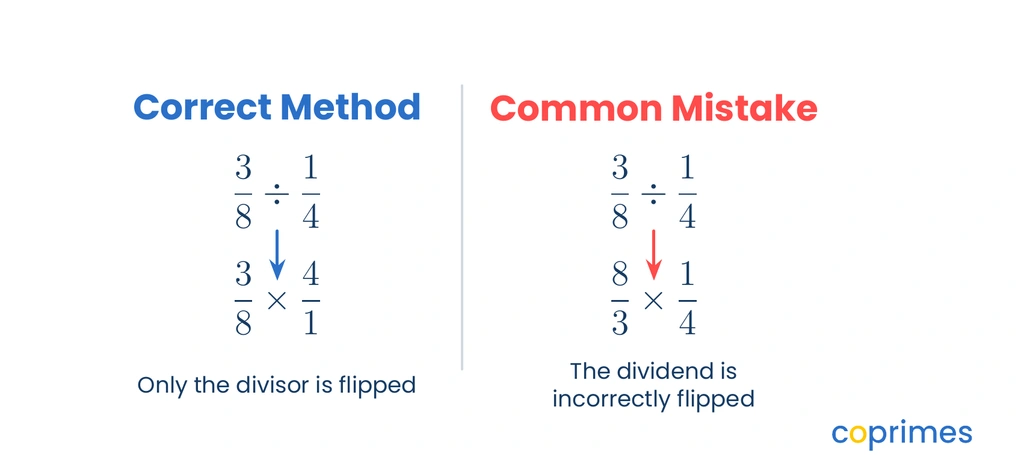
The most frequent error in fraction division is flipping the wrong fraction before multiplying.
Always invert the divisor, which is the fraction on the right side of the division sign. If you flip the dividend instead, the result will be mathematically incorrect. Another common mistake is changing the division sign to multiplication but forgetting to flip the second fraction altogether.
Frequently asked questions
These answers address common conceptual questions about fraction division rules and results.
Can you divide a fraction by zero?
No. Division by zero is mathematically undefined. You cannot form groups of size zero, nor can you find the reciprocal of zero, because is not a valid number.
Do I need common denominators to divide fractions?
No. While you can divide using a common-denominator method, the reciprocal multiplication method is generally faster and does not require you to find a common denominator first.
Is the quotient always smaller than the dividend?
No. When dividing by a positive fraction that is less than , the quotient will be larger than the dividend. For example, .
Practice questions
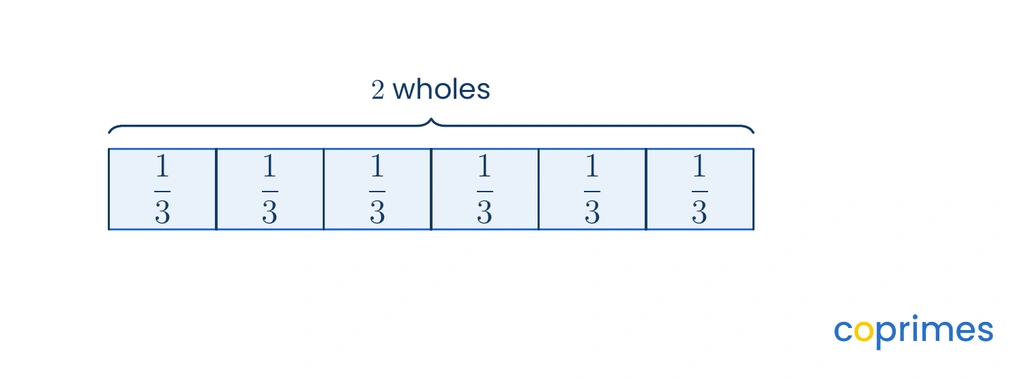
Which division equation is modeled by this visual?
Evaluate .
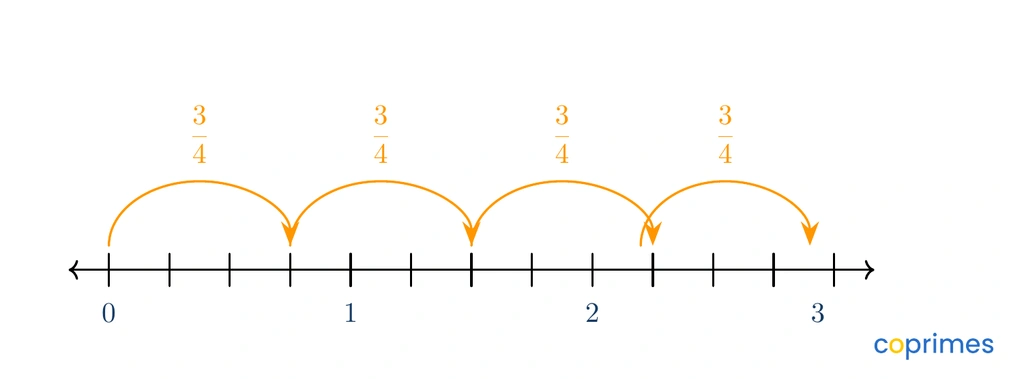
Which division equation is modeled by the jumps on this number line?
A student calculated and wrote . What mistake did they make?
They inverted the dividend instead of the divisor.
They forgot to simplify the final answer.
They inverted both fractions instead of keeping one.
They changed the operation without flipping any fraction.
They inverted the dividend instead of the divisor.
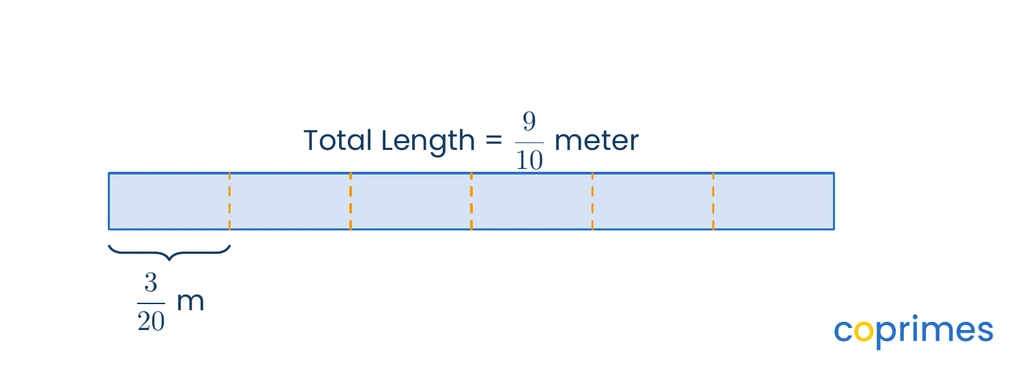
A piece of ribbon is of a meter long. It is cut into smaller segments that are each of a meter long. How many segments are there?