
Recurring Decimals: Definition, Method and Examples
A recurring, or repeating, decimal is a type of non-terminating repeating decimal in which one digit or a fixed block of digits repeats forever.
Because they can always be expressed as a ratio of two integers, all recurring decimals belong to the set of rational numbers. The infinitely repeating pattern is the hallmark of these numbers, distinguishing them from decimals that stop or those that go on forever without any repeating sequence.
What are recurring decimals?
When you divide two integers and the division never yields a zero remainder, the quotient often results in an infinite, predictable pattern.
Understanding this predictable pattern is the key to answering what is a recurring decimal. Every recurring decimal is a rational number because the infinite repetition guarantees it can be mathematically converted into a fraction.
To represent these numbers cleanly without writing an endless string of digits, mathematicians use a specific recurring decimal notation known as bar notation, which marks exactly which digits repeat.
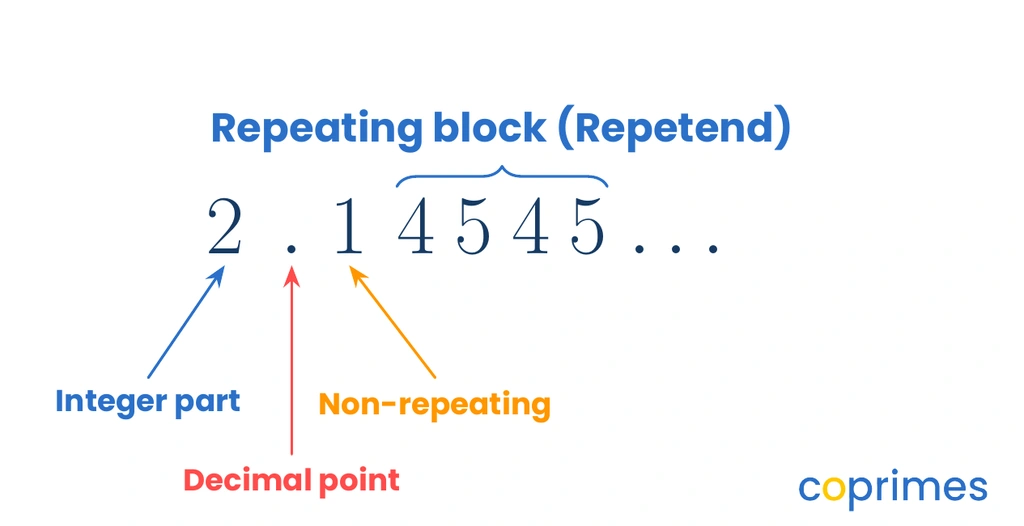
Show the repeating block
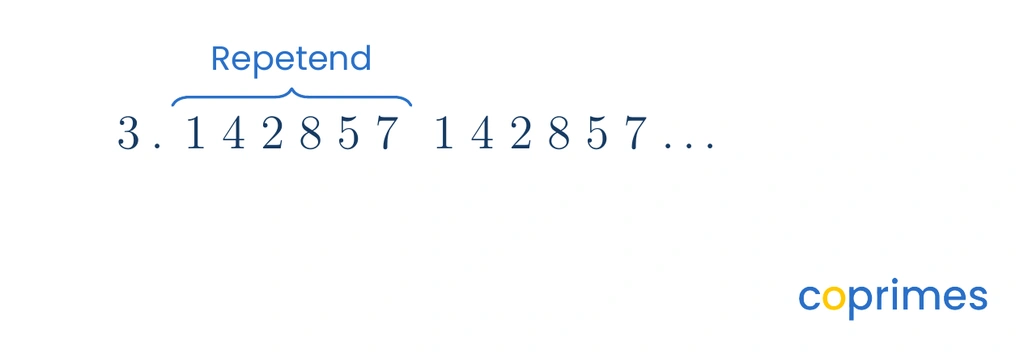
The specific digit or sequence of digits that repeats infinitely in a recurring decimal is called the repetend.
Recognizing the repetend is the first crucial step in analyzing these numbers. Recurring decimals are generally classified into two distinct types based on where the repetend begins.
Pure recurring decimals are those where the repeating block starts immediately after the decimal point. There are no other digits between the decimal point and the repetend.
Mixed recurring decimals contain at least one non-repeating digit immediately following the decimal point before the repeating block begins. Identifying the boundary between the non-repeating part and the repeating block is essential for mathematical operations.
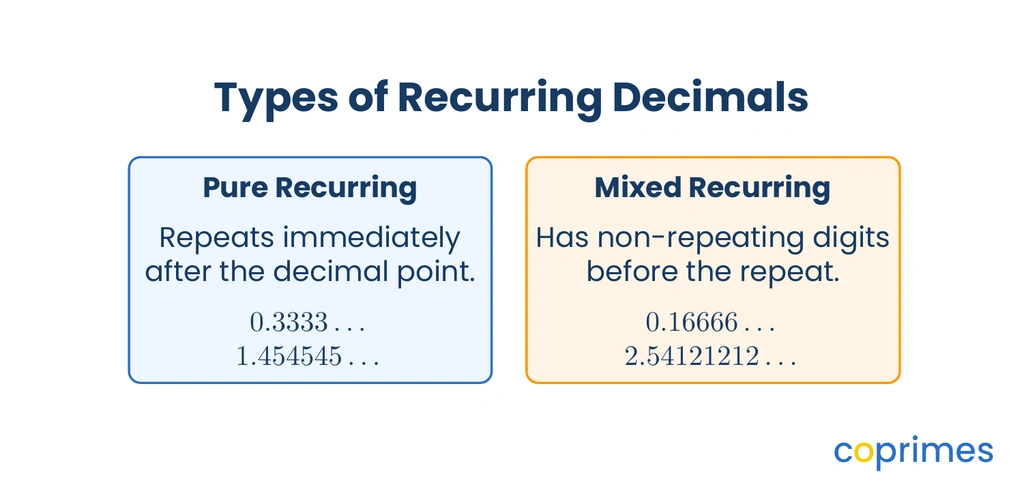
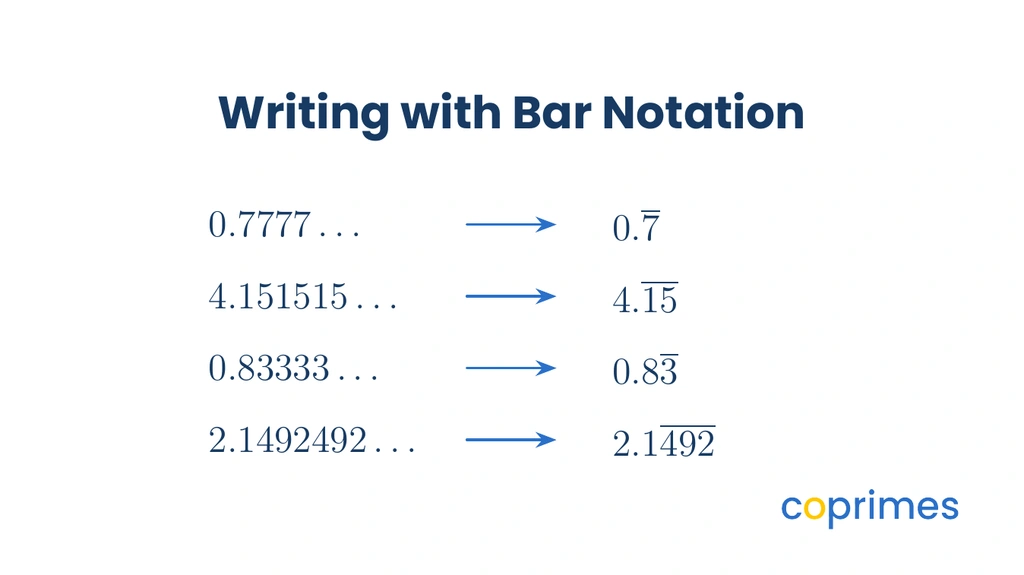
Use bar notation
Writing out a sequence of digits with an ellipsis (three dots) can be cumbersome and sometimes ambiguous.
To represent recurring decimals cleanly and precisely, mathematicians use bar notation. In this notation, a horizontal line, called a vinculum or simply a bar, is placed strictly over the repeating block of digits.
For example, if the digit repeats infinitely, you place a bar over the . If a three-digit sequence like repeats, you place the bar over the entire sequence of . It is extremely important that the bar covers only the repetend and nothing else.
In some international regions, dot notation is used instead. A single dot is placed over a single repeating digit, or two dots are placed over the first and last digits of a repeating block. However, bar notation remains the most globally recognized standard in algebraic education.

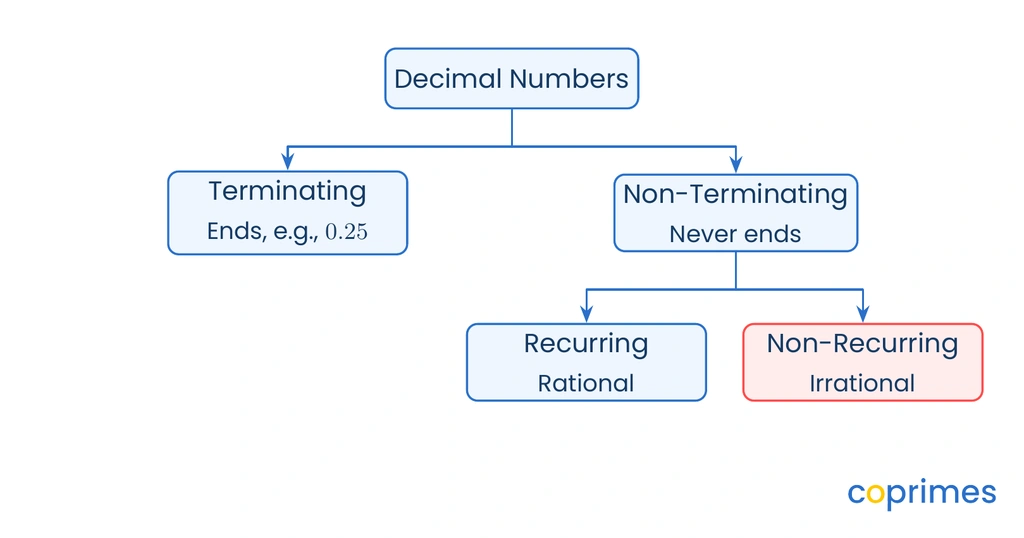
Recurring versus non-recurring decimals
When dealing with decimals, it is vital to categorize them properly. All decimals can first be split into two main groups: those that end and those that do not.
Decimals that end are known as terminating decimals. If a decimal does not end, it is called a non-terminating decimal.
Non-terminating decimals are further split into two distinct categories. If the infinite decimal settles into a repeating pattern, it is a recurring decimal.
If the infinite decimal never settles into a repeating pattern, it is a non-recurring decimal. These non-terminating, non-recurring decimals represent irrational numbers, such as the mathematical constant pi or the square roots of non-square integers.
A critical misconception is that every non-terminating decimal will eventually repeat. This is false. A pattern can be infinite and non-recurring.
Connect recurring decimals to fractions
Because every recurring decimal represents a rational number, there is a reliable algebraic method to convert it into a fraction consisting of an integer numerator and a non-zero integer denominator.
Understanding the decimal expansion of rational numbers involves mastering this conversion process.
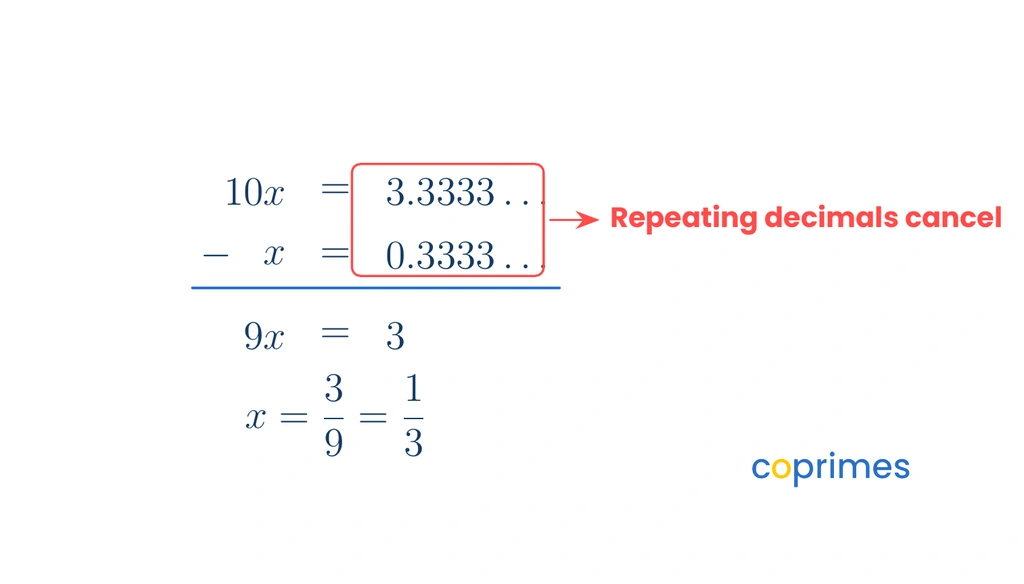
The core technique relies on setting the recurring decimal equal to a variable. You then multiply both sides of the equation by a power of corresponding to the number of digits in the repeating block.
Subtracting the original equation from this new equation beautifully cancels out the infinitely repeating decimal portion, leaving a simple algebraic equation to solve. This forms the foundation for mapping repeating decimals to fractions.
Worked examples
Here are progressive examples demonstrating how to properly analyze and write recurring decimals.
Example 1: Identifying repetend and applying bar notation
Question: What is the correct bar notation for the pure recurring decimal ?
Method:
- Look at the digits immediately following the decimal point to find the repeating pattern.
- Identify that the digit is the only digit repeating infinitely.
- Place a single bar over the repeating digit.
Answer: The correct bar notation is .
Check: The number does not have any non-repeating parts, making it a pure recurring decimal.
Example 2: Categorizing and writing mixed recurring decimals
Question: Convert the decimal into bar notation and classify it as pure or mixed.
Method:
- Examine the sequence after the decimal point. The digit appears once and does not repeat. The digits and repeat infinitely as a block.
- Because there is a non-repeating digit before the repeating block, this is a mixed recurring decimal.
- Write the number, placing the bar exclusively over the repetend.
Answer: The mixed recurring decimal is written as .
Check: The bar covers only the repeating sequence of , correctly excluding the non-repeating .
Example 3: Converting a recurring decimal into a fraction
Question: Prove algebraically that the recurring decimal is a rational number by converting it into a fraction in its simplest form.
Method:
- Set the repeating decimal equal to a variable. Let
- Because the repetend has two digits, multiply the entire equation by .
- This creates a new equation:
- Subtract the original equation from the new equation to eliminate the repeating part, which leaves .
- Isolate the variable to form a fraction.
- Simplify the fraction by dividing the numerator and denominator by their greatest common divisor, which is .
Answer: The fraction is .
Check: Since the number can be written as a fraction where the numerator and denominator are integers, it is a rational number.
A learning plan shaped by your child, not the class
State-aligned Math plus our own Logic and English curriculum. An adaptive baseline test finds the gaps and fills them.
Common mistakes
A frequent error occurs when applying bar notation to mixed recurring decimals. Students often drag the bar too far to the left, accidentally covering a non-repeating digit.
For instance, writing the number with the bar over both the and the is incorrect; the bar must only cover the .
Another widespread mistake involves early rounding. When performing calculations with repeating values, rounding the number to a few decimal places introduces compounding errors.
It is always best to convert the recurring decimal into its exact fractional form before proceeding with addition, subtraction, multiplication, or division.
Lastly, do not assume that a decimal is non-recurring just because you cannot immediately see the pattern in the first few digits. Some rational numbers, like the fraction , have a repetend that is six digits long.
Frequently asked questions
What is a recurring decimal?
It is a decimal number that extends infinitely, featuring a specific digit or group of digits that repeats endlessly in a predictable pattern.
Are recurring decimals rational numbers?
Yes. Every single decimal that repeats infinitely in a pattern can be converted into a fraction made of two integers, which is the exact definition of a rational number.
What are repetend decimals?
This is simply a synonym for recurring or repeating decimals. The word "repetend" specifically refers to the block of digits that undergoes the infinite repetition.
What is the difference between recurring and periodic decimals?
There is no mathematical difference. "Periodic," "recurring," and "repeating" are interchangeable terms used to describe the same type of infinite decimal expansion.
Practice questions
Which of the following numbers is an example of a pure recurring decimal?
How is the non-terminating decimal properly written using bar notation?
Which statement regarding decimal numbers is entirely true?
All non-terminating decimals are recurring.
Every recurring decimal can be expressed as a fraction.
Terminating decimals cannot be converted into fractions.
The value of pi is an example of a recurring decimal.
Every recurring decimal can be expressed as a fraction.
Evaluate the decimal expansion of . Which of the following represents its correct bar notation?
A student wants to convert the pure recurring decimal into a fraction. By what number should they multiply both sides of the equation in the first step?