
Terminating Decimals: Definition, Method and Examples
A terminating decimal has a finite number of digits after the decimal point; a simplified fraction has a terminating decimal exactly when its denominator has no prime factors other than and .
What is a terminating decimal?
A terminating decimal is a decimal number that contains a finite number of digits after the decimal point. Unlike decimal expansions that go on forever, a finite decimal eventually comes to a complete end.
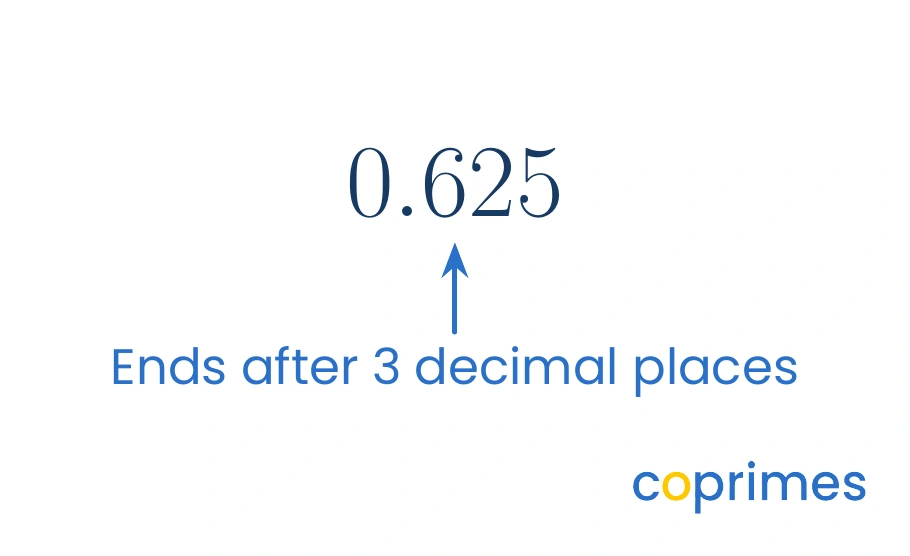
The digits in these numbers do not repeat infinitely. When you type certain fractions into a calculator, the screen displays a fixed sequence of digits and then stops entirely.
Recognise finite decimal digits
You can recognise ending decimals because they can always be written exactly using a specific place value without any remainder.
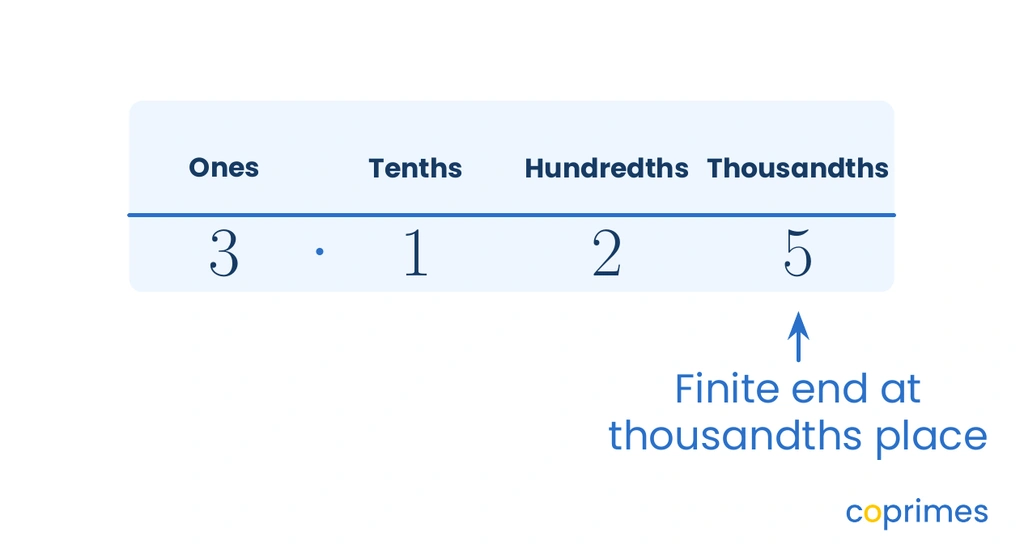
Because the decimal ends at a specific place value, it can be written as a fraction where the denominator is a power of . The number in the visual above has three decimal places, meaning it ends exactly in the thousandths place.
We can write it as without losing any information. This terminating decimal expansion is mathematically exact.
Connect fractions and terminating decimals
To switch from fractions to decimals, you can divide the numerator by the denominator. If the division leaves a remainder of zero at some point, the quotient is a terminating decimal.
Another method is to find an equivalent fraction whose denominator is a power of .
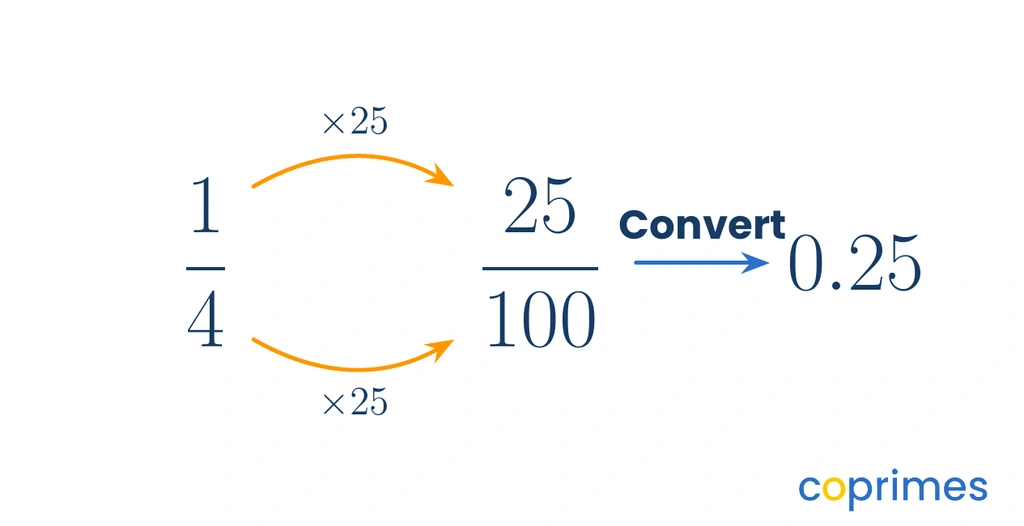
For the fraction shown above, you can multiply the top and bottom numbers by . This gives , which equals exactly.
Since rational numbers are defined as the ratio of two integers, every terminating decimal is a rational number.
A learning plan shaped by your child, not the class
State-aligned Math plus our own Logic and English curriculum. An adaptive baseline test finds the gaps and fills them.
Use denominator prime factors
You do not always have to divide to find out if a decimal will eventually end. You can use prime factorization to test the denominator directly.
A simplified fraction terminates when its denominator contains no prime factors other than two and five.
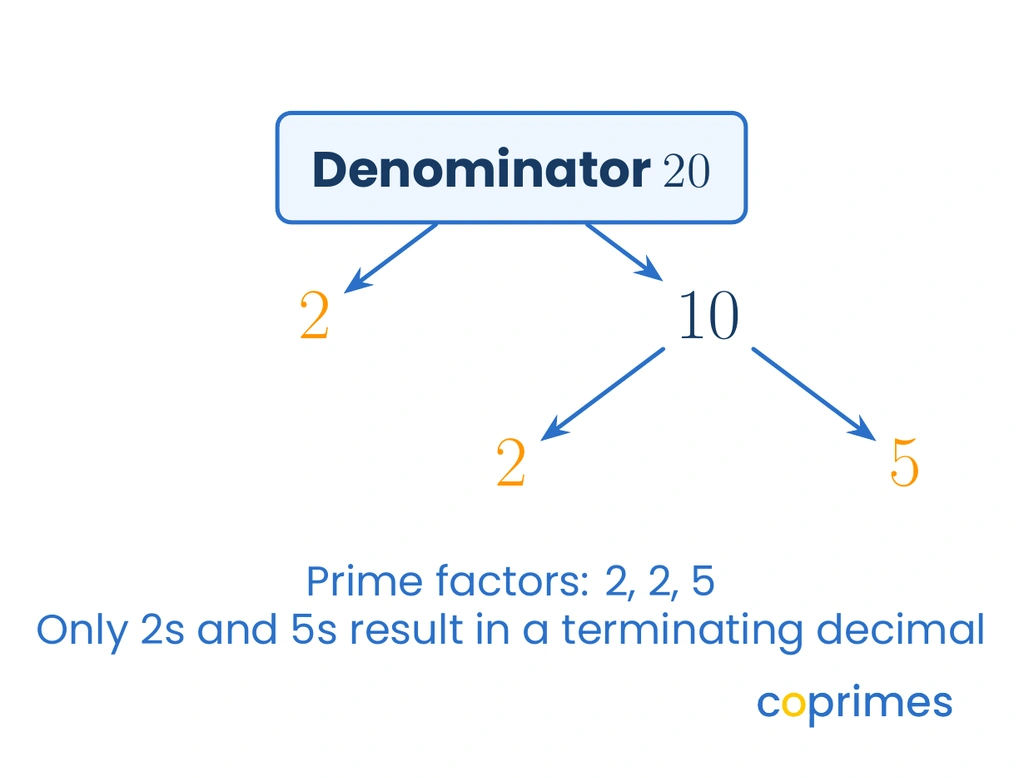
Consider the denominators , , and . The prime factorization of is . The prime factorization of is . The prime factorization of is . Fractions with these denominators, when fully simplified, will always terminate.
Now consider denominators like and . The number is a prime factor itself. The number is . Because these contain prime factors other than or , fractions with these denominators will not terminate.
Simplification is an essential first step. You must simplify the fraction before checking the prime factors of the denominator. If you check the fraction without simplifying, you might see the factor of in the denominator and incorrectly assume it does not terminate. However, simplifies to , which terminates perfectly as in decimal form.
Compare terminating and recurring decimals
The decimal expansion of rational numbers always results in one of two outcomes. The decimal will either terminate completely or it will become a repeating pattern.
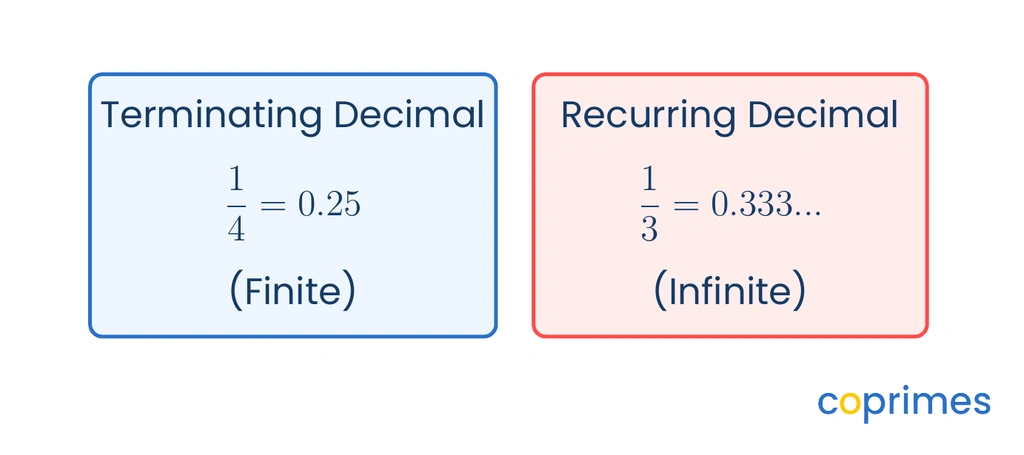
While a terminating decimal comes to a complete stop, recurring decimals have a digit or a block of digits that repeat endlessly without ever concluding.
Worked examples
Review these examples to see how the prime factor rule applies to different denominators.
Example 1: Identifying a terminating decimal from its denominator
Question: Determine if the fraction results in a terminating decimal.
Method:
- Ensure the fraction is in its simplest form. The numbers and share no common factors other than .
- Find the prime factors of the denominator. The denominator is . We can write as . This factors completely to .
- Apply the prime factor rule. The only prime factors are and .
Answer: The fraction will produce a terminating decimal.
Check: , which is a terminating decimal.
Example 2: Converting a fraction without long division
Question: Find the exact decimal expansion of .
Method:
- Identify the prime factors of the denominator. The prime factorization of is .
- Multiply by powers of to create powers of . Because there are three twos, we need three fives. Multiply the numerator and the denominator by .
- Write the equivalent fraction as a decimal. This gives .
Answer: The decimal expansion is .
Check: , confirming the equivalent fraction is correct.
Example 3: The importance of simplifying first
Question: Determine if the fraction results in a terminating decimal.
Method:
- Simplify the fraction. Both and are divisible by . The simplified fraction is .
- Factor the new denominator. The prime factorization of is .
- Conclude based on the factors. Because the prime factors are strictly and , the decimal will terminate.
Answer: The fraction produces a terminating decimal.
Check: , which is indeed a terminating decimal.

Common mistakes
A very frequent error occurs when a student tries to determine if a decimal terminates without first simplifying the fraction.
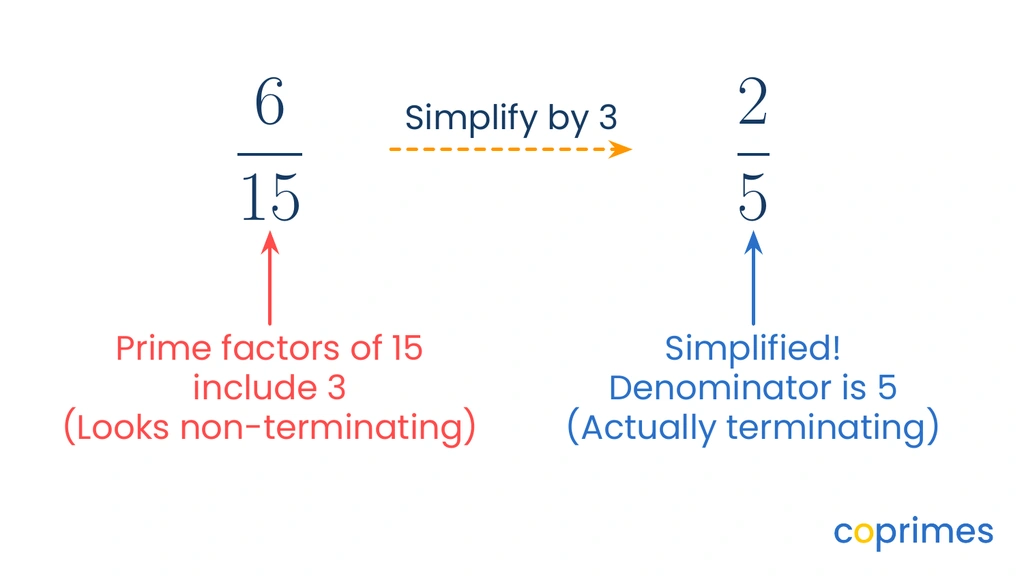
If you look at the unsimplified fraction , you might notice the denominator is . Because of the , you might assume the decimal will recur. However, the simplified fraction clearly terminates as exactly.
Another common mistake is believing that every terminating decimal must be an integer. This is entirely false. An integer like is technically a terminating decimal because it can be written as and stops. However, numbers like and are terminating decimals that are definitely not integers. They represent true fractional values that simply happen to have finite decimal expansions.
Frequently asked questions
Here are clear answers to common questions about finding and using these finite decimals.
How can you quickly tell if a decimal terminates?
A decimal terminates if it has a finite number of digits after the decimal point and does not have a repeating bar or dot over any digits. If it is in fraction form, simplify it and check if the denominator contains only prime factors of and .
Can a negative fraction be a terminating decimal?
Yes. The sign of the number does not affect whether the decimal terminates. The fraction converts directly to the terminating decimal .
Why do we only look for twos and fives in the denominator?
Our number system is based on powers of . The prime factors of are and . Therefore, to make an equivalent fraction with a denominator of , , or , the simplified fraction must only contain these specific prime factors in its denominator.
Practice questions
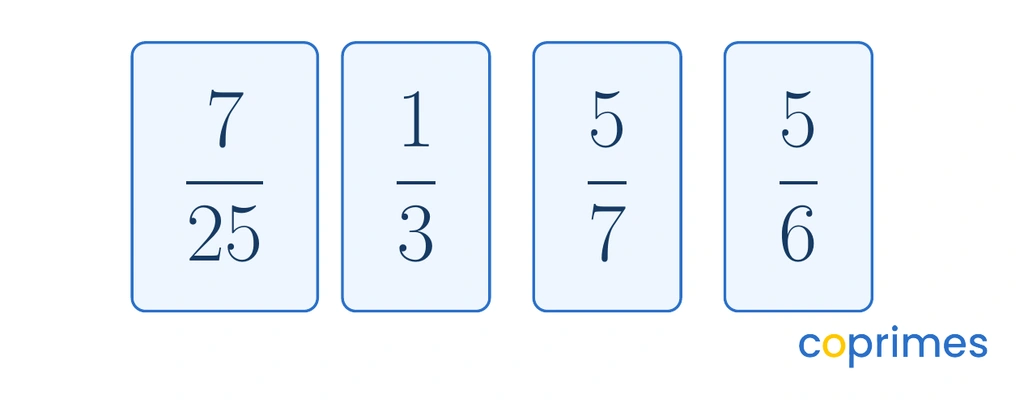
Which of the rational numbers shown above will have a terminating decimal expansion?
What is the exact decimal expansion of ?
Which of the following unsimplified fractions will result in a terminating decimal?
Why does produce a terminating decimal while does not?
The prime factorization of consists only of twos.
The numerator is smaller than .
All even denominators yield terminating decimals.
The denominator is larger than the numerator.
The prime factorization of consists only of twos.
Which statement about terminating decimals is strictly false?
Every terminating decimal is an integer.
A terminating decimal has a finite number of digits.
Every terminating decimal represents a rational number.
A denominator of guarantees a terminating decimal.
Every terminating decimal is an integer.