
Repeating Decimals to Fractions
To convert a repeating decimal to a fraction, define the decimal as a variable, multiply by a power of ten that aligns the repeating block, subtract the original equation to eliminate the repeated digits, solve for the variable, and simplify the result.
How do you convert a repeating decimal to a fraction?
Converting a repeating decimal into a fraction requires an algebraic method that eliminates the infinite decimal tail.
Because the digits go on forever, you cannot simply place the decimal over a power of ten as you would with terminating decimals. Instead, you create two equations that share the exact same infinite repeating part.
When you subtract the smaller equation from the larger one, the infinite tails perfectly cancel each other out, leaving a whole number. This method allows you to rewrite recurring decimals as exact fractions.
Use notation for the repeating block
Before converting, it is essential to identify exactly which digits repeat.
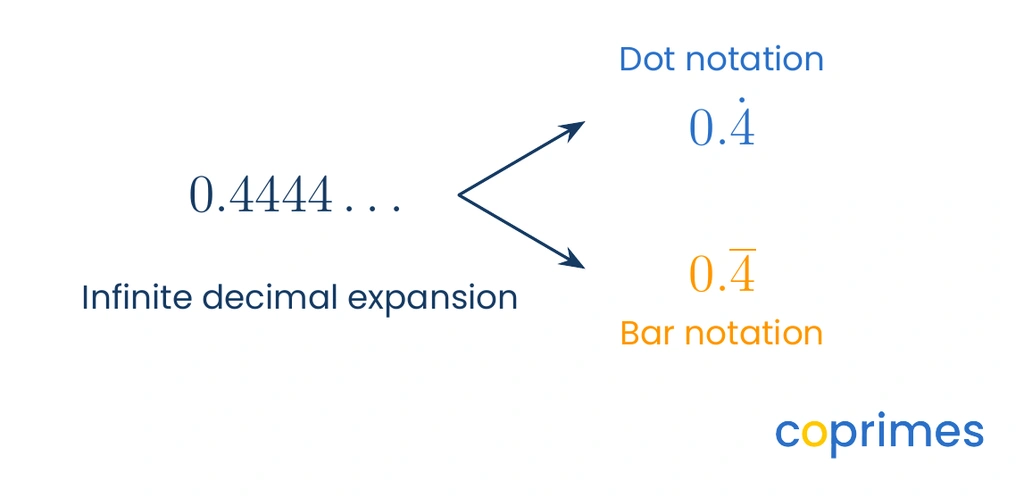
The repeating sequence is called the repetend. In mathematics, this infinite repetition is shown using either a horizontal bar or a dot placed above the repeating digits.
If only one digit repeats, a single dot or a short bar is placed over it. If a block of multiple digits repeats, a bar covers the entire repeating block, or dots are placed over the first and last digits of the block.
Set up two aligned equations
To begin the conversion, set a variable such as equal to the original repeating decimal.
Next, multiply both sides of the equation by a power of ten. The power of ten depends on how many digits are in the repeating block.
If one digit repeats, multiply by . If two digits repeat, multiply by . If three digits repeat, multiply by . This shifts the decimal point exactly one full repeating block to the right, creating a new equation with the same infinite tail.
A learning plan shaped by your child, not the class
State-aligned Math plus our own Logic and English curriculum. An adaptive baseline test finds the gaps and fills them.
Subtract to eliminate repetition
Place the new multiplied equation directly above the original equation, ensuring the decimal points are perfectly aligned.
When you subtract the original equation from the multiplied one, the identical repeating digits after the decimal point cancel each other out completely.
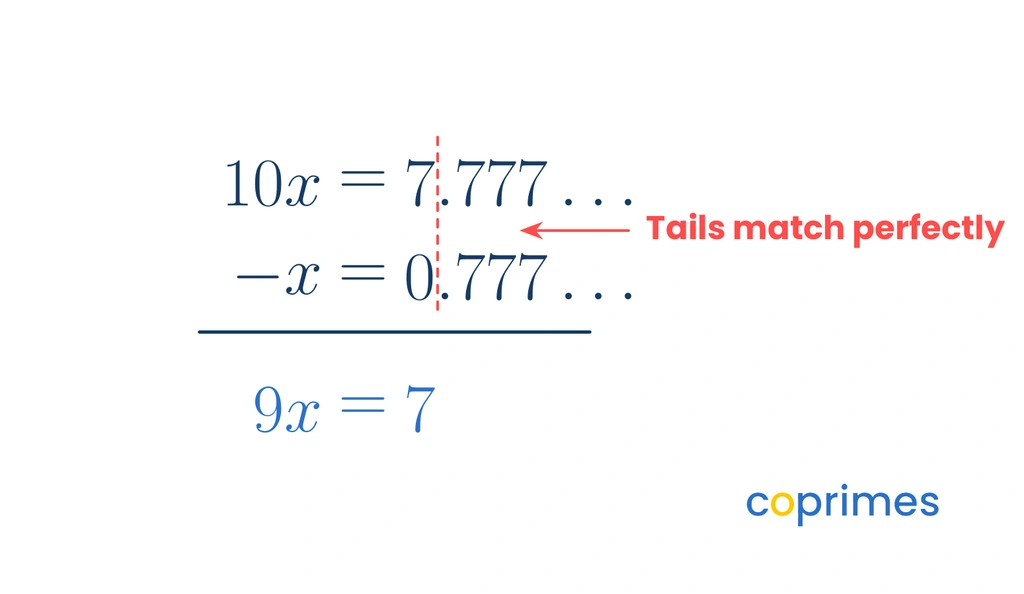
This step removes the infinite decimal entirely, replacing it with a simple linear equation that contains only whole numbers.
Solve and simplify
After subtraction, you will be left with an equation of the form , , or .
Divide both sides by the coefficient of to isolate the variable. The resulting expression is the fractional equivalent of the repeating decimal.
Finally, reduce the fraction to its lowest terms by dividing the numerator and denominator by their greatest common divisor. Always look for common factors like , , , or when simplifying fractions.
Handle a non-repeating prefix
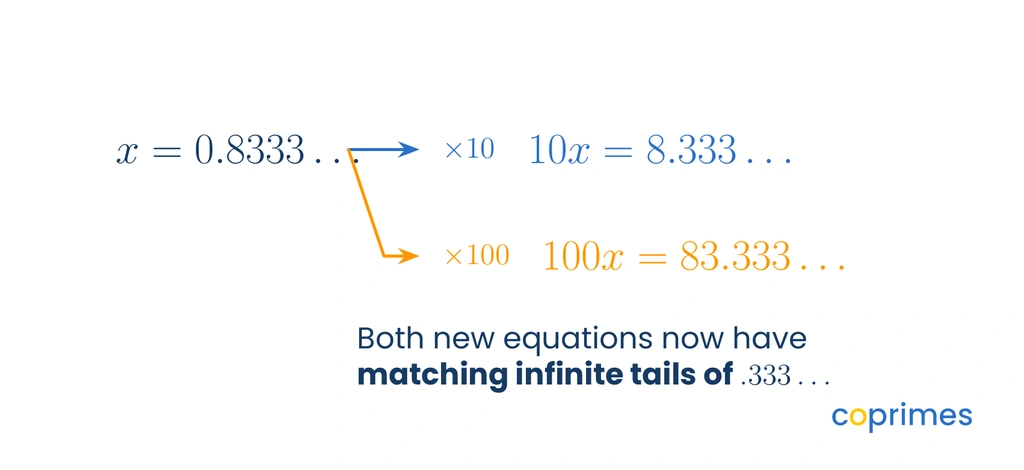
Sometimes a decimal contains a mixture of non-repeating and repeating digits, such as .
To convert these, you must set up two new equations that both place the decimal point immediately after a repeating block. Multiply the original variable by a power of ten large enough to shift the non-repeating prefix to the left of the decimal. Then, multiply by another power of ten to shift one full repeating block past the decimal.
Subtracting these two new equations will perfectly align and eliminate the repeating tails.

Worked examples
Example 1: Converting a single repeating digit
Question: Write as a fraction in simplest form.
Method:
- Define the decimal as a variable:
- Multiply by because one digit repeats:
- Subtract from to get .
- Solve for to get .
Answer:
Check: Using division, , which verifies the answer.
Example 2: Converting a two-digit repeating block
Question: Write as a fraction in simplest form.
Method:
- Define the decimal as a variable:
- Multiply by because two digits repeat:
- Subtract from to get .
- Solve for to get .
- Simplify the fraction by dividing the numerator and denominator by to get .
Answer:
Check: Multiplying by gives , and by gives , confirming the simplified form.
Example 3: Converting a decimal with a non-repeating prefix
Question: Write as a fraction in simplest form.
Method:
- Define the decimal as a variable:
- Multiply by to move the non-repeating prefix past the decimal point:
- Multiply the original variable by to move one full repeating block past the decimal point:
- Subtract from to get .
- Solve for to get .
- Simplify the fraction by dividing the numerator and denominator by to get .
Answer:
Check: Dividing by yields , verifying the result.
Common mistakes
A frequent error is multiplying by the wrong power of ten. Always count the number of digits under the repetition bar. If there are two repeating digits, you must multiply by , not .
Another common mistake is misaligning the decimal points during subtraction, especially when a non-repeating prefix is present. Ensure the repeating tails perfectly match before subtracting. If the tails do not match, the subtraction will leave an unwanted decimal remainder rather than a whole number.
Finally, students often forget to simplify the resulting fraction. Every valid decimal expansion of rational numbers corresponds to a fraction in its lowest terms, a foundational property of rational numbers.
Frequently asked questions
What does the bar over a decimal mean?
A horizontal bar over one or more digits in a decimal indicates that those specific digits repeat infinitely. For example, represents continuing without end.
Can every repeating decimal be converted to a fraction?
Yes, every repeating decimal represents a rational number, which means it can always be written as a fraction where the numerator and denominator are both integers.
Why do we get denominators with nines?
When you subtract an variable from a power of ten like or , the resulting coefficient is a sequence of nines, such as or . This coefficient becomes the denominator when you isolate the variable.
Practice questions
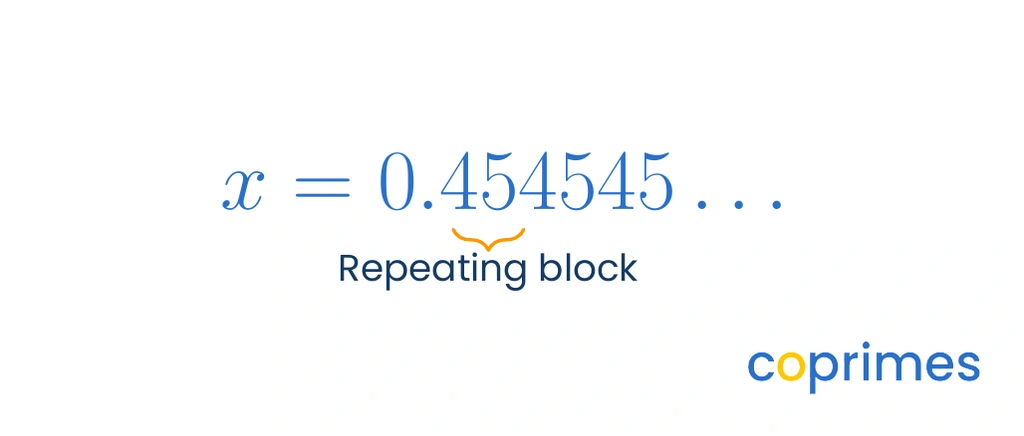
To eliminate the repeating tail of the decimal shown, which equation correctly aligns the repeating digits for subtraction?
What is the fraction equivalent of the repeating decimal in its simplest form?
A student wants to convert the decimal into a fraction. Which pair of equations should be subtracted to perfectly eliminate the repeating tail?
and
and
and
and
and
What is expressed as a fraction in simplest form?
Convert the repeating decimal into a fraction in its simplest form.