
Reverse Percentages: Finding the Original Amount
Reverse percentages find an original amount from a known percentage of it: identify what percent of the original the final value represents, then divide by its decimal multiplier or find one percent and scale to one hundred percent.
Understanding how to work backwards with percents helps you calculate original prices before discounts or starting values before a period of growth.
What are reverse percentages?
A reverse percentage problem requires you to find an original amount when you are only given a portion of it and the percentage that portion represents. In these problems, the unknown original amount is always exactly .
Normally, you calculate a percent of a number by multiplying the whole amount by a percentage. A reverse percentage inverses that process. You work backwards from the part to find the whole.
The unknown original amount always represents exactly 100 percent.
Identify the known percentage of the original
Before calculating, you must determine what percentage of the original amount your current value represents.
If a problem states that of an unknown number is , the known percentage is simply . The value aligns with , and the goal is to find the value that aligns with .
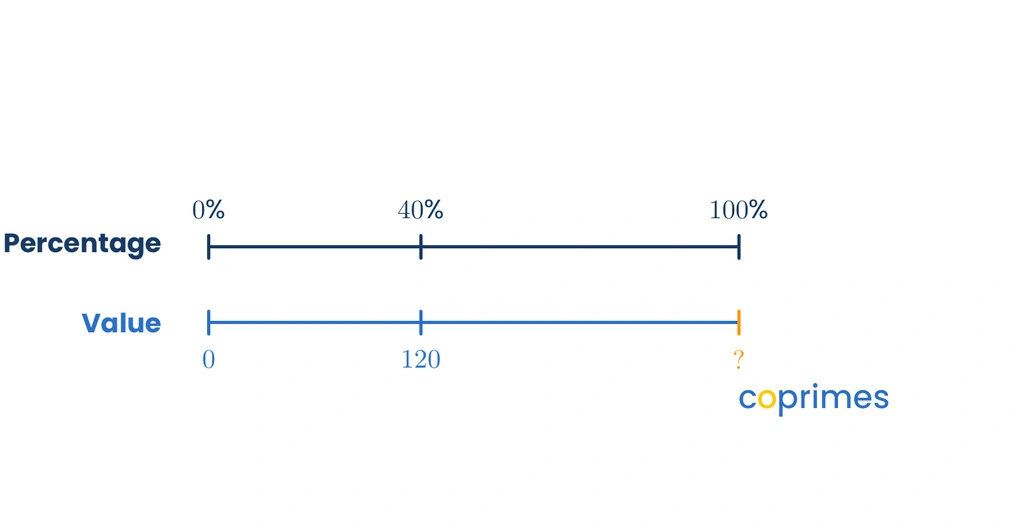
However, if a value is the result of an increase or decrease, the known percentage will be greater than or less than . Correctly identifying this starting percentage is the most important step in finding the original amount.
Use the one-percent method
The one-percent method, sometimes called the unitary method, scales the known amount down to before scaling it up to .
- Set the known percentage equal to the final value.
- Divide both sides by the percentage to find of the amount.
- Multiply both sides by to find , which is the original amount.
For example, if of a number is :
- Divide by :
- Multiply by :
You can also use other common factors. If you know , you could divide by to find , then multiply by to find .
A learning plan shaped by your child, not the class
State-aligned Math plus our own Logic and English curriculum. An adaptive baseline test finds the gaps and fills them.
Use an inverse multiplier
Instead of finding , you can use a single operation by dividing the final amount by the percentage's decimal multiplier.
To find a percentage of an amount, you multiply the original value by the decimal equivalent of the percentage. To reverse the process, you divide the final value by that same decimal multiplier.
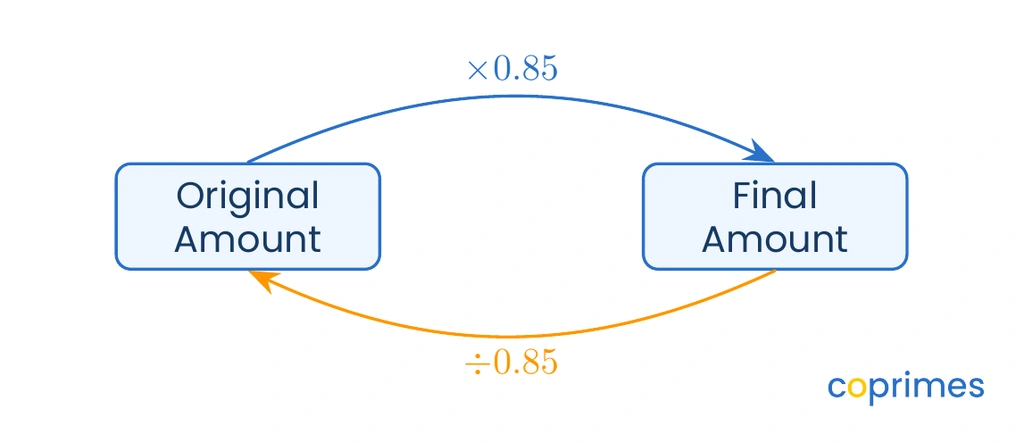
If of a number is , the decimal multiplier is . Divide the final amount by the multiplier: . The original number is .
Reverse an increase or decrease
When a value has changed, you must first calculate the new percentage relative to the original .
For a percent increase, add the increase to . If a population grows by , the new population represents of the original.
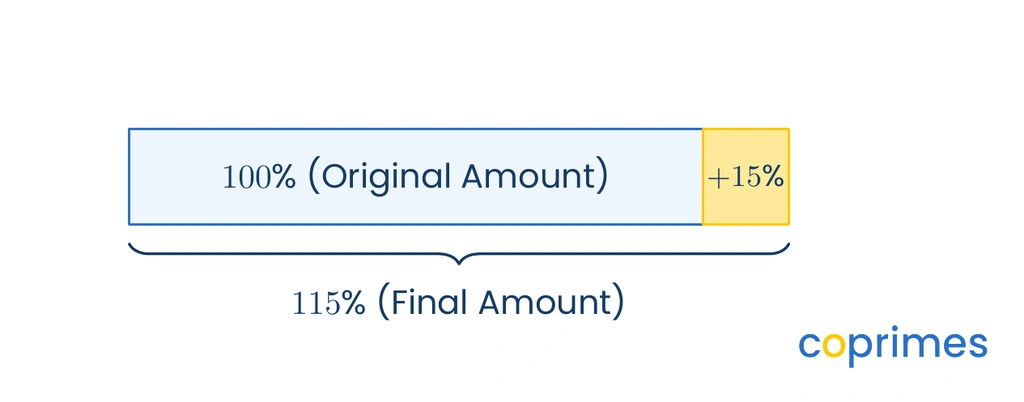
For a percent decrease, subtract the decrease from . If a price is reduced by , the new price represents of the original. Once you identify this new percentage, apply either the one-percent method or an inverse multiplier to find the original .
Worked examples
These examples show how to find the original amount for a part-percent, a decrease, and an increase.
Example 1: Finding the whole from a part
Question: of a number is . What is the original number?
Method:
- Set the percentage equal to the value: .
- Divide both sides by to find : .
- Multiply by to find : .
Answer: The original number is .
Check: of is .
Example 2: Reversing a percent decrease
Question: A jacket is sold after a discount. The sale price is dollars. What was the original price?
Method:
- Subtract the decrease from to find the final percentage: .
- Set the percentage equal to the sale price: .
- Divide both sides by to find : .
- Multiply both sides by to find : .
Answer: The original price was dollars.
Check: Applying discounts of to dollars gives dollars.
Example 3: Reversing a percent increase
Question: A tree's height increased by over one year. Its new height is . What was its height at the start of the year?
Method:
- Add the increase to to find the new percentage: .
- Convert the percentage to an inverse multiplier: .
- Divide the final value by the multiplier: .
Answer: The original height was .
Check: A increase on is .

Common mistakes
Calculating the percentage of the new amount
The most common error is finding the given percentage of the final number and adding or subtracting it. For example, if a price after a decrease is dollars, you cannot find the original price by adding of dollars. The decrease was calculated on the unknown original amount, not the final amount.
Using the wrong multiplier for an increase or decrease
If a value increases by , the new value is of the original. You must divide by . Dividing by will find the whole if the final value was only of the original, which produces an incorrect, much larger number.
Frequently asked questions
How do you know when to use reverse percentages?
You should use reverse percentages whenever a problem gives you a final amount after a percentage has been applied, or gives you a part of an amount, and asks you to find the starting value or the whole.
Can you use a ratio table for reverse percentages?
Yes. A ratio table is an excellent way to organize the one-percent method. You place the percentage in one column and the value in another, then perform the same multiplication or division on both sides until you reach .
How does this relate to overall percent change?
When calculating percent change, you find the percentage by comparing the difference to the original amount. In reverse percentages, you are given the percent change and the final amount, and you must work backward to discover that original amount.
Practice questions
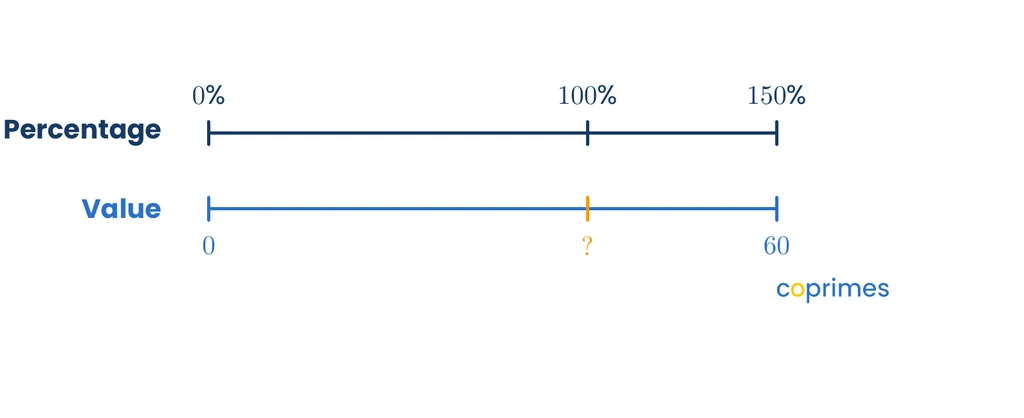
Based on the number line, what is the original amount representing ?
If of an unknown number is , what is the original number?
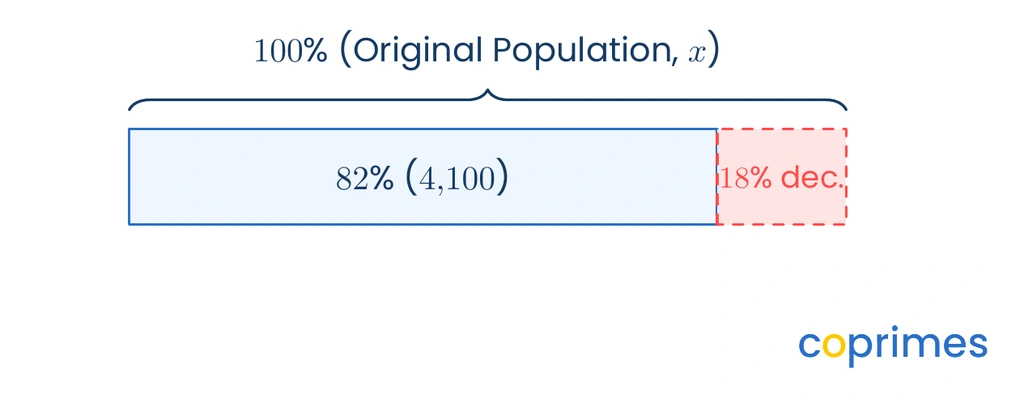
A town's population decreased by . The new population is . Which equation can be used to find the original population, ?
After a increase, a student's score in a game is . The student calculates the original score by finding of and subtracting it. What is the correct original score?
A store marks up a wholesale price by to set its retail price. If the retail price is dollars, what was the original wholesale price?
dollars
dollars
dollars
dollars
dollars