
Discounts: Definitions, Formulas, and Examples
A discount is a reduction from a list price. To find the discount amount, calculate it as a percentage of the list price, then subtract it to find the sale price. Alternatively, use a multiplier equal to one minus the discount rate as a decimal to find the final sale price directly.
What is a discount?
A discount is a specific type of percent decrease applied to the price of an item or service. Sellers use discounts to reduce the cost for buyers during sales or promotions.
When an item is discounted, the buyer pays less than the original advertised cost. The amount saved is the discount itself, which is typically given as a percentage of the original price.
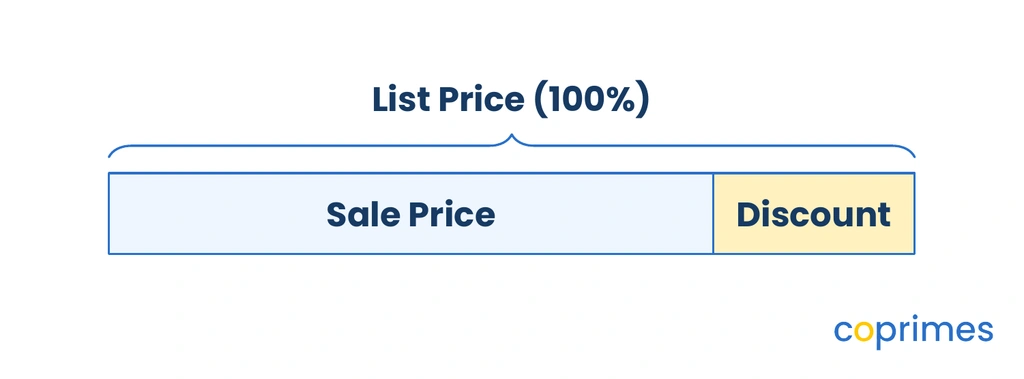
Identify list price, discount and sale price
Calculating discounts requires understanding three distinct amounts and how they relate to one another.
The list price is the starting price, the discount is the amount removed, and the sale price is the final amount paid.
- List price: The original price of the item before any changes. This is also called the marked price or regular price.
- Discount: The total amount of money subtracted from the list price.
- Sale price: The final price the buyer pays after the discount is applied.
The fundamental relationship between these values is a simple subtraction equation:
Find a discount amount
Discounts are usually advertised as a percentage rate rather than a flat currency amount. To find the currency reduction, calculate the percent of a number using the list price.
The discount rate must be written as a fraction or a decimal before multiplying. For example, a discount rate is written as or .
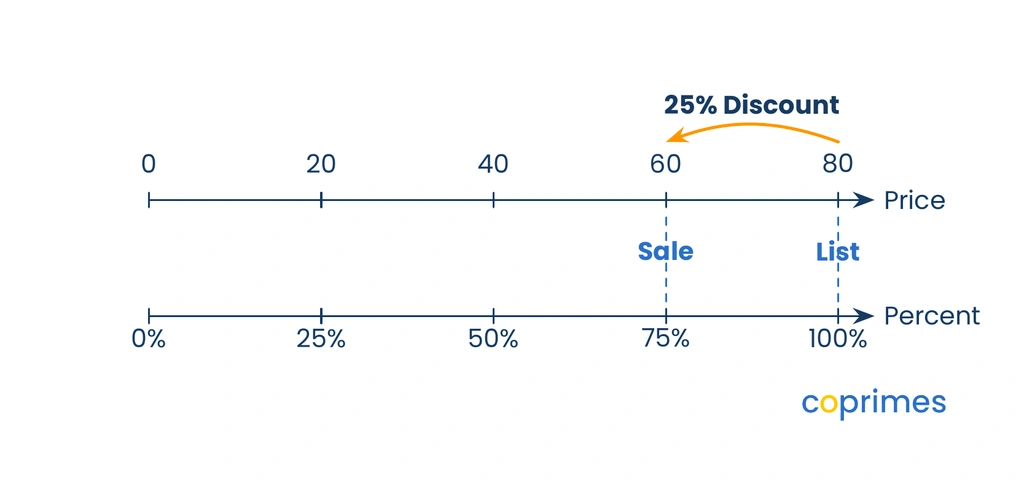
Once the discount amount is found, subtract it from the list price to find the sale price.
A learning plan shaped by your child, not the class
State-aligned Math plus our own Logic and English curriculum. An adaptive baseline test finds the gaps and fills them.
Use a sale-price multiplier
Finding the discount and then subtracting requires two steps. To calculate the sale price in one step, use a sale-price multiplier.
Because the list price represents , subtracting the discount percentage gives the percentage the buyer actually pays.
Convert this paying percentage to a decimal to form the multiplier.
If an item is discounted by , the buyer pays of the original price. The sale-price multiplier is .
Find a discount rate
Sometimes the list price and sale price are known, and the unknown value is the percentage discount rate.
First, subtract the sale price from the list price to find the absolute discount amount.
Next, divide the discount amount by the list price to find the decimal rate, and multiply by to convert it to a percentage.
Always divide by the original list price, never the new sale price.
Worked examples
These steps are foundational for solving all percentage word problems. Finding the original list price before a discount is an application of reverse percentages.
Example 1: Finding the sale price
Question: A jacket has a list price of dollars. It is on sale with a discount. What is the sale price?
Method:
- Convert the discount percentage to a decimal.
- Multiply the list price by the decimal to find the discount amount.
- Subtract the discount amount from the list price.
Answer: The discount is dollars. The sale price is dollars.
Check: Use the multiplier method. . Multiply dollars. The answers match.
Example 2: Calculating the discount rate
Question: A bicycle originally costs dollars but is sold for dollars. What is the discount rate?
Method:
- Subtract the sale price from the list price to find the discount amount.
- Divide the discount amount by the list price.
- Multiply by to convert to a percentage.
Answer: The discount is dollars. The rate is , which is .
Check: Calculate a discount on dollars. dollars. Subtracting dollars gives dollars.
Example 3: Finding the original list price
Question: After a discount, a smartphone is sold for dollars. What was the list price?
Method:
- Determine the paying percentage. The buyer pays of the list price.
- Write the relationship as an equation. .
- Divide the sale price by the decimal multiplier to find the list price.
Answer: The list price was dollars.
Check: Find of dollars, which is dollars. Subtract dollars from dollars to get dollars.

Common mistakes
Avoid these frequent errors when calculating discounts and sale prices.
- Using the sale price as the base: When calculating a percentage discount or finding the discount rate, the percentage must always refer to the original list price. A discount means of the list price, not of the final price.
- Subtracting percentages directly from prices: If an item costs dollars and has a discount, the sale price is not dollars. The must first be converted into a currency amount by multiplying dollars, which is then subtracted.
- Adding successive discounts: If an item has a discount and then an additional discount, the total discount is not . The second discount applies only to the new, already-reduced sale price.
Frequently asked questions
Discounts frequently appear in real-world math word problems. Review these common questions to solidify your understanding.
How do you calculate a discount?
Multiply the original list price by the percentage discount rate written as a decimal. This gives the total discount amount. Subtract this amount from the list price to find the final sale price.
What is the formula for the sale price?
The sale price can be found in one step using the formula .
What is a marked price?
The marked price is another term for the list price or original price. It is the cost before any discount is applied.
Practice questions
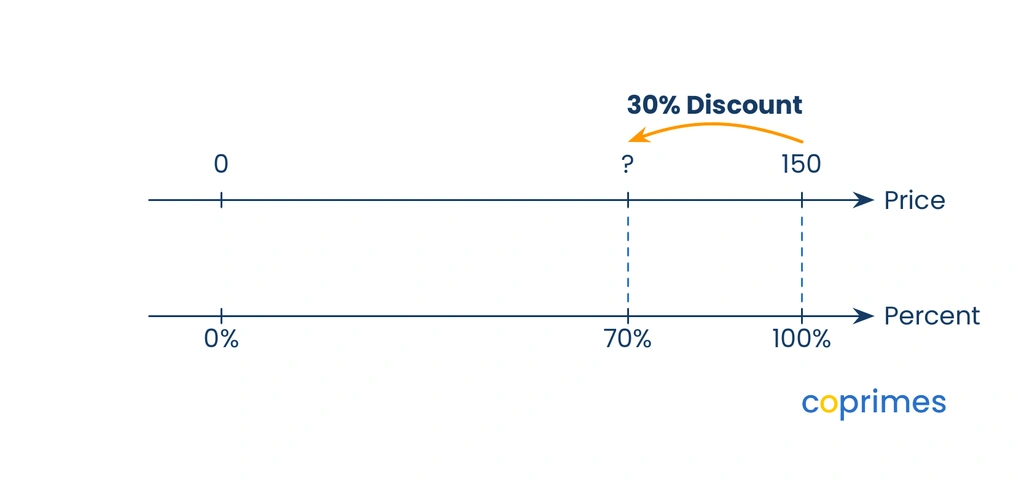
Based on the double number line, what is the sale price of the headphones?
dollars
dollars
dollars
dollars
dollars
A laptop has a list price of dollars. If it is sold at a discount, what is the total amount of the discount?
dollars
dollars
dollars
dollars
dollars
Which expression calculates the sale price of an item with a list price of dollars after a discount?
When calculating the percentage discount rate on an item, what is the correct division step?
Dividing the list price by the discount amount.
Dividing the discount amount by the sale price.
Dividing the discount amount by the list price.
Dividing the sale price by the list price.
Dividing the discount amount by the list price.
After receiving a discount, a customer pays dollars for a television. What was the original list price?
dollars
dollars
dollars
dollars
dollars